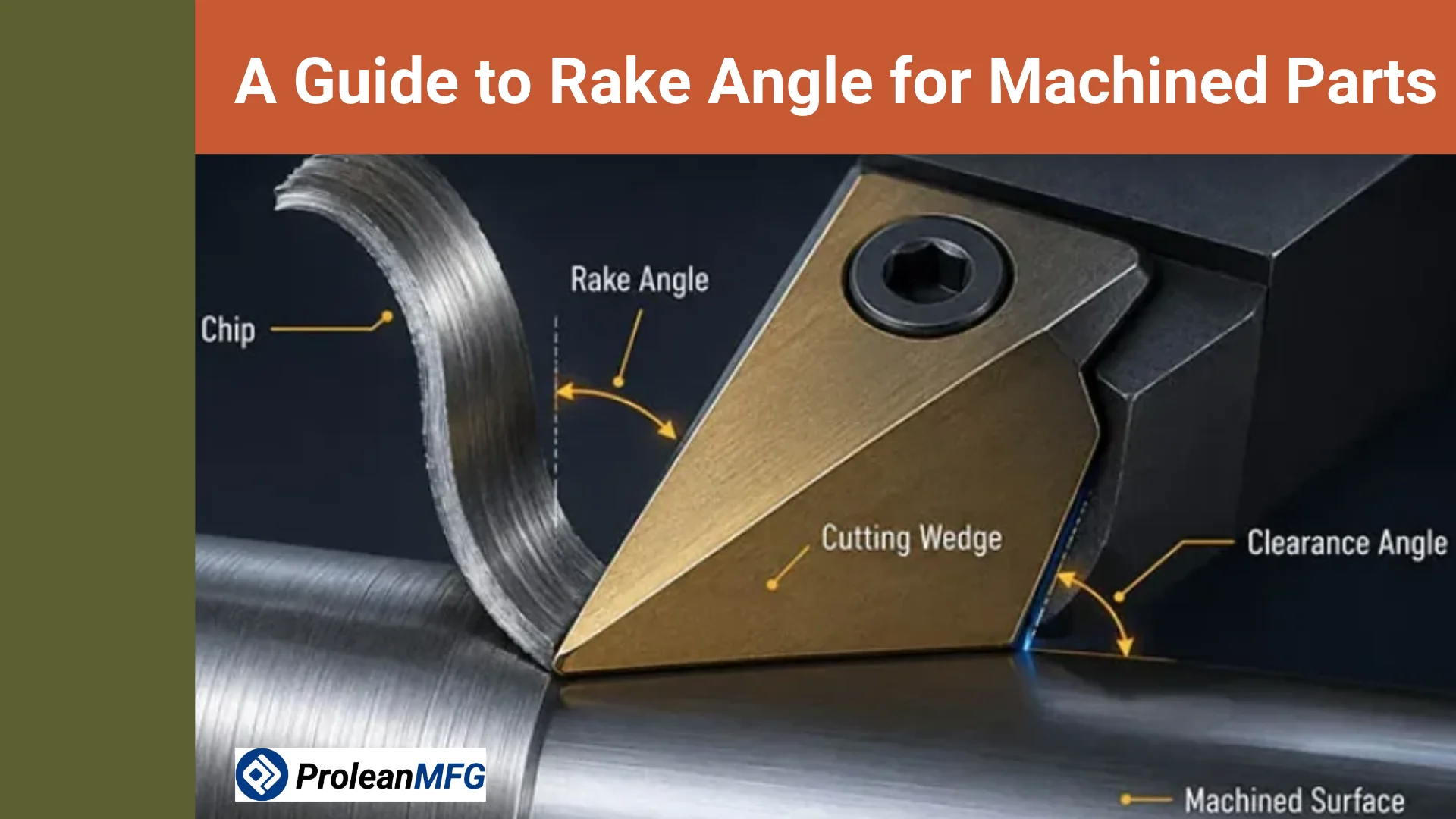
Rake angle is the angle between a cutting tool’s rake face and a reference plane perpendicular to the machining direction. It is negative (approximately −5°) for hard steels and interrupted cuts, and positive (approximately +5° to +20°) for aluminum and other soft metals.
The angle affects how the cutting tool interacts with the workpiece. Consequently, it influences surface finish, heat, vibration, cutting force, and machining efficiency.
The correct value ensures timely machining, lower per-part cost, and higher machining performance.
This angle cut guide explores the concept, the different types of angles, and how it affects machining. Read on to learn how to specify it and avoid machining surprises.
Key Takeaways
- A positive rake angle suits ductile materials like aluminum (about +20°). It uses low cutting force.
- A negative rake suits hard, abrasive materials like hardened steel and cast iron. It is also used for roughing and interrupted cuts.
- The right angle should be matched to the specific part because it depends on machining operation, material, and machine capability.
- A CNC machining service provider that selects tooling geometry carefully delivers tighter tolerances and better surface finishes.
What is the Rake Angle?
Rake angle refers to the angle between the tool’s rake face and a reference plane perpendicular to the machining direction. The chips formed during machining flow across the rake face.
Rake angle
What Does the Rake Angle Measure?
The rake is measured in degrees from the reference plane to the rake face. It controls chip flow and shape. Among all tool angles for cutting, it has the strongest influence on shearing in CNC machining. It also affects heat formation in machining because of the relationship between friction and material shearing.
Therefore, it is important to maintain an optimum angle. With a high positive rake, cutting efficiency is high and cutting forces are low.
With a negative rake, cutting efficiency is poor. More heat is generated, and the cutting forces are higher. [1]
Rake Angle Effect in CNC Machining
The angle affects CNC machining in heat, chip control, cutting force, and surface finish.
Heat: A more negative rake angle protects the edge but generates more heat. A more positive rake produces less heat because it reduces shear energy and friction.
Chip Control: A positive rake produces thinner, free-flowing chips. A negative rake angle produces thicker, tightly curling chips.
Cutting Force: Increasing the positive rake angle reduces the cutting force. Increasing the negative angle increases the cutting force.
Surface Finish: A positive angle produces a smoother surface on ductile materials. A negative angle can produce a rougher surface but with better size holding for heavy loads.
The effects are summarized in the table below.
| Type of rake | Chip shape | Cutting force | Edge strength | Surface finish |
| Positive | Thin, free-flowing | Low | Low | Smooth |
| Negative | Thick, curled | High | High | Average |
| Zero | Medium | Medium | Medium | Average |
How does rake angle affect handling?
The angle affects handling through tool stability, chip evacuation, and workpiece response.
Positive rake angle – A positive angle suits flexible and thin-walled parts. The chips are thinner and more free-flowing.
Negative rake angle – A negative rake lathe tool generates more force against the workpiece. The tool performance is more predictable under tough conditions. Rigid fixturing is required to support heavy loads.
What Happens if the Rake Angle Increases?
Increasing the angle, or changing it from negative to positive, has both merits and demerits.
Here is what can happen:
- Lower cutting force
- Less power consumption
- Thinner chips and a smoother surface finish
- Poorer heat dissipation at the tool tip
What is Positive and Negative Rake Angle?
Positive and negative angles are among the main categories of angles in CNC machining. The other category is zero rake. These categories are discussed in more detail below.
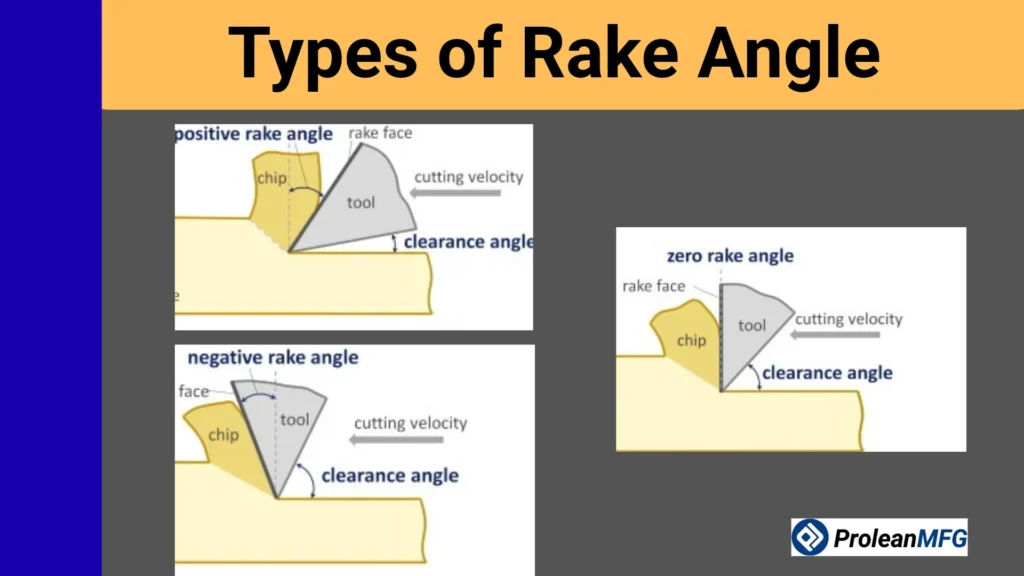
Types of rake angle
Positive Rake Angle
A positive rake angle is formed when the sum of the clearance angle and wedge angle is less than 90°. The resulting sharp cutting edge is very efficient in machining.
The advantages of a positive rake angle include;
- Reduced cutting force
- Smoother surface finish
- Free cutting
The limitations of a positive rake angle include;
- Thinner, less durable edge
Negative Rake Angle
For the negative rake angle, the sum of the clearance angle and wedge angle is more than 90°. A negative rake lathe tool, such as a negative-rake turning insert, is the common method for roughing hardened shafts.
The advantages of a negative rake angle include;
- a strong, durable cutting edge that is suitable for machining titanium and other hard materials.
The limitations of a negative rake angle include;
- Higher cutting force
- Higher power requirements
- Vibrations
- Unsuitable for delicate, thin-walled parts
Neutral Rake Angle
A neutral or zero rake angle is where the sum of the clearance angle and wedge angle is exactly 90°. It forms a neutral cutting edge that is best suited for general turning operations and balanced performance.
The advantages of zero rake angle include;
- Simple tool geometry
- Predictable performance for general-purpose jobs
- Balanced cutting efficiency
The limitations of zero rake angle include;
- Lower cutting efficiency compared to the positive rake angle
- Lower edge strength compared to the negative rake angle
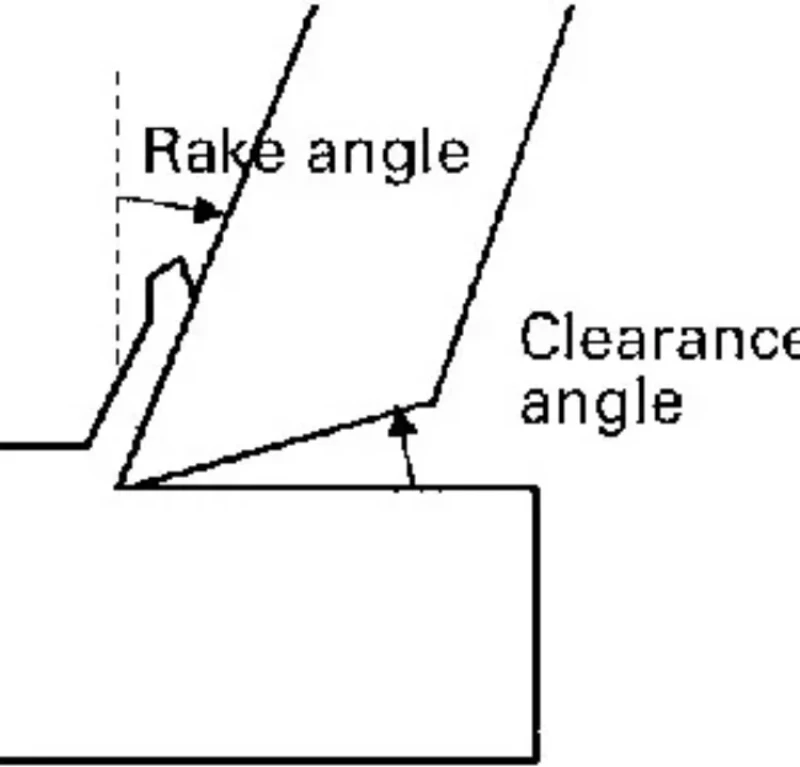
What is the Difference Between Rake Angle and Clearance Angle?
Rake and clearance are the two main tool angles for cutting. They have different positions, functions, and effects in CNC machining. However, the two should be balanced for effective and durable cutting.
| Angle Type | Function | Location | Main Effects |
| Rake | Controls shearing and directs chip flow | Tool face/top | Cutting force, edge strength |
| Clearance | Prevents rubbing between the workpiece and tool flank | Tool flank/side | Surface finish, tool wear |
The clearance and rake angles are shown in the diagram below.
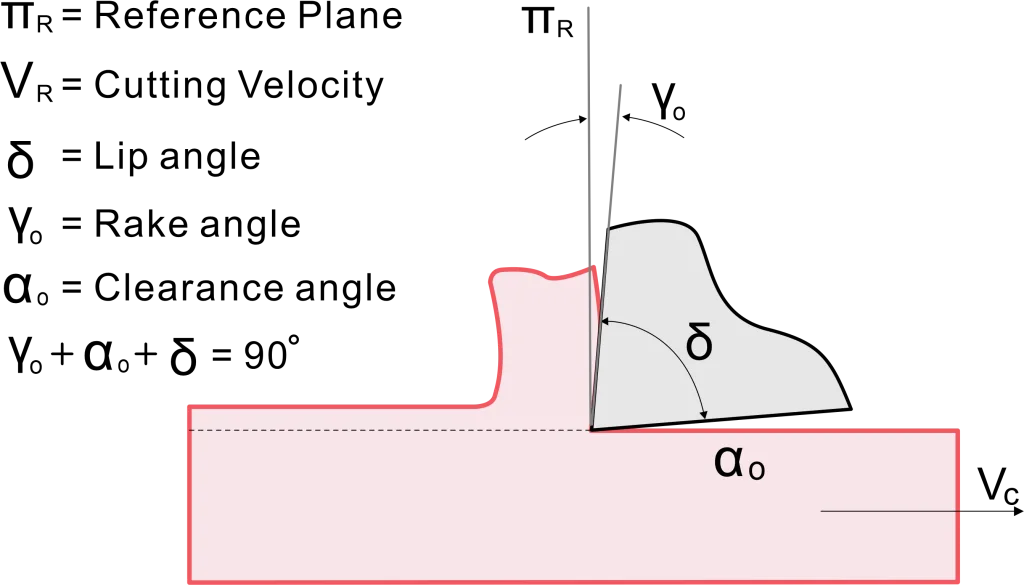
Rake angle vs clearance angle
Factors for Choosing Rake Angle for Machining Applications
Important factors to consider when choosing the rake angle are the type of material, production volume, machining strategy, and machine capability.
Type of Material
Usually, ductile materials like aluminum and mild steel are well suited to positive rake angles because they shear easily. Hard, brittle, or abrasive materials like cast iron and hardened steel work excellently with negative angles. The strong edge resists chipping.
Production Volume
Production volume affects machining consistency and tool economics, which have a bearing on the angle. For high production volume, the goal is to minimize the frequency of changing tools. The cost per part is lower with negative-rake inserts. They are double-sided, so each insert gives twice the cutting edges.
Positive rake tools can be used for low volumes. They support varied machine setups and materials.
Machining Strategy
The ideal rake angle can also depend on the machining approach. Finishing is typically best done using a negative rake angle. Since roughing machining aims at removing more material, a positive rake angle is preferable.
Finishing is typically best paired with a positive rake angle for a sharp edge and clean surface. Since roughing removes more material and creates shock, a negative rake angle is recommended for its strong edge.
Machine Capability
A high-horsepower machine can support a high material removal rate (MRR). Such a machine is best used with negative angles to handle the cutting forces. Lower-powered machines can be reserved for positive angles.
Where is the Rake Angle Commonly Used?
Any tool for cutting angles on metal has a rake face. Rake angle applies to a wide range of machining operations. The most common include;
- Manual Machining
- CNC Turning
- Milling
- Drilling
- Broaching
- sawing
In each application type, the effect and principle are the same: The tool face shape determines the cutting force and chip formation.
Rake Angles for Different Materials
There are recommended rake angles in degrees for different materials, including aluminum, Inconel, titanium, low carbon steel, and high carbon steel.
| Material | Rake angle in degrees | |
| Carbide (°) | HSS (°) | |
| Aluminum | +10 to +20 | +15 to +30 |
| Inconel | +5 to +10 | +5 to +10 |
| Titanium | +5 to +10 | +5 to +10 |
| Low carbon steel | 0 to +10 | +10 to +15 |
| High carbon steel | −5 to −10 | Not common |
| Brass | 0 to +5 | 0 to +8 |
| Plastics | 0 to +10 | +10 to +20 |
| Stainless steel | +5 to +10 | +8 to +15 |
| Cast iron | −5 to 0 | 0 to +5 |
Note that these are only indicative figures for turning. A sample should always be tested.
Source: Machinery’s Handbook, 31st ed. Industrial Press, 2020.
Still unsure which geometry is ideal for your material? Consult machinists at ProleanMFG for recommendations.
Determining the Right Rake Angle in a Cutting Tool
The rake angle of a cutting tool can be either built-in or from the tool holder design.
Built-in Rake Angle
Some CNC machining tools have a pre-designed rake angle. These include HSS tools, form tools, and carbide inserts. The machinist chooses the insert geometry based on the machining job at hand.
Tool Holder Design
When it comes to some machining methods, for instance, milling and turning, the angle can be incorporated into the tool holder. The angle can also be adjusted through tilting the tool during machining.
Best Practices for Effective Rake Angle for Machining Cutting
Use this angle cut guide’s rules of thumb to get started.
- Abrasive, hard materials – negative rake angle ensures a stronger edge with wear resistance
- Soft materials – Positive rake angle for a clean finish and smooth shearing
- Interrupted cuts – A negative rake lathe tool can withstand persistent shocks
- Feed and Speed – Match the feed and SFM in machining to the rake. Higher speed usually goes with a positive rake. A very sharp edge combined with too slow feed can produce chatter.
Consider this example:
Turning 6061 aluminum with a +15° carbide insert produces thin chips and low cutting forces at high speed. Turning hardened steel with a −5° insert produces a stronger edge at lower speed and higher force.
These are handy tips for machining cutting in most instances. Before selecting a tool for cutting angles, however, always work on a sample first. This test helps adjust the geometry to the optimum on a case-by-case basis instead of depending on default settings.
In Conclusion
The rake angle is more than a theoretical angle that engineers apply to a cutting tool. The ideal rake is at the intersection of various machining system factors, including machine rigidity, coolant, insert design, part geometry, and machining efficiency.
A better understanding of the angle and other tool angles for cutting means better tool selection, higher machining efficiency, and overall improved machining performance.
Choose a machining partner who is open about their tooling choices. Their cost and quality control are reliable and predictable.
ProleanMFG cuts aluminum, titanium, and Inconel across a wide range of production volumes, so we know all the tooling factors and trade-offs for reliable machining outcomes. Consult us for CNC machining services tailored for your parts and production goals.
Share drawing details today, and we will respond within 24 hours with a no-obligation quote.
Resources
[1]https://www.sciencedirect.com/topics/engineering/rake-angle
[2] Machinery’s Handbook, 31st ed. Industrial Press, 2020.