Sheet metal punching
Review for repeated round holes, slots or patterns that fit available tooling. Confirm pitch, edge clearance and the permitted burr side.
Sheet metal fabrication / holes and slots
Send your drawing for a quote on round holes, slots and repeat openings in sheet metal parts. We review which features suit punching and confirm the manufacturing route and finished requirements in the quote.
Review the feature pattern, material thickness, tool geometry and edge requirements to choose a practical process.
DXF · STEP / STP · PDF
Need an NDA before sharing? ↗
 01 / THE PROCESS
01 / Project fit
One drawing can include features with very different manufacturing needs. A repeated hole pattern may suit punching, while an irregular outer profile may suit laser cutting. The route should account for flatness, burr orientation and downstream bending or assembly.
02 / Capabilities
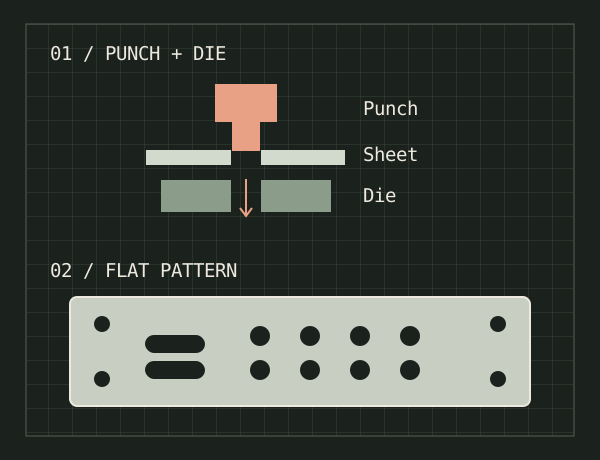
Punching shears an opening with a punch and die. The route depends on the geometry, material and feature pattern, as well as the edge condition and any operations that follow.
Review for repeated round holes, slots or patterns that fit available tooling. Confirm pitch, edge clearance and the permitted burr side.
Review for variable outlines, irregular openings or designs that are still changing. Confirm edge requirements and the effect of the cutting route on the finished part.
Review dedicated tooling for stable, repeat parts that combine cutting and forming. Compare tool investment, validation needs and expected reorder quantities.
Identify the mounting hardware, slot travel and primary locating features. Give the finished sizes where coating or fit matters.
Specify pitch, open area where functional, and any solid margins for bends or fasteners. Mark the panel face that will be visible.
Show corner radii, mating geometry and the required edge condition. Review tool fit or laser cutting if the opening is irregular.
03 / Specifications
Usable dimensions, tolerances and tooling are confirmed against the part geometry, material and finished condition.
04 / Materials
These material families are starting points for drawing review. Confirm the exact grade and stock condition for the job.
Confirm grade and temper. Review visible-face marking and distortion around dense patterns or narrow webs, especially when the panel is formed later.
Specify the grade and whether stock is bare, galvanized or otherwise coated. For coated material, agree on acceptable marking and the treatment of exposed cut edges.
Specify the alloy, finish and grain direction where relevant. Include cosmetic face, edge condition and feature density for tooling and handling review.
05 / Finishing and secondary operations
List downstream operations and the features they affect so they can be included in the quotation.
Show which side can carry a burr and which surfaces touch a gasket, cable, mating part or operator. Confirm edge treatment before the quote is finalized.
Use the formed model to show hole-to-bend locations, hardware installation side and access. Confirm whether critical holes are measured in the flat or finished condition.
Define coating and color where applicable. Identify tight slots, hardware holes and contact surfaces that need masking or a finished-size check.
06 / Quality and inspection
ProleanMFG's SGS-certified ISO 9001:2015 quality management scope is production of hardware accessories. Part-level checks are agreed against the order and drawing.
Specify the primary datum, center-to-center pitch and any position control. Identify which features align the finished part to its mating component.
Show minimum ligaments on the drawing and mark flatness where it affects fit. Agree on which face and panel condition are used for inspection.
Define the acceptable edge condition and the face to protect. If inspection reports or first-piece samples are required, include them when requesting the quote.
07 / Design guide
Closely spaced holes and small edge distances can affect the route and panel shape. Identify the areas where pitch, open area or strength cannot change.
Supply actual corner radii and functional clearances. Compare matched tooling, multiple hits and laser cutting where an opening does not suit a standard tool.
Call out formed features separately from through-holes, such as louvers or embosses. These require separate tooling and feasibility review. Identify prefinished faces that need protection during handling.
08 / From inquiry to delivery
The quotation defines the supplied condition, operations, inspection requirements and expected schedule.
Share the model and current drawing revision, material, thickness, finish, first order and expected repeat quantities.
Review process choice, critical geometry, tooling or hardware, finish and inspection records. Agree how any exceptions will be documented.
Confirm the drawing revision and order scope before production. Agree what to inspect and how to protect finished parts for delivery.
09 / FAQ
Yes. Include the sizes, corner radii, spacing, thickness and desired edge condition. We review the tooling route and whether any features would be better cut separately.
Minimum values depend on the material, thickness, geometry and available tooling. Show the smallest holes, closest spacing and distance to the edge so the pattern can be reviewed against your drawing.
Include the formed geometry, critical positions and the finish specification. The quotation can cover a combined route after checking feature distortion, access and the required final dimensions.
Punching creates an opening by shearing the sheet. Stamping is a broader set of press operations that can include punching, blanking and forming. The process choice depends on features, tooling and order pattern.
Share the complete profile and feature pattern. The quote can compare a single process with a combined route where the pattern, outline, tolerances or edge requirements justify it.
Feature count, tool availability, stock, nesting, deburring, bending and order quantity affect cost. Include repeat demand and any special feature or inspection requirements in the RFQ.
From drawing to part
Include material, quantity, critical features and finish. We can review the process and quote scope against your requirements.