
One expensive sourcing mistake we often encounter: Buyers who cringe at the sight of a 5-axis CNC machining quote with an hourly rate about 60% higher than in 3-axis machining, and ultimately pick 3-axis machining outrightly.
The 5-axis vs. 3-axis cost for a machined part has many elements; The hourly cost is just one of them. You should also consider other cost factors, including setup, cycle time, scrap, and fixtures. If the geometry allows, 5-axis machining, which is detailed in this 5-axis CNC machining guide, can reduce setups and make more economic sense than 3-axis machining.
In some cases, 5-axis CNC machining is more affordable than 3-axis, and vice versa. This guide provides a way to decide when to use 5-axis machining or opt for 3-axis machining. It provides a worked example for comparison.
At the end of the article, you will have a simple rule to use when requesting quotes. Keep reading.
Key Takeaways
- Simultaneous 5-axis machines use all five axes at once for curved surfaces; 3+2 positioning locks the two rotary axes at a specific angle and machines with the 3-axis setup.
- A key advantage of 5-axis machining is relational accuracy. The workpiece is clamped once, so features on different faces retain their relative positioning.
- Setup count is the determining cost factor between 5-axis and 3-axis machining. 5-axis makes more sense for a part requiring at least four setups. 3-axis machining is a stronger candidate for fewer setups.
- Comparison between 3-axis and 5-axis should go beyond the hourly rate. 3-axis costs approximately $75–125/hr compared to $125–200/hr. However, from the worked example, the final cost per part for 5-axis is lower at $77 versus $111. The difference comes from first-pass yield, setups, and fixtures.
What 5-Axis Actually Adds (and the Two Machine Styles)
Both 5-axis and 3-axis machines are CNC machines. For a review of the basics, check: What is CNC machining?
In 3-axis machining, the controllable axes are X, Y, and Z, all linear. The difference in 5-axis machining is the addition of two rotary axes. This transforms the machining because, with a single clamping, the cutting tool can approach the workpiece from almost any angle.
With part flipping avoided, the errors and costs of machining complex parts are reduced.
5-axis machines don’t deliver this capability the same way. Distinctions are found in the machine design and the specific application of the rotary axis during machining. The two angles are discussed next as trunnion vs head/head and 3+2 positioning vs simultaneous.
Trunnion vs Head/Head
Trunnion (Table-Table): This machine has a table on which the workpiece rotates and tilts. Its compact size makes it well suited for small- to medium-sized parts.
Head/Head (Swivel-Head): The table remains fixed while the spindle head rotates and tilts. The setup is well suited for aeroplane structures and other large-sized parts.
Both of these are typically milling machines. Details of how milling machines cut and shape materials are here:
3+2 Positioning vs Simultaneous
As mentioned, the main difference between 3+2 machining and simultaneous machining is the rotary axis’s operation during machining.
3+2 Machining (Positional): Two rotary axes position the workpiece or cutting tool in a specified inclination. This orientation is fixed and maintained throughout the operation.
Simultaneous 5-axis: For this arrangement, the set rotary and linear axes stay in a coordinated state as the cutting takes place. The machine keeps adjusting the relative orientation of the workpiece and cutting tool during the machining process.
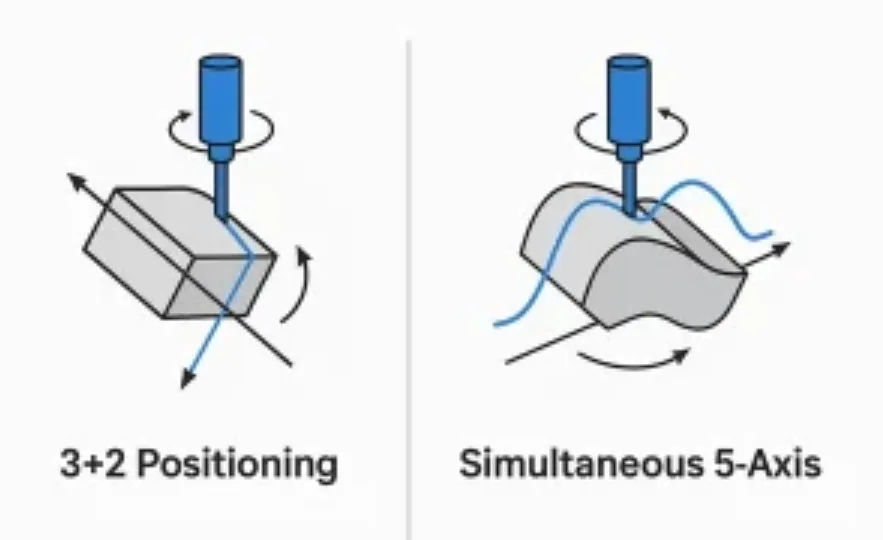
3+2 positioning vs simultaneous 5-axis machining
You can find a fuller explanation of how these machines work here:
5-Axis CNC Machining Basics, Applications, And Relevance
The Real Rate Difference, With Numbers
The typical machining shop 5-axis vs. 3-axis costs differ like this:
| Machine type | Typical hourly rate |
| 5 axis average hourly rate | $125–200/hr |
| 3-axis average hourly rate | $75–125/hr |
The rates listed are industry estimates in the US, which can vary by region, shop, or machine.
Why the Hourly Rate is the Wrong Metric
The 5-axis hourly rate can be misleading because it reflects the cost per hour of machining, not the number of hours required to machine a part.
Consider a fairly complex part being machined on a 3-axis machine and a 5-axis machine. There are four setups on the 3-axis machine, while the 5-axis machine requires only one.
What cost makes more sense here? The total cost of producing a good part is in the 5-axis machine. The 3-axis machine uses more fixtures and more handling, and has a higher chance of errors.
The Setup-Count Rule
The setup count rule in machining recommends the minimization of the number of times a workpiece is repositioned or unclamped because it affects accuracy, tolerance, and machining time.
A datum reference frame is the measurement source for positional tolerances on an engineering drawing. Features on different faces of a workpiece should be machined from the same frame. [1]
From our experience, the handling time increases by 15 to 30 minutes for every extra setup. The stack-up error also increases by up to approximately 0.075 mm.
If the 3-axis machining process requires at least 4 more setups, it’s worthwhile to check the 5 axis CNC machining quote too. For less than 4 setups, the 3-axis machining method wins on price.
Worked Comparison: One Part, Two Routes
Consider this worked example of 5 axis vs 3 axis cost put side by side. It comprises 3-axis machining (5 setups) and 5-axis machining (1 setup). It is for machining a 6061 aluminum enclosure with features on five sides. There is a run of 45 parts.
| Element | 3-Axis Machining | 5 axis CNC machining |
| Setups | 5 (for 5 faces) | 1 |
| Average Machining rate | $90/hr | $150/hr |
| Cycle time per part | 42 minutes | 24 minutes |
| Handling time per extra setup | Up to 30 minutes | Zero |
| Machining cost for 45 pieces | $2,835 | $2,700 |
| Programming and setup | $650 | $375 |
| Fixture cost | Fixtures, $1,500 total | A single fixture at $400 |
| Stack-up error | Up to 0.075 mm per re-clamp | Single datum, so minimal error |
| First-pass yield | 90% | 98% |
| Total cost | $4,985 | $3,475 |
| Cost per part | $110.78 | $77.22 |
| Effective cost per good part | Approximately $123 | Approximately $79 |
Note:
These are illustrative calculations and figures. Actual results vary by process, material, and part
Machining cost = rate × cycle time × quantity
(3-axis: $90 × 42/60 × 45 = $2,835;
5-axis: $150 × 24/60 × 45 = $2,700)
Of course, these numbers can change based on the material. A material like brass is easier to cut than harder alloys. For more details about the former, see brass CNC machining.
When 5-Axis Is Worth It
5 axis CNC machining is worth considering if the part has compound angles or 3+ faces, tight position tolerances on faces, contoured faces, and deep pockets.
Features on Compound Angles or 3+ Faces
Angled or 3+ faces are where the cost difference between 5-axis machining and 3-axis machining is clearest. The cutting tool in 5 axis CNC machining has easier access to compound angles and reduces re-clamping.
A 3-axis machine usually requires a setup for each new face, or a custom fixture for each angled feature. This increases operator time and fixture requirement costs.
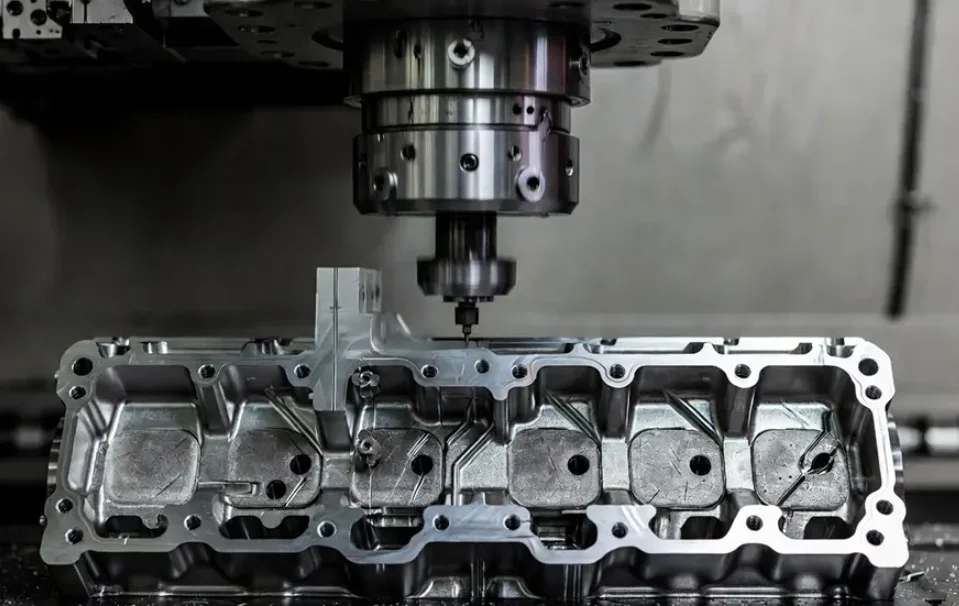
5-axis angled machining
Faces with Tight Positional Tolerances
Experience shows us that there is a location error of up to 0.075 mm for every reclamp. This is too much to risk for tight tolerances – when features must hold tolerances within ±0.05 mm. Multiple setups are recommended.
5 axis CNC machining, with its single setup, constrains the facial relationship to the machine rather than the operator or fixtures.
Consider parts such as these;
- Gearbox housings
- Aerospace brackets
- Valve and manifold bodies
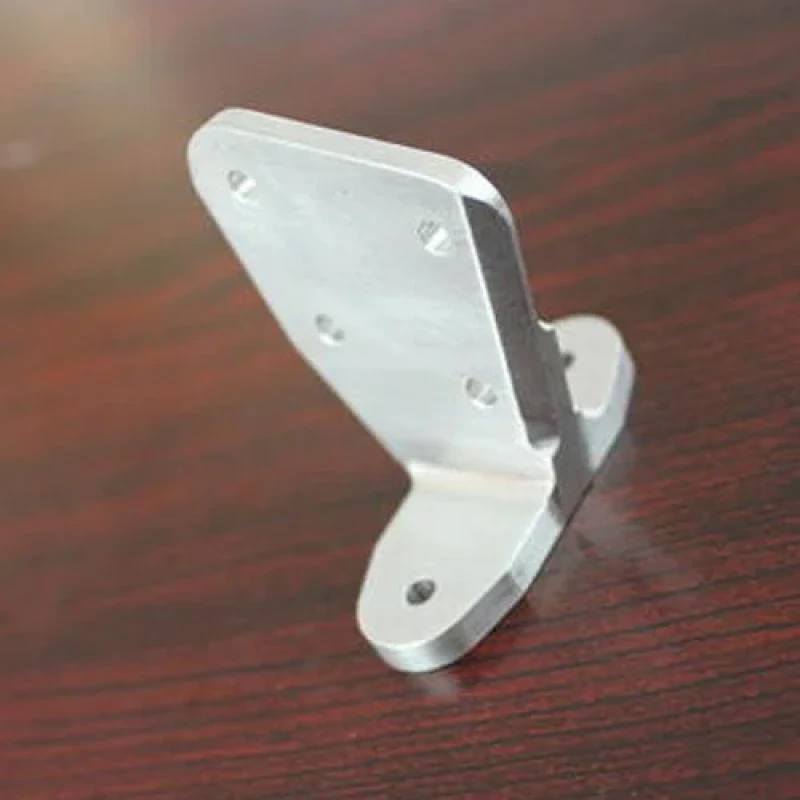
Aerospace bracket
Contoured Surfaces
Parts such as turbine profiles and impeller blades require the cutting tool angle to be controllable relative to the moving surface. 5-axis CNC machining suits this work because the tool orientation can be adjusted continuously. From experience, it can produce a smoother surface finish in fewer passes.
Since the tool for 3-axis is at a fixed orientation, it usually requires more passes for the same surface finish. Lay, roughness, and waviness describe surface texture. [3] Scallops appear in the surface texture of the machined part. They can be reduced with additional passes.
Deep Pockets with Short Cutting Tools
Machining a deep pocket on a 3-axis machine means using a long, slender tool. Among the problems related to this are tool issues such as chatter and deflection. But with the tilting of 5-axis machining, such features can often be machined more easily.
The advantages of this setup are;
- Longer tool life
- Shorter cycle times and faster feeds in many cases
- High-quality surface finish
- Tighter feature tolerances of approximately ±0.05 mm for single setup
When 5-Axis Is Just More Expensive
Three main scenarios are simple prismatic parts, non-critical geometry and loose tolerances, and high-volume runs with a purpose-built fixture.
Looking at these instances closely, 5-axis machining is more expensive than 3-axis machining when the higher hourly rate directly affects the overall price. That’s when 5-axis CNC machining fails to reduce the costs for scrap, fixtures, or setup.
Simple Prismatic Parts
For prismatic parts with simple machining requirements, the higher cost of 5-axis machining can be unnecessary. Examples of such parts are spacers, brackets, and plates.
A 3-axis machine can handle such parts within the same cycle time, but at a lower cost.
For a detailed coverage of the suitability of these machines, visit 3 Axis CNC Machining Principles, Applications, Pros
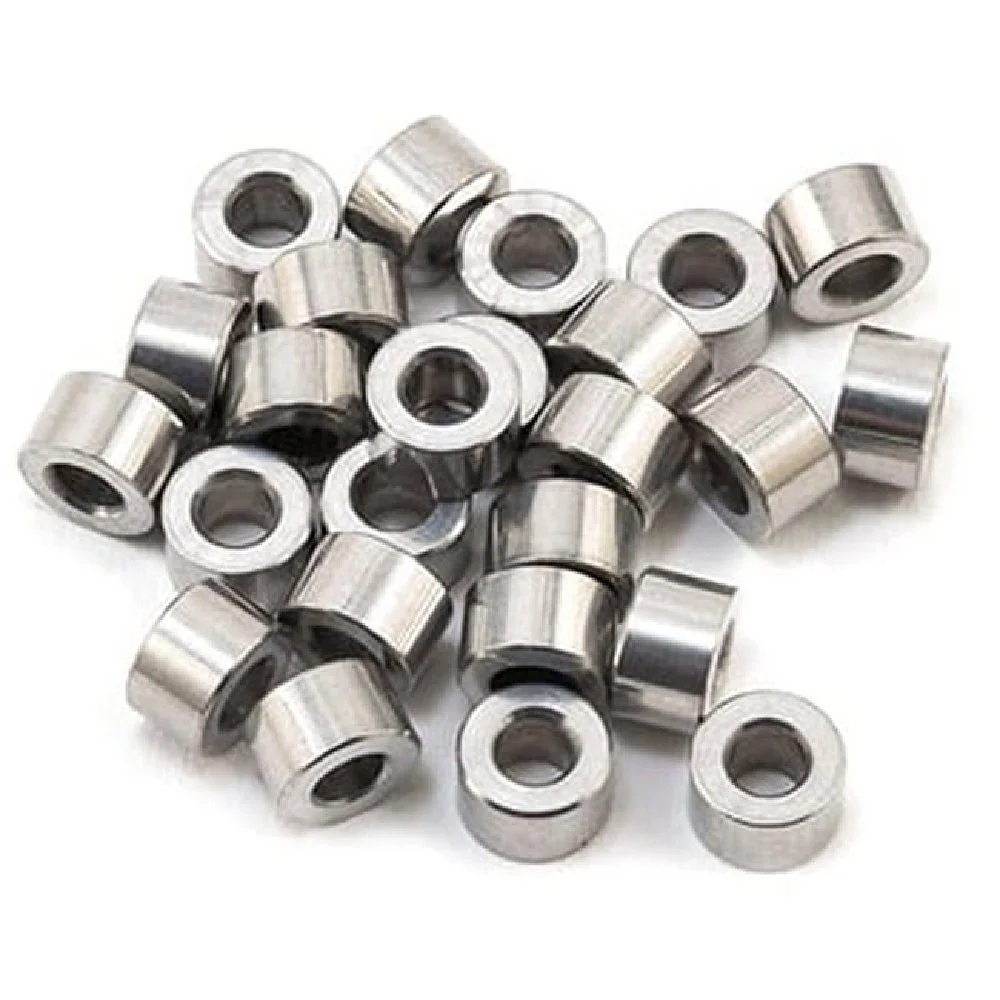
Aluminum spacers
Non-critical Geometry and Loose Tolerances
General tolerance classes apply if there are no individual tolerance callouts. [2] If the CAD drawing allows general tolerances of between ±0.1 and 0.2 mm (many machinists use around ±0.13 mm as the default), a ±0.025–0.075 mm stack-up is normally within the tolerance.
With no tight tolerances to protect, 5-axis machining has no major value here. The buyer would be paying for unnecessary accuracy of single-clamping.
High Volume Runs With a Purpose-Built Fixture
When there are thousands of parts to produce, a purpose-built 3-axis fixture is cost-effective because it spreads the cost. As the number of parts increases, the cost advantage of 5-axis machining can dwindled or disappear. The unit cost of 3-axis machining can start to dominate.
How to Ask for the Right Quote
The specifics you send to the CNC machining service provider determine how accurate the quote is. Important items to provide include the 2D drawing, 3D model, material and finish, budget, quantity, destination country, and NDA (if necessary).
For the case of 3-axis vs. 5-axis machining, follow these steps to get the right quote.
- Send the complete 2D drawing and 3D model indicating all the critical tolerances
- Indicate the quantity and repeat orders, if any. Remember that prototype CNC machining runs come with fixture and setup costs for very few pieces.
- Request 5-axis and 3-axis quotes to compare
- For each of these approaches, ask for cycle time, fixture cost, and setup count
- Ask the tolerances that a single setup can attain
- Compare the cost per quality part for 5-axis vs 3-axis machining
In Conclusion
5-axis machining loses to 3-axis machining in one aspect of the total cost: cost per hour. Other aspects of the total cost matter too, particularly the setup cost. A part requiring four or more setups is better machined on a 5-axis machine. If not, you set yourself up for extra setup time and stacked-up errors.
5-axis is a strong candidate for machining deep pockets, compound angles, and multi-face features. You can comfortably machine prismatic parts with loose tolerances on a 3-axis machine. When these differences are unclear, ask for both quotes and compare.
ProleanTech encourages this clarity in CNC machining quotes, starting with DFM reviews as early as possible in the production process.
Send us your CAD drawing for an engineer to review it and get back to you within 24 hours. You don’t have to indicate the axis count; we’ll do that bit for you after analyzing both paths. We can share the analyses on request.
For more on our solutions, check our CNC machining services segment.
FAQ
Is 5-axis always more expensive?
No. 5-axis machining may have a higher per-hour cost, but the total cost of machining involves more than just the per-hour cost. Setup cost, which is typically lower on 5-axis than 3-axis machining, is a big factor.
Stack-up errors and machining time increase with the number of setups. 5-axis machining brings savings from fewer setups and less handling. But for simpler parts requiring no more than three setups, 3-axis machining is often more cost-effective.
What is 3+2 machining?
3+2 machining is a 5-axis machining style that locks the two rotary axes in a certain orientation during machining. This ensures machining occurs on the standard three linear axes. 3+2 machining is simpler to program and more affordable than simultaneous 5-axis machining.
How much slower is titanium on 5-axis?
In our experience, machining titanium on a 5-axis machine is several times slower (2 to 5 times, depending on the grade) than machining aluminum. Ti-6Al-4V (Grade 5) is approximately three times as hard as 6061 aluminum.
Titanium requires more robust tool wear management and slower cutting speeds. On the 5-axis machine, the benefits come from shorter, stronger tools and fewer setups. Complex titanium geometries can be produced more easily than on a 3-axis machine.
Resources
[1]https://www.asme.org/codes-standards/find-codes-standards/y14-5-dimensioning-tolerancing
[2]https://qualityforum.zeiss.com/migration/images/137_8bb2b6eeb6a9e6554d254c216a890c89.pdf
[3]https://www.asme.org/getmedia/f22128e5-acad-429d-bc75-0ac4bdffdf44/b46-1-2019-11×17-poster.pdf