
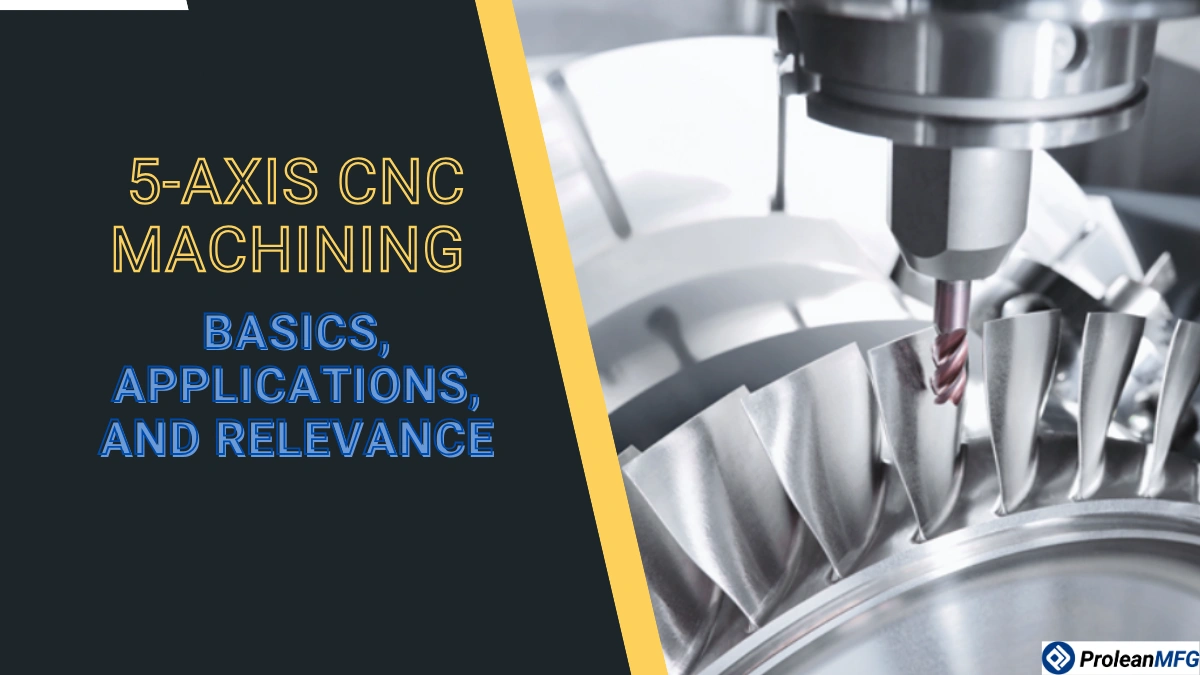

The multi-axis machining concept may have preceded CNC technology, but the combination of this method with CNC capabilities happened in the 1990s. This laid the foundation for today’s advanced 5-axis CNC machining, which is characterized by the simultaneous movement along five axes.
The relative movement of the cutting tool and workpiece along five axes is the secret behind the limitless machining capabilities of the 5-axis CNC machines. It uses the usual three linear axes during machining, but it also uses the two other axes to reposition the cutting tool and workpiece during operation.
The exact method of repositioning depends on whether the 5-axis CNC machine is an indexed 5-axis CNC milling or a continuous 5-axis CNC milling type.
The gap between the initial punch card-based machining to today’s advanced multi-axis solutions is huge, as evidenced by the superior intricacy of the machined parts in modern machinery and equipment.
Manufacturers use 5-axis machining extensively for its benefits, like precision, speed, and versatility. In aerospace, for instance, manufacturers are able to meet the stringent part requirements for engines, turbine blades, and others.
There is a lot to talk about this manufacturing technology. This article highlights the working principle, background, applications, versions of 5-Axis CNC machining, and more.
The History Of 5-Axis CNC Machining
The 5-axis CNC machining process is as old as the emergence of advanced and complex components and parts for the aerospace industry, so that dates back some time. When conventional machining systems were unable to meet the requirements of this industry, a new process was born. That was in the mid-20th century or thereabout.
Starting out with many manual controls, the 5-axis machining system has progressively become automated to the advanced solutions we have today. Most developments have been in software and computing, but servo motors are also much better than they were before.
It is impossible to ignore the contribution of the 3+2 machining method in the development of 5-axis machining because this technique blends CAM (computer-aided manufacturing) and CAD (computer-aided design). 5-axis CNC machining borrows a lot from the flexibility of the 3+2 machining method.
Hardware developments are also noteworthy, especially the long journey of improving the multi-axis spindle boxes capabilities.
What Is 5-Axis CNC Machining?
5-axis CNC machining is a subtractive manufacturing setup highlighted by the simultaneous movement of the cutting tool along five axes as it machines the workpiece. It is an improvement of the conventional 3-axis CNC machining through the addition of 2 rotational axes.
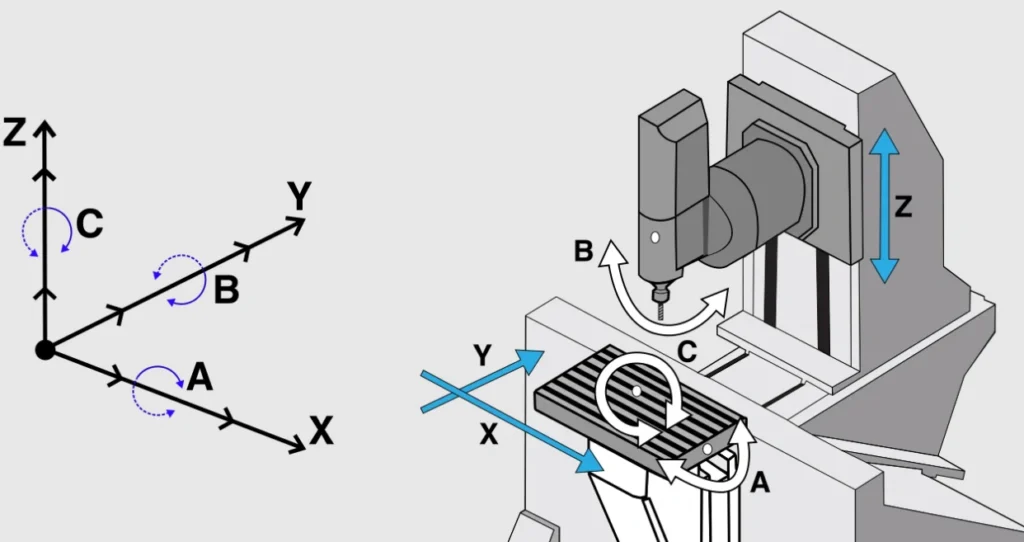
Axes movement in 5-axis CNC machining
The addition of rotational axes to create five axes of motion allows the cutting tool to approach the workpiece from any direction. With the multi-directional feature, the 5-axis CNC machining system can machine complex parts.
The manufacturing process is much more powerful and versatile with three linear movements (X, Y, and Z) and two rotary movements (A and B).
How Does 5-Axis CNC Machining Work?
The 5-axis CNC machine works by simultaneous control of the cutting mechanism along the three linear or standard axes and two extra rotational axes during machining. The three linear axes are designated as X, Y, and Z, while the additional axes are either a combination of A and C or A and B.
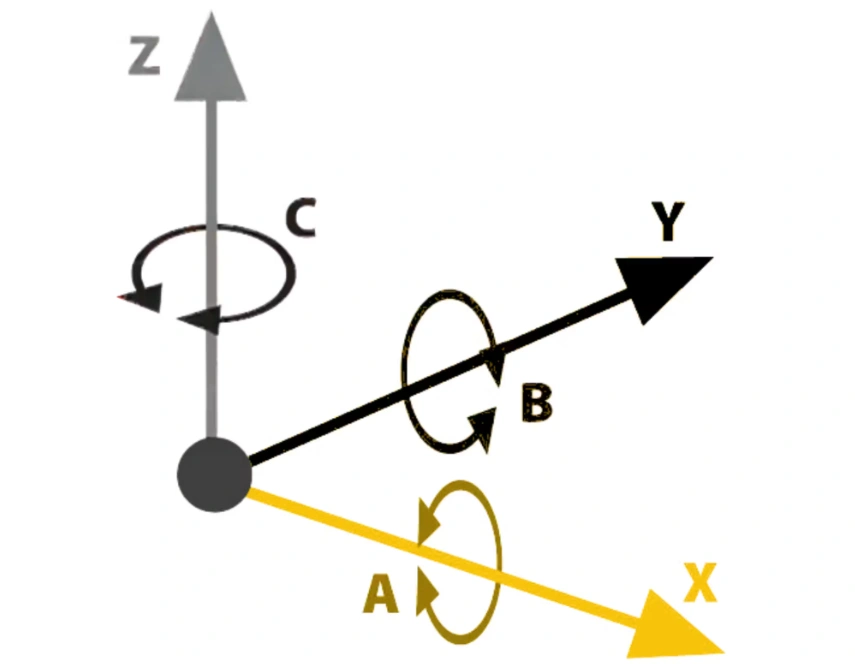
Three linear axes and two rotary axes
Like any other CNC machining process, 5-axis CNC machining involves a CAD step, translation of the design to machine-friendly language, machining, and post-machining processes.
Computer Aided Design (CAD)
This step entails using the product requirements to create a 3D model. It all starts with the designer’s sketch, which is exported to the CAD software, where it is fine-tuned. This step determines a large percentage of the quality of the final CNC-machined part.
CAM Programming
When the CAD design is ready, it is then taken to CAM software to be transformed to a format the CNC machine system can understand. The CAM program provides the cutting details such as toolpaths and dimensions, and codes needed for the 5-axis machine components to function as expected.
Machine Tool Setting And Cutting
With the programming ready, the machinist can set the machine and workpiece and start the cutting process. There are some settings to consider when clamping the workpiece and the cutting tool – type of cutting tool, workpiece coordinates, CNC machining parameters, and so on.
Monitoring And Inspection
The 5-axis CNC machining process may be automated, but it requires real-time monitoring. Inspecting the finished parts is also part of the CNC machining process. Sensors within the machine monitor temperature, cutting forces, workpiece position, and such machining elements.
Inspection covers various aspects of the machined part, like flatness, surface roughness, and roundness.
Different Configurations/Types Of 5-Axis CNC Machining
There are different configurations of 5-axis machines, each suited for specific applications. Based on the position of the rotational axis, 5-axis CNC machines can be categorized as;
- Rotary Table and Pivoting Spindle Head
- Double Rotary Table
- Trunnion Table Machine
- Swivel or Articulating Head
Rotary Table and Pivoting Spindle Head
This type of 5-axis CNC machine features a 360-degree rotary table on which the workpiece sits. With a diameter and height capacity of 50 inches, the configuration is perfect for turbine housings and other components with angled holes.
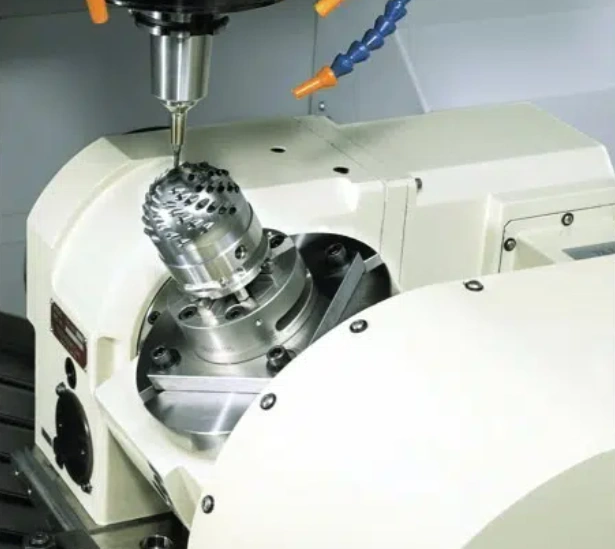
Rotary table CNC machine
Double Rotary Table
The double rotary table type of 5-axis CNC machine is renowned for its sizable table that gives room for different orientations of the A-axis. Its wide flexibility is based on the extensive room available for this axis. Manufacturers prefer this configuration for machining outer diameters of components, especially where rings or holes are involved.
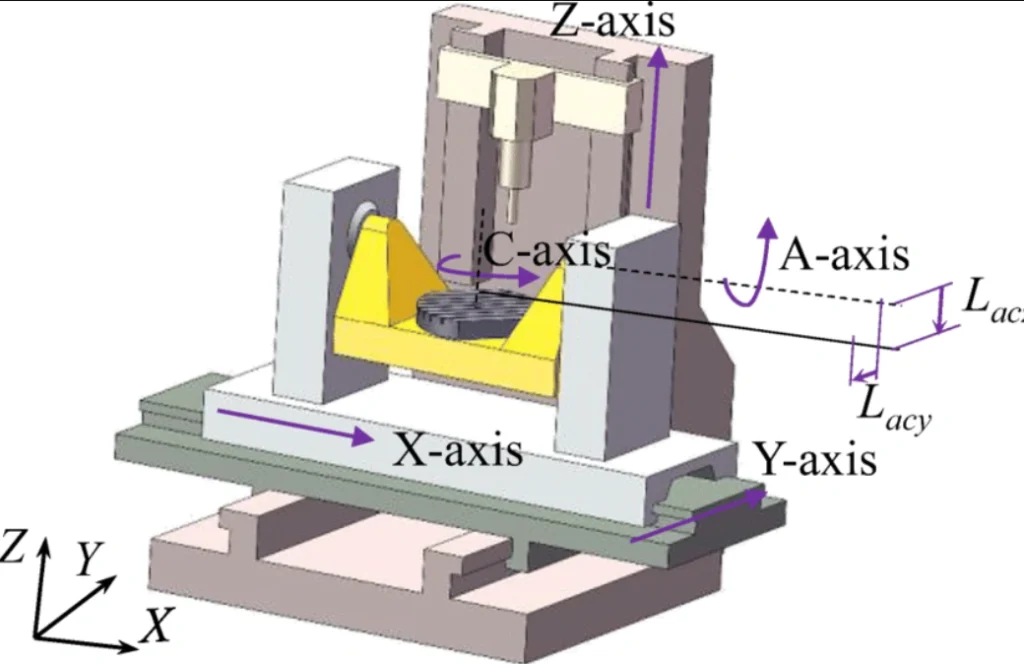
Double rotary table configuration
Trunnion Table Machine
For the Trunnion Table Machine, the trunnion table uses both rotary axes. It is one of the most relatable to the usual 3-axis CNC machine. With a better capacity to tilt and allow for viewing of the machining process, this configuration is ideal for machining complex prismatic faces and deep cavities/undercuts.
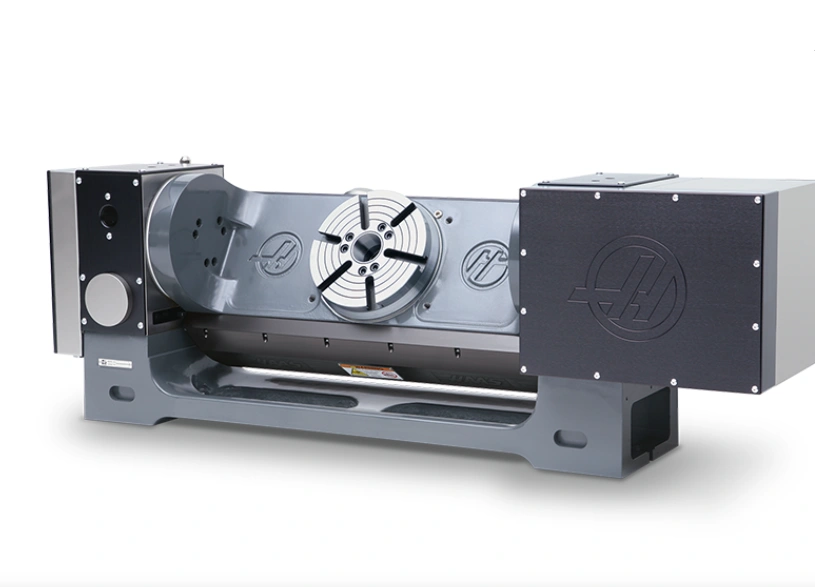
Trunnion table 5-axis CNC machine
Swivel or Articulating Head
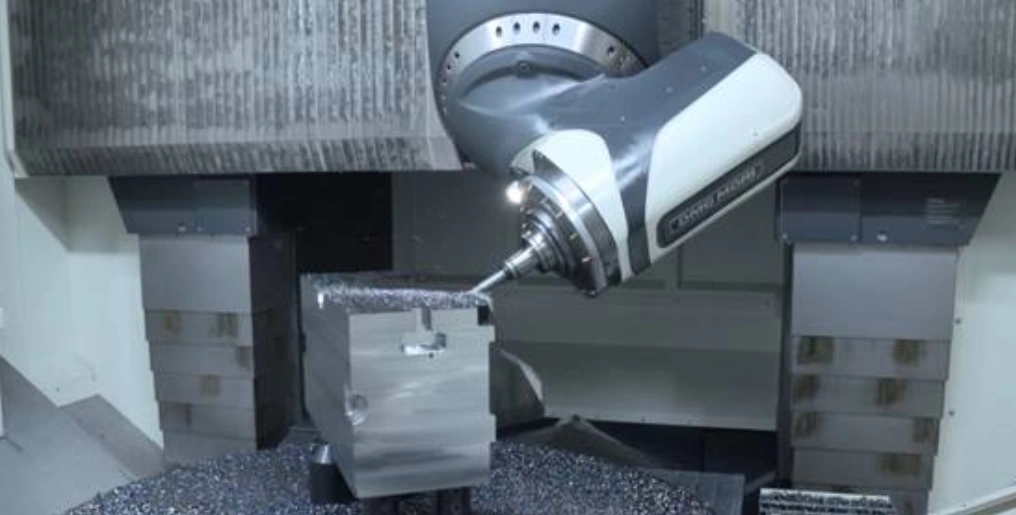
Articulating head 5-axis CNC machine
There are two ways when it comes to this setup:
- Head-head: The head performs all rotational movements as the table remains stationary.
- Head-table: Has a rotating table and a tilting head
Why Use 5-axis CNC Machining? The Benefits
The biggest selling point of 5-axis CNC machining services in the whole world is the capability to produce complex parts easily. Its precision and efficiency at it is unlike what other configurations can deliver. With 5-axis CNC machining, the machinist does not have to set up the machine every time.
It is an extremely flexible system that suits the demanding manufacturing requirements today.
Here are some of the advantages of 5-Axis CNC machines in detail;
Can Machine Complex Parts
The additional two axes on the 5-axis CNC machine allow for more movements, which are instrumental in actualizing complex shapes and designs. Angles and arcs that would previously require several setups are now achievable in one go on this machine. Indeed, this machining solution has rendered the overly complex fixtures unnecessary.
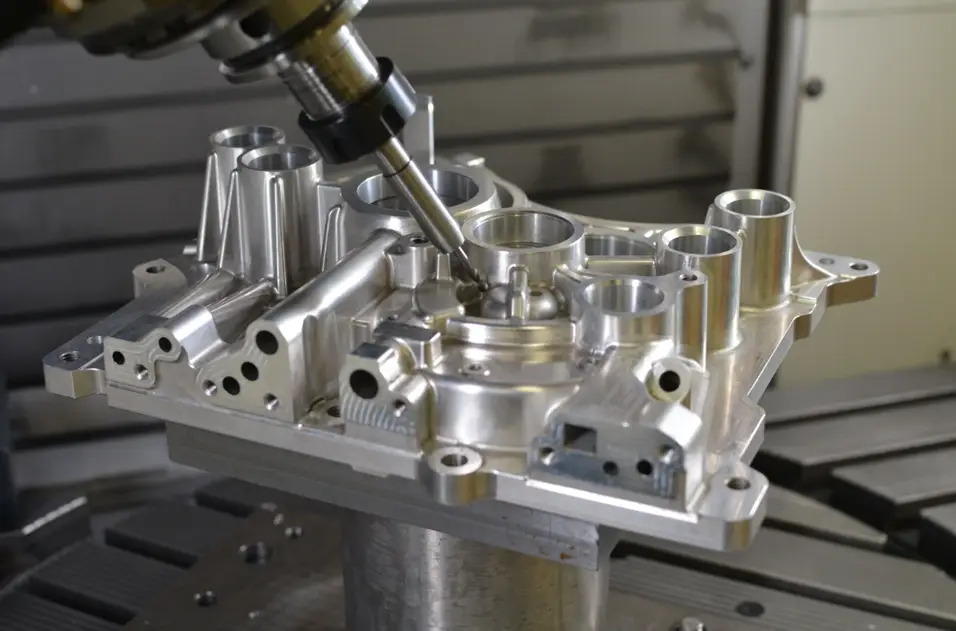
Machining a complex part
Has Unmatched Machining Precision
Another reason industries prefer 5-axis CNC machining is the unrivalled level of precision compared to machining setups with fewer axes.
Provides An Excellent Surface Finish
When a part is closer to the cutting tool and better oriented, as is the case with 5-axis machining, surface finish is one of the areas where improvement is noticeable. The logic is that when the distance between the cutting tool and workpiece is shorter, shorter, sturdier tools can be used.
Vibrations are minimal, and the surface finish is highly improved even at elevated rotational speeds.
Has Enhanced Production Efficiency
The machining time in 5-axis machining is shorter than in alternatives with fewer rotational axes, for instance, 3-axis CNC machining. When the cutting tool and workpiece are closer together, the machinist can easily implement faster cutting speeds and finish the job faster without compromising quality.
Requires Minimal Setup
This machining method is synonymous with the “Done-in-One” concept, meaning that setup can be done in the blink of an eye. Apart from saving time, this approach minimizes human and machine errors.
What Are The Limitations Of 5-Axis CNC Machining?
As seen above, there are many reasons to use 5-axis CNC machining, but there are some reservations as well. We can start with the high cost of acquiring these machines, which is much higher than what 3-axis machines fetch. More about this and other limitations of the system are discussed below.
High Cost
We cannot run away from the fact that these machines are significantly more expensive than those with fewer axes. Fetching hundreds of thousands of dollars is common with these machines.
However, this is not often a big concern because the industrial setups that often invest in these machining powerhouses can recoup the cost with the successful implementation of their projects.
Requires a Highly Trained Operator
From programming to general running, the level of skill needed to handle 5-axis machining is much higher than in more conventional machines. Creating programmes that incorporate all five axes and deliver the envisaged parts requires more than average expertise.
Operators have to be highly trained to run these machines because mistakes can be dire – a small error can amount to costly repairs and replacements.
What Is The Difference Between 3, 4, And 5-Axis CNC?
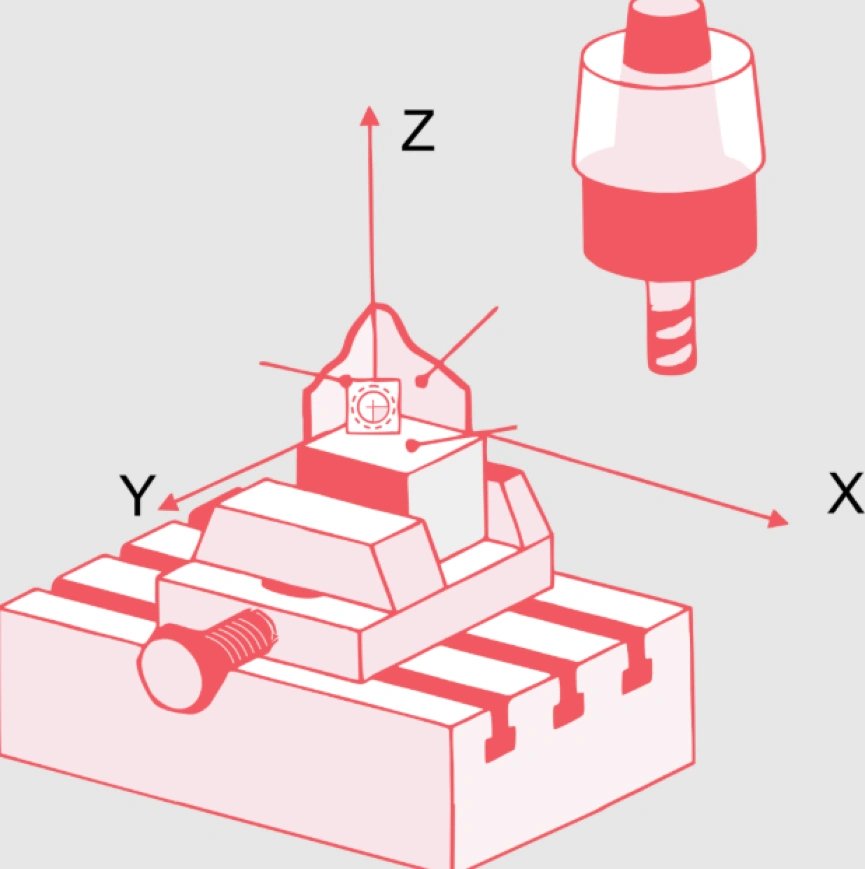
3-axis CNC machining
The versatility of 5-axis CNC machining in complex machining jobs with intricate details and unique angles is much higher compared to what 3-axis CNC machining and 4-axis CNC machining systems can achieve. These alternatives are meant for more basic machining jobs, so their designs are simpler.
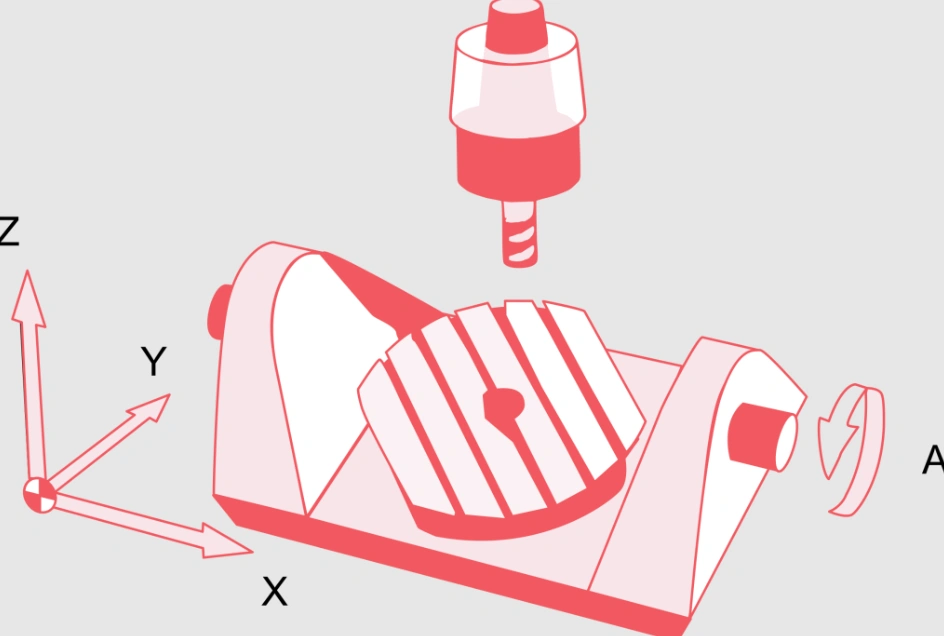
4-axis CNC machining
The simpler designs mean less investment in the alternatives, and the running costs are also lower. However, these alternatives demand more human intervention, which can contribute to more occurrences of machining errors.
Choosing between 5-axis CNC machining and alternatives calls for an analysis of all the angles – cost, convenience, machining quality, and speed.
The table below summarizes these comparisons for easier determination.
| Property | 5-axis CNC machining | 4-axis CNC machining | 3-axis CNC machining |
| Movement axes | Along X, Y, Z, plus two rotational axes (A, B, or C) | Along X, Y, Z, plus A-axis (rotation around X-axis) | Cutting tool movement along X (left-right), Y (forward-back), Z (up-down) |
| Complexity of parts | Highly complex partsSuperior geometries | Average to complexLess manual manipulation required | Simple to averageRequires multiple setups |
| Advantages | SimpleWidely availableMore affordable | Part rotation allowedExcellent for cylindrical partsMore efficient than 3-axis machining | Machines complex partsExcellent accuracy, precision, and surface qualityShorter lead times |
| Limitations | Only one side per setupMultiple setupsRisk of misalignments | Can’t handle complex anglesMore complex programming compared to 3-axis machining | High investment costRequires skilled machinists/programmers |
What Are The Applications Of 5-Axis CNC Machines?
The high demand for complex parts with tight tolerances has increased the popularity of 5-axis CNC machining systems across different industries. From turbine blades for aerospace to smooth contoured parts for medical, the applications of 5-axis machining services are uncountable.
Aerospace Industry
The super accurate CNC of the 5-axis machine is ideal for parts needed for this critical industry. It can machine specialist materials to tight tolerances that comply with industry standards.
Capabilities to take advantage of include CNC turning, CNC milling, 3D machining, and CMM inspection, which ensures all parts meet quality and reliability requirements.
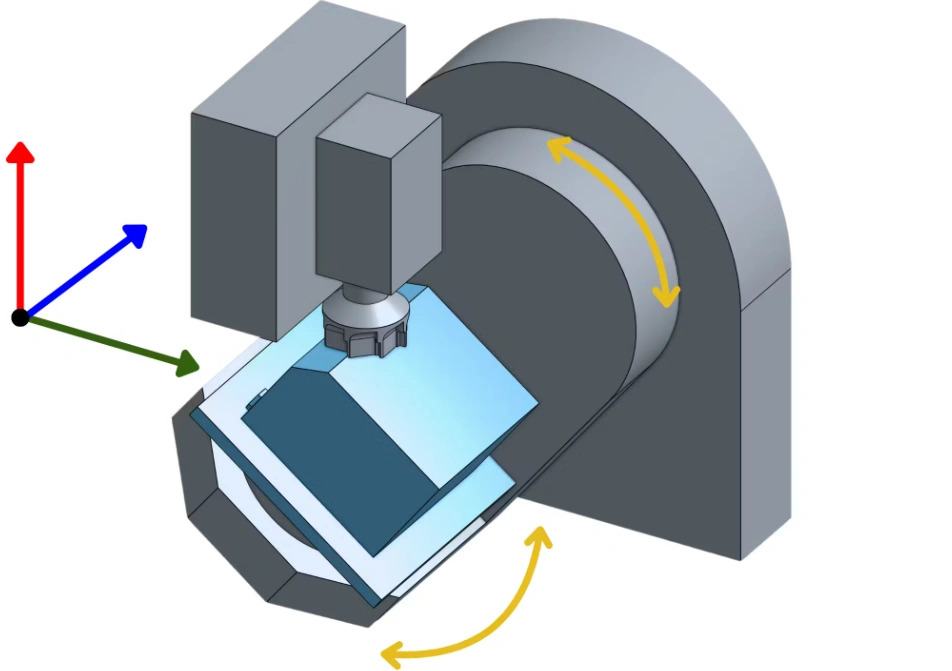
5-axis CNC milling
Alt text: Diagram showing 5-axis CNC milling with tool approaching workpiece, X, Y, Z linear axes and one rotary axis indicated
Medical Industry
5 5-axis CNC milling machine is highly complex and easily applicable in the manufacture of medical devices. The advanced technology and the related capabilities are useful in producing complex items with fewer setups and lower cost.
The required medical equipment can be manufactured fast and still meet tight requirements, saving clients’ time and money. The best 5-axis CNC machines can machine medical-grade materials according to industry regulations.
Military Applications
Militaries across the world are increasingly investing in sophisticated equipment, from stealth aircraft parts to jet engine components, and custom firearm parts to naval propeller blades. The options for this sector are limitless when it comes to the complexity that 5-axis machining can offer.
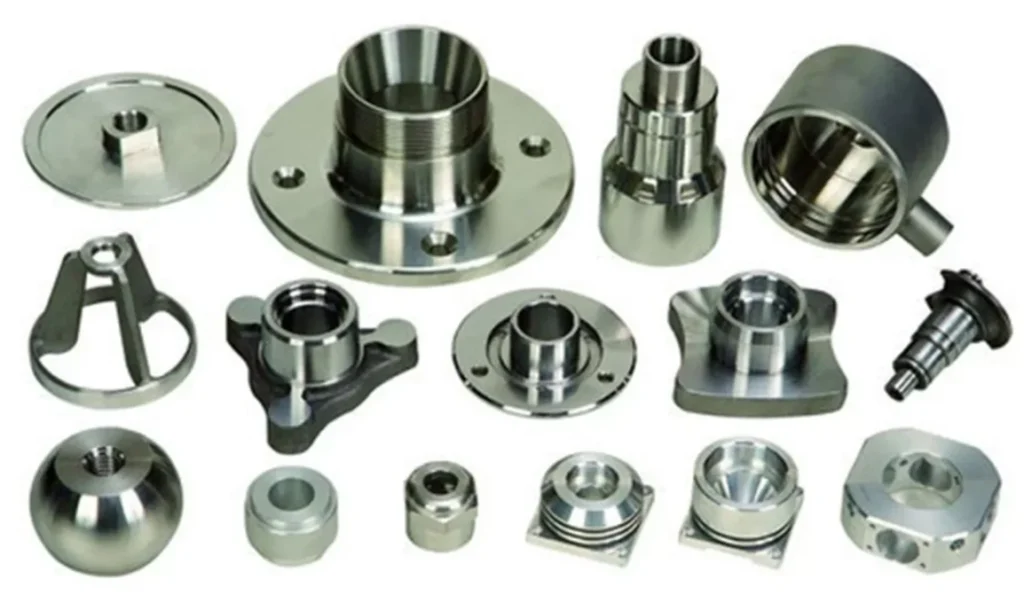
Military parts
Oil And Energy Sector
This is another prominent partner for 5-axis CNC machining solutions providers. The impact of the machining solution has been remarkable in this area, which is synonymous with not only tough materials, but also complex geometries and tight tolerances.
5-axis machining fits the part production requirements, easily manufacturing housings, drill heads, and valves. Where machining on multiple sides is necessary, the short setup time of the machine comes in handy.
Worth mentioning is the compatibility of the machining capability with tough materials like Inconel and titanium, which are common in this sector.
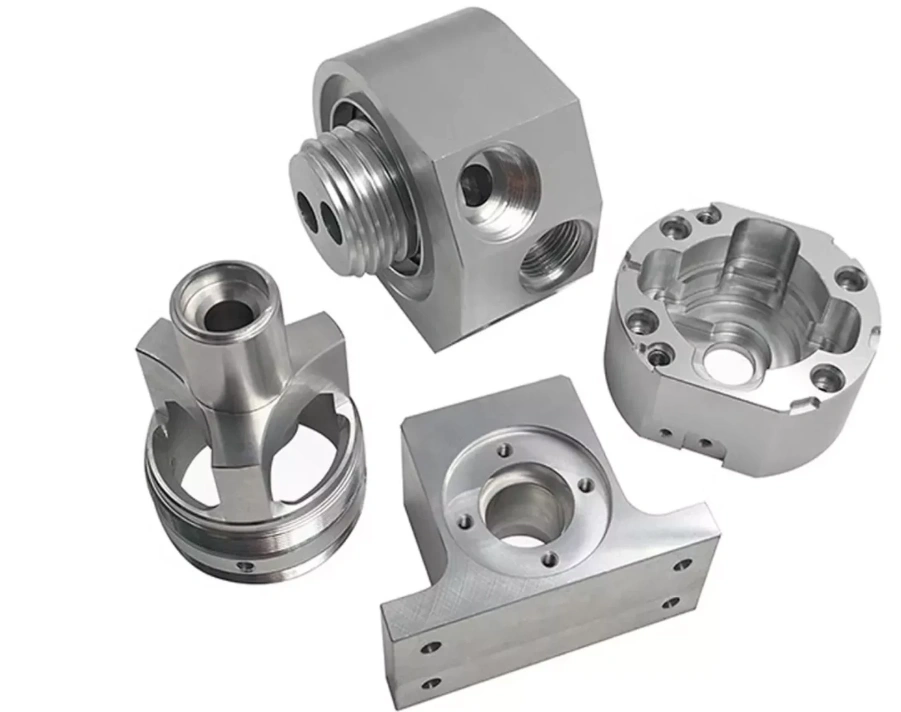
Energy industry parts
And when it comes to the need for versatility, especially for custom products, 5-axis machining doesn’t disappoint.
What Types Of Parts Can Be Machined Through 5-Axis CNC Machining?
As the applications outlined above show, 5-axis CNC machining is a perfect manufacturing method for accurate parts with angled surfaces and tight tolerances, which are difficult to produce with older approaches, such as 3-axis CNC machining.
Aerospace turbines, medical implants, and automotive engine housings are examples of such parts. So many industries rely on parts produced through this solution, and the reasons have been discussed here.
Below, we outline some common types of parts mostly machined through 5-axis CNC machining.
Uniquely Shaped Parts
Many people ask if CNC machines can produce unique shapes. Indeed, these machines are designed to produce shapes and designs that were initially considered too unique to be done on the machine table. The 5-axis CNC machine can be adjusted to different orientations.
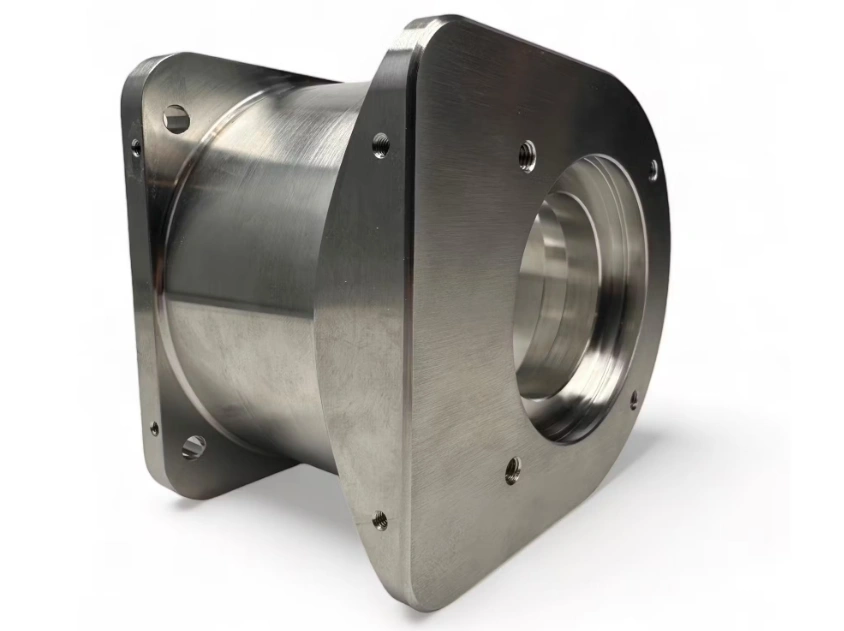
Complex geometry part
The CAD/CAM software solutions give the engineer or designer the freedom to come up with limitless designs that can then be translated into code for the CNC machine to follow. So, this multi-axis can easily help produce diverse and uniquely shaped items for any application.
Box Type Parts
In case you are wondering, box-type parts have a prismatic shape and can have features on multiple sides. These features include cavities, holes, and grooves. Machining such parts is difficult because of not only the multiple setups required, but also limited tool access, difficulty maintaining precision across all sides, and the inherent risk of the part colliding with CNC machine components.
With 5-axis CNC machines, the cutting tool has easy access to all sides; hence, setup times are significantly minimized, tolerances are much better, and the machining process is more cost-effective.
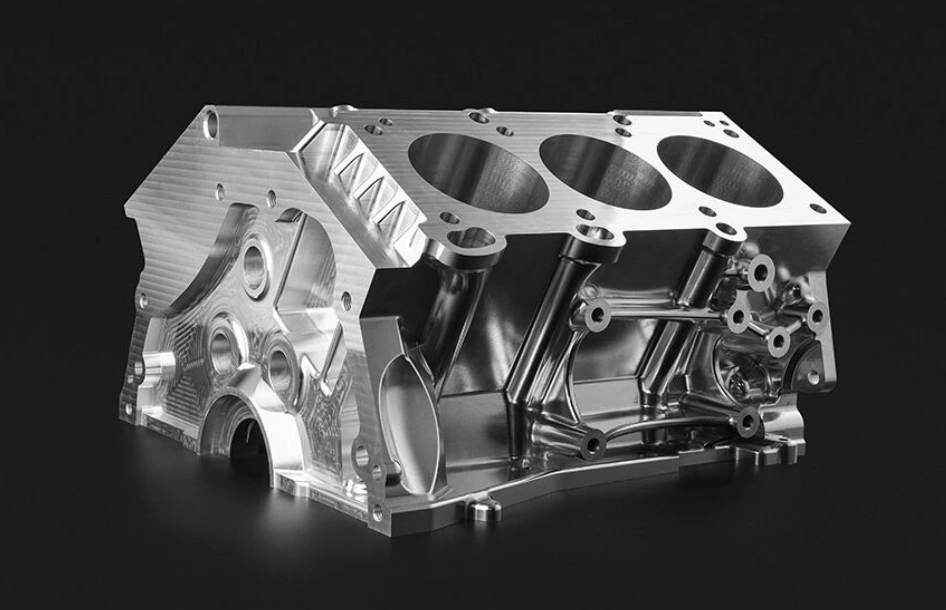
Multi-face Parts
Multi-faced parts and components are common in automotive transmission systems, robotic systems, medical devices, and aerospace. Because of their complex geometry, machining them using fewer axes machines is challenging.
Multi-faced part
Manufacturers use 5-axis machining because this method does not require repositioning every time a new face is to be machined. This maintains high levels of precision and minimizes the lead time.
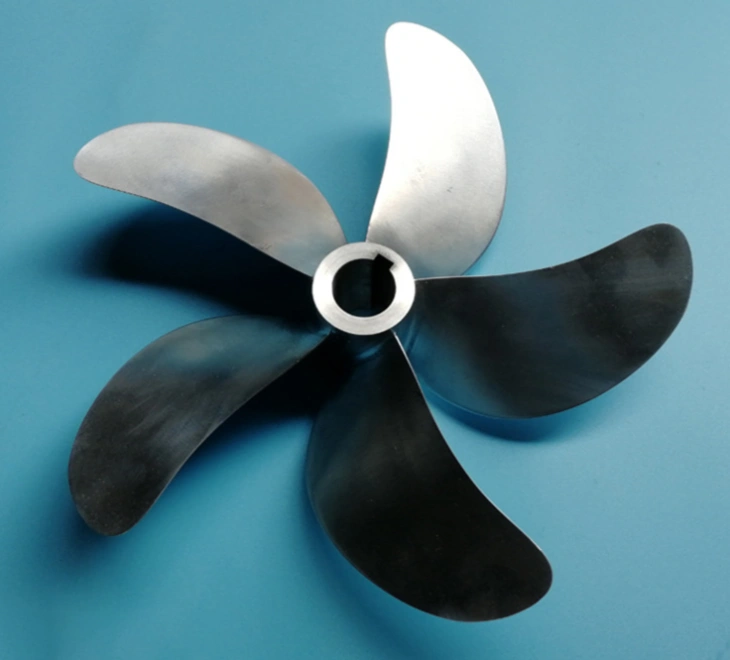
Complex Contoured Parts
For those in or serving industries where ergonomic and aerodynamic surfaces are critical, complex contoured parts from CNC machining are common. These also are very effectively done using 5-axis CNC machining.
Automotive, marine, medical, aerospace, and consumer electronics are some industries that use such parts extensively.
Complex contoured part
Curved Surface Parts
Finally, but not least, 5-axis CNC machining comes in handy in the manufacture of curved surface parts such as fuselage panels in aircraft, body panels in cars, and ergonomic handles for household electronics.
It is so easy to produce these parts using this machining method than with fewer axes.
5-Axis CNC Machining vs 3+2 Axis Machining
5-axis CNC machining and 3+2 Axis Machining are similar to the extent that they both utilize five axes, but the specific movement of the axes during machining differs. While the 5 Axis Machining moves all the axes simultaneously, 3+2 Axis Machining locks the rotational axes.
For a more thorough understanding of this difference, let’s check how the 3+2 Axis Machining system works.
Working Mechanism Of 3+2 Axis Machining
3+2 axis machining is similar to other machining methods in that it entails machine setup, the machining process, and quality control. The uniqueness of this machining approach is seen in the setup and machining process.
Unlike the 5-axis machining arrangement, the 4th and 5th axes do not move simultaneously with the first three during machining. Instead, servo motors or hydraulic clamps lock them in either 30°, 45° or 90°.
So, this is what happens:
- The CNC machine positions the workpiece in the desired orientation using the two extra axes.
- When the desired angle or orientation is achieved, the machinist locks the additional axes into position.
- The machinist proceeds in the standard 3-axis machining format while the workpiece is oriented as above
- The rotary axes are used to reposition the workpiece as required in between the machining processes
Tips To Get The Most From 5-Axis CNC Machining
Given the huge investment that goes into a 5-Axis CNC Machine, it is important to ensure optimal use of the machine. It all starts with ensuring the manufacturer has the right machine configuration, whether it is in terms of table or head design.
Other considerations include the type of software used and the post-processing capability of the CNC machine. It is also critical to ensure strict compliance with safety best practices when using these monster machines.
Consider the following two points for optimal results with the 5-axis CNC machine:
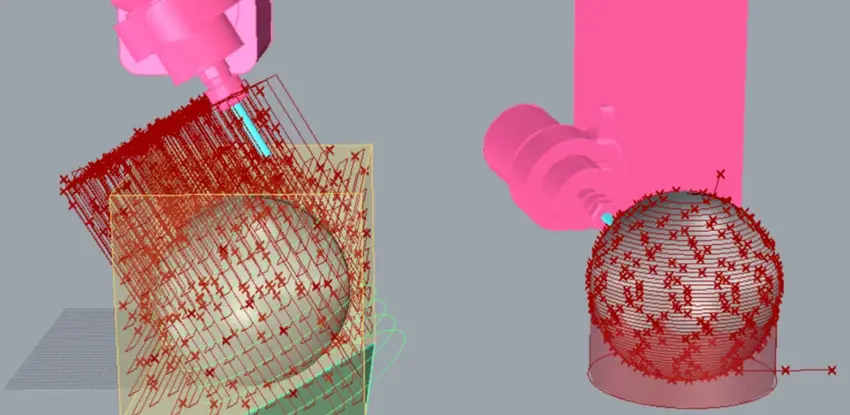
1. Tool Path Optimization
CNC roughing and finishing tool paths
Tool path optimization is correlated to machining efficiency and quality. Therefore, getting used to the most optimal tool paths should be the goal of every manufacturer. These best practices help achieve this.
- Proper cutting tool selection
- Optimized cutting parameters
- Use related CAM features like rest machining and adaptive clearing
2. Collision Prevention
The complexity of 5-axis machining can be disastrous if not properly handled. Collisions between the machine components and the workpiece are a constant problem, hence the need to identify ways to avoid them.
Ways to prevent collision include maintaining the 5-axis CNC machine in good condition, practicing safe machining, and using simulation software to identify potential issues.
In Conclusion
5-Axis CNC Machining is designed for the reliable and precise manufacture of complex parts. Aerospace, medical, and many other industries requiring parts with close tolerances use this manufacturing technology.
If you require complex parts with the best precision and accuracy for any industry, then 5-axis CNC machining services from ProleanMFG is your best solution. Call us today for more information.