

CNC programs get better every day, and so do the capabilities of the machines. The 3-axis computer numerical control (CNC) machine may seem to be losing the battle to multi-axis machining solutions, but it is still very common in manufacturing. Those in small and medium-sized enterprises are particularly still fond of this machining technology.
Due to their relatively simpler design and smaller size, 3-axis CNC machines are more affordable, easier to operate, and available for multiple jobs. Parts for general manufacturing, automotive, and simple molds are easily produced on these machines.
This article is a coverage of the basics of 3-axis CNC machining: Working principle, pros and cons, comparison to alternatives, and more.
What Is 3-Axis CNC Machining?
3-axis CNC machining is a subtractive manufacturing method that entails using cutting tools on a machine to progressively remove material from a workpiece. It is a fundamental machining process and widely renowned for its reliability and simplicity.
While not ideal for complex geometries for aerospace and similar industries, this form of CNC machining is the best for manufacturing basic geometries. Since many industries still use fundamental CNC machined parts, it will take time before we can say adios to 3-axis machining.
As the 3-axis CNC machine diagram below shows, the machining process works along three linear axes – X-axis (left to right movement), Y-axis (front to back movement), and Z-axis (up and down movement).
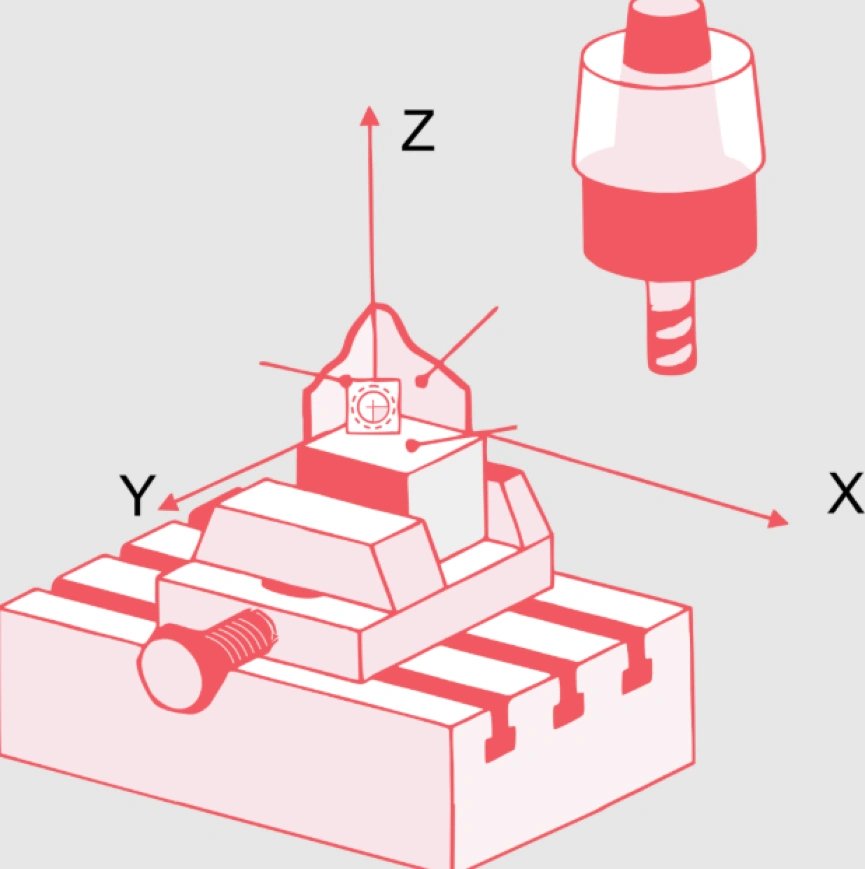
3-axis CNC machining diagram
How Does 3-Axis CNC Machining Work?
The working principle of 3-axis CNC machining is based on the movement of the cutting tool and workpiece along three linear axes as guided by a computer program. While the cutting tool moves in one direction, the workpiece moves in the other two.
Here are the steps in detail.
Step 1: Computer-aided design (CAD) and Conversion
The part to be machined is first designed in the CAD software. It is then converted to be recognizable by the CAM software.
Step 2: G-code
The CAM software creates G-codes, which are instructions that the CNC machine can understand.
Step 3: Feeding G-code
The machinist feeds the G-code into the 3-axis CNC machine. This code is designed to control several aspects of machining – depth of cut, cutting speed, feed rate, and others.
Step 4: CNC Machine Setup
The workpiece is fixed on the machine worktable, ready for machining. The cutting tool is also fixed to the spindle.
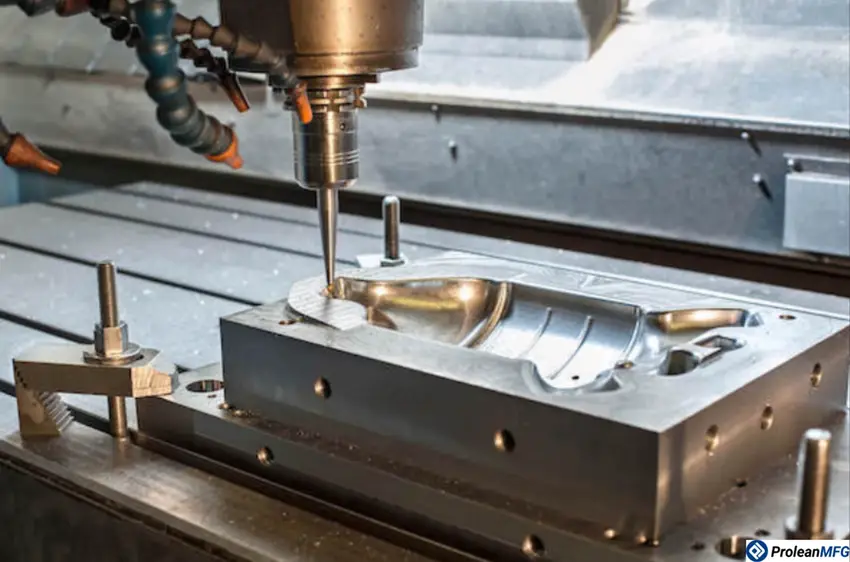
Clamped/fixed workpiece
Step 5: The Machining
The CNC machining step is mostly about executing the program. As the CNC controller interprets the code, the machine tool moves along the three axes and produces the desired shape on the workpiece.
Step 6: Post-processing
The machined part is checked for dimensional accuracy and surface quality before being approved as complete. If necessary, the machined part can undergo cleaning, surface finishing, or surface treatment.
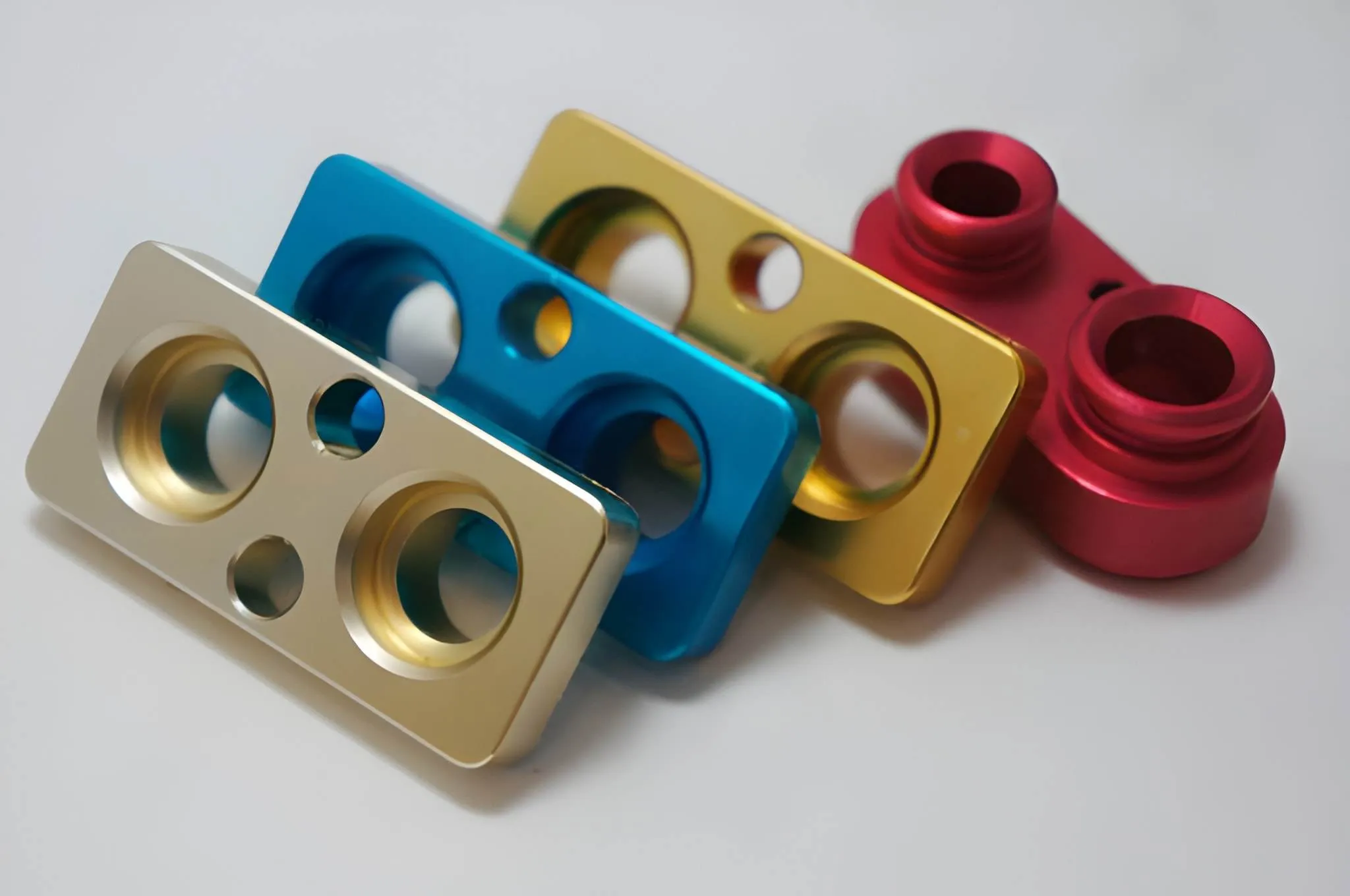
Post-processed CNC-machined part
Common 3 Axis CNC Machines
3-axis machining services are available in different designs, all meant to fulfil specific manufacturing requirements. There are milling machines, routers, and turning centers as the most common types of these machines.
Production and prototyping companies use these CNC machines for cost-effective and reliable results. Of course, the setups for the machines differ, but the three degrees of movement put them in the same category.
Here’s a table summarizing these different versions of 3-axis CNC Machines:
| Type of 3-axis CNC machine | Capabilities/features | Applications of 3-Axis Machining | Advantages | Limitations |
| Machining lathe | Rotates the workpiece, tools move along X & Z axes | Turning, threading, boring, facing | Fast for symmetrical parts, Repeatability | Limited to cylindrical/symmetrical parts |
| Machining center | Vertical spindle, automatic tool changer, high precision | Drilling, tapping, milling, boring | Versatile, precise, automation-friendly | Pricey, less suitable for sizable parts |
| Milling machine | Spindle moves vertically; table moves along X and Y axes | Slotting, facing, and contouring | Easy to operate, perfect for flat/angled surfaces | Slower than machining centers, manual tool changes |
| Engraving machine | High-speed spindle, smaller tools, intricate movement | Engraving, mold making | Ideal for fine details and soft materials | Not recommended for hard materials or deep cuts |
| Machining router | Lightweight gantry system, high-speed spindle, bigger table | Woodworking, material shaping | Sufficient working area, fast for soft materials | Unsuitable for hard metals |
| Plasma cutter | Plasma arc cuts through conductive materials | Sheet metal cutting | Fast cutting, minimal setup | unsuitable for high-precision machiningRough cus |
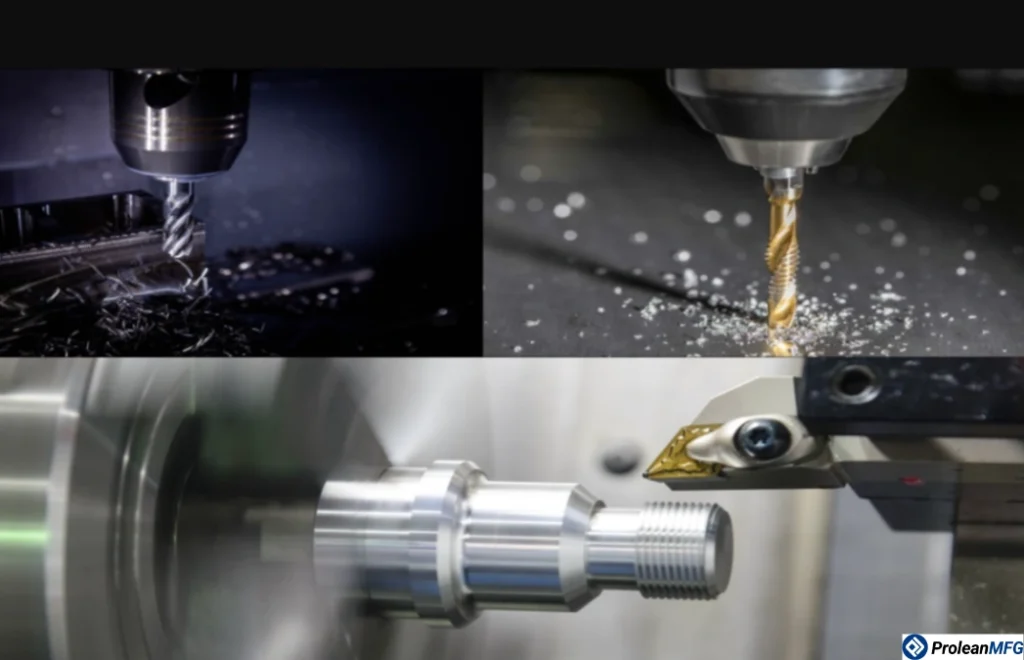
Types of 3-axis CNC machining methods/operations
What Can A 3-Axis CNC Machine Do?
Any industry dealing in or using parts of simple to average complexity can rely on 3-axis CNC machining for quality parts. This is where many parts for automotive, household electronics, molds, and general manufacturing come in.
This machining approach is capable of creating slots, contours, flat surfaces, and holes needed to make such parts. As an affordable and relatively versatile manufacturing method, 3-axis CNC machining is a go-to solution for standard manufacturing and custom projects.
Below are the applications of a 3-axis CNC machine for different industries have been mentioned:
Automotive
The automotive industry needs the accuracy and precision of 3-axis machining to manufacture transmission parts, engine parts, and many others.
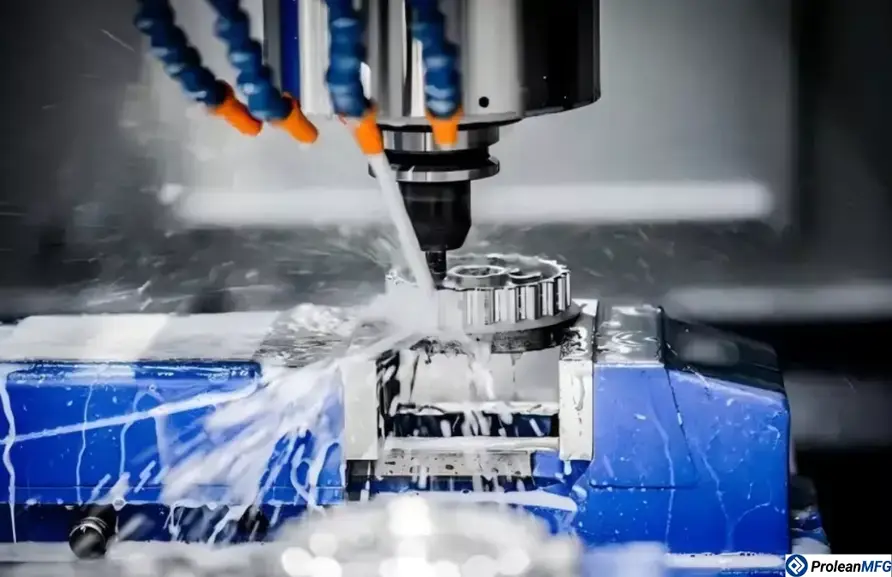
3-axis CNC machining of a gear for automotive
Electronics
3-axis CNC machining can help manufacture a wide range of electronics, from semiconductors to motherboards.
Aerospace
The precision-centric aerospace industry requires a dependable manufacturing process that suits the strict requirements. 3-axis machining fits this, so it is widely used in the manufacture of airfoils, panels, and turbines, among many other parts.
Medical
The accuracy capability of 3-axis CNC machining is essential in the production of medical sector parts like surgical devices, dental implants, and orthopedic implants.
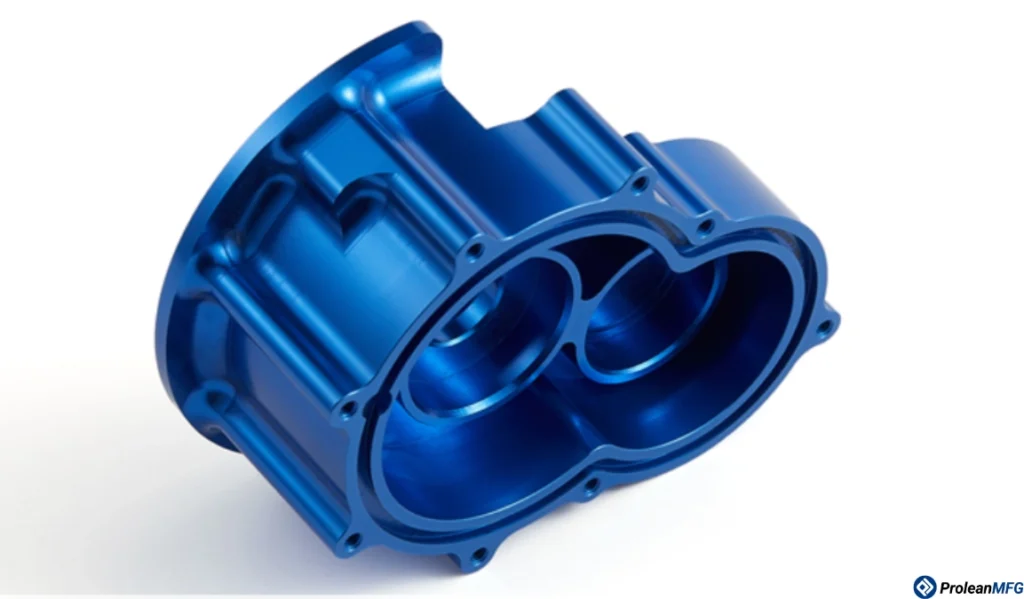
CNC milled medical part
Prototyping
When it comes to new product development, this machining technique is preferred by many manufacturers. They use it to manufacture prototypes and speed up the process.
Mold & Die-Making
Molding and die-casting are preferable manufacturing methods for some parts. 3-axis machining is a popular enabler of this industry, helping in the cost-effective production of molds and dies.
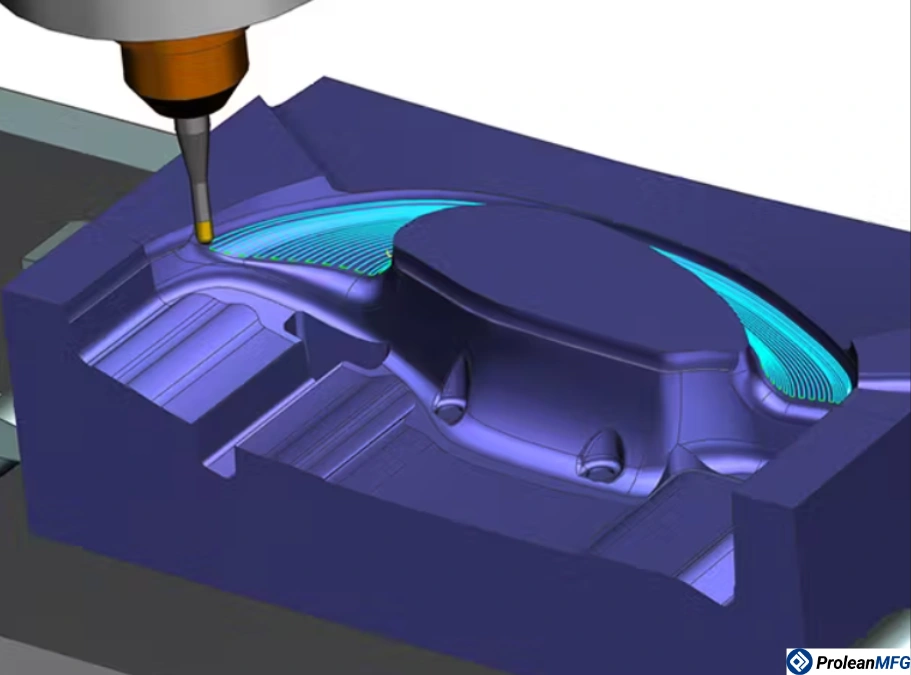
Mold-making with 3-axis CNC machining
Jewelry
Not to be forgotten in the list of applications of 3-axis CNC machining is the beauty industry, specifically jewelry. CNC machines in this category are highly regarded for their engraving and precision-cutting capabilities.
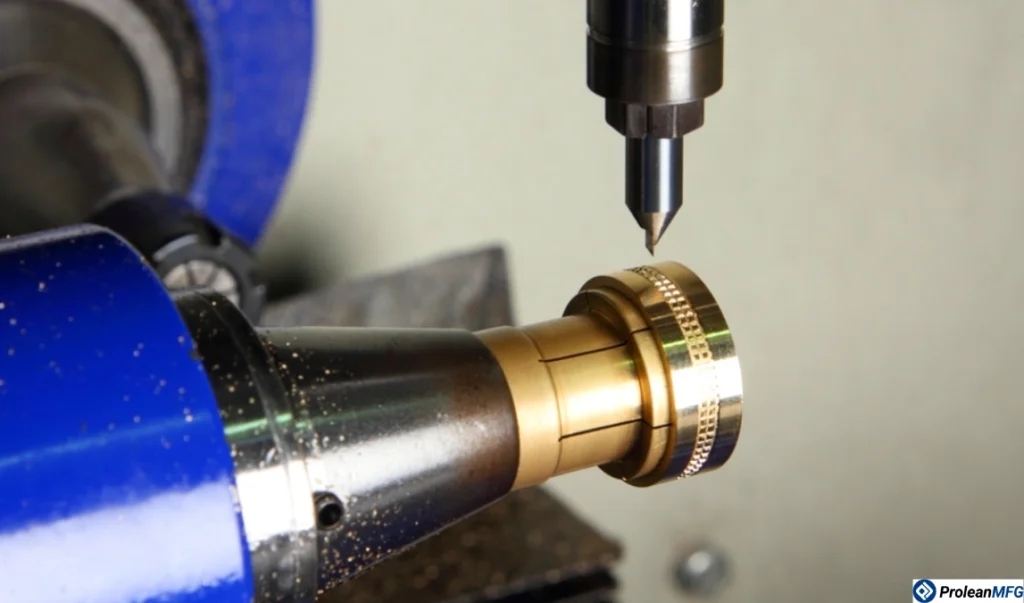
Jewelry making
Pros Of 3-Axis CNC Machining
Many manufacturers choose 3-axis machining for its several advantages – accurate machining, repeatable results, low costs, ease of use, and wide availability. With such characteristics, this machining method is suitable for both beginners and experienced users.
Regarding the manufacturing process, the benefits highlighted make sense for modern manufacturers, too.
Accurate Machining
3-axis CNC machining provides higher machining accuracy than the less automated conventional options.
Repeatability
This is the capability of the machine to attain the same reach every time and after many repeatable operations. It is a measure of a CNC machine’s reliability and stability. The 3-axis machining technique scores highly in this aspect.
Low-Cost Machining
This machining technique is cost-effective, for instance, through reduced material wastage. Its software-based operation ensures precision cutting and consequently, less unnecessary cutting. It also does not consume excessive power.
Widely Available
As a fundamental technology, 3-axis machining is widely available. This comes with many tied benefits, including availability of expertise and replacement parts.
Cons Of 3-Axis CNC Machining
Despite the positives of 3-axis CNC machining highlighted above, this method, like any other, has some drawbacks worth considering. Its challenges in machining complex geometries are expected considering the limited degrees of machining.
The need to reposition the workpiece every now and then can increase processing time, ultimately affecting profits.
Parts’ Complexity Limited
The limitation to three linear axes means that this machining technique cannot produce overly complex geometries or shapes.
Multiple Repositioning
The need to reposition the tools and workpieces more times compared to superior machining technologies is a notable challenge in 3-axis machining.
Cost aspect
Although 3-axis machines can be more affordable compared to multi-axis CNC machines, the cost is still prohibitive compared to conventional machining technologies.
What Is The Difference Between 3-Axis and 5-Axis CNC Machines?
When analysing 3-axis CNC machining, it is often in the light of newer more advanced forms of machining. One of the best comparisons in this case is 3-axis CNC Machining vs. 5-axis CNC Machining. While 3-axis CNC machining is lower cost and simpler to operate, 5-axis CNC machining is more complex and costlier.
Here is a more detailed analysis of these comparisons to help in choosing the right machining solution:
1. Cost – Initial And Running
The 3-axis CNC machine has basic components such as ball screws and servo motors, and nothing much beyond that, as compared to the 5-axis CNC machine. The fewer number of parts translates to lower investment cost and running costs, including the cost of electricity to run the machine.
The cost for the 5-axis CNC machine is notably higher due to more parts that are more complex to run and maintain. Features such as a tilting head and automatic tool changer make the machine more expensive to use. The maintenance and repair requirements are much higher.
2. Machined Part Complexity
When you need a really complex part, the machine of choice is one with higher axes 5-axis machine. The two extra axes of this machining setup mean more capability, that is, multi-directional machining needed for complex part manufacture. Producing deep pockets and undercuts is effortless for the 5-axis machine, yet it can be a herculean task for 3-axis machining.
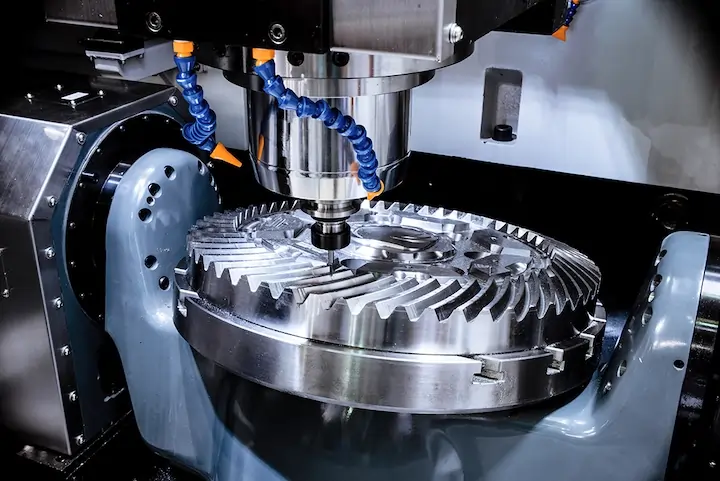
Complex part are more effectively manufactured through 5-axis CNC machining
3. Ease Of Use
Regarding ease of use, programming and setting up the CNC machines are the main considerations. The rotational movements and tool vectors on 5-axis CNC machines are so advanced that only the latest software solutions can handle them. A good example of such software is Mastercam, which is very reliable for creating complex designs and simulating processes.
With 3-axis CNC machining, the setup and programming is more straightforward. With basic G-code, the machinist can easily machine the required parts.
4. Machining Accuracy And Precision
The precision levels between 3-axis CNC machining and 5-axis CNC machining are different, with the latter having better performance. It is important to point out that accuracy and precision in CNC machining are distinct concepts.
Accuracy is the closeness of a machined component’s measurement to the intended measurement, while precision is the repeatability of the machined part’s measurements across different parts.
The accuracy and precision levels for the two machining technologies are as captured in the table below.
| Machine | 3-axis | 5-axis |
| Accuracy (mm) | ±0.003 to ±0.010 | ±0.0002 to ±0.0005 |
| Precision (mm) | ±0.002 to ±0.005 | ±0.0001 to ±0.0005 |
5. Manufacturing Volume
On this factor, the difference between 3-axis and 5-axis CNC machining lies in the setup time and part complexity. In other words, the specific project or application determines which of the two methods suits the desired manufacturing volume.
If simple geometry parts are required, then 3-axis machining is more preferable for high manufacturing volumes. Similarly, for parts of complex geometry, the versatility of 5-axis CNC machining prevails for high volumes.
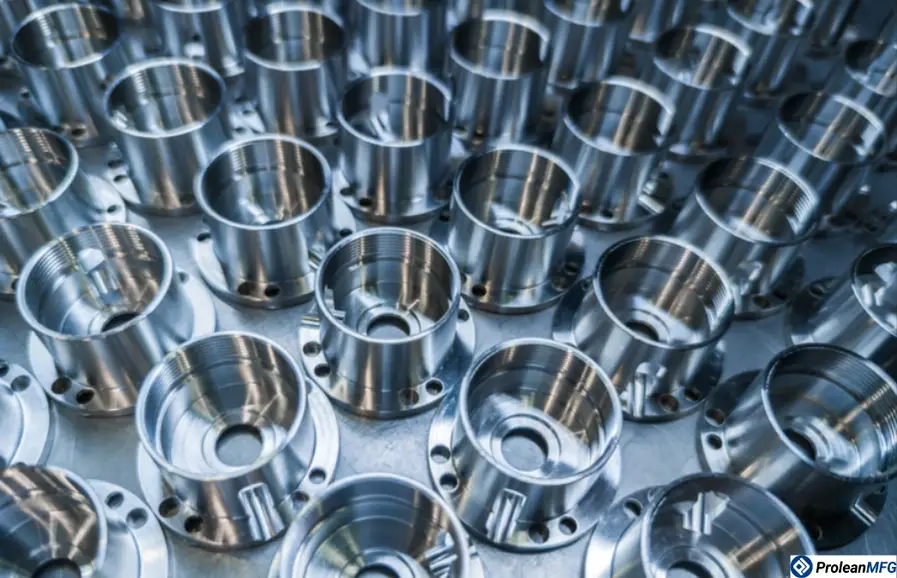
Multiple CNC-machined parts
Conclusion
3-axis CNC machining is a valuable upgrade of conventional machining with advantages such as higher accuracy, repeatability, and lower machining cost. Medical, aerospace, electronics, and automotive are some popular industries using parts machined using this technique.
With state-of-the-art 3-axis CNC machining capabilities coupled with unmatched expertise, ProleanMFG is your one-stop place for high-quality CNC parts for various applications of 3-axis machining.
Call the team today for reliable CNC machining services!
FAQs
What is 3-axis machining?
Though sometimes used interchangeably with 3-axis CNC machining, the term 3-axis machining refers to any machining process that utilizes three linear axes – X, Y, and Z.
What can you make with a 3-axis CNC?
You can make a wide range of items with a 3-axis CNC including mechanical parts, enclosures, engravings, automotive parts, and flat parts.