Select for the job
Connect grade choice to welding, wear and loading.
CUSTOM PARTS / ENGINEERING & MACHINING
Bearing seats, coated locating holes and welded brackets need different decisions. We connect carbon steel grade, machining sequence and final surface treatment to the way your component is assembled.
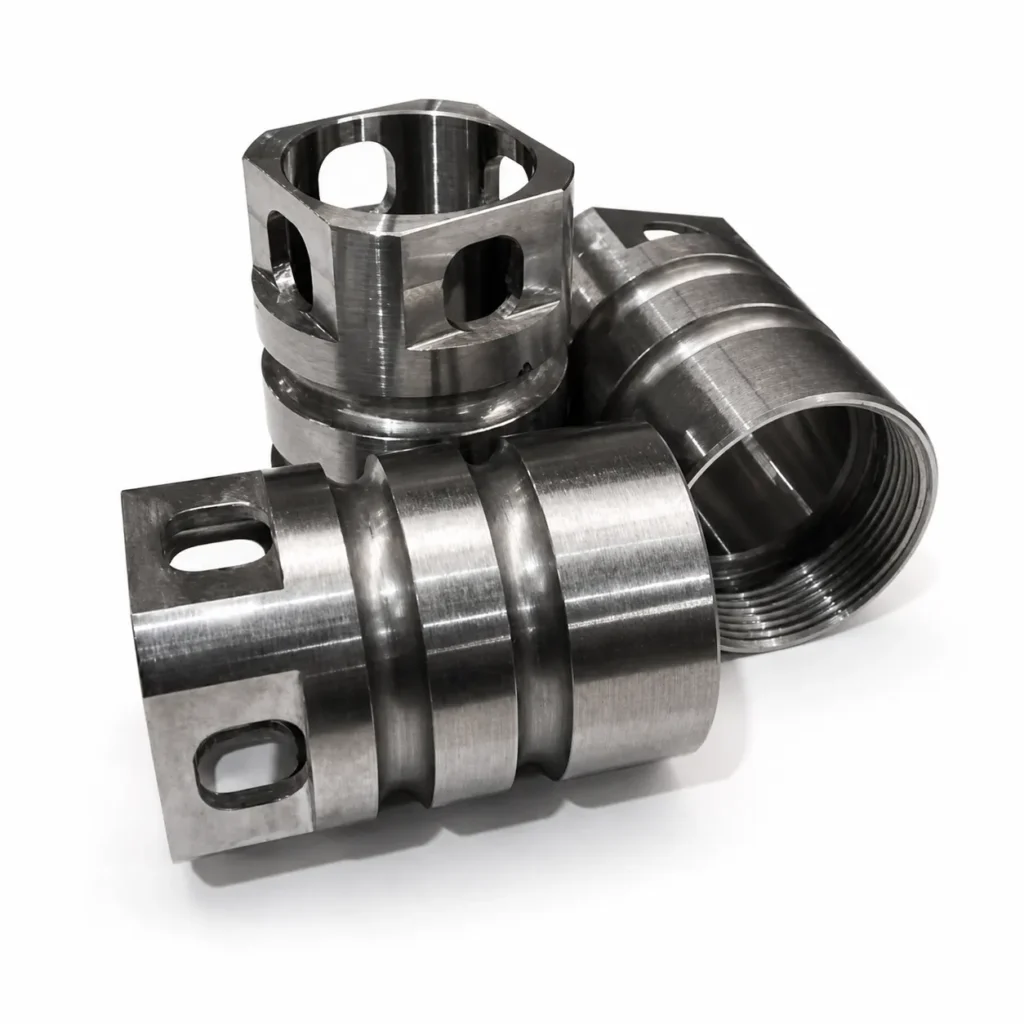
Our review links the feature that matters in your assembly to the proposed setup, machining sequence and acceptance check.
| Your part challenge | Our proposed approach | How to verify the result |
|---|---|---|
| Plating reduces a locating-hole clearance | Identify the final dimension and assess masking or machining allowance. | Measure the locating feature in the specified finished condition. |
| Welding moves a machined bracket | Review assembly datums and whether functional faces should be finished after welding. | Check the assembled geometry rather than the loose components alone. |
| A pin needs localized wear resistance | Review grade, hardening scope and the remaining finishing operations. | Agree hardness and size acceptance at the working surface. |
ILLUSTRATIVE ENGINEERING BRIEF
Illustrative RFQ: 60 brackets, two Ø8.00 +0.03/0 mm locating holes and a zinc-plated external finish. The holes must accept the assembly pins after finishing.
These numbers describe an example customer requirement, not a completed customer project or a guaranteed machining limit. Final feasibility is confirmed from the drawing.
Machining to the final hole size before plating can leave insufficient assembly clearance. Unspecified masking can cause inconsistent acceptance.
Proposed acceptance: final hole size and position, coating documentation as specified, and a pin-fit check on the finished bracket.
Connect grade choice to welding, wear and loading.
Identify the functional faces through machining and assembly.
Resolve masked areas, thickness and final sizing.
Use the finished part as the acceptance basis.
Confirm the grade after the functional requirements are clear.
Choose the grade using load, wear, welding and treatment needs. Comparable 1045 and C45 designations still require the governing standard to be confirmed.
| Material option | Selection context | What to confirm |
|---|---|---|
| 1018 | Fabricated and general mechanical components | Review welding, loading and any case-hardening requirement. |
| 1045 / C45 | Loaded or wear-sensitive components | State the governing material standard and treatment condition. |
Material reference: Material or fabrication reference ↗.
Confirm the governing standard and permitted material with the purchaser. Comparable names are not automatic substitution approval.
It depends on the coating and required finished fit. Identify the fit so masking or allowance can be proposed.
Send both component and assembly drawings, the welding scope and the final datum requirements for process planning.
The example is a customer brief used to explain the proposed engineering route. Actual limits, cost and timing are confirmed from the complete drawing.
Send the CAD and drawing revision, exact grade, quantity and the critical requirements discussed above. Include mating-part details and required inspection records.
ENGINEER YOUR NEXT PART
Send the drawing and tell us which feature controls assembly, sealing or motion. Our review connects that requirement to a proposed route and inspection scope.