
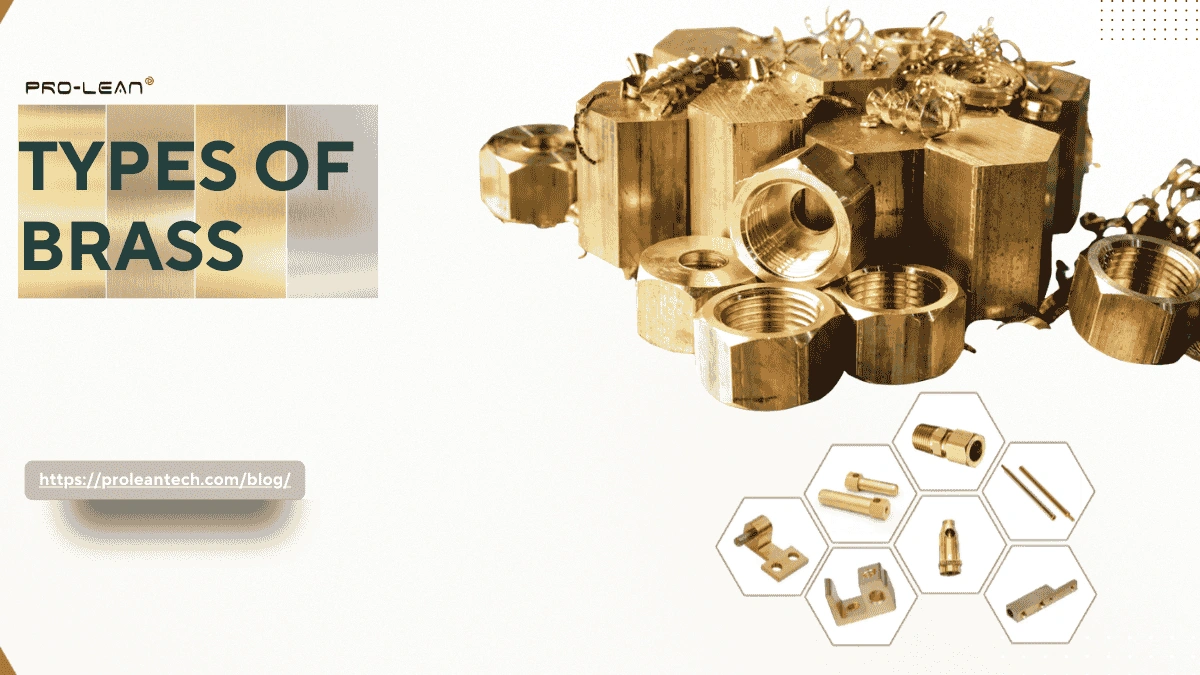

Brass is composed of Copper and Zinc, along with small amounts of other alloying elements. Several types of brass are used in manufacturing to produce electrical & thermal components, fittings, appliance parts, decorative items, medical components, and musical instruments.
This is because of brass’s versatile properties, including conductivity, corrosion resistance, aesthetic appeal, and machinability.
Understanding different types of brass material, their properties, and performance helps you choose the right material for your brass machining services.
This article will elaborate on the eight common types of brass material used in manufacturing, including their composition, benefits, and uses.
What is Brass?
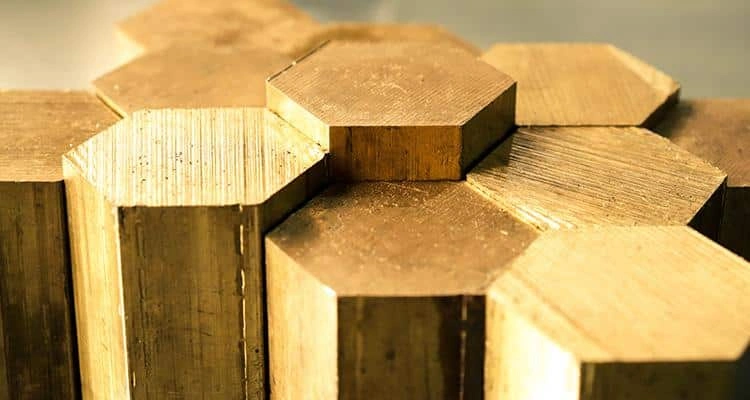
Brass material
Brass is an engineering alloy of Copper & Zinc. In certain grades, other elements such as tin, lead, or aluminum are also added to enhance brass corrosion resistance, machinability, and mechanical properties.
Depending on the brass type, the crystal structure can be face-centered cubic (FCC), body-centered cubic (BCC), or both. FCC (alpha) results in excellent cold workability, and the BCC lattice makes the material stiffer.
Additionally, brass is also considered an aesthetic material that provides a bright golden color.
What Are the Alloys of Brass?
Brass alloys are commonly classified based on zinc content and microstructure, which results in different types such as alpha, beta, and alpha-beta brasses, as well as application-specific alloys like naval, red, and nickel brass.
The alloys of brass are Cartridge Brass, Naval Brass, Red Brass, Yellow Brass, and Alpha Brass
Beta Brass, Alpha-beta or duplex brass, and German Silver.
Key Properties of Brass
Next, let’s look at the key physical & mechanical properties of brass:
- Corrosion Resistance: Brass is one of the corrosion-resistant metals, which prevents oxidation and resists corrosion when it comes into contact with moisture or water.
- Formability: Brass can be shaped through bending, rolling, deep drawing, and other metal-forming processes.
- Machinability: Brass alloys with a minor amount of lead provide excellent machinability, and they can be processed with milling, turning, drilling, threading, and other methods.
- Strength: Zinc % in brass determines the strength (moderate to high) and ductility.
- Conductivity: The presence of copper in brass provides high electrical & thermal conductivity.
Composition Table for Different Types of Brass
As mentioned before, zinc and copper are the main constituents in brass composition. Subsequently, other alloying elements, such as tin and lead, are added to some specialized brass grades.
- Copper: 60-70%
- Zinc: 30-40%
Next, look at the brass composition percentage for different grades in the table below.
| Brass Type | Cu (%) | Zn (%) | Pb (%) | Sn (%) | Ni (%) | Other (%) |
| Naval / Tin Brass | 58–60 | ~39 | — | ~1 | — | — |
| Red Brass | ~85 | ~5 | ~5 | ~5 | — | — |
| Leaded Brass | 57–65 | Balance (~32–42) | 1–3 | — | — | — |
| Yellow Brass | 67–70 | 30–33 | 0.1–0.5 | trace | — | Fe/others trace |
| Beta Brass (CuZn15) | ~15 | ~85 | — | — | — | — |
| Alpha Brass | 65–70 | 30–35 | — | — | — | Al/Fe/Si trace |
| Alpha-Beta Brass | 55–65 | 35–45 | optional trace | — | — | — |
| Nickel Brass (German Silver) | 50–70 | 20–40 | — | — | up to 20 | — |
Tin or Naval Brass
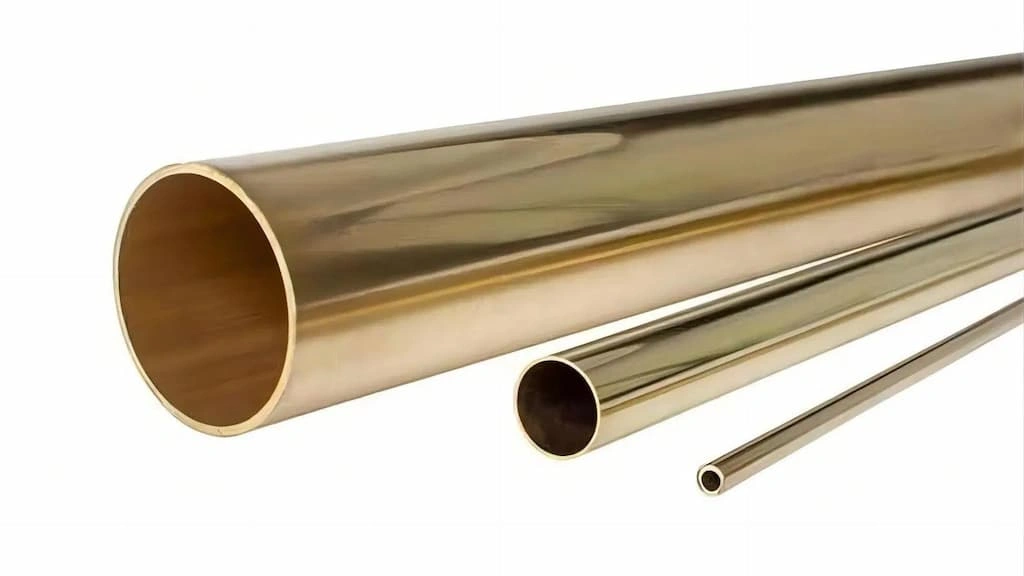
Naval Brass
Naval brass, also known as tin brass, is characterized by its tin content in the composition, along with copper and zinc. This additional tin content enhances the marine corrosion resistance, wear resistance, and strength.
Some common uses of Naval Brass are marine parts, propellers, ship fasteners, and pump bodies.
Composition (C46400): 58- 60% Copper (Cu), ~ 39% Zinc (Zn), and 1% Tin (Sn)
Benefits of Naval Brass
- Suitable for both cold & hot working
- Compatible with soldering and brazing
- Durable in seawater environments
Red Brass
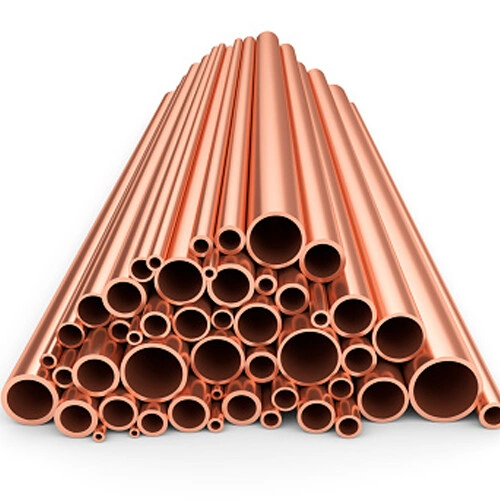
Red brass
These types of brass are characterized by their reddish appearance, such as C23000, C83600, and C84400. They involve lead, tin, and iron, along with copper and zinc. Consequently, red brasses provide excellent castability and corrosion resistance.
Examples of applications for red brass materials include pump housings, valve hardware, decorative & architectural items, fittings, plumbing components, etc.
Composition: ~85 % Copper (Cu), 5 % Zinc (Zn), 5 % Tin (Sn), and 0.5% Lead (Pb)
Benefits of Red Brass
- Highly corrosion-resistant in harsh environments
- Compatible with welding, soldering, and brazing.
- Good aesthetic appeal and suitable for decorative uses.
- Red brasses are reliable for plumbing works.
- Easy to machine and cast
Leaded Brass
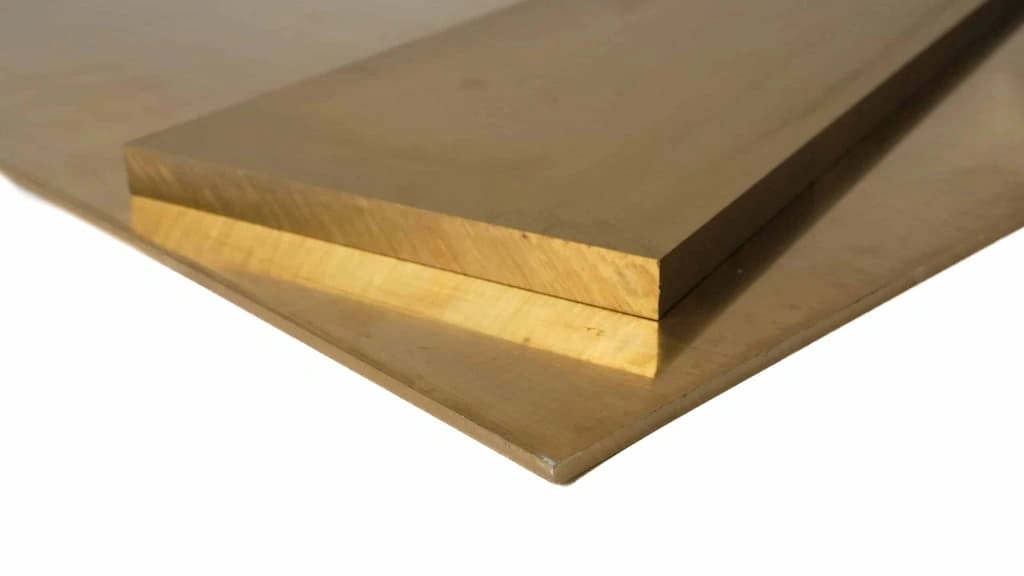
Lead brass
As the name suggests, leaded brass contains 1 to 3% lead in its alloying composition, which increases machinability and allows it to be shaped into complex components. But lead compromises the brass’s ductility.
This free-machining brass is predominantly used to produce milling & turning parts with precision & finish. E.g., threaded fasteners, CNC plumbing, screws, and connectors.
Composition: 57-65% of Cu, 1 to 3 % of Pb, and balanced zinc.
Benefits of Leaded Brass
- Excellent machinability and can be milled, turned, and drilled with precision.
- Good surface finish
- Minimal wear and longer tool life
Yellow Brass
Yellow brass
Yellow brass includes ~ 67- 70% copper(Cu) and ~30 to 33% zinc with minor impurities. Meanwhile, brass’s corrosion resistance and bright goldish-yellow appearance make it a good material for arts and decorative items. E.g., sculptures, ornaments, musical instrument parts, and decorative arts.
Moreover, brass grades from C20000 to C29999 are classified as yellow type brass.
Composition: ~ 67- 70% Cu and ~30- 33% Zn, and 0.1–0.5 % traces of lead, tin, iron, etc.
Benefits of Yellow Brass
- Moderate mechanical strength and excellent cold-workability
- Eye-catching aesthetic and smooth finish
- Suitable for ammunition casing components
- They can be joined with different methods.
Beta Brass

Beta brass
Beta brass, also known as die-casting brass, contains a higher amount of zinc than copper. Higher zinc content lowers the melting point of brass, which is beneficial for die-casting.
This type of brass is used for hinges, door locks, fasteners, faucet handles, and structural hardware.
Composition (CuZn15): ~85 % Zn and 15% Cu
Benefits of Beta Brass
- Strength and hardness can be increased with heat treatment.
- Lower melting point and excellent casting properties of brass allow for die-casting.
- Wear-resistant and durable
Alpha Brass
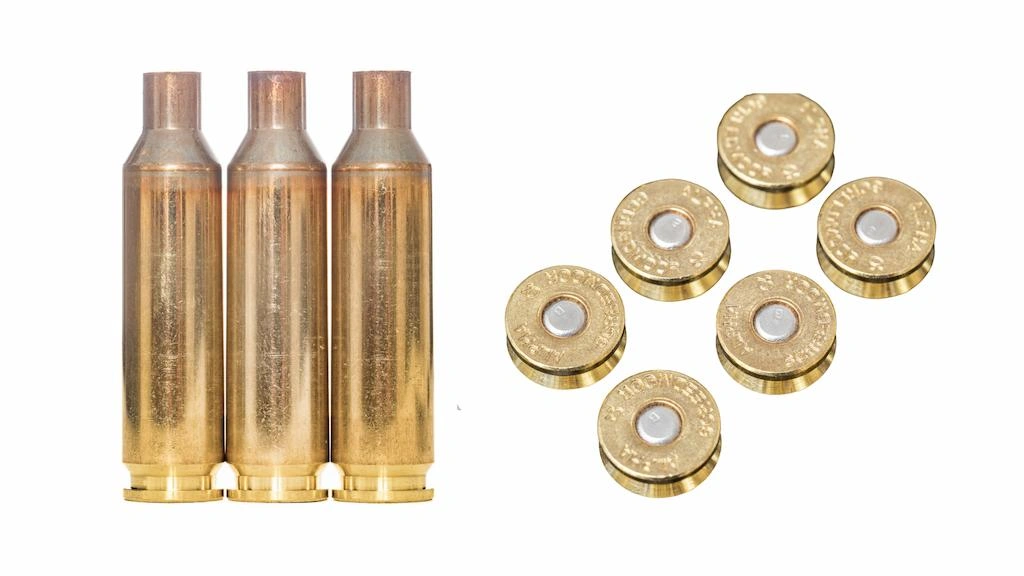
Alpha brass applications
It is a single-phase brass alloy that is ductile and has excellent workability. The composition of alpha brass includes copper, zinc, and small traces of aluminum, iron, and silicon.
In particular, alpha brass C26000 is also known as cartridge brass and is widely used for cartridge ammunition applications.
Common applications of alpha brass include ammunition cases, thermal exchangers, screw & bolt fasteners, plumbing fittings, and deep-drawn cups.
Composition: ~65–70% Cu and 30–35% Zn
Benefits of Alpha Brass
- Excellent cold working properties for bending, stamping, deep-drawing, and other forming processes.
- Balanced mechanical strength and ductility
- Corrosion-resistant in mild-to-aggressive environments
- Good electrical conductivity
Duplex or Alpha-Beta Brass
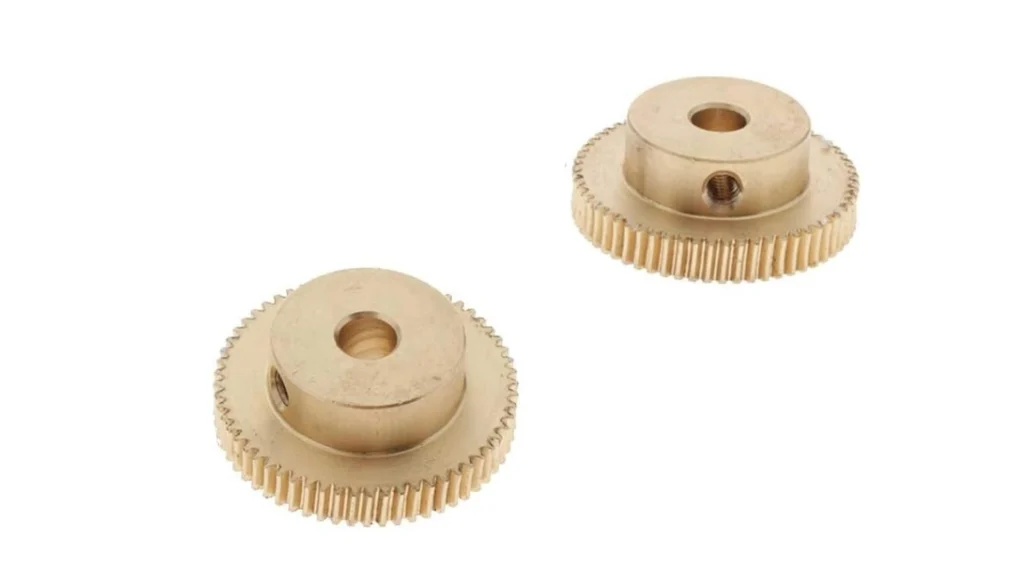
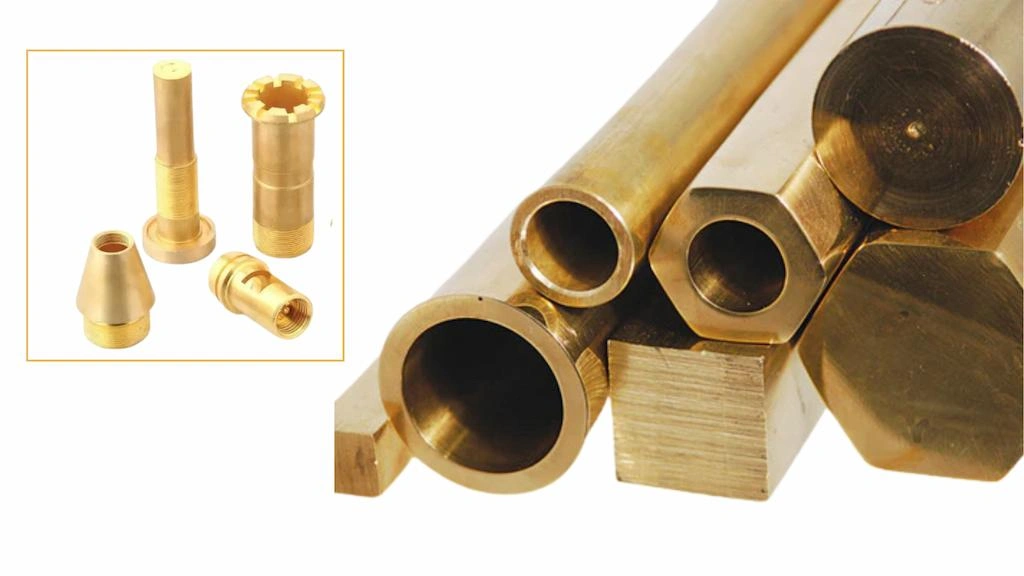
Alpha-beta brass parts
Duplex, also known as alpha-beta brass, features a two-phase (FCC & BCC) microstructure that provides balanced physical and mechanical properties.
Moreover, the combination of hot and cold working capabilities of duplex brasses makes them compatible with precision metal-forming operations.
These types of brasses are used for hot-forged components, valves, small gears, and related applications.
Composition: ~ 55–65% Cu and 35–45% Zn
Benefits of Alpha-Beta Brass
- Stronger than alpha and lower toughness than beta brass
- Balanced properties, such as strength, ductility, corrosion-resistance, conductivity, etc.
- Heat-treatable; strength and surface hardness can be improved.
- Adding a small amount of lead can significantly enhance the machinability.
Nickel Brass (German Silver)
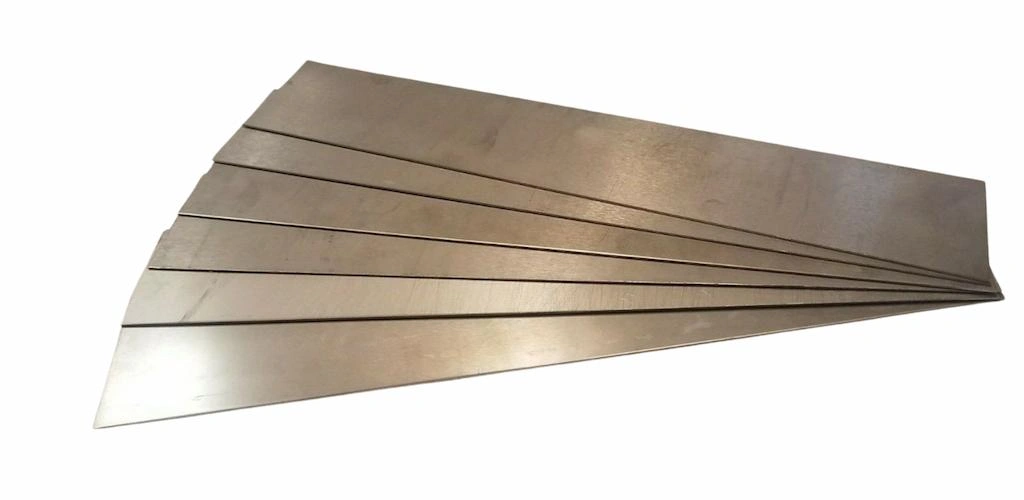
German silver sheet
Nickel brass, also known as German silver, is a highly corrosion-resistant material with a silvery appearance, due to the presence of nickel in its alloying composition.
Nickel brass components withstand humid, marine, and other harsh environments and resist tarnishing over the long term.
You can use Nickel brass to produce coins, decorative products, components for musical instruments, marine fasteners, plumbing hardware, medical instruments, etc.
Composition: ~ 50-70% of Cu, 20-40% of Zn, and up to 20% of Ni
Benefits of Nickel Brass
- Excellent aesthetic appeal and corrosion resistance
- Refined grain structure and enhanced mechanical strength
- Food-safe material and easy to clean
- Safe for many medical instruments, devices, and external equipment.
Brass vs Bronze vs Copper: How They Differ?
Copper is a pure non-ferrous metal, whereas brass and bronze are its alloys. Brass is a copper-zinc alloy, and bronze is a copper-tin alloy, in addition to some other alloying elements.
Brass includes 60 to 70% copper and 30 to 40% zinc, lead, iron, and manganese in minor amounts. On the other hand, bronze is primarily composed of ~88% copper and ~12% tin.
Copper is an ideal choice when electrical and thermal conductivity directly influence the part’s performance. Brass provides strength and corrosion resistance and is more machinable than copper. It is used in plumbing fittings, fasteners, musical instruments, etc. Furthermore, you can choose bronze for marine applications, fitting hardware, bushings, etc.
If you want to read a comprehensive comparison of copper & brass materials, read “Copper vs Brass” here.
What Is the Brass Machining Process?
Brass can be shaped into desired part & products using CNC milling, turning, drilling, and other machining processes. Each of these processes has distinct capabilities and use preferences.
Let’s further elaborate on them.
- Brass CNC Milling: It is used for complex 3D parts with irregular contours, internal features, slots, etc. E.g., Heat exchanger plates, manifolds, valve bodies, and brackets.
- Brass CNC Turning: Turning is for cylindrical brass parts, such as pipe fittings, nozzles, fasteners, valve stems, and shafts.
- Brass CNC Drilling: CNC drilling creates precise holes in all types of material and can perform secondary operations such as boring and reaming.
Brass Material Applications in Manufacturing
Brass material is used across various industrial manufacturing sectors, including electrical, automotive, plumbing, industrial machinery, architecture, aerospace, medical, energy, and musical instruments.
Let’s look at the table below for further details with examples.
| Industrial | Why Brass? | Application Examples |
| Electrical | Conductivity & corossion-resistance | connectors, busbars, switches, and grounding parts. |
| Automotive | Wear resistance and durability | Fuel system fittings, bushings, valve guides, radiator cores. |
| Plumbing | Corrosion resistance, leak-proof sealing, antimicrobial properties | Couplings, pump parts, valves, pipe fittings, and faucets. |
| Industrial Machinery | Low friction and good strength | Bearings, bushings, valves, etc. |
| Architecture | Aesthetic appeal and finishes | Lighting fixtures, decorative items, and door handles |
| Aerospace | Non-magnetic, corrosion-resistant, and reliable | Fasteners, fittings, instrumentation parts, tubing |
| Medical | Antimicrobial properties and ease of sterilization | Fluid connectors, oxygen system fittings, and surgical instruments |
| Musical Instruments | Acoustic properties and aesthetic finish | Instrument tubes, trumpets, and trombones |
| Energy | Conductivity, heat resistance, and reliability | Electrical terminals, earthing systems, transformer & relay parts, etc. |
Factors to Consider for Choosing the Best Brass Type for Your Parts
You must consider various factors when choosing the right type of brass for your project, such as desired strength, structural robustness, application environment, manufacturing method, appearance, finish, and material cost.
If you need high strength and structural robustness, brass with a higher zinc content is preferred. If the parts need to operate under or on seawater, Naval brass is ideal. Similarly, other brasses are also designed with some specific properties.
Summing Up
Alpha Brass is known for cold forming, Beta is for die casting & structural hardware, and Alpha-beta provides balanced ductility and strength. Consequently, other types of brass, such as naval, yellow, red, duplex, and nickel brass, also provide unique properties and advantages.
Factors like desired strength, corrosion resistance, conductivity, appearance, machinability, formability, and cost determine which brass is ideal for your parts.
If you are looking to outsource custom brass components, our brass machining service can deliver the quality and precision you need. We have multi-axis CNC equipment and quality control instruments to handle complex designs.
FAQs:
What is alpha and beta brass?
Alpha is a single-phase brass with < 37% Zinc, whereas Beta is also a single-phase brass but with ~ 45 to 50% Zinc.
What is the cheapest type of brass?
The price of brass depends on the composition. Typically, brasses with higher zinc contents are the cheapest ones.
Which is worth more, red brass or yellow brass?
Due to their higher copper content (~85%), red brasses are worth more than yellow brass.