
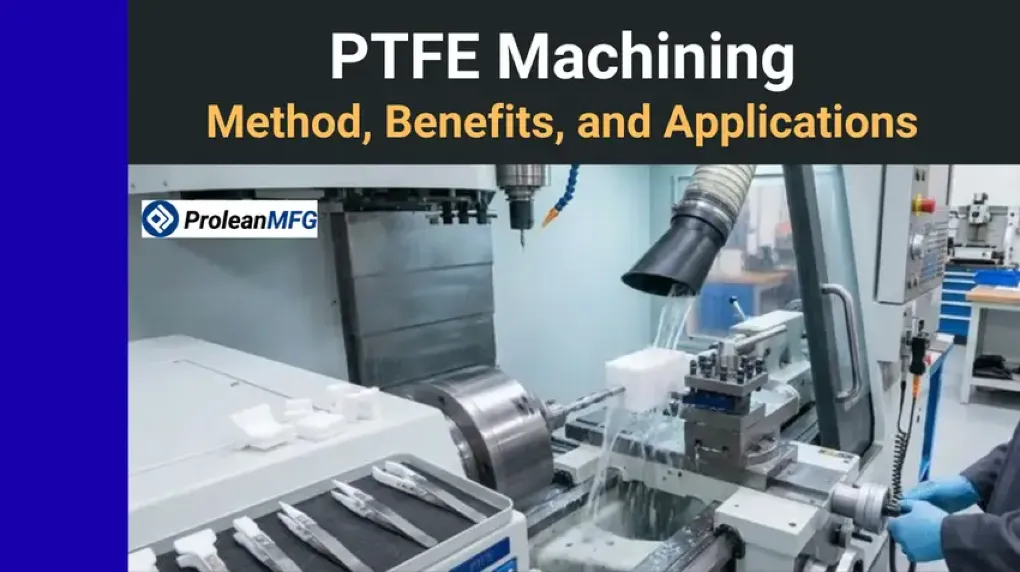

PTFE machining is the CNC-cutting of polytetrafluoroethylene (PTFE) into precision engineering components. PTFE is a machinable engineering plastic widely used in industrial applications. It is also commercially known as Teflon™. Engineers specify PTFE machined parts for their low coefficient of friction, superior chemical inertness, and continuous service capability from -200°C to +260°C. [1]
When you use standard plastics for machined parts, issues related to chemicals, heat, friction, and tolerances often arise. Downtimes and expensive replacements can become recurrent headaches. PTFE CNC machining, when engineered and machined correctly, can solve these challenges.
With grades such as glass-filled PTFE, virgin PTFE, carbon-filled PTFE, and carbon/graphite-filled PTFE, businesses have a variety of options to enhance the performance of their components and parts.
This article covers PTFE machining aspects, including material properties, suitability for CNC machining, and machining tips used by top manufacturers.
What is PTFE?
PTFE or polytetrafluoroethylene, is a versatile, high-performance fluoropolymer that became commercially available in 1947 with the trade name Teflon™. Its chemical formula PTFE [CF2-CF2]n resembles that of polyethylene (PE), with the hydrogen atoms replaced by fluorine.
Advantages of Machining PTFE
The material advantages of machining PTFE include corrosion resistance, low friction, temperature tolerance, electrical insulation, and a non-stick surface.
- Corrosion Resistance: PTFE resists a wide range of acids, bases, and solvents. [2] This ensures reliable performance in tough environments.
- Low Friction: The material’s low coefficient of friction translates to minimized lubrication requirements in moving parts.
- Temperature Tolerance: With a continuous service of up to ~260 °C, PTFE machined parts can perform reliably in a wide temperature range without degradation. [1]
- Electrical Insulation: PTFE makes excellent insulating components because it has high volume resistivity and dielectric strength.
- Non-Stick Surface: The material has a low surface energy of approximately 18 mN/m, so adhesion is minimal. This makes it suitable for a wide range of anti-fouling applications.
Limitations of Machining PTFE
The limitations of machining PTFE are low dimensional stability, low mechanical strength, high tool wear, burr risk, and high coefficient of thermal expansion.
- Low-Dimensional Stability: PTFE has high creep behaviour (ASTM D2990). It performs poorly in highly precise parts due to the resulting deformation.
- Low Mechanical Strength: With a tensile strength of approximately 30 MPa, PTFE is not ideal for high-load applications. [3]
- High Tool Wear: Friction on the cutting tool tends to be high due to the material’s softness and deformation tendency, a relationship that aligns with the ISO 3685 tool life principles.
- Burr Risk: Burr formation goes hand in hand with ductility, so you can expect this challenge when machining PTFE.
- High Coefficient of Thermal Expansion: Expanding capability of 100–150 ×10⁻⁶ /°C means that PTFE outdoes metals in this aspect. The process engineer must therefore compensate for this property in design.
Properties of PTFE
The most prominent properties of PTFE are flexibility, chemical resistance, heat resistance, UV resistance, electrical insulation, anti-adhesion capability, low coefficient of friction, fatigue resistance, and low water absorption.
- Flexibility
- Chemical resistance
- Heat resistance
- UV resistance
- Electrical insulation
- Anti-adhesion capability
- Low coefficient of friction
- Fatigue resistance
- Low water absorption
How Machinable is PTFE?
PTFE is highly machinable. Indeed, CNC Teflon machining is the recommended method for producing precision parts from engineering plastics.
As long as the machinist accounts for the material’s thermal expansion and low rigidity, machined PTFE parts ranging from simple to complex can be machined. Multi-axis CNC machining of PTFE enables the production of manifold blocks, valve bodies, and other complex parts.
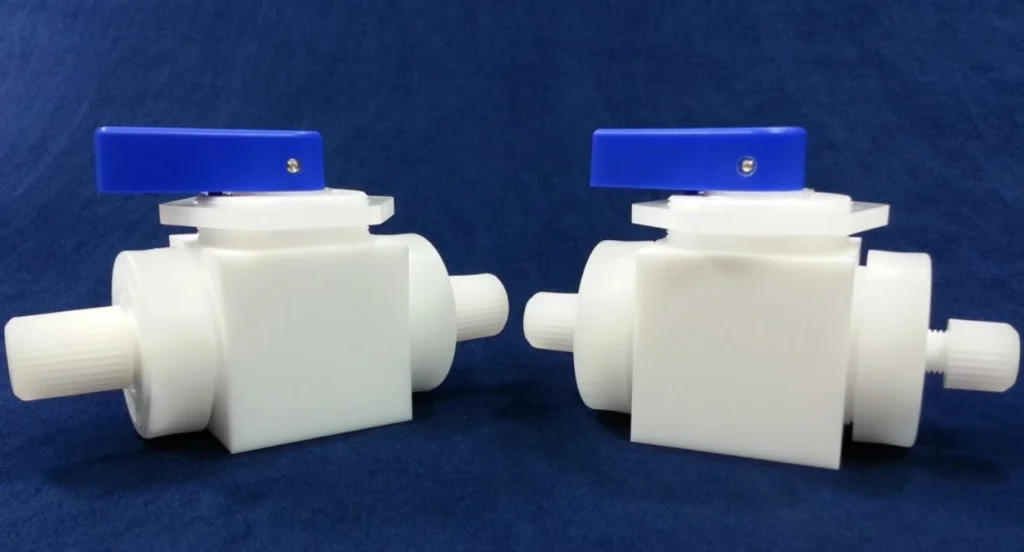
PTFE ball valve
Keep in mind that PTFE machining requires discipline due to the material’s properties. Temperature management is critical because PTFE has high thermal expansion. A combination of controlled feed rate and light material removal is highly recommended.
Note also that the fixturing strategy for machining Teflon should account for potential dimensional drift. It should be as light as possible.
As a buyer, you want to confirm your machining service provider adheres to such fundamentals of machining PTFE.
Is PTFE Safe to Machine?
Yes, it is safe to machine PTFE, but only if heat is well managed. Machining the material becomes a health risk if the temperature of the material exceeds 250 degrees Celsius because the material starts to release toxic fumes.
So, safe machining of PTFE is about effective temperature control. The use of sharp tooling and good coolant is one of the must-haves in the machining process.
Main Machining Operations for PTFE
The main machining operations for PTFE are CNC turning, CNC milling, grinding, drilling, laser cutting, and waterjet cutting. The decision to use one over another depends on the part’s complexity and geometry.
- CNC Turning – CNC turning entails turning a PTFE blank as a stationary tool is positioned to produce the desired geometry. A shallow depth of cut and low machining speed are ideal for PTFE. Turning is used to produce rings, shafts, and other cylindrical parts.
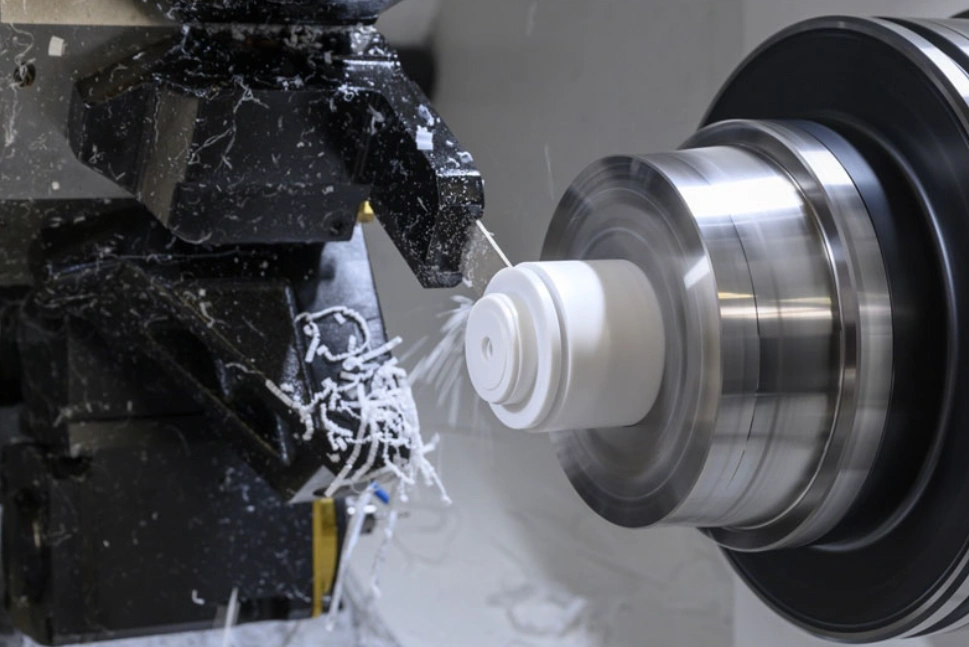
PTFE CNC turning
- CNC Milling – CNC milling allows the rotating tool and the clamped Teflon workpiece to move along different axes.
- Grinding – The machinist uses grinding to produce a fine surface finish for the part. This is essential for low-friction Teflon parts.
- Drilling – Drilling is a popular method for making holes in machined PTFE parts. It entails a rotating drill bit placed perpendicular to the workpiece.
- Laser Cutting – Laser cutting produces clean, accurate shapes from PTFE. A powerful beam, through the sublimation process, vaporizes the Teflon surface along the toolpath. Usually, these cuts do not require secondary machining.
Grades of Machinable PTFE
Teflon grades applicable for CNC Teflon machining include glass-filled PTFE, virgin PTFE, carbon/graphite-filled PTFE, bronze-filled PTFE, and pigmented PTFE.
- Carbon-filled PTFE is excellent for bearing and sealing applications. However, it isn’t as effective in oxidizing chemical environments.
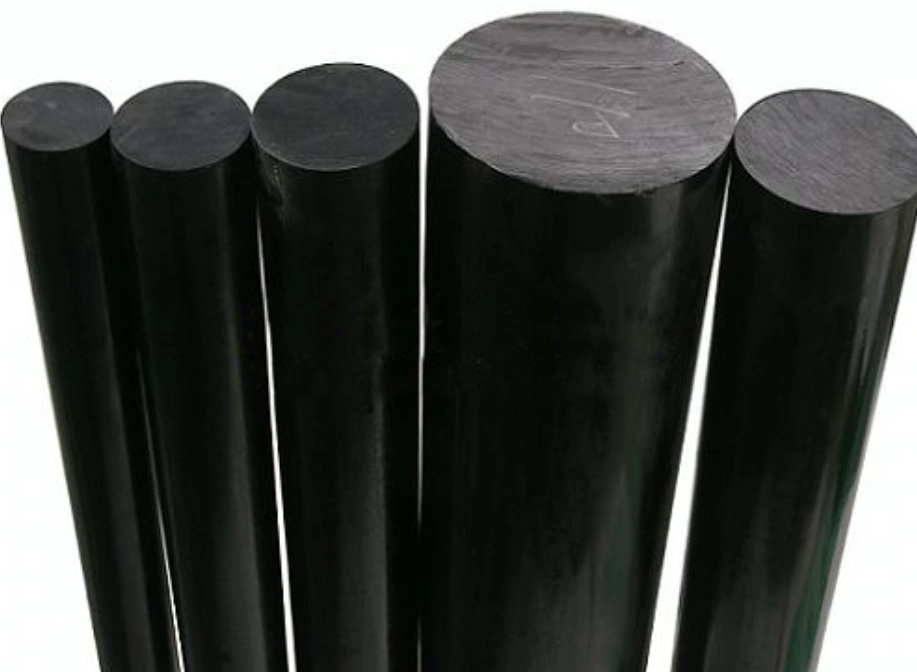
Carbon-filled PTFE rods
- Glass-filled PTFE is recommended for creep resistance and compressive strength.
- Virgin PTFE is pure with excellent chemical resistance. Since it is FDA and USP Class VI compliant, the machinable PTFE is widely used in food and pharmaceutical applications. [5]
- Bronze-filled PTFE is also thermally conductive. It also has superior load-bearing capacity. Provided the environment is corrosion-free, this grade performs effectively for seals and bearings.
- Pigmented PTFE has UV-resistant pigments. The material offers enhanced visibility.
Considerations for CNC Teflon machining
The most important considerations when CNC machining PTFE include tooling, fixturing, cleanliness, tolerances, surface finish, and thin walls.
1. Tooling
Sharp high-speed steel or carbide tools are required in machining the material. In addition, it is critical to adhere to ISO 3002 (cutting tool nomenclature) with high clearance angles (10–15°) and rake angles (5–15°) to enhance effective shearing. This strategy also minimizes material deformation.
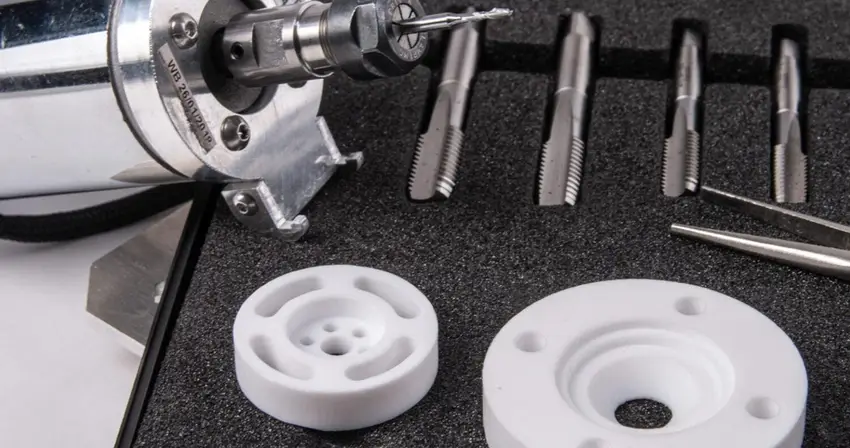
Sharp tooling for PTFE machining
2. Fixturing
Minimal clamping forces can easily deform PTFE during machining. Machining experts use custom fixturing and soft jaws based on ISO 230 (machine tool testing and accuracy). Special collars may also be used to spread the clamping force and prevent material distortion.
3. Cleanliness
For machining Teflon for pharmaceutical or food-grade applications, the machining environment is as crucial as dimensional stability.
The most important question is, does the machining partner adhere to these professional handling protocols?
4. Tolerances
CNC Teflon machining can achieve ±0.05 to 0.10 mm tolerance (ISO 2768-mK as a general reference), but it is important to consider thermal expansion. Designs for critical fit should incorporate temperature specifications. [4]
5. Surface Finish
A standard smooth finish of Ra 0.8–1.6µm (ISO 4287 / ISO 1302) is achievable with PTFE CNC machining. Subsequent passes may be considered for finer finishes. Make sure to specify the desired surface finish.
6. Thin Walls
Small features and thin walls may be difficult to achieve in PTFE machining. A wall thinner than 0.5mm exposes the part to deflection risk. A seasoned machining partner can still deliver such requirements with meticulous process planning in adherence to general CNC plastic machining guidelines, such as ASTM D3294.
Applications of Machined PTFE Components
Teflon machined parts are critical in industries such as food processing, chemical processing, aerospace & defense, automotive, and medical.
Food Processing
The chemical inertness, temperature resistance, and non-stick properties of PTFE are ideal for food processing applications. Valves, seals, and belts in the industry are commonly made from the material, in compliance with EU Regulation (EC) No 1935/2004 and related regional standards.
Chemical Processing
Since PTFE is chemically inert, it works perfectly under chemical exposure. The material works reliably in environments exposed to strong bases like sodium hydroxide and potassium hydroxide and solvents like acetone and methanol.
It also suits acids such as sulfuric acid and nitric acid, as outlined in the ASTM D543 (chemical resistance of plastics). That’s why PTFE machined parts perform reliably as gaskets, linings, and valve seats.
Aerospace
Machined PTFE components are used to manufacture cable insulation and electrical connectors.
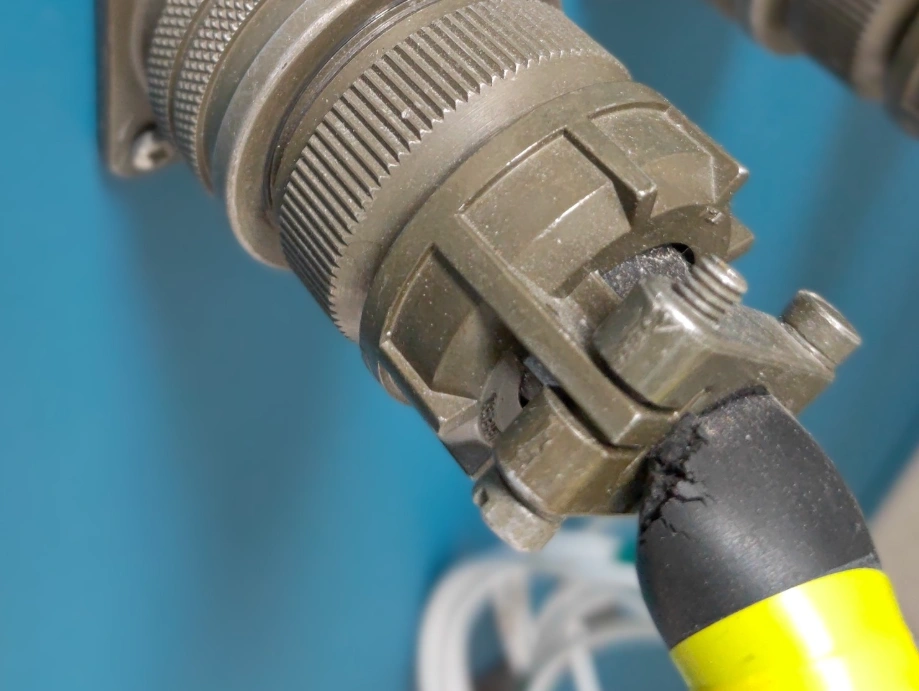
PTFE electrical connector for aerospace
These components are critical for the industry. They should have high dielectric strength and temperature resistance, properties provided by the material..
Automotive
Another typical area of application is the automotive industry, where PTFE’s properties, such as wear resistance and low friction, are highly valued. Popular components made from the material are seals, bushings, gears, and valves.
The impressive continuous service temperature of approximately 260 °C [1] and strong chemical resistance, coupled with a low coefficient of friction of up to 0.10, are extremely helpful.
Medical
In the medical field, some of the most important characteristics of parts are biocompatibility and chemical inertness. PTFE qualifies in both. Reputable manufacturers use the material’s machined parts for seals and tubings.
Compliance with ISO 10993 (biocompatibility testing) and USP Class VI is highly recommended for such.
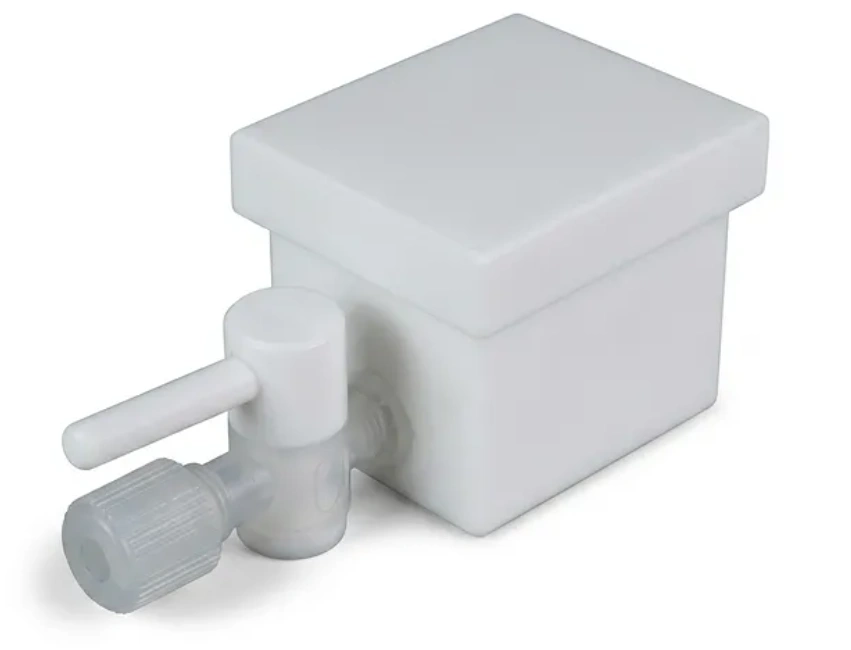
Custom Teflon laboratory part
Alternative Materials to PTFE
Options include PEEK, nylon, UHMWPE, and PFA / FEP. These alternative materials to PTFE can sometimes be considered, especially when the material’s limitations are a concern.
PEEK
PEEK has superior creep resistance and strength. If you are looking for machined engineering plastic parts for load-bearing applications, the material can be a suitable replacement for PTFE.
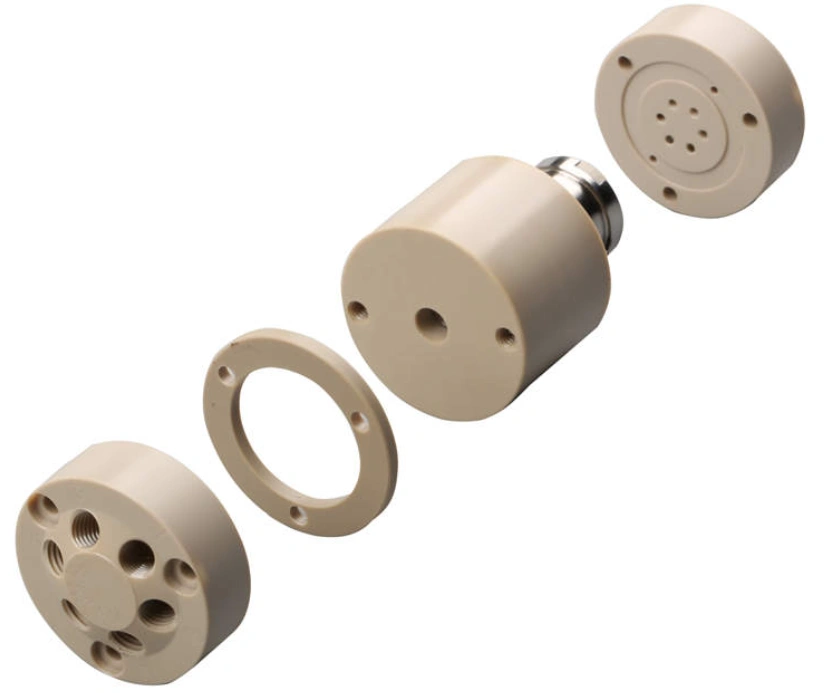
Machined PEEK parts
However, machining PEEK is relatively challenging. The material is also considered pricey, compared to standard machining plastics.
Nylon
PA66/PA6 is a general-purpose engineering plastic highly valued for its cost-effectiveness. Its main limitations are moisture absorption and poor chemical resistance.
UHMWPE
This is an FDA-compliant engineering plastic with excellent impact strength and wear resistance. It is also relatively cost-effective. If temperature is not an issue, UHMWPE makes very good food-grade machined parts.
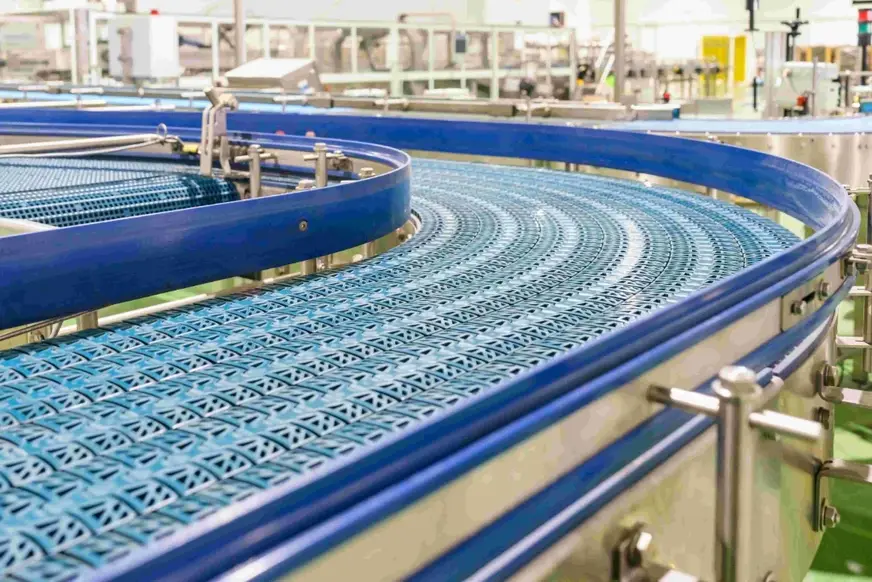
UHMWPE in food processing
PFA / FEP
While the chemical resistance of PFA and FEP is comparable to that of PTFE, the materials are not as suitable for precision CNC machining. That’s because their lower dimensional stability and higher softness don’t suit cutting forces. Therefore, we recommend PTFE for high-tolerance machined parts.
Conclusion
We have outlined the fundamentals of CNC Teflon machining, noting that the fluoropolymer is corrosion-resistant and temperature-tolerant. Its machined parts have non-stick surfaces and low-friction properties.
This makes the PTFE material applicable in common industries such as medical, automotive, food processing, and electrical. But the material has its machining challenges, including the production of fumes at high temperatures.
Safe machining demands professional handling using advanced machinery and tooling. The tooling should be sharp, and the fume extraction strategies up-to-date.
You need PTFE machined parts that can hold tolerances, perform reliably under load, and remain usable in chemical environments. Work with PTFE – Teflon CNC machining service operating under ISO 9001-certified quality systems for precision-engineered parts for your demanding engineering applications.
References
[1] ASTM International, ASTM D3294 – Standard Specification for Polytetrafluoroethylene (PTFE) Resin Molded Sheet and Molded Basic Shapes.
[2] ASTM International, ASTM D543 – Standard Practices for Evaluating the Resistance of Plastics to Chemical Reagents.
[3] ASTM International, ASTM D638 – Standard Test Method for Tensile Properties of Plastics.
[4] International Organization for Standardization, ISO 2768 – General Tolerances.
[5] U.S. Food and Drug Administration, 21 CFR & 177.1550 – Perfluorocarbon Resins.