

Metal punching combines speed, repeatability, and cost-efficiency in a way that few other processes can match. This is the first process engineers turn to when they need to punch hundreds or thousands of identical holes with tight tolerances.
It is important to understand that punching involves more than just knowing how a tool can press through metal. Material grade, punch to die clearance, press type, and hole geometry are all variables that affect whether or not a part is finished according to specification. It is important to get the variables right from the start to get custom sheet metal fabrication services. This will save both time and money.
This guide helps you to understand the types of metal fabrication processes, and can be used as a starting point for evaluating your fabrication partner or comparing the process options available for upcoming projects.
What is Sheet Metal Punching?
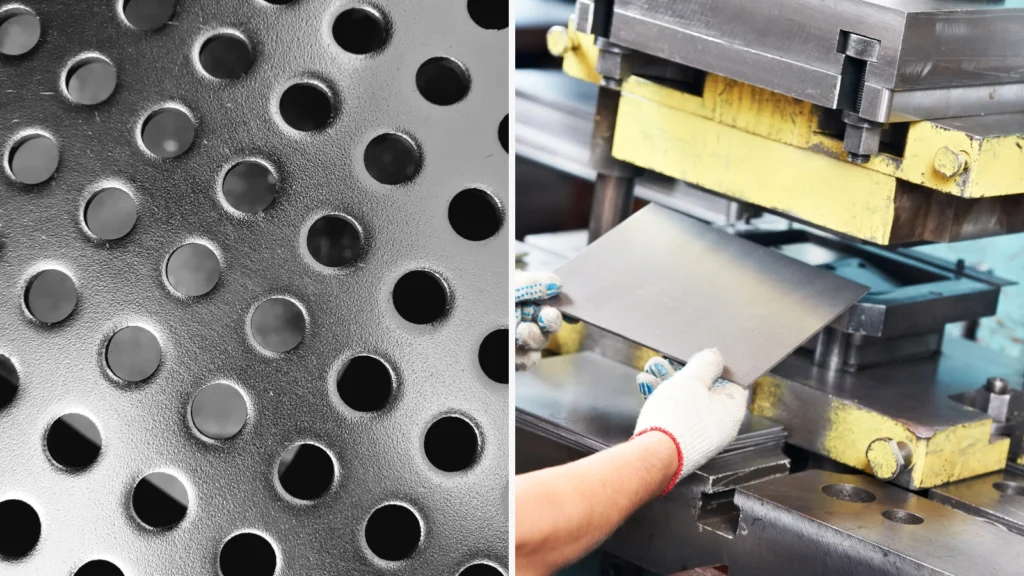
Sheet metal punching, also known as cold-forming, is a sheet metal fabrication process that involves driving a hardened tool through a sheet of metal into an identical die cavity. This shears out the material, leaving behind a hole or shape cutout. The sheet with the hole or feature on it is the finished product.
The punch and die must be precisely matched, with a very small space between them. This is called the clearance. The punch deforms metal by plastic means before shearing it cleanly. The slug is deposited through the opening of the die and collected as scrap. Meanwhile, the sheet is repositioned to the next stroke.
How is it Different from Drilling?
The material is removed gradually by rotating the cutting tool. Punching is a shearing motion. This distinction can have a significant impact on production: A punch press can perform hundreds of strokes in a minute, whereas a drill has to complete a full rotating sequence for each hole. Punching is much faster for parts with many holes. Punching produces consistent and predictable hole geometries in each cycle. This allows for tighter process control on high-volume runs.
Materials for Punching
All sheet metals, such as mild steel, stainless steel, aluminum, brass, and copper, can be punched. A standard CNC punching machine can handle sheet thicknesses up to 6 mm. In the case of thicknesses greater than 6 mm, hydraulic presses are required or alternative methods. Due to its greater shear strength and higher punching force, stainless steel generates more heat. Lubrication is therefore essential. Aluminum can be punched cleanly with lower force, but it can grate against tooling when clearances aren’t adjusted.
How does Metal Punching Work?
Punching is done in a set sequence, whether it’s a single-station press machine or a CNC turret fully automated machine.
Step 1: Loading the Sheets and Positioning Them
The operator or automated feed system loads the sheet onto the machine bed and secures it with clamps or a coordinate-referenced holding system. This is the most important stage – any misalignment will affect all subsequent holes.
Step 2: Tool Indexing
In a CNC Turret Punch, the machine automatically selects the right punch and die based on a programmed tooling order. In a single station press, the operator must install the punch and die before the run starts.
Step 3: Punch Stroke
The punch is driven downward by the press at high speed. The punch makes contact with the metal surface and causes an elastic, then plastic, deformation. Finally, the material is sheared. The slug falls through the opening of the die into a scrap collecting system below.
Step 4: Retraction & Repositioning
The cycle is repeated. The sheet is repositioned under CNC control at the next location of the hole, then the punch retracts. Modern CNC turret punched parts with multiple holes can be produced at speeds of 400 to 1,600 strokes/minute.
Step 5: Secondary Operation
After punching, sheets can undergo deburring or edge finishing. They may also be bent or have their surface treated. Punching is usually done first for parts that need both bends and holes. This prevents distortion of pre-formed geometry.
Types of Metal Punching Operations
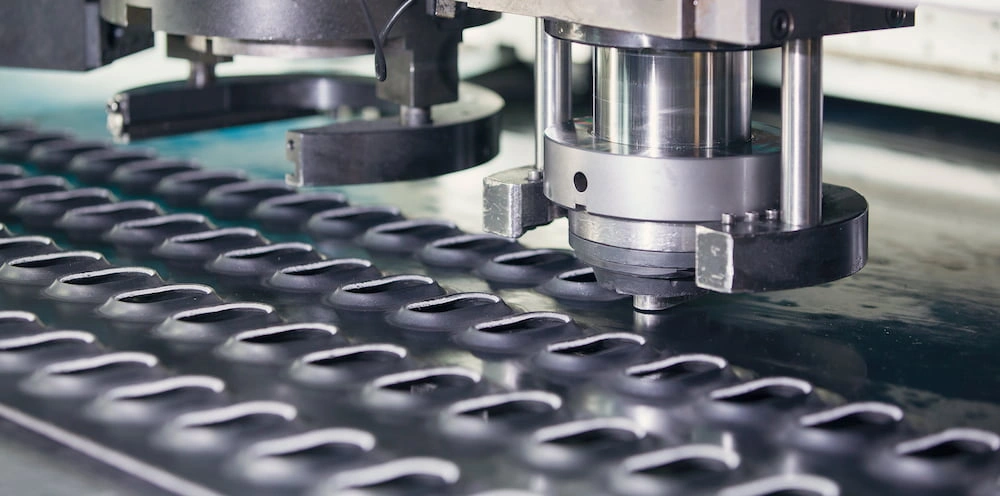
Punching is a group of processes that are all related and each one suited for a specific output requirement.
Piercing
The standard method of creating holes in sheet steel is by piercing. The product is the hole; the scrap is the slug. When most people think of punching, they picture this.
Blanking
The scrap is not the blanking. The sheeting that surrounds the blank is discarded. Blanking is used for flat, profiled parts that will then be further formed into final parts.
Notching
The material is removed from the sheet’s edge, not its interior. This is done to prepare the edges of sheets for joining, folding, or fitting into assemblies.
Lancing
The lancing technique creates a partial separation of the material without removing it completely. The sheet is bent so that the cut portion creates a vent louver or tab.
Embossing & Forming
Some punching operations don’t cut the sheet but rather deform it in order to create raised features or stiffening ribs. These are forming processes performed on a punch press with forming dies instead of cutting dies.
Cluster and Progressive Punching
Cluster punching combines multiple punch tools in a single stroke to punch several holes at once. The sheet is moved through a series of die stations, adding features to the sheet at each station until the part leaves the final station. Both methods increase the output rate for parts that are complex parts.
Sheet Punching Machines are Available in Different Types
The foundation of any punching operation is the press. The output quality, the cycle time, and the operating costs are all affected by selecting the right type of press for a job.
Manual Punch Press
The manual press is operated by pulling the mechanical lever, which converts hand power into a punching stroke. Manual presses are only suitable for lighter materials and smaller production volumes. However, they can be used in situations that require flexibility, such as short runs or custom jobs.
CNC Turret Punch Press
The CNC Turret Punch is the mainstay of modern production punching. The machine holds a rotating turret with punches and dies, and switches them automatically under computer control. The machine reads directly from CAD files and repositions sheets along the X and Y axes in between strokes. This setup is useful for high precision sheet metal parts production as the turret allows transitions between part programs with minimal human intervention. It is effective for both mixed-batch and high-volume production.
Hydraulic Punch Press
Hydraulic presses punch force via a hydraulic cylinder, not a mechanical crank. These hydraulic presses are ideal for thicker materials or large holes, where a high force that can be controlled is required. The hydraulic press’s stroke speed is slower than that of mechanical presses. However, the ability to adjust stroke depth and pressure gives them an advantage in specialty forming operations.
Punch Press Servo-Electric
The popularity of servo-electric presses has grown due to their energy efficiency, quieter operations, and precision control of punch position and speed at any point during the stroke. They do not need hydraulic fluid management, unlike hydraulic machines. They are ideal for operations in which stroke programmability can improve part quality.
Punch and Die Tooling: What Actually Cuts the Holes?
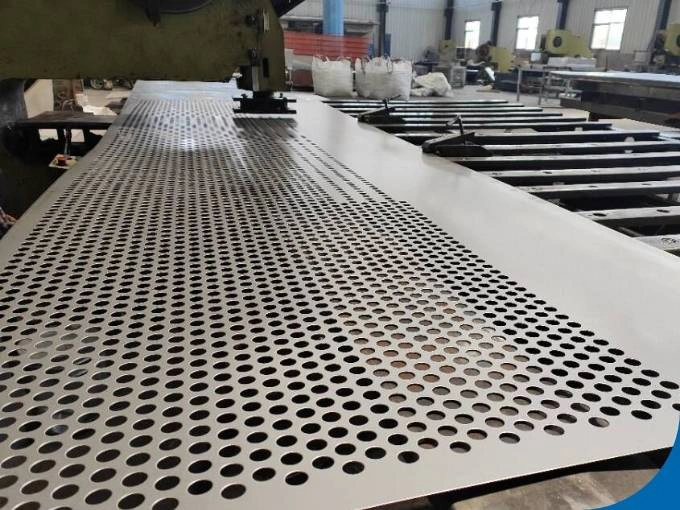
The tooling is responsible for the majority of the quality of a sheet metal hole punch. Tooling that is worn, misaligned, or not properly cleared can produce burrs, holes that are out of round, and inconsistent slug extraction.
Shapes of Sheet Metal Hole Punch
- Round punches are the most commonly used, and they can be used to make fastener clearance holes or general through-holes.
- Square and rectangular hole punches are used for structural connections, cable routing, and keyway features. A square hole punch for metal requires precision die alignment in order to maintain sharp edges.
- Slotted and elongated punches are used to produce slots and elongated ventilation grilles.
- Specialty profiles for specific assembly tasks: D-cuts, keyholes
- Custom form punches – create logos, texts, or unique profiles with a single stroke
Punch-to-Die Clearance
The clearance is the distance between the outer edge of the punch and the inside of the die opening. It is usually expressed as a percent of the material thickness. A small clearance can cause excessive wear on the punch and create rough holes. A large rollover zone and secondary fractures can be caused by too much clearance. For mild steel, the clearance is usually 5 to 8 percent of the material thickness on each side, but it can vary, considering the specific grade and other factors like material hardness. Aluminum, which is softer than stainless steel, requires a larger clearance.
Die Materials
The most common tool steels used for punches and dies are D2, SKD11, and H13. These are selected according to production volume, wear requirements, and material hardness. The higher alloy grades are more durable but also costlier upfront. Lower-grade tool steel can be used for short prototype runs.
Sheet Metal Punching vs. Alternative Processes
Understanding the advantages of each process is essential to choosing between laser cutting, punching, and stamping.
| Criterion | Sheet Metal Punching | Laser Cutting | Stamping |
| Speed (hole-intensive Parts) | High (400-1600 spm). | Slow down for multiple holes | Fastest for high volume |
| Tooling Cost | Moderate | No, | High-quality |
| Setup Time | Low (CNC). | Minimal | High-quality |
| Minimum size of the hole | Limitation by thickness | Smaller holes possible | Limited by the design |
| Best volume range | Medium to High | Medium prototype | High volume |
| Edge quality | Good, may need deburring | Excellent, clean | Good |
| Complex contours | Limited | Excellent | Moderate |
Punching is the most cost-effective method for high-volume production. Laser cutting is best suited for prototypes, contoured profiles, and situations where the tooling investment cannot be justified. For extremely large volumes of identical components, stamping is superior to both methods. The tooling costs are amortized over millions of cycles.
Choose punching when your part requires a large number of holes in a repeating pattern and production volume is medium to high, as the per-part cost stays low once the CNC program is set up.
Laser cutting is the better option when the design has complex contours, very small holes, or frequently changing profiles, where investing in hard tooling is not practical. Stamping should be selected only when volumes are extremely high, and the part design is fully finalized, since the high upfront tooling cost only makes sense when it is spread across millions of identical parts.
Design Rules for Sheet Metal Punching
When designing parts for punching, it is important to pay attention to some geometrical constraints. Ignoring the rules can lead to tool failures, excessive burring, or distorted components. Here is a brief design guide of sheet metal fabrication.
Minimum Hole Size
The minimum hole size should be at least equal to the thickness of the material. The punch will be under more bending stresses if it is smaller, reducing its life expectancy and impacting hole quality. Some fabricators recommend that stainless steel be 1.2 times thicker than the material due to increased shear forces.
Hole-to Edge Distance
Too many holes close to the edge of a sheet can cause distortions and cracks. As a rule, the distance between the hole edge and the sheet edge should be at least the thickness of the material. For stiffer materials, it is best to keep this distance to 1.5 times that thickness.
Hole-to Holes Spacing
Too many holes can cause material to deform during the punching process. Keep a distance between the hole edges of at least two times the thickness of the material.
The Rule of 3:1 for Form Features
If the punching operation creates a feature, rather than a hole (such as a louver, embossment, or a slit), the height of the feature above the sheet should not be more than three times the thickness of the material. If the feature is taller, it can cause metal to thin out excessively and tear, as well as create springback issues. Custom stamping tools or redesigning a feature can be used to meet the design requirement.
Hole Placement Near Bends
When the sheet is bent, holes placed too close to the bend lines will cause deformation. According to the bend radius and the grade of the material, the minimum distance between a hole’s edge and a bend is usually two to three times its thickness. It is rare to place holes after bending, so this rule should be considered at the design stage.
What are the Industrial Applications of Sheet Metal Punching?
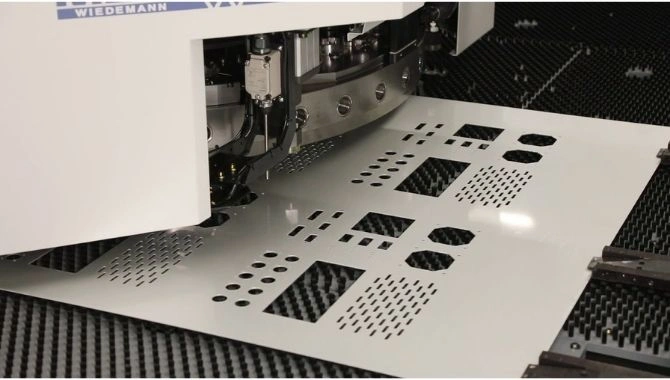
An industrial hole punch is used in a wide range of industries.
Electrical Enclosures & Control Panels
Electrical enclosures and cabinets require ventilation holes, knockouts for cable entry, mounting holes for DIN Rails, and cutouts to accommodate switches and displays. All of these can be handled by CNC punching in one setup while maintaining the precise location required for component fit.
Automotive Components
The sheet metal used in vehicle construction is punched: floor pans and seat brackets. Body reinforcement panels, exhaust heat shields, and body reinforcement panels. For high-volume components, progressive die stamping is preferred. However, mid-volume parts and model-specific pieces are often punched by CNC turrets.
HVAC and Architectural Metalwork
When pattern density and consistency are important, punching is used for perforated metal grilles and ventilation panels. These parts can have thousands of holes in a sheet, and CNC punching is able to produce them at high speeds.
Electronics Manufacturing
All sheet metal chassis, rack mount enclosures, and server housings use punched-holes for mounting hardware, cable organization, and airflow. To ensure that electronic assemblies fit properly, tight hole tolerances are essential.
Custom Sheet Metal Brackets
Hole patterns are often combined with subsequent bending in sheet metal bracket used for structural, mechanical, and electrical applications. Custom Sheet Metal Fabrication Services punches out the pattern of the holes before the sheet is sent to the press brake. This ensures accuracy in both operations.
What are the Most Common Mistakes in Sheet Metal Punching? And How to Avoid Them
Even experienced operators face predictable problems. Understanding where problems come from allows them to be prevented.
Excessive Heat Buildup
The tooling will soften over time if you punch at high speeds. Proper lubrication will reduce friction at the interface between die and punch. Tool life can be extended by slowing down the stroke rate for problematic materials and using coatings like titanium nitride.
Puncturing Holes Smaller than Material Thickness
When you try to punch holes smaller than your sheet thickness, the punch is overstressed, and the result is rough, oversized ones. Laser cutting may be a better option for small holes. Punching can handle larger holes.
Ignoring Punch-to-Die Clearance
When shops use the same clearance for all materials, they produce inconsistent results. The clearance must match the material type and thickness. When stainless steel is run with clearances calibrated to aluminum, it will cause excessive burring of the tool and rapid wear.
Skip Deburring
The shearing action always leaves some burr on the edges of punched parts. Burrs can cause assembly issues, injuries to handlers, and paint adhesion problems depending on the application. Most production parts are deburred after punching.
Poor Nesting in CNC Programs
Material is wasted by inefficient nesting of parts. Optimizing CNC punching programs will maximize material usage, reduce scrap, and lower per-part cost. Modern CAM software has automatic nesting tools that improve yield.
What is the Cost of Sheet Metal Punching?
The cost of punching is influenced by several variables, which interact differently based on the production volume.
The cost per part is affected by the complexity of the part, its material, thickness, number and size of holes, and tolerances required. Standard round and square hole tooling is readily available and inexpensive. The cost of custom-profile tooling to create non-standard holes is amortized over the course of production.
In low volume, it is the programming and setup costs that are dominant. As the volume increases, the cost per part drops dramatically because the same setup can serve more parts. At this point, punching is more cost-effective for designs with many holes than laser cutting. Progressive die stamping offers lower costs per part for very large volumes but requires an upfront investment in tooling.
The cost of material is determined by the grade and weight of the sheet. Deburring, surface treatments, and inspection are secondary operations that add to the cost of a part but are not negotiable in finished assemblies.
Its Role in Wider Fabrication Workflows
Punching is rarely done in isolation. It is part of a larger type of metal fabrication process workflow that includes cutting, bending, and welding. Understanding where punching falls in the process helps engineers to make better decisions regarding design and planning.
Before forming, punching is done almost always on flat sheets. It is not practical to return a sheet that has been bent or welded in a three-dimensional structure back to the punch press. This rule should be used to design parts from the beginning: all hole locations, formed shapes, and relief cuts must be planned in the flat-blank phase.
In the case of parts that incorporate sheet-metal bracket fabrication with punching, bracket geometry and hole patterns are developed in a CAD program, and then programmed into CNC punches and press brakes as part of a coordinated sequence. This integration saves time by ensuring that the holes and bends are aligned correctly on the final part.
Answers to Frequently Asked Sheet Metal Puncturing Questions
Punching is the process of creating holes or cutouts in sheet metal with a punch press. This machine is often a CNC Turret. Stamping includes operations such as blanking, forming, and drawing. These are usually done in high volume using progressive dies. Stamping is a more expensive process, but it results in lower costs per part at high volume.
Yes. In production, stainless steel is often punched. Due to its greater shear strength than mild steel, it requires a higher press tonnage. Lubrication is also essential to control heat and tool wear. To maintain clean-edged holes, the punch-to-die distance should be carefully set for stainless steel.
On well-maintained machines with the proper sheet fixturing, CNC punching is capable of holding hole location tolerances as tight as 0.1mm. The tolerance for hole diameter depends on the tooling and clearance settings. Typical production tolerances are plus or minus 0.05 to 0.1mm.
The majority of CNC turret punchers can handle sheets up to 0.5 mm thick. Although thinner gauges can be punched, they require special tooling and slower punch speeds in order to avoid sheet distortion.
Laser cutting is best for small holes (less than the material thickness), complex contoured cuts, prototype quantities, where tooling investments are not justified, or materials with a heat-affected area. Punching is preferred for high-volume production of holes, standard hole shapes, and applications with medium-to-high quantities.
Conclusion
Sheet metal punching can be a cost-effective and productive way to make holes. It can produce high-quality, consistent holes faster than any other cold-forming method for parts with a lot of holes. To achieve this performance, you must match the press type with the material and the production volume. You also need to set the punch-to-die distance correctly for each grade of material, follow design rules regarding hole size, proximity to bends and edges, and maintain tooling in good shape.
ProLean MFG’s team can provide punched holes to be used in electrical enclosures, structural brackets, architectural panels, and more. They combine CNC punching capabilities with a broader range of services. custom sheet metal fabrication services. You can also find out more about the following: Sheet metal bracket. Expertise is required to transform a flat design into a finished part that can be inspected. ProLean MFG can help you with your project needs and provide a quote that is based on the actual geometry of the part.