

The decision between aluminum and titanium is one of precision manufacturing’s most important decisions. Both metals have non-ferrous properties, are corrosion-resistant, and are valued for their strength-to-weight ratio. The differences are dramatic when you dig deeper. The first is the machinist’s dream, while the second requires specialist tooling and slower feeds as well as a much larger budget.
The stakes are high. Aluminum and titanium have very different properties in terms of tensile strength. Thermal behavior. Fatigue life. And the total cost. In a subsea application, titanium may be the only option. A part that is perfect in aluminum could fail catastrophically. This decision can lead to rework, time on the job, or even worse, a failure in the field.
ProLean MFG offers a variety of resources for CNC machining materials, including metals and non-metals. For aluminum-specific projects, the custom aluminum machining is a good starting point to understand what tight-tolerance production of aluminum actually costs.
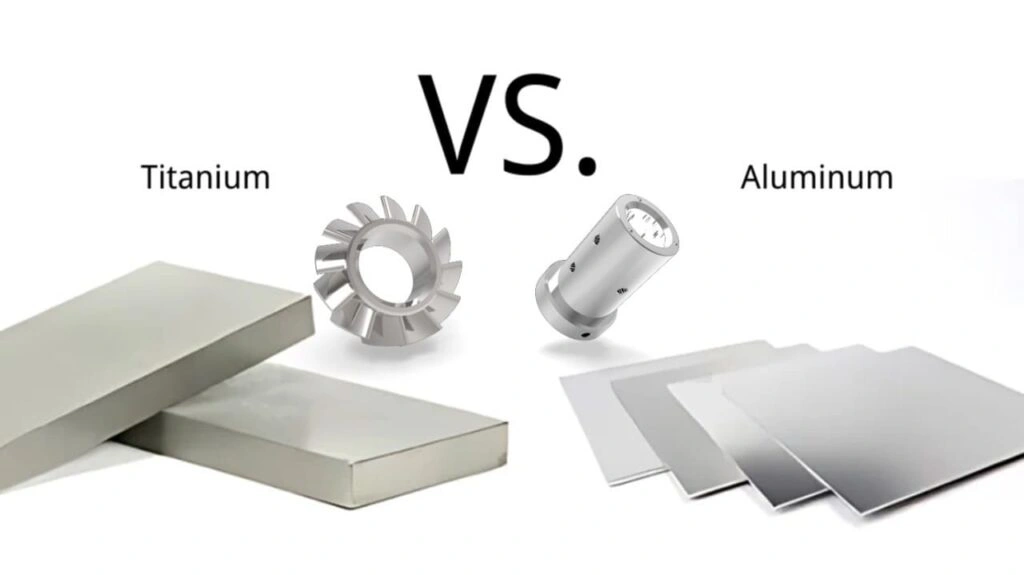
Titanium vs Aluminum: A Quick Comparison
A side-by-side analysis of the two engineering grades is a good starting point. The table below compares Aluminum Grade 6061-T6 with Titanium Grade 5(Ti-6Al-4V), which is the standard aerospace alloy used for precision machining.
| Property | Aluminum 6061-T6 | Titanium Grade 5 | Enjoy the Benefits |
| Density | 2.7 g/cm3 | 4.43 g/cm3 | Aluminum |
| Tensile strength | 310 MPa | 950 MPa | Titanium |
| Strength to Weight Ratio | Good | Excellent | Titanium |
| Melting Point | 660degC | 1,660degC | Titanium |
| Corrosion resistance | Good | Excellent | Titanium |
| Thermal Conductivity | High-quality | Low-cost | Application-dependent |
| Machinability | Easy and fast | Slow and difficult | Aluminum |
| Raw Material Cost | Low ($) | Very high ($$$$$) | Aluminum |
Three things immediately stand out. Aluminum is lighter in volume. Titanium’s strength is so great that it allows for thin, compact parts. Aluminum is the winner when it comes to cost and speed of machining.
The Myth of Strength to Weight and Density
It is important to correct this first before moving on.
Is Titanium Lighter Than Aluminum?
No. No. This is a common misconception, even among engineers who are new to the material selection process.
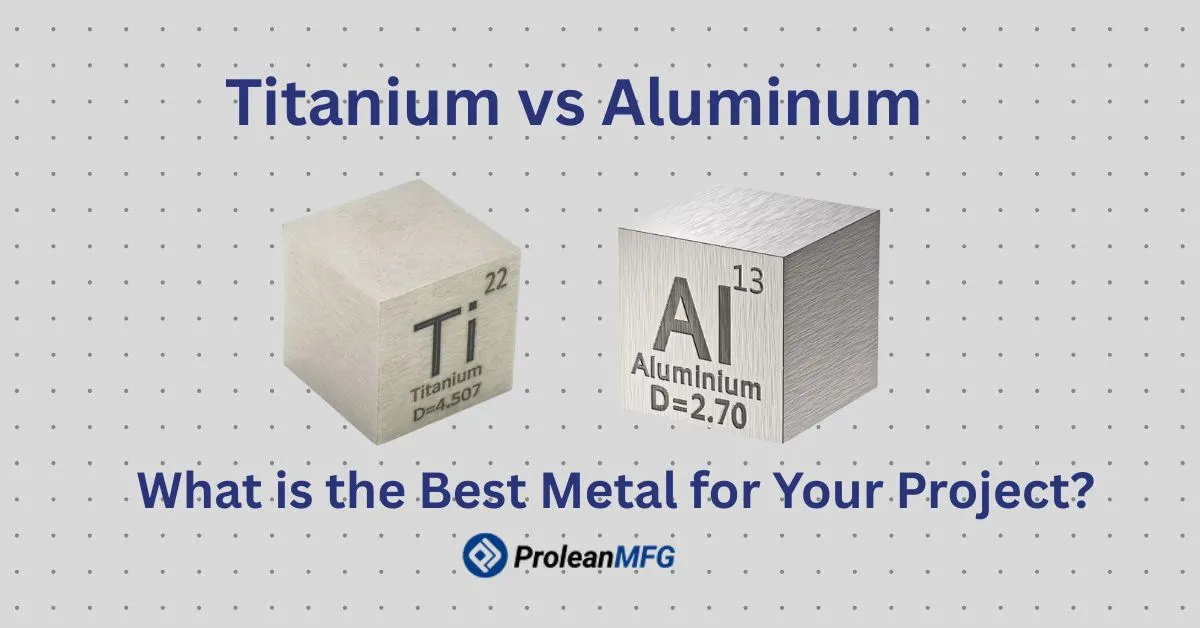
Aluminum is approximately 2.7g/cm3. Titanium weighs approximately 4.43 g/cm3, which is about 60% more by volume. The titanium block is always heavier if you make two identical blocks from each metal.
Why is titanium called “lightweight” in the aerospace and motorsport industries? Answer: Specific strength (also known as strength-to-weight ratio). Titanium Grade 5 has a tensile force of around 950MPa. This allows engineers to design parts thinner, hollower, and more compact while still handling the exact same load. Not because the metal is lighter, but because there is less of it needed.
Fatigue Life: Titanium has no real competition
Fatigue behavior is often a deciding factor for components that are subjected to repeated cycles of loading, such as suspension arms or springs.
Aluminum does not have a true fatigue limit, but they do have fatigue strength, which can be used to predict failure after a specific number of cycles. Aluminum parts will eventually fail if they are subjected to enough stress cycles. It is possible to predict and engineer the number of cycles until failure, but failure will always be the endpoint.
Titanium has a different behavior. The fatigue strength of titanium depends on the alloy, loading conditions, and environmental factors. It is the only material that can be used for parts that flex thousands of times during their lifetime and are not easily replaceable.
Aluminum vs Titanium Properties: Corrosion and Environmental Resistance
At times, the location of use for a material can be the deciding factor in what type of material to use. Both metals can be conducive to forming layers of oxides; however, they behave differently in aggressive environments.
Behavior of Oxidation and the Pitting Process
Aluminum oxidizes when exposed to the elements, and the layer of oxidized aluminum can provide a sufficient barrier to corrosion for a long period of time. Problems, however, arise when aluminum is exposed to environments that contain chloride, such as seawater or road salt. In such environments, the oxide layer is broken down, and pitting corrosion attacks the aluminum, strongly compromising its structural integrity.
This can be a significant issue for aluminum, but not for titanium. In contrast to aluminum, titanium has a very stable oxide layer that is capable of healing. Because of this, titanium can be exposed to environments such as seawater, strong acids, and even body fluids. This is also the reason titanium is the primary material used in most orthopedic implants.
Galvanic Corrosion: A Major Concern in Mixed Metal Assemblies
Aluminum structures combined with titanium fasteners are a risk that many engineers overlook.
Galvanic corrosion is a type of corrosion that occurs in aluminum and titanium when they are in direct electrical contact and are wet (or submerged) in an electrolyte solution. It is important to note that titanium is categorized as a noble metal and does not corrode under the conditions that cause aluminum to corrode rapidly. As such, aluminum is always the anode and is the one that suffers.
There are two methods to address this:
- Before assembly, anodizing aluminum surfaces provides a protective barrier.
- For insulation, nylon sleeves, Tef-Gel, plastic washers, or other materials that are anti-corrosion may be used.
Without taking these measures, your joints will almost certainly fail in outdoor or marine s
Environmental Factors to Consider When Choosing between Aluminum and Titanium
Aluminum with the appropriate surface treatment can be a cost-effective and effective option for applications that are in a controlled indoor environment or when weight savings is the main concern. Corrosion exposure is also minimal. Titanium’s superior corrosion-resistance is a good choice for applications that are exposed to salt spray, acids, biological environments, or industrial environments with high chemical and biological activity.
Understanding these differences at the selection stage will prevent costly failures, unplanned repairs, and safety risks in the future.
Why Aluminum for Machining Is the Default Choice
The difference in machining composite work is most noticeable in the aluminum category. Factors like – machinability, impact cost, lead time, and surface finish are considerations for anyone working with CNC machining materials within a production schedule.
Why Aluminum Machines are so Efficient
Aluminum is comparatively soft and has high thermal conductivity. In an operation where a CNC cutter is used to cut aluminum, the heat is concentrated in the so-called chip. This results in almost instantaneous removal (flinging) of the chip from the workpiece, causing rapid convection. Accordingly, the cutter is kept cool. Furthermore, the machine can be configured to high spindle speeds with aggressive rates of feed (low workpiece removal rates) that lead to short cycle times.
The overall effect is that the machine is able to maintain high tool longevity and very low cost per machined part. Robust thermal characteristics are the principal benefit of aluminum machining.
Another positive aspect of aluminum is the surface finish quality. Aluminum is a great material for standard end mills, and it achieves a high degree of surface finish in most cases without any special post-processing, making it great for prototypes and end consumer products, as well as any situation where time and precision are critical factors.
Why Different Techniques Are Needed for Machining Titanium
Machining techniques for titanium vs aluminum are different. Because titanium has a very low thermal conductivity, it means that heat is not dissipated by the chips as it is with aluminum, and instead is retained at the cutting edge of the tool, creating a phenomenon known as heat stacking, and increasing the rate at which tool tips become dull. When titanium is cut aggressively, standard carbide cutting edges become dull in a matter of minutes.
What aggravates the situation is the combination of:
- Heat is not dissipated by the workpiece, but instead is focused at the tip of the cutting tool.
- The high degree of hardness and strength of titanium. This results in high cutting forces and adds additional mechanical stress to the already heat-loaded tool.
- The low modulus of elasticity means that titanium tends to spring back when cut, which can result in the part deflecting or bouncing in such a way that it causes tool chatter and results in a poor surface finish.
When machining titanium alloy, it is necessary to take advantage of slower cutting speeds, unique tools, and high-pressure directed cooling to the exact cutting interfaces, as well as the use of rigid fixturing to reduce deflection. This specialized tooling and the additional machining time are the reasons why titanium quotations take about 30% to 50% longer than for aluminum jobs.
Cost Analysis: Raw Material Price vs. Total Cost of Ownership
Initial pricing looks different based on the metal. Stocks of titanium are 5-10 times more expensive than stocks of aluminum due to their more expensive extraction method. Aluminum is extracted through a process that is easy to perform electrolytically. In contrast, titanium extraction is more expensive due to the Kroll Process, which requires extreme heat, vacuum, and magnesium, which is reactive.
Think Beyond the Purchase Order
For short-run production, prototyping, or other consumer applications where cost is a key driver, aluminum is the clear winner. In contrast, for more industrial applications, focusing on material costs alone risks poor decisions.
Consider a chemical plant pump component. An aluminum part costs $100, but due to chemical pitting, it may need to be replaced every two years. That means in a decade it could cost more than $100, and that’s not even considering the cost in parts, labor, or downtime.
The titanium equivalent, which may cost $400, could potentially let the pump last for its whole lifespan, and its total cost over that period of time is simply $400.
When it comes to applications with more serious consequences, it is better to consider life cycle costs rather than sticking to initial costs.
Applications in Industry
Knowing which metals are predominant in practice allows understanding which direction a new project could take.
Aerospace
Commercial airplanes are usually made of aluminum alloys 7075 or 2024, which are used to manufacture panels of the fuselage and skin of the wings, as well as in the non-load-bearing frames. For components that are subject to high heat and high cycling stress, such as landing gear, engine parts, firewalls, and compressor sections of jet engines, titanium is used.
Automotive and Motorsport
Aluminum is used in parts that are produced in high volumes, such as engine blocks, cylinder heads, suspension arms, and wheels. Titanium is used in low-volume, high-performance, and high-cost applications. For example, titanium exhaust systems are lightweight and heat-resistant. Titanium valve retainers enable the engine to operate at high RPM and improve performance by reducing the reciprocating mass. To reduce the weight on racing cars, titanium lug nuts are used.
Marine and Subsea
Aluminum is used for boat masts and hulls, where maintenance is easy, and cost is a major factor. Titanium is the best choice for propeller shafts and heat exchangers for desalination equipment. It can also be used for deep-sea remotely controlled vehicles (ROVs) where maintenance access may be difficult or expensive.
Medical Devices
Titanium is used in surgical implants, orthopedic plates and screws, and dental fixtures because of its biocompatibility. Aluminum is not used for implantable devices. Aluminum is a cost-effective material for external housings of medical equipment and structural components, where biocompatibility does not need to be considered.
Engineers Make Common Mistakes when Choosing between These Metals
Even experienced engineers can fall into traps when choosing between titanium and aluminum. These are the most expensive ones.
Selecting titanium out of prestige, rather than necessity. Titanium’s reputation leads to spec decisions that are not justified. Aluminum is almost always the better choice if a part needs to be replaced regularly and operates in a room temperature environment with moderate stress.
Ignoring galvanic risk in mixed assemblies. Titanium fasteners are commonly used in aluminum structures in weight-sensitive applications. In outdoor or marine environments, engineers who ignore galvanic isolation are prone to premature joint failure.
Underestimating titanium machining lead times. It is a mistake to quote a titanium job based on an aluminum schedule. Titanium parts are more time-consuming because of slower feeds, frequent tool changes, and tighter control over the process. By incorporating this into the project schedule from the beginning, delays can be avoided.
Comparing raw materials costs without considering the lifecycle. Aluminum is selected in applications where titanium offers a lower total cost throughout the product’s life.
What is the Right Alloy Grade?
Most materials selection guides conclude with “pick aluminum or titanium.” That is actually only half of the decision. The alloy grade within each metal family determines if the part fails or not.
Aluminum Alloy Grades: Aligning the Grade with the Application
Aluminum is not uniform. The characteristics of the 6000 and 7000 series aluminum are different during loading and production.
6061 T6 is a versatile material. Welding is easy, and corrosion resistance is excellent. Structural brackets and enclosures are ideal applications.
7075 T6 is aircraft-grade aluminum. It has almost twice the tensile strength of 6061. Unfortunately, its corrosion resistance is worse, and it is more difficult to weld. When there are environmental controls, and strength is a priority, 6061 is better.
Because of excellent fatigue resistance, 2024 T3 is used in aircraft fuselages. However, without anodizing, it will corrode easily.
It is a common mistake to specify 6061 instead of 7075 when designing for fatigue, as the error only occurs on surfaces subjected to it.
Grade 5 Titanium Alloy is Not Enough
Most environments will require a different grade. The starting point is Grade 5, which is Ti-6Al-4V.
Commercially Pure Titanium, or Grade 2, has less strength than Grade 5, but has better corrosion resistance and better ability for forming operations. It is used for heat exchangers and medical implants, where the ability to create metals in complex shapes is more important than the metals’ strength.
Grade 5 medical is known as Grade 23. This type receives extra low interstitial chemistry, which is the process used to lower the levels of oxygen and iron present in a titanium alloy. This improves fracture toughness and is used in orthopedic and surgical instruments.
Grade 9 is a mixture of titanium and aluminum with 2.5V. It is iso-strength with Grade 5 and pure titanium; it has a relatively low strength. It is ideal for use in bicycle tubing, aerospace tubing, and hydraulic lines where good formability and moderate strength are required.
Considering only Grade 5 Titanium and not the conditions it will be used under, the forming requirements will result in a loss of potential benefits and a greater expenditure.
Performance and Surface Finishing Options
For both raw aluminum and titanium, surface treatments are beneficial. Surface treatments can increase the service life, improve resistance to corrosion, and, in some cases, can be altered to give the part a different functionality.
Surface Treatments for Aluminum
When it comes to surface finishing methods for aluminum, an excellent candidate for various methods is aluminum. The reason for this is to address aluminum’s greatest weakness, which is its susceptibility to pitting.
Type II Anodizing enhances the oxide layer by 5 to 25 nanometers. It improves wear resistance, accepts and improves color dye for color coding, and adds to corrosion resistance. It applies to consumer goods, housing, aerospace, and outdoor aluminium parts.
Hard anodizing (Type II) oxide layer increases from 25 to 100 microns. The surface becomes as hard and as durable as tool steel. This is beneficial for hydraulic components, wear surfaces, and sliding parts.
Alodine/Chromate Conversion Coating balances corrosion resistance and electrical conductivity. It is widely used in aerospace assemblies, where there is a need for grounded continuity.
Powder Coating gives a thick layer of polymer for maximum weather resistance and aesthetics. This is more common in consumer and architectural applications than in precision engineering.
Titanium Surface Treatments
Finishing decisions for titanium are influenced more by biocompatibility and adhesion needs than by protective requirements because titanium is corrosion-resistant by nature.
Titanium anodizing does not create a protective layer as aluminum anodizing does. Instead, it creates interference colors. This is used mainly for the identification of parts in consumer and medical applications.
Nitriding is what gives cutting tools their gold TiN coating. It enhances the surface hardness of titanium and increases resistance to sliding friction. This increases the life of parts that slide against titanium.
Passivation enhances the existing protective oxide layer and removes surface contaminants. Medical titanium implants and titanium used in food production require passivation to guarantee they are biocompatible.
Electropolishing is used to smooth the surface of titanium at a molecular level. It is applied to surgical instruments and parts that are in contact with fluids and for which a surface finish could compromise hygiene or the flow in case of a hydraulic circuit.
Specifying a type of surface finish during the design stage is certainly better than doing it afterward, and will extend the service life of the part while reducing total cost.
Conclusion
It is not a matter of choosing which metal is better in absolute terms. What is important is to combine the properties of the materials with the requirements of the application. At this cost point, aluminum possesses unmatched structural metal thermal efficiency and machinability. Where failure isn’t an option, titanium’s strength-to-weight ratio, corrosion resistance, and fatigue resistance are worth the cost.
Aluminum should suffice for most applications. However, if there are critical elements that will be subjected to high temperatures, stress, and corrosion, then titanium is the ideal material. ProLean MFG’s custom aluminum machining and CNC machining materials can assist in determining the ideal material, leading to the completion of the custom part. Requesting a quote is often the best way to circumvent expensive material changes in the future.
Frequently Asked Questions about Titanium vs Aluminum
Is titanium stronger than aluminum?
Yes. Titanium Grade 5 can withstand tensile forces of up to 950 MPa. Even 7075-T6, the most common and strongest aluminum alloy, is only 570 MPa. Titanium is roughly twice as strong.
Is titanium lighter than aluminium?
Not at all. Aluminum weighs 2.7g/cm3 while titanium is 4.43g/cm3. Titanium’s reputation as a “lightweight” material in aerospace is due to its superior strength-to-weight ratio. This allows engineers to use fewer materials to carry the same amount of load, resulting in lighter assembled parts.
Can titanium and aluminum be welded together?
No, not by TIG or MIG. Direct fusion welding produces intermetallic compounds that crack instantly. Mixed-metal assemblies require mechanical fasteners or specialized friction welding with galvanic isolation at the contact points.
When is aluminum a better choice for machining than titanium?
Budget, lead time, and thermal conductivity are all important factors. Aluminum is faster to machine, less expensive, and has excellent performance in a variety of engineering applications.