

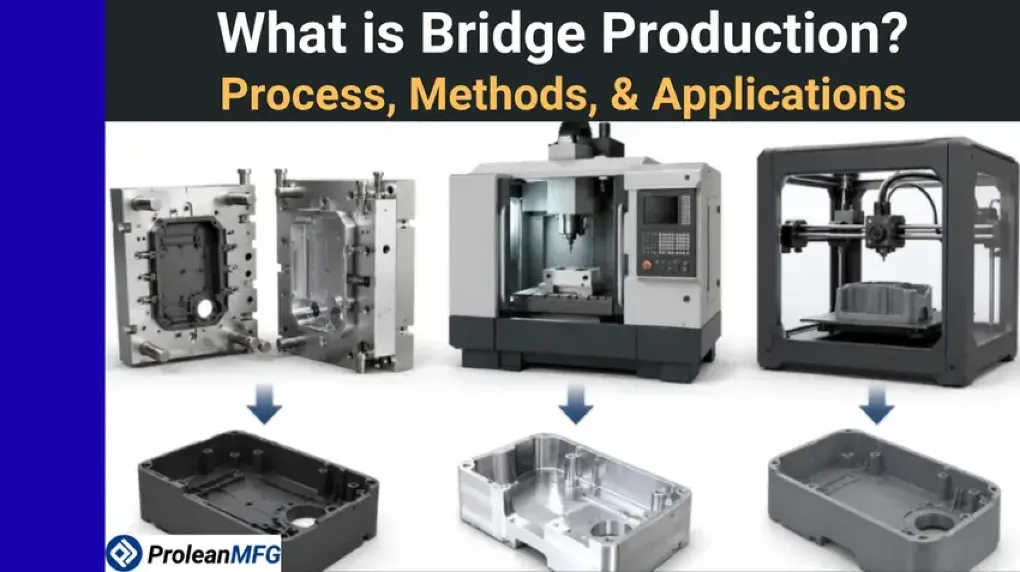

Bridge production is a manufacturing stage connecting prototype validation and full-scale mass production. Manufacturers use it to produce 100 to 10,000 market-ready units. It is a rapid tooling-based strategy for making early sales and pilot testing, as hard tooling awaits.
Prototyping proves the concept, but tooling for mass manufacturing can take months. Committing to tooling before real-world tests exposes the process to expensive reworks in case the part fails. Bridge manufacturing uses interim tooling to produce market-ready components and helps identify design flaws early.
CNC machining, rapid injection molding, or 3D printing are used to produce market-ready parts, enabling businesses to validate real-world performance. Only after that can they invest in hardened tooling.
3D printing and CNC machining support lower-volume, complex parts. Consider rapid injection molding for higher volumes of production-level materials.
This article covers the four-stage process, compares cost, flexibility, lead time, and risk against conventional production. It further explains when to choose CNC machining, injection molding, or 3D printing. The article also outlines the industries that rely on bridge production.
What is Bridge Production?
Bridge production is a manufacturing strategy that connects prototype validation and full-scale mass production. Manufacturers use it to produce 100 to 10,000 units of market-ready products. These parts also adhere to regulatory and quality requirements, most directly, the ISO 9001 for Manufacturing.
The term “bridge” means exactly that – this strategy fills the gap between low-volume prototype production and high-volume manufacturing.
The parts from bridge production are sold to early customers for the purpose of piloting and market testing. The manufacturing methods in bridge production may differ from those in mass production, but the performance and reliability requirements are similar.

The Bridge Production Process
The four main stages of bridge production are low volume production, market testing, design tweaks, and mass production. Each of these stages is critical. Skipping any of them can have serious ramifications downstream. For instance, if you overlook the design tweaks, production tooling may require costly repairs downstream.
- Low volume production – This is the initial batch of 100–10,000 units that is produced using interim bridge tooling
- Market testing – Units are sent to early customers for pilot testing to get real-world feedback.
- Design tweaks – Engineers incorporate tweaks to the bridge products based on manufacturability data and field performance
- Mass production – The finalized design is taken to full-scale production
Position of Bridge Production in the Product Development Cycle
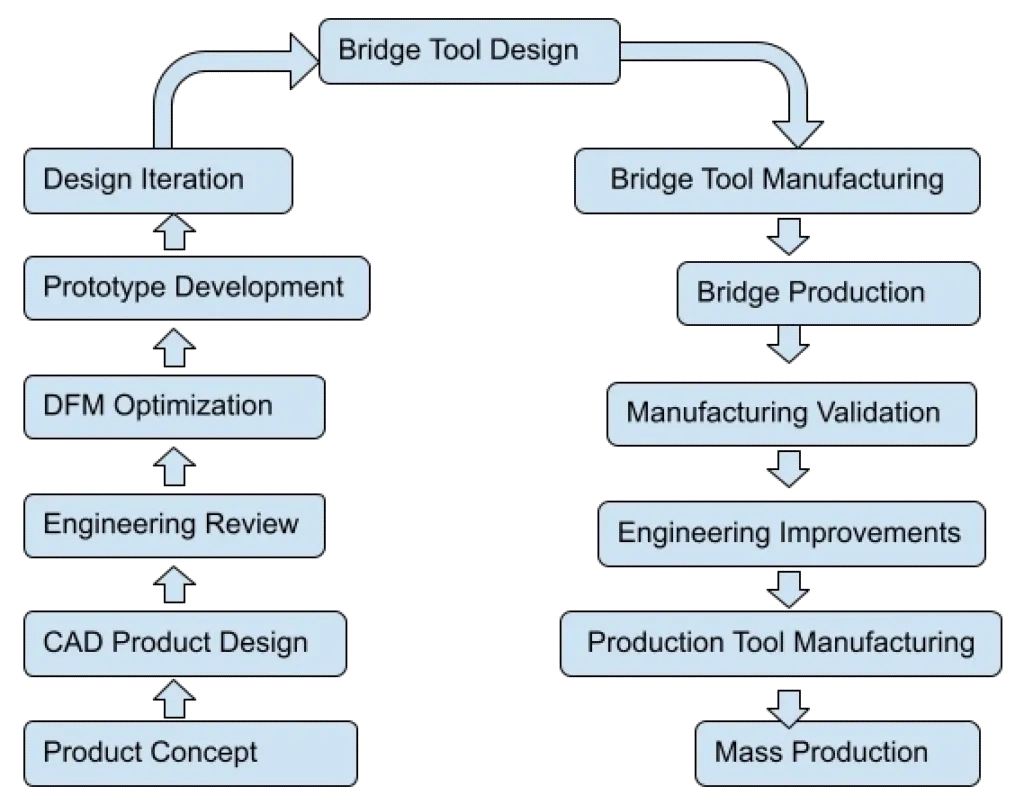
Bridge production is between prototype development and mass production tooling. The exact position relative to other stages in the cycle is shown in the workflow chart below.
What is the Difference between Bridge Production and Conventional Production?
While more expensive per unit compared to conventional production, bridge production is more flexible, faster, and lower risk.
| Element | Bridge production | Conventional production |
| Cost | Higher per unit | Lower per unit |
| Flexibility | High | Low |
| Lead time | Weeks | Months |
| Risk | Lower | Higher |
Bridge Production vs Prototype Production
The main distinction between bridge production and prototype production is the engineering purpose and scale. Prototype production is for proving the viability of a concept, while bridge production is for proving the manufacturability.
| Element | Bridge production | Prototype production |
| Engineering purpose | Validate market fit and manufacturability | Validate design |
| Production volume | 100 to 10,000 parts | 1 to 50 parts |
Key takeaway: The bridge production process steps are not optional checks – they are the risk-lowering strategies for bridge production instead of the direct tooling option. Overlook design adjustments or pilot tests, and you are staring at the risks that bridge manufacturing seeks to remove.
Common Bridge Production Methods
Manufacturers commonly use CNC machining, 3D printing, or rapid injection molding for bridge manufacturing. These methods are chosen based on material, finish requirements, and production volume.
ProleanMFG’s bridge production services give a wide range of options between prototyping and production phases, backed by rapid tooling. Get an instant quote!
CNC Machining
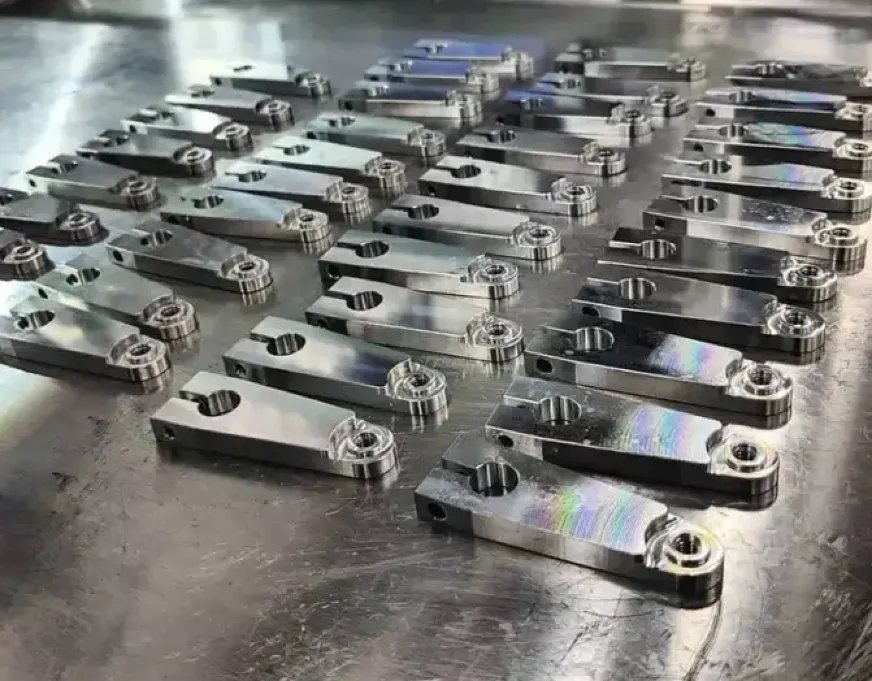
One of the most popular applications of CNC machining is in bridge production. It is an ideal method for validating engineering designs before a company commits to full-scale manufacturing.
CNC machining entails removing material from a block using computer-driven tools. The benefits of the process include compatibility with a broad range of materials and the ability to meet tight tolerances.
CNC machining is ideal for low- to medium-volume production. The parts made by CNC machining are ready to use, with the necessary strength and precision.
Benefits of CNC Machining in Bridge Manufacturing
- Fast Turnaround: 12–24 Hours
- Ultra-Tight Tolerances: ±0.001″
- 100+ Materials & 40+ Finishes
- ISO 9001:2015 Certified
- Competitive Pricing for Prototypes & Production
Limitations of CNC Machining in bridge manufacturing
- Higher cost per part at larger volumes
- Geometric constraints on complex features
Rapid Injection Molding
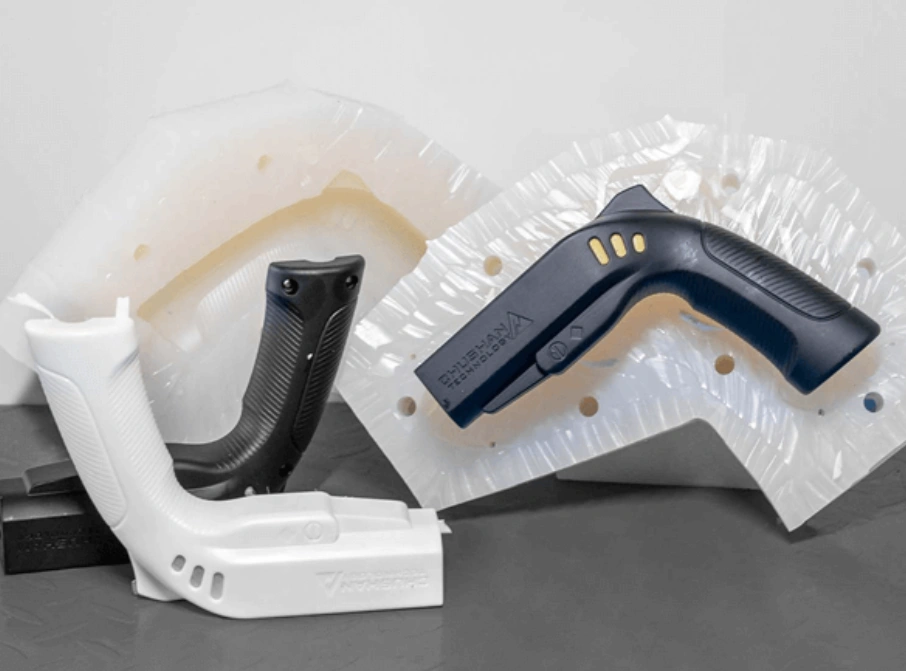
Rapid injection molding accelerates the mold manufacturing process from the conventional months to as little as days. This sped-up process is achieved through rapid CNC mold machining, simplified mold structure, and the use of aluminum/pre-hardened steel injection molds.
Bridge tooling is a core industry supported by this rapid approach. Competitive businesses, such as automotive and consumer electronics, need this strategy.
As the hardened manufacturing mold is being built, bridge tooling injection molding provides parts for pilot testing.
Benefits of Rapid Injection Molding in Bridge Manufacturing
- Flexibility
- Real production-grade materials – meets standards such as ASTM D1238 and ASTM D792 [1][2]
- High quality
- Short lead time – Days to weeks
Limitations of Rapid Injection Molding in Bridge Manufacturing
- Costlier design changes
- Upfront cost can be high
- Fewer cycles – 100,000 – 500,000
3D Printing
Industrial 3D printing, also called additive manufacturing, is a strategic production method that offers flexibility, speed, and complexity. It is what manufacturers turn to when the design is too difficult to mold or CNC machine. This method is excellent when tooling would be too slow.
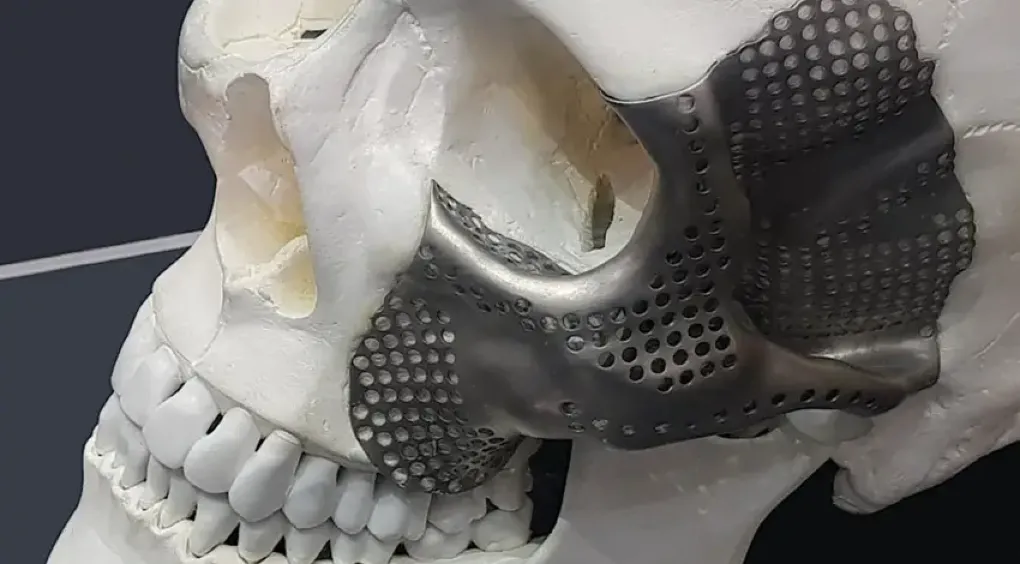
3D printing provides the fastest turnaround. It is ideal for low volume manufacturing of complex geometries. Unlike injection molding and CNC machining, additive manufacturing has no manufacturing constraints. This shortens the lead time from months to as few as days!
3D printing fits in bridge production, as well as in other stages such as concept validation.
Benefits of 3D printing in bridge manufacturing
- Functional prototypes and end-use parts in as fast as 3–5 days
- Multiple 3D printing processes: FDM, SLA, SLS, MJF
- Tight Tolerances as fine as ±0.2 mm
- Engineering plastics, nylon, elastomers, and metal options are available
- Cost-effective low-to medium volume production
Limitations of 3D printing in bridge manufacturing
- Lower mechanical performance for load-bearing parts
- Typical requirement for post-processing of surfaces
- Limited material selection
These benefits and limitations should not confuse you. It is easy to choose one, provided you have determined the part’s mechanical, material, and volume requirements.
CNC machining and 3D printing are the preferred bridge manufacturing technologies when the main factors are the geometry of lower-volume parts. Engineers will opt for rapid injection molding for production-grade materials at higher volumes.
Advantages and Limitations of Bridge Manufacturing
Bridge manufacturing offers faster product launch and lower risk. However, it comes with a higher per-unit cost and a shorter bridge tooling life.
Advantages – lower initial investment, faster product launch, better manufacturing validation, reduced inventory risk, higher engineering flexibility
Limitations – shorter mold life, higher unit cost
Key Industries Using the Bridge Production Process
Popular industries that use bridge production are aerospace, medical, automotive, consumer electronics, and industrial machinery. Most of these need this strategy for compliance in market testing.
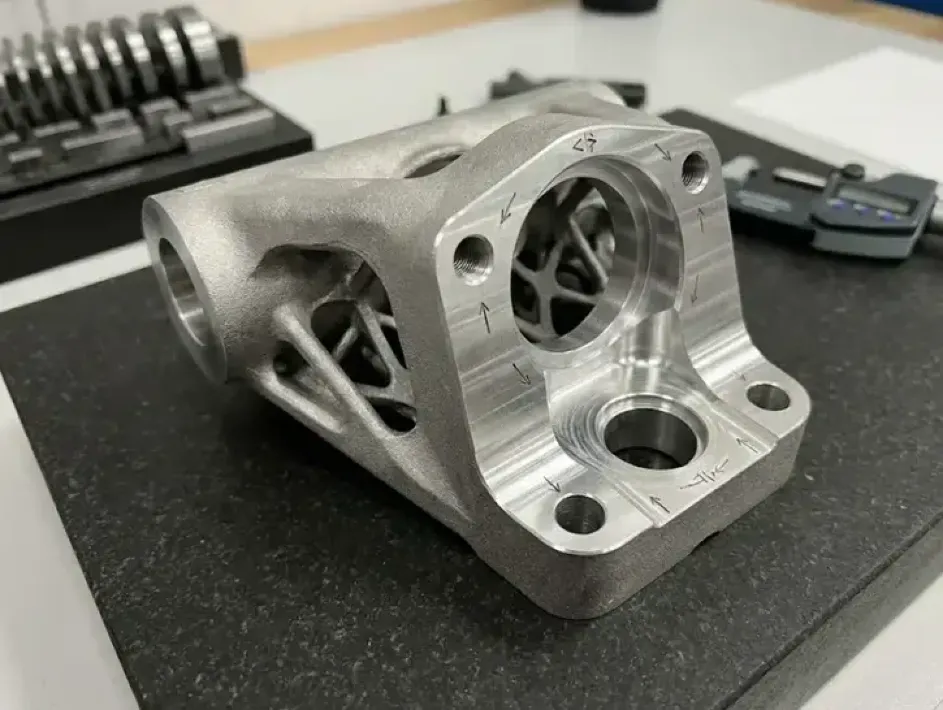
Aerospace – Structural components, brackets, replacement parts, and ground support equipment
Medical – Device enclosures, instrument housings, disposable device components
Automotive – Under-hood components, aftermarket parts, sensor housings, interior trim
Consumer Electronics – Brackets, connectors, enclosures
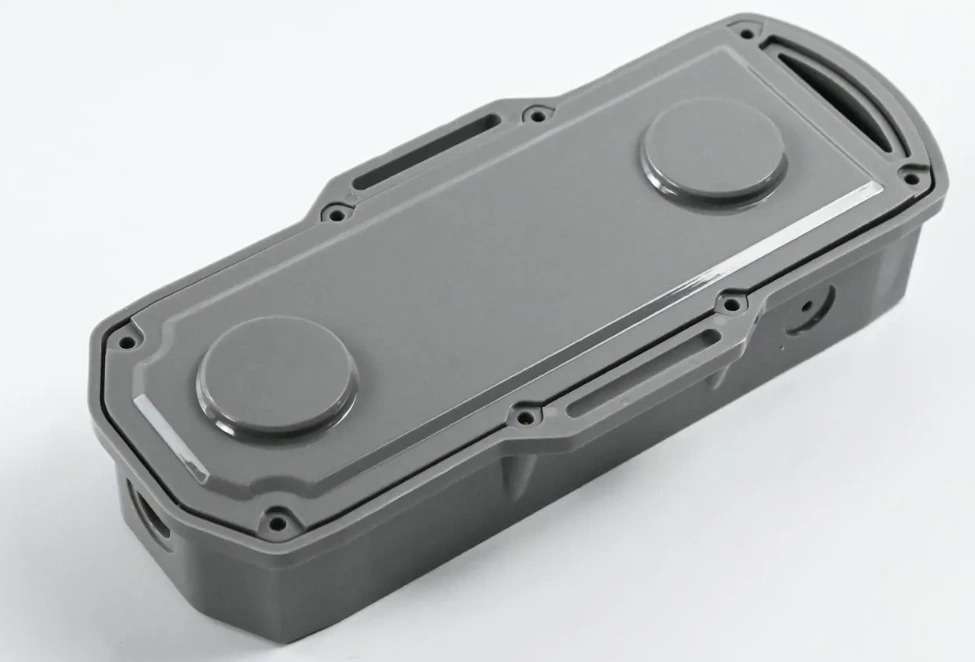
Industrial machinery – Functional prototypes, OEM replacement parts, jigs, housings, custom brackets
Challenges and Considerations in Bridge Production
Manufacturers using bridge production should plan for supply chain complexity, technical capacity, high initial investment, phase synchronization, and quality inconsistency.
- Supply chain complexity – advanced supply chain management software, strategic partnerships with key suppliers, safety stock
- Requirement for technical capabilities – quality CAD/CAM software, advanced training programs
- High initial investment – longer production runs (economies of scale), detailed cost analysis, explore financial supports
- Difficulty synchronizing production phases –
- Quality inconsistency – Can be handled through in-process quality checks and inspection protocols.
These challenges aside, the core value of bridge manufacturing is still supreme. The risk is lower, and market entry is faster. Manage these limitations expertly, and you have all the reasons to apply bridge products.
Conclusion
Bridge manufacturing fills the void between prototyping and mass manufacturing. OEM teams rely on it to produce market-ready units for pilot testing. Whether CNC machining, rapid injection molding, or 3D printing, the right method depends on production volume, material, and part geometry.
Skipping any of the four bridge production stages raises project risk. Completing low-volume production, market testing, design tweaks, and mass production in order keeps costs predictable.
Avoid tooling lead times that delay your launch. Our rapid tooling services deliver market-ready parts so you can validate your designs and their manufacturability before investing in hard tooling. Upload your design for a technology-based quote within 24 hours!
Resources