
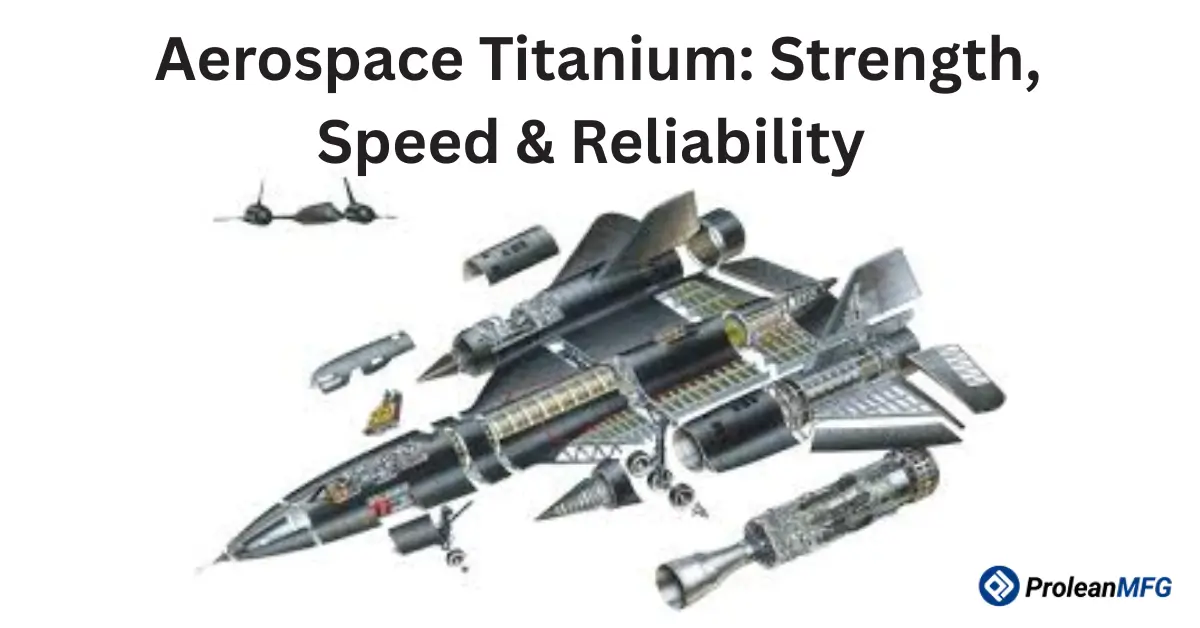

Aerospace titanium is a lightweight, high-strength-to-weight ratio, and corrosion-resistant metal used to build critical aircraft components. Titanium is 45% lighter than steel but equally strong. This metal can perform reliably in temperatures as low as −150°C and as high as 600°C. This makes it an ideal choice for jet engines, airframes, and space exploration.
Aerospace titanium is a critical metal due to its strength-to-weight ratio, even at the extremely low temperatures, typically below −150°C. Titanium is the strongest metal due to its strength, water, heat, and salt resistance for various applications, ranging from dental implants to airplanes.
The choice of material can make or break the effectiveness and efficiency of aircraft in aerospace engineering. This comprehensive guide explores aerospace titanium properties, alloy types, common aircraft applications, and precise advanced CNC machining of titanium.
What is Aerospace Titanium?
Aerospace titanium is not found in pure form to be used in aerospace parts. Titanium can not be used directly due to its hardness and difficult machining. It is found in nature within mineral compounds in the Earth’s crust as raw material. It goes through many steps, such as extraction, special melting, mixing with other metals like aluminum and vanadium, and strict testing to make it “aerospace grade”.
Titanium is a type of chemical element. The symbol of titanium is Ti, and its atomic number is 22.

Titanium resists fatigue better than most aerospace metals. Aircraft components face repeated stress cycles during every flight. Titanium handles this without cracking or weakening over time. Titanium performs reliably in both conditions without losing structural integrity.
Titanium is used in hypersonic aircraft surfaces that reach temperatures above 300°C at speeds over Mach 5. Similarly, NASA’s Artemis and SpaceX use titanium heavily because it can handle both cold and hot conditions without breaking. Titanium is used up to 25% of the total weight of modern jet engines like the GE9X. The metal provides strength, safety, and reliability where other materials are unable to perform well.
Aerospace Titanium Alloys Explained
The most widely used aerospace titanium alloy is Ti-6Al-4V (Grade 5). This alloy covers approx. 50% consumption globally. Pure titanium is already strong and corrosion-resistant. But when mixed with metals, it becomes more flexible, easier to machine, and better suited for extreme aerospace conditions.
The Ti-6Al-4V (Grade 5) alloy, when mixed with aluminum, makes it lighter and stiffer. Mixing with Vanadium helps to handle stress without cracking. This alloy accounts for nearly 50% of global titanium consumption. These aerospace titanium alloys are designed to perform in extreme conditions without failing.
Titanium alloys become more flexible and easier to shape when mixed with other metals.
These metals include traces of aluminum, molybdenum, vanadium, niobium, tantalum, zirconium, manganese, iron, chromium, cobalt, nickel, and copper. There are six grades of pure titanium: grades 1, 2, 3, 4, 7, and 11. Whereas titanium alloys have 4 varieties: Alpha, Near-Alpha, Alpha-Beta, and Beta.
Here is a completely defined table for the titanium alloys varieties:
| Category | Alloys | Description |
Alpha (α) Alloys | TI CP Grade 1 | Highest ductility and lowest strength among ASTM grades; ideal for extensive forming; highly resistant to corrosion due to exceptional purity |
| TI CP Grade 2 | Balance between strength and formability; increased tolerances for iron and oxygen; versatile for aerospace applications | |
| TI CP Grade 3 | Higher strength and oxygen tolerance compared to Grade 2; suited for more robust mechanical applications | |
| TI CP Grade 4 | Strongest commercially pure grade; excellent ductility and mechanical properties at elevated temperatures; ideal for high-performance parts | |
| Near-Alpha Alloys | TI 3AL-2.5V | Balance between strength and formability; used in hydraulic systems; effective for airframe applications; resistant to stress and corrosion |
Alpha-Beta (α-β) Alloys | TI 6AL-2SN-4ZR-2MO | Designed for high-temperature applications, with superior creep resistance, and optimal for extreme stress conditions |
| TI 6AL-4V | Most widely used alloy; high strength, toughness, and resistance to fatigue and corrosion | |
| TI 6AL-4V ELI | Lower impurities, superior fracture toughness, and weldability; used for critical structural applications | |
| TI 6AL-6V-2SN | Higher strength than Ti 6Al-4V; excellent durability; resistant to creep at intermediate temperatures | |
Beta (β) Alloys | TI 15V-3CR-3SN-3AL | Versatile and heat-treatable; outstanding cold-formability; ideal for complex components |
| 3Al 8V 6Cr 4Mo 4Zr | Metastable Beta C TM alloy; used for landing gear, springs, and fasteners |
The table below highlights different grades along with their uses and key characteristics:
| Grade / Alloy | Description | Form/Conditions |
| Titanium Grade 1 | Unalloyed, low strength, low oxygen, high formability; used in airframes, heat exchangers, and desalination units | Titanium Grade 1, Annealed |
| Titanium Grade 2 | Unalloyed, medium strength; used in airframes, aircraft engines, and marine parts; good weldability and corrosion resistance | Titanium Grade 2, Annealed |
| Titanium Grade 3 | Unalloyed, high strength; excellent corrosion resistance and good weldability; used in airframe and aircraft engine parts | Titanium Grade 3, Annealed |
| Titanium Grade 4 | Highest strength pure unalloyed titanium; used in airframe, aircraft engine parts, marine, surgical implants, hydraulic tubing; good formability and corrosion resistance | Titanium Grade 4, Annealed |
| Titanium Grade 5 (6AL-4V) | Alloyed with 6% Aluminum and 4% Vanadium; medium strength; used in airframe, turbine engine parts, and surgical implants | Titanium Ti-6Al-4V (Grade 5), Annealed Titanium Ti-6Al-4V (Grade 5), Annealed BarTitanium Ti-6Al-4V (Grade 5), STATitanium Ti-6Al-4V (Grade 5), STA Bar |
| Titanium 6AL-4V ELI | Alloyed with 6% Aluminum and 4% Vanadium; Extra Low Interstitial | Titanium Ti-6Al-4V (Grade 5), ELI, Annealed |
| 3AL-2.5V | Alloyed with 3% Aluminum and 2.5% Vanadium | 3AL-2.5V, alpha annealed3AL-2.5V, Alpha-Beta Annealed, Quenched 3AL-2.5V, Beta-Annealed, 950ºC3AL-2.5V, ST 925ºC, Aged 480ºC |
| 5AL–2.5Sn & ELI (5-2.5) | Alloyed with 5% Aluminum and 2.5% Tin; also ELI | 5AL–2.5Sn5AL–2.5Sn ELI, Annealed |
| 6AL–2Sn–4Zr–2Mo (6-2-4-2) | Alloyed with 6% Aluminum, 2% Tin, 4% Zirconium, 2% Molybdenum | 6AL–2Sn–4Zr–2Mo (6-2-4-2), Duplex Annealed6AL–2Sn–4Zr–2Mo (6-2-4-2), Sheet |
| 6AL–6V–2Sn (6-6-2) | Alloyed with 6% Aluminum, 6% Vanadium, 2% Tin | 6AL–6V–2Sn (6-6-2) Annealed 6AL–6V–2Sn (6-6-2), STA 870 °C/565 °C 6AL–6V–2Sn (6-6-2), STA 910 °C/540 °C |
| 8AL–1Mo–1V (8-1-1) | Alloyed with 8% Aluminum, 1% Molybdenum, 1% Vanadium | 8AL–1Mo – 1V (8-1-1)8AL–1Mo – 1V (8-1-1), Annealed 8 hr at 790ºC (1450ºF)8AL–1Mo – 1V (8-1-1) Duplex Annealed8AL–1Mo – 1V (8-1-1) Beta Annealed, Aged8AL–1Mo – 1V (8-1-1) Beta Solution Treated 8AL–1Mo – 1V (8-1-1) ST 980ºC (1800ºF), Aged 595ºC |
| 15V–3Cr–4AL–3Sn (15-3-3-3) | Alloyed with 15% Vanadium, 3% Chromium, 4% Aluminum, 3% Tin | 15V–3Cr–4AL–3Sn (15-3-3-3), Solution Treated15V–3Cr–4AL–3Sn (15-3-3-3), ST 790ºC, Aged 480ºC15V–3Cr–4AL–3Sn (15-3-3-3), ST 850ºC (1560ºF), Aged 545ºC |
Titanium is a highly durable metal and has many uses in its pure form. The alloys of titanium are highly flexible and malleable. These alloys are ideal for many applications and industries. No single alloy fits all applications. The alloy selection depends on temperature, stress, and machining requirements
Therefore, ProLean MFG is a leader in making titanium materials. The company offers different types and grades of aerospace titanium, fulfilling the strict needs of aerospace parts. Hence, there are diverse options available for different applications.
Why Use Titanium in the Aerospace Industry?
Titanium is used in the aerospace industry because of its unique characteristics. These special qualities fulfill the tough demands of modern airplanes and ships. Therefore, engineers and designers prefer to use it.
There are several compelling reasons to use titanium in the aerospace sector:
High Strength-to-Weight Ratio
Titanium is as strong as steel but has a lower density and is about 45% lighter. Although it is less stiff than steel but much stiffer than aluminum. These properties make titanium ideal for various applications, including aerospace components. This is important for airplanes because if the plane is lightweight, it uses less fuel and can carry more weight.
Excellent Corrosion Resistance
Excellent corrosion resistance of titanium helps parts last longer, need less repair, and saves time and money. This characteristic makes it suitable for aircraft parts resisting rust and damage in tough conditions like high altitudes and strong chemicals.
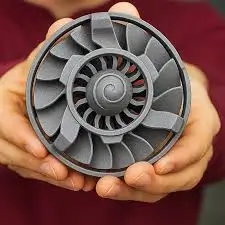
Superior Fatigue Strength
Titanium has a special quality that makes it good at handling repeated stress. It does not easily crack or break. As aeroplanes’ components are being used repeatedly, the material can experience fatigue over time. Therefore, titanium is significant for the durability of the aerospace components.
Works Well Across a Wide Temperature Range
Titanium works well in both hot and cold conditions. Some airplane components, like jet engines and hypersonic flight, face very high and very low temperatures. This property of titanium helps these parts stay strong in both of the extreme conditions.
What are the Common Uses of Titanium in Aerospace?
The titanium is used in airframes, jet engines, landing gear, fasteners, and hydraulic systems. This metal is chosen for its strength, light weight, and corrosion resistance.
Prolean MFG has advanced technologies with alloys that are well-suited for many aircraft applications.
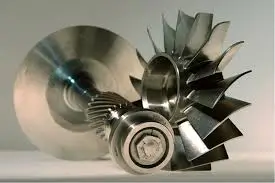
- Aircraft Engines: Titanium is commonly used for engine parts that operate up to 1100 degrees F (593 degrees C). The parts of titanium designed for engines are blades, discs, hubs, inlet guide vanes, and cases.
- Structural Airframe Applications: Due to its strength and lightness, titanium is used to make airframe structures such as wing boxes, fuselage frames, and landing gear.
- Commercial Rotorcraft: Titanium is a selected material for commercial and military helicopters because it is durable and strong.
- Avionics and Electronics: Soft magnetic alloys are helpful for aircraft electronics and parts. They help to make smaller motors, which reduces weight. The non-magnetic property does not disturb the navigation system.
Titanium is used for both commercial and military applications. It’s also ideal for avionics and navigational systems due to its non-magnetic property. Titanium is also used in satellite structures and fuel systems, where corrosion resistance and low weight are critical.
Reach out to ProLean MFG to ensure you choose the right aerospace-grade titanium for your next project. Our team offers tailored quotes and expert material guidance based on your machining requirements. Contact us today and discuss your needs and your procurement requirements faster and easier.
ProLean MFG has high-performing aerospace titanium alloys in streamlined procurement, meeting the needs of the aerospace industry.
Aerospace Manufacturing Process for Titanium
The aerospace manufacturing process involves extracting titanium from its ore and producing high-purity titanium sponge. This process is called the Kroll process. After this, it is remelted in a vacuum to form strong blocks called ingots. These blocks are shaped by forging or casting. And then carefully cut by the precise machines. This process ensures the strength-to-weight ratio for the production of jet engines and airframe components.
Therefore, the key stages of the aerospace manufacturing process for titanium are:
- Extraction of ore (Kroll Process): The titanium is not found in pure form and exists in rutile and ilmenite. The Kroll process turns ores into titanium sponge. This process is complex because titanium can react with oxygen at high temperatures.
- Melting and Alloying: The extracted material is then melted in a vacuum. This stage involves alloying elements like aluminum, vanadium, or molybdenum to achieve specific properties that are required for aerospace parts.
- Primary Shaping (Forging & Rolling): This forging and rolling process ensures that the material can handle stresses and extreme loads during the flight. Forging process improves strength and structural integrity, whereas rolling helps to achieve uniformity and thickness.
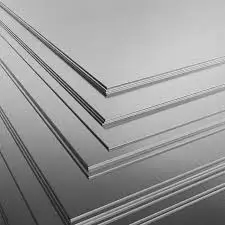
- CNC Machining of Titanium: Aerospace CNC machining of titanium is used to form precise components. The CNC machining cost varies between $30 to $200 per hour or more.
The parts of CNC machining titanium are exceptionally durable. However, titanium CNC machining is challenging because of its low thermal conductivity. Heat remains in one place due to the material’s low thermal conductivity during CNC machining. This can cause heat to build up fast, cutting tool wear, and the metal can become slightly distorted.
- Heat Treatment: The heat treatment is applied to enhance the properties of titanium, such as fatigue, strength, and toughness. Processes like annealing or solution treatments optimize the internal structure of the material alloys. This makes it well-suited for aerospace conditions.
- Surface Treatment and Finishing: Treatment and finishing processes are used to further polish or coat the workpiece. This can improve corrosion resistance, surface durability, and wear resistance of the final aerospace component.
- Quality Control and Testing: Quality control and testing of every titanium component is strictly followed. The aerospace parts must pass through the standard testing, such as NDT, mechanical performance test, and ultrasonic inspection.
Aerospace titanium goes through 6 steps before becoming an aerospace component, such as extraction, melting, alloying, shaping, machining, and testing. Every aerospace titanium component must pass NDT, ultrasonic inspection, and mechanical performance testing before it is cleared for use.
Final thoughts: Titanium & The Future of Aerospace
Aerospace titanium is an ideal material to produce airplane components due to its properties. Titanium offers high strength-to-weight ratios, fatigue strength, corrosion resistance, and temperature resilience. ProLean MFG’s diverse range of titanium alloys is widely used in aerospace CNC machining applications, ensuring superior performance and durability. The demand for aerospace titanium is expected to grow significantly. As technology advances, titanium will play an even bigger role in the future of flight and space exploration.
Answers to Frequently Asked Aerospace Titanium Questions
The aerospace titanium raw material stock is available in different forms, such as sheets, bars, plates, and billets.
Aerospace titanium Breitling is a multifunctional pilot’s watch, typically 40-43mm in diameter, made of titanium. Titanium made the watch lightweight and durable, and water-resistant.
Aerospace-grade titanium (typically Ti-6Al-4V) is almost 45% lighter and stronger than stainless steel.
The disadvantages of titanium for aircraft are that it is almost 6 times more expensive than aluminum, difficult to machine, limited availability, and difficult to weld and process.
The most widely used aerospace titanium alloy is Ti-6Al-4V (Grade 5). This alloy covers approx. 50% consumption globally in aerospace applications.
Aerospace titanium is precisely machined with advanced CNC machining that uses carbide tools, high coolant flow, and low cutting speeds.