
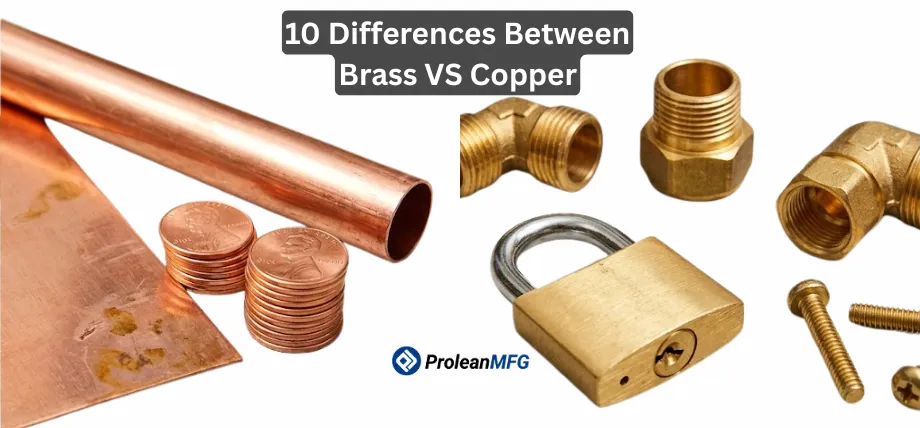

Copper and brass are used for different applications. Learn how to differentiate and identify copper vs brass by color. Copper has a reddish-brown color, and brass has a yellow tint. Understand the composition of brass, an alloy of copper and zinc, for your project material selection.
Copper is a pure metal with some of the best electrical and thermal conductivity, making it extremely useful in electrical systems and heat exchangers. Brass, an alloy of copper and zinc, offers enhanced mechanical properties like higher tensile strength, better machinability, rust resistance, and aesthetic improvement, making it suitable for precision fittings and components.
How To Differentiate Between Brass and Copper Visually?
Pure copper has a strong reddish-brown hue from a high purity level, and its electronic configuration absorbs the blue-yellow spectrum. Brass with up to 40% zinc in its composition is brighter and more yellowish, depending on the copper proportion. The color change comes from an atomic change in the brass alloy’s lattice structure, reflecting light differently.
The fastest way to differentiate between brass and copper is by using their color tones and surface characteristics. These visual characteristics are influenced by their atomic structures and alloying elements.
What Is Brass Made of?
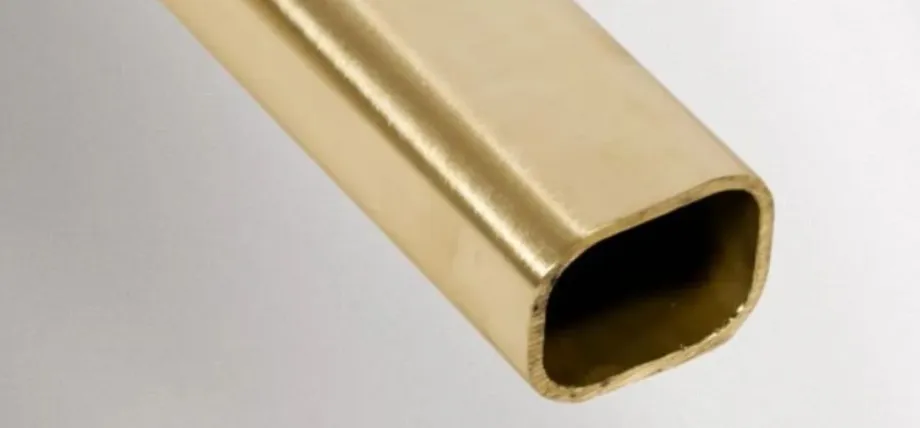
Brushed Brass Extrusion
Brass is a binary alloy mostly made of Copper (Cu) and Zinc (Zn), with varying zinc percentages to alter specific properties. Standard composition of brass includes 60% – 70% copper and 30% – 40% zinc for cartridge brass.
Admiralty brass (UNS C44300) has 1% tin and traces of lead for enhanced corrosion resistance for marine applications. Altering the zinc percentage can change mechanical and physical properties; for example, admiralty brass with 35% zinc has better formability.
Some brass alloys also have trace elements like iron (up to 0.06%) or lead (up to 3%) in free machining grade (UNS C36000) to improve machinability and refine the grain structure. The complete compositions of standardized wrought brasses are in ASTM B36.
| UNS Designation | Common Name | Copper (Cu) | Zinc (Zn) | Lead (Pb) | Tin (Sn) | Iron (Fe) | Other Elements |
| C23000 | Red Brass | 84.0-86.0% | Balance | 0.05% max | – | 0.05% max | – |
| C26000 | Cartridge Brass (70/30) | 68.5-71.5% | Balance | 0.07% max | – | 0.05% max | – |
| C36000 | Free-Cutting Brass | 60.0-63.0% | Balance | 2.5–3.7% | – | 0.35% max | – |
| C44300 | Admiralty Brass | 70.0-73.0% | Balance | 0.07% max | 0.9–1.2% | 0.06% max | As: 0.02–0.06% |
| C46400 | Naval Brass | 59.0-62.0% | Balance | 0.10% max | 0.5–1.0% | 0.10% max | – |
| C38500 | Architectural Brass | 55.0-59.0% | Balance | 2.5–3.5% | – | 0.35% max | – |
| C28000 | Muntz Metal | 59.0-63.0% | Balance | 0.30% max | – | 0.07% max | – |
| C27000 | Yellow Brass | 63.0-68.5% | Balance | 0.09% max | – | 0.07% max | – |
What Is Copper Made of?
Copper is a pure metal and a chemical element made of copper atoms. It has the symbol Cu and atomic number 29. Electrolytic Tough Pitch (ETP) copper (UNS C11000) achieves 99.9% purity with 0.04% oxygen for conductivity for commercial and engineering applications.
In natural form, copper exists in its natural isotope of 69.15% Cu-63 and 30.85% Cu-65. In processed copper, impurities such as phosphorus or silver can improve weldability.
Copper is not an alloy (a mixture of two or more metals). Copper is extracted from its core through smelting and electrolysis, producing highly pure ingots for extrusion, drawing, and stocks.
10 Differences Between Brass and Copper
1. How Is Brass Different From Copper in Appearance
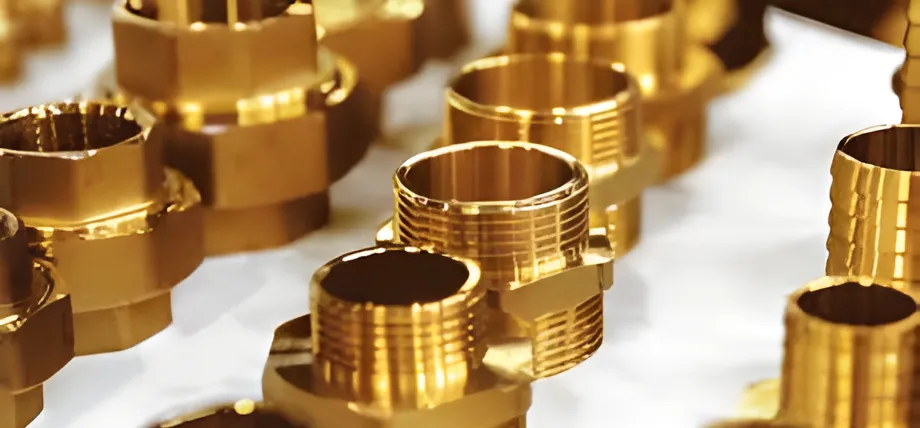
CNC Machined Brass Components
Brass differs from copper in appearance due to its alloy composition, resulting in a yellow-gold tone, while copper has a red-orange hue. The zinc composition (30%) in brass allows it to scatter light to produce a warmer, metallic sheen, while pure copper’s color stems from its electronic band transition.
If your copper has a blue or green hue, this is because copper oxidizes to form cuprous oxide, while brass tarnishes but is better at resisting moisture. Brass is more aesthetic and decorative, and it suits hardware that requires visual appeal. Copper’s patina (blue-green hue) is also used in applications for a distinct aging look.
2. Brass Vs Copper Properties
The physical and mechanical properties of brass and copper diverge based on their microstructures. Copper has a pure FCC lattice structure with a density of 8960 Kg/m3, thermal conductivity of 401 W/mK, and electrical conductivity of 100% IACS.
Brass has a range of densities depending on the alloy, but the most common values range between 8400 and 8700 Kg/m3, depending on Zinc content. It has a tensile strength of up to 500 MPa compared to copper, which has 210 – 250 MPa. Brass has a thermal conductivity of up to 150 W/mK.
| Property | Copper (UNS C11000) | Brass (UNS C26000, 70/30) |
| Density (g/cm³) | 8.94 | 8.53 |
| Thermal Conductivity (W/m·K) | 388 | 120 |
| Electrical Resistivity (µΩ·cm) | 1.71 | 6.16 |
| Electrical Conductivity (% IACS) | 100 | 28 |
| Tensile Strength (MPa) | 220–240 (annealed) | 330–470 (annealed to half-hard) |
| Yield Strength (MPa) | 50–70 (annealed) | 130–345 (annealed to half-hard) |
| Elongation (%) | 35–50 (annealed) | 30–60 (annealed to half-hard) |
| Brinell Hardness (HB) | 40–50 (annealed) | 65–110 (annealed to half-hard) |
| Melting Point/Range (°C) | 1083 | 900–940 |
| Corrosion Resistance | Good (oxide layer; weak in acids/salts) | Good (neutral/freshwater; dezincification risk in saline) |
| Machinability Rating | 20 | 90 |
3. Brass Vs Copper Corrosion Resistance
Corrosion resistance is a dynamic property that changes depending on environment, exposure, and alloy composition. Pure copper can form a protective oxide layer showing minimal corrosion (<0.1 mm/year) in fresh water, but it undergoes pitting corrosion in acidic and saline conditions.
Brass, specifically low zinc grades (less than 15% zinc content), offers good resistance in atmospheric conditions, with dezincification minimized in alloys like admiralty brass. High zinc brasses (>30% Zn) corrode faster in seawater, but overall, brass is better in mildly alkaline conditions.
4. Brass Vs Copper Strength and Load Bearing
Due to alloying effects, brass almost always surpasses copper in strength and load-bearing capacity. Copper has a yield strength of approximately 33 – 70 MPa. The ultimate tensile strength of copper is around 210 MPa, which limits its use in low-stress applications.
Brass metal fabrication achieves yield strengths of 95 – 400 MPa and UTS of 338 – 469 MPa. Brass can perform better in higher load capacities in applications like fasteners and gears. Fatigue resistance in brass is enhanced through work hardening, and endurance limits can range up to 150 MPa against copper’s 60 MPa. Brass also reduces deformation under cyclic stresses.
5. Brass Vs Copper Melting Point
The melting point of copper is 1084 °C due to its pure metallic bonds that require significant energy to break the lattice. Brass, an alloy, has a slightly lower melting point, ranging from 900 to 940 °C, depending on the composition of brass.
In the phase diagram, zinc lowers the liquidus temperature. In casting processes, brass’s lower melting point facilitates easier pouring and reduces energy costs. The lower costs are also reflected in recycling, forging, annealing, and heat treatment processes.
6. Brass Vs Copper Electrical Conductivity
Copper is rated as 100% IACS (International Annealed Copper Strength). Copper’s electrical conductivity is 5.96 x 10^7 S/m because of its free electrons. Brass is rated 28 – 40 % IACS or 1.59 x 10^7 for 70/30 brass. It has reduced conductivity from zinc’s higher resistivity and electron scattering effects.
Resistivity in brass increases with zinc content, making brass unsuitable for high-current conductors but feasible for some connectors.
7. Comparing Brass and Copper Costs
Copper and brass costs vary from place to place. Pure copper trades at $4 – $5 per pound, while brass, containing 70% copper and 30% zinc, costs $2 – $3 per pound. Machining costs of copper and brass are similar, and in many cases, making brass parts is cheaper than making copper parts.
8. How are the Applications of Brass and Copper Different?
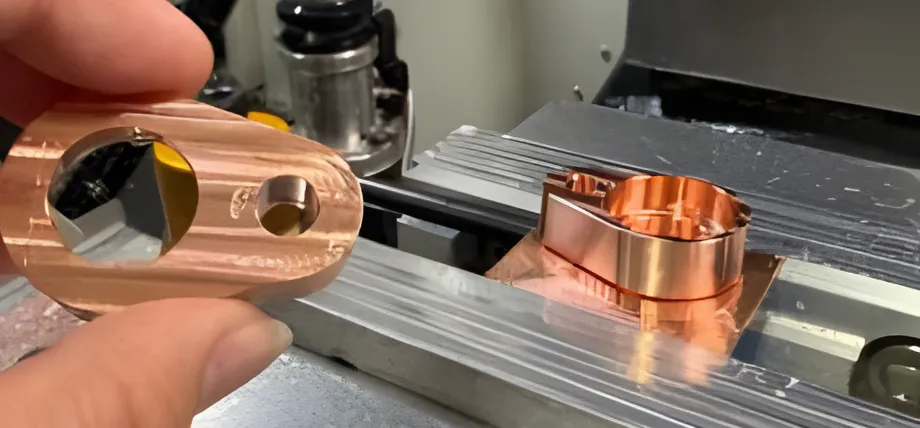
Copper Part After Milling
| Application Area | Copper (UNS C11000) Applications | Brass (UNS C26000/C36000/C46400) Applications |
| Electrical Systems | Power cables, busbars, circuit board conductors | Electrical connectors, terminal blocks |
| Thermal Management | Heat sinks, radiators, HVAC tubing | Limited use; cooling system fittings |
| Plumbing | Water tubing, refrigeration lines | Valves, pipe fittings, faucets |
| Mechanical Components | Soft for high-stress parts | Gears, bearings, screws, bushings |
| Marine Applications | Susceptible to saline corrosion | Propeller shafts, marine hardware (naval brass) |
| Musical Instruments | Rare; tuning pins in some designs | Trumpets, saxophones, bells |
| Decorative/Architectural | Cladding, roofing | Door handles, fixtures, jewelry |
| Automotive | Wiring harnesses, radiators | Bushings, connectors, valve guides |
| Aerospace | Thermal management in avionics | Fasteners, fittings |
| Medical/Health | Antimicrobial surfaces, water purification | fittings in medical gas systems |
9. Which Metal Is Softer: Brass or Copper?
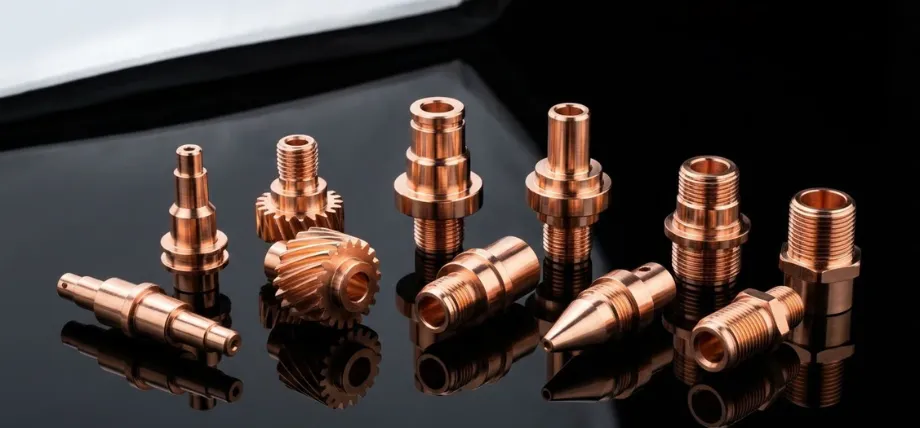
Complex Machined Copper Fittings
Copper is softer than brass, with a Brinell hardness of 35 – 50 HB compared to brass, which is 55 – 150 HB, owing to its alloy strength. Copper’s low yield strength (33 MPa annealed) allows easy deformation and makes it ideal for drawing into wires, but it can deform under impact.
The hardness of brass increases with zinc, and its abrasion-proofing increases with zinc. In the Vickers test, copper has a 40 – 60 HV, while cartridge brass reaches 80 – 120 HV. For soft-forming operations, copper is better than brass but lacks mechanical durability.
10. Brass Vs Copper Machinability
Brass is rated at 100% machinability (UNS C36000), far exceeding copper’s 20 – 30 % machinability due to zinc. Zinc produces a chip-breaking effect and low work hardening.
Copper is a ductile metal, and this is reflected during cutting and CNC machining of copper. Copper’s ductility produces gummy chips and tool buildup, necessitating slower speeds (50 – 100 sfm). It is possible to machine brass at high speeds with minimal burrs, reducing cycle times. Brass CNC Machining also has better surface roughness (<1.6 μm), making it more suitable for precision parts.
What Are The Key Advantages of Using Brass Parts and Components Over Copper?
Brass offers several engineering advantages over copper, including superior strength, better machinability, and lower costs. Brass parts are, on average, 20% cheaper than copper parts in production costs.
To extend life and function in applications like fittings and valves in marine settings, dezincification brasses like C46400 are used.
In load-bearing applications, brass withstands higher stresses without fatigue failure. Its lower melting point is also better for casting and forging. Brass is a better choice for high-volume part production overall.
How To Choose Between Copper and Brass Alloys?
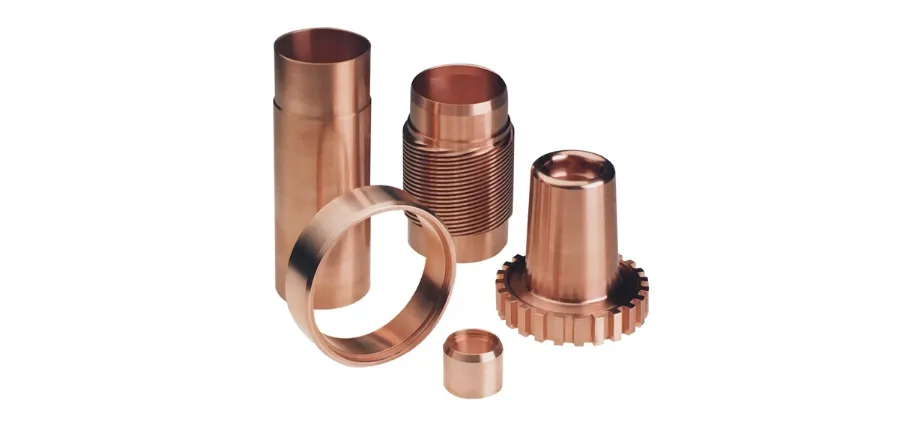
Precision Copper Turnings
- Electrical and Thermal Performance: Copper has an electrical conductivity of 100% IACS or 1.71µΩ·cm resistivity and thermal conductivity of 388 W/m K, which is much better than brass at 28% IACS or 6.16 6.16 µΩ·cm and thermal conductivity of 120 W/m K.
- Mechanical Requirements: Brass offers superior tensile strength (330–470 MPa) and yield strength (130–345 MPa) compared to copper (220 – 240 MPa tensile, 50 – 70 MPa yield).
- Corrosion Resistance: Copper forms a protective oxide layer in neutral atmospheres, but underperforms in pitting. UNS C44300 resists corrosion in freshwater and mildly alkaline conditions but risks saltwater dezincification.
- Machinability: Brass, especially free-cutting grades like UNS C36000, has a machinability rating of 90–100%, which allows you to use high-speed machining and cheaper cutting tools.
- Special Properties: Brass suits musical instruments due to acoustic properties, while copper is ideal for antimicrobial surfaces in medical settings
- Finishing and Visual Requirements: Brass’s yellowish-gold hue suits decorative applications like architectural hardware, while copper’s reddish tone or patina can be used in some architectural applications.
Checklist To Decide Between Brass and Copper
- Does the application prioritize electrical conductivity?
- Is high thermal conductivity required?
- Are strength and load-bearing capacity essential?
- Will the component operate in corrosive environments?
- Is machinability a priority for manufacturing?
- Is cost a limiting factor?
Brass CNC Machining Service
We provide ISO certified metal machining services for many brass alloys and surface finishing services for all parts. You can also request our DFM support and material traceability reports to ensure the correct brass or copper grade is used.
Request a free quote today!
Conclusion
Copper and brass are both metals that excel in different applications. Copper is mostly used for its electrical properties, while brass is used for its machinability, durability, and long-lasting properties. Advantages of Brass include machinability, lower cost, acoustic properties, aesthetic properties, and durability, but poor electrical properties.
There are many brasses you can choose from for a number of applications, and you can go a step further by using phase diagrams to optimize your parts’ performance for reliable part production and engineering designs.
FAQ
How To Identify Brass Vs Copper?
Copper is reddish-brown, and brass is yellowish. You can also use a magnet, as brass may slightly stick, while copper does not.
How To Tell Copper Vs Brass?
Copper is reddish-brown, while brass is yellowish. You can also check the weight of both brass and copper, as brass is heavier due to its denser material.
What Is the Difference Between Copper Vs Brass?
Copper is a pure metal, reddish, soft, and non-magnetic. Brass is an alloy of copper and zinc.