
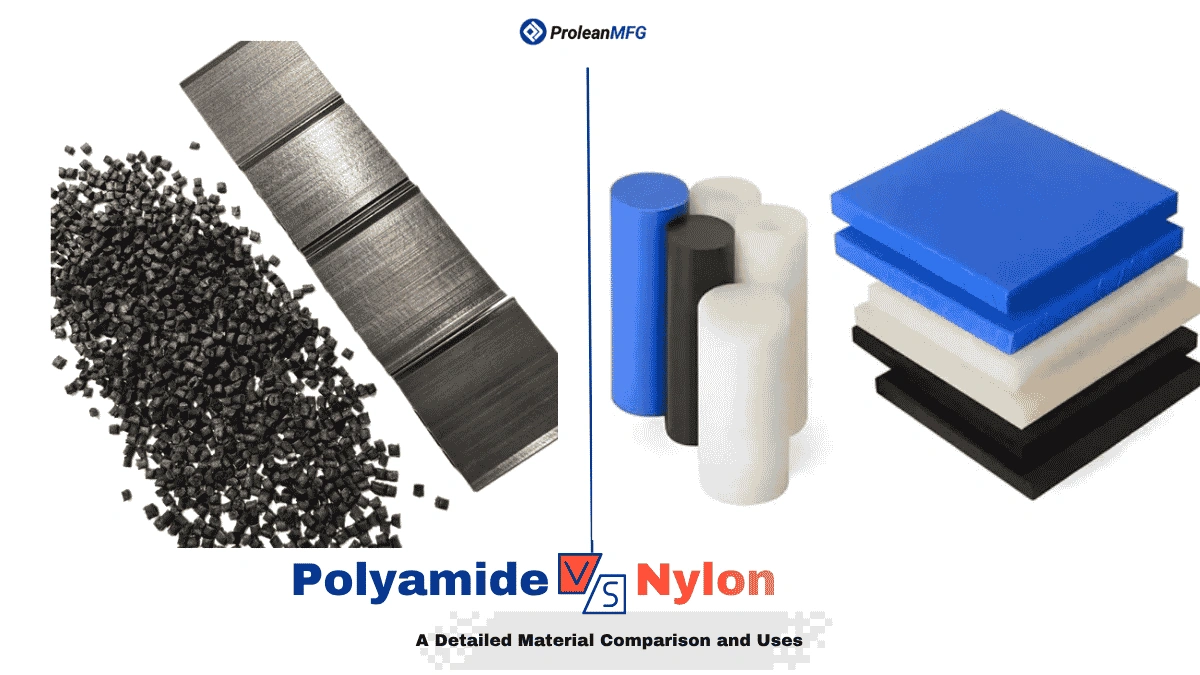

Polyamide(PA) is a group of engineering polymers containing repeating –CO–NH– linkages, whereas Nylon is an aliphatic Polyamide (a subtype of Polyamide). In manufacturing, they are used as interchangeable terms.
Almost 90% of polyamides used in manufacturing are Nylon grades. PA 6 and PA 66 together account for ~70% of the global polyamide market. Nylon offers high strength, abrasion resistance, impact strength, and a low coefficient of friction, whereas PA is chosen when low water absorption and flame resistance are high priorities for applications.
Whether you are a designer comparing Polyamide vs Nylon to choose the optimal CNC machining material for your parts, or an engineer machining these materials, this article provides a comparative analysis to help with decision-making.
Let’s get started!
Difference Between Polyamide and Nylon: What Sets Them Apart?
Let’s understand the polyamide vs nylon in one sentence: “All Nylons are Polyamides, but not all polyamides are Nylons”. It means that Nylon is a type of polyamide, made from repeating amide (-C(=O)- NH-) bonds.
During manufacturing, polyamides are engineered with different additives, polymerization procedures, and reinforcing fibers or glass. This allows for customization of the material for performance, versatility, and thermal stability.
The customization of properties depends on the molecular chain structure: aliphatic, aromatic, or semi-aromatic. Most of the machining Nylons are aliphatics.
What is Polyamide? ( Introduction and Structure)
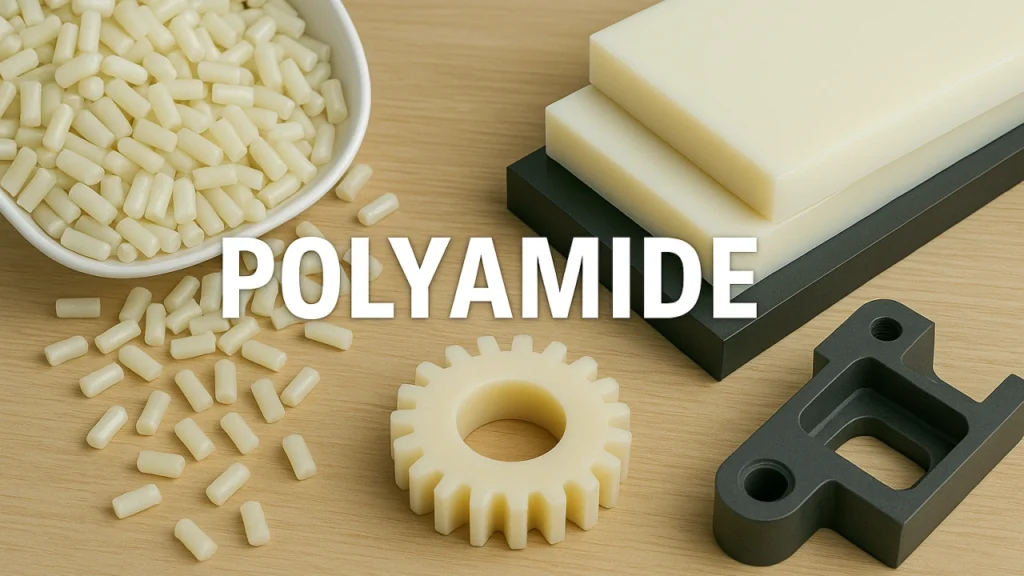
Polyamide material
What Kind of Material Is Polyamide? Polyamide is a synthetic polymer material defined by the amide group bonds in its microstructure. Aramids, polyamide-imide(PAI), and Nylon are the common types of polyamides used in manufacturing.
Polyamide Structure
The polyamide structure consists of repeating amide chains, which are formed by condensation of –COOH + –NH₂. The chains are planar and resonance-stabilised, resulting in high strength, stiffness, and lightness.
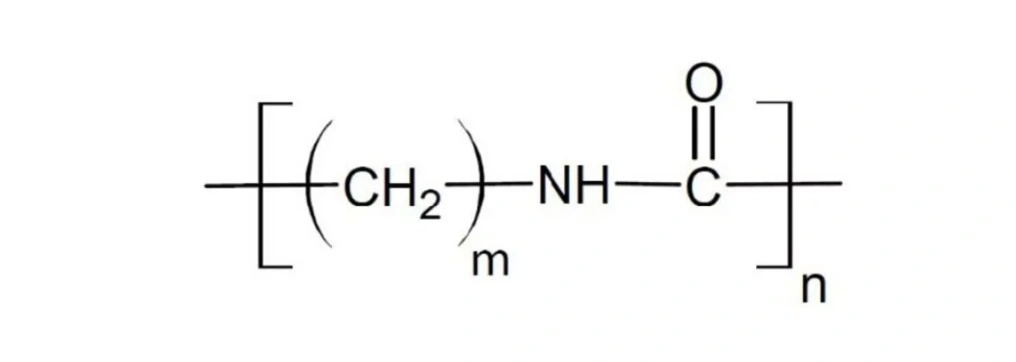
Polyamide structure
Polyamides are strong and tough. They provide high strength, moderate heat tolerance, wear resistance, electrical insulation, and good resistance to everyday chemicals.
How Can I Identify the Polyamides?
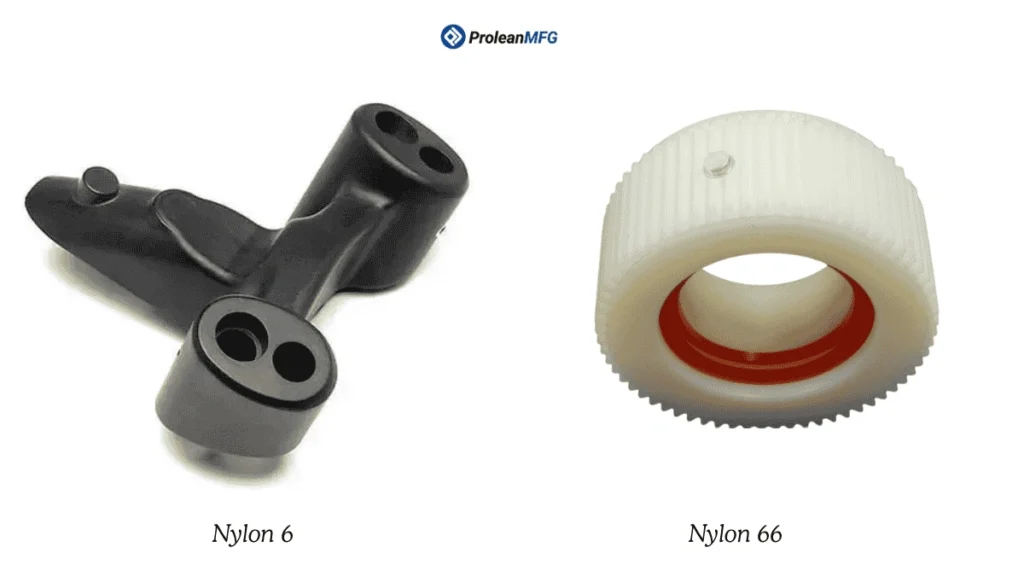
Nylon 6 and Nylon 66 parts
Visual identification is difficult because the material looks like many other plastics. Manufacturers often use a datasheet that contains information on identification factors such as flame color, burning rate, and float characteristics of specimens placed in fluids of different densities.
A more accurate way is destructive testing of the material in an engineering lab. In this method, the workpiece is subjected to various stress levels, pressures, and other conditions until it reaches the breaking point.
Types of Polyamide Materials
| Criteria | Aliphatic PA | Aromatic PA | Semi-aromatic PA |
| Composition | Low amide density, linear aliphatic C-C chains | Aromatic amide bonds to the benzene ring | Aromatic diacid + aliphatic diamine (hybrid). |
| Examples | Nylon 6, Nylon 6/6, Nylon 11, etc. | Kevlar® and Nomex® | PA 6T/66, PA 6T/6I, PA 9T |
| Machinability | Excellent, HSS/ Carbide tooling | Poor, required a rigid setup and specialized coated tools | Moderate; these can be machined but are harder than aliphatics |
| End Uses | precise bearings, bushings, threaded fasteners, hydraulic manifold inserts | Armour panels, flame-retardant insulators | Fuel system valve seats, industrial pump housing, and electrical connector bodies |
What is Nylon? ( Introduction and Grades)
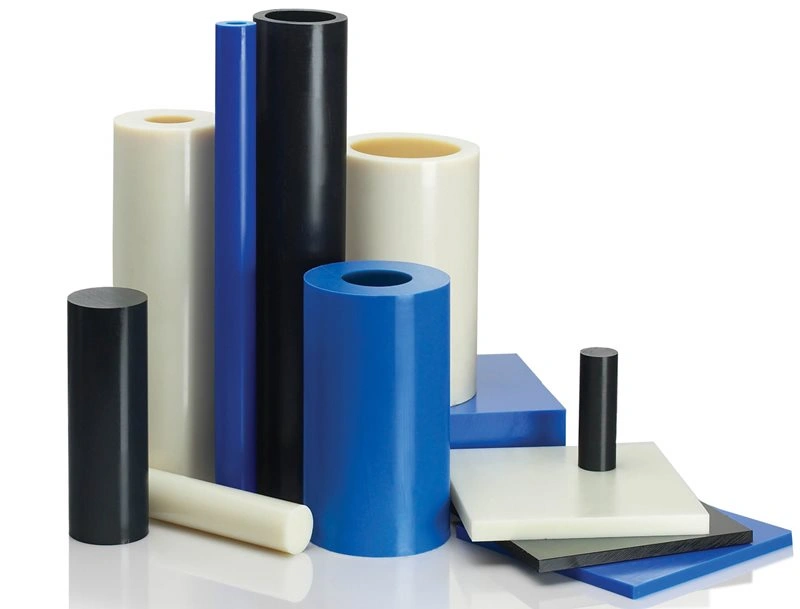
Nylon material
Nylon is an aliphatic polyamide; it is the most common type of polyamide material in machining, injection molding, and 3D printing. It comes in different grades, such as Nylon 6, Nylon 6/6, Nylon 11, and glass-filled Nylons; 6 and 6/6 are the most common grades used in Nylon machining.
Each of these varies in chemical composition, thus offering slightly different properties. For instance, Nylon 11 is better in impact resistance than Nylon 6; reinforced nylon provides higher stiffness than other grades.
Common Nylon uses are gears, bushings, bearings, and testing prototypes of industrial parts.
Grades of Nylon (6, 6/6, 11, 12)
| Grade | Composition | End Properties |
| PA 6Nylon 6 | Repeated: –[NH–(CH₂)₅–CO]–n | High strength & stiffness, machinability, and chemical resistance |
| PA 6/6Nylon 6/6 | hexamethylenediamine (6C) + adipic acid (6C): –[NH–(CH₂)₆–NH–CO–(CH₂)₄–CO]–n | Highest strength & stiffness (except for reinforced), machinability, higher impact toughness, and flexural strength. |
| PA 11Nylon 11 | Repeated –[(CH₂)₁₀–CO–NH]–n | High chemical resistance, low moisture absorption, and dimensional stability |
| PA 12Nylon 12 | Repeated –[(CH₂)₁₁–CO–NH]–n | High stress-crack resistance, good abrasion resistance |
| PA-GFReinforced Nylon | PA6 or PA66 matrix, with silane coupling agent (0.5–1.5 wt%) | Strong, excellent tensile strength, improved flexural strength |
What Kind of Material Is Nylon?
Nylon is a strong synthetic polymer that is made with the condensation polymerization of petrochemicals or renewable sources) in a controlled environment. It is light, smooth, stretchy, and has a low coefficient of friction.
How Can I Identify the Nylon?
Like Polyamide, you can look at the data sheet or test the nylon specimen in a lab. It is difficult to identify with visual inspections and touch, because PET, Acrylic, Teflon, and a few other plastics also look like Nylon.
Polyamide Vs Nylon: Key Differences
Polyamide is a broad polymer family, whereas Nylon is one of its many types. Nylon and other polyamides differ in their composition, strength, thermal stability, durability, impact strength, flexibility, machinability, and raw material cost.
Composition
Nylon 6 and Nylon 6/6 are made with the polymerization of petrochemicals, whereas natural polyamides are typically based on proteins. Diamines, diacids, amino acids, and lactams are the common Nylon monomers, whereas Polyamide monomers are more diverse ( Caprolactam, hexamethylene diamine, adipic acid, etc.)
Tensile Strenght
Nylon 6/6 grade provides high tensile strength (up to ~90 MPa), but it is not as high as that of Kevlar polyamide. Subsequently, GF-Nylon and CF-Nylon offer higher tensile strength than unfilled grades.
Tensile properties of polyamides are commonly determined using ASTM D638 or ISO 527 test methods. ASTM D638 is a general tensile-testing standard for PA6, PA66, and other grades. Material classification and specification of nylons are covered by standards such as ISO 1874-1.
Thermal Resistance
The melting point of Nylon 6/6 is ~ 260°C and can perform until ~120-200°C (depending on exposure time and environmental conditions). On the other hand, some high-performance polyamides (such as Kevlar®) resist heat up to 400 °C.
Durability
Nylons are durable materials; they resist impact load and abrasion, and do not wear quickly. Some aramid polyamides are more durable than Nylons, but they differ in structure and cost more.
Nylon 6/6 is durable enough for gears, bushings, and similar mechanical parts. Meanwhile, you can choose aramids for extreme application environments, such as firefighting wear and bulletproof vests.
Flexibility and Impact Resistance
Nylons are a flexible material, and they provide high impact strength so that the parts can withstand heavy loads and repeated shocks. Nylon 11 and 12 are more flexible than 6 and 6/6. Meanwhile, aramid and natural polyamide are less flexible than synthetic Nylons.
Chemical Resistance
Nylon polyamides show good resistance against alkalies, oils, solvents, and mild acids. On the other hand, aromatic and long-chain polyamides provide better resistance, along with low moisture-sensitivity. For instance, the chemical properties of nylon are not superior to Kevlar®.
Machinability
Nylon 6/6 has the highest machinability among the grades; it can be shaped into complex parts using CNC mills, lathes, drill presses, and turning centers with tolerance ± 0.127 mm (or lower). On the other hand, fiber-filled Nylons and/or aramid polyamides are less machinable.
Material Cost
PA6 and PA66 are among the cheapest polyamides. They cost less than semi-aromatic, aromatic, and aramid polyamides. While being cost-effective, PA 6 & PA 66 deliver high-performance properties and lightweightness. The cost typically ranges between $1 and $3.50 per kg.
Factors to Consider While Choosing between Polyamide vs. Nylon
Deciding which material is suitable to manufacture your part/product between Polyamide vs Nylon involves considerations of multiple factors, application requirements, machinability, thermal resistance, cost, and industry-specific compliances.
Application Requirements
Nylon provides flexibility, strength, load-bearing capacity, and wear resistance. On the other hand, other polyamides uses are related to components requiring moderate flexibility and good strength for the application. You can opt for reinforced nylons if higher performance is desired.
Application Environment
Consider the moisture content in the application environment, as it directly impacts the dimensional stability of machined nylon parts. Nylons absorb more water than most other polymers. Nylon 12 can be a good option in such an environment if you are not looking for other types of polyamides.
Machinability
Nylon 6 and Nylon 6/6 have higher machinability and can be shaped using carbide tools. Glass-filled nylons are stiffer & stronger, but their abrasiveness makes them relatively difficult to machine. Subsequently, aromatic polyamides have lower machinability than reinforced nylons/
Thermal Resistance
If your parts/products need to perform at elevated temperatures and withstand regular thermal shocks, consider the thermal stability of polyamide vs nylon during material selection.
Raw Material Cost
Compare the market price of short-listed nylon grades and other polyamide materials, and determine whether that fits under the project budget or not.
Industry-specific Compliances
Industries like medical, food-processing, aerospace, and automotive have various regulatory compliances regarding the use of raw materials. For instance, food-processing components need FDA compliance.
What’s Better, Nylon or Polyamide?
Nylon is also a polyamide, and which one is better depends on your application’s requirements. Nylons are superior when balanced properties are required, whereas other polyamides are superior in chemical resistance and dimensional stability.
Aromatic polyamides provide higher strength and stiffness, but are expensive and difficult to machine.
Summing Up
Nylon is a subtype of Polyamide and is widely used in CNC machining compared to other types. This is because of balanced mechanical, chemical, and thermal properties.
You can choose Nylon grades for the most demanding applications in automotive, aerospace, medical, general hardware, and other industries. Polyamides are suitable when moderate strength is sufficient for performance, and moisture absorption & dimensional stability significantly matter.
A wise decision-making process must consider end-application requirements, environmental conditions, material prices, ease of machining, and industry compliance.
At ProleanMFG, we not only help with material selection but also provide comprehensive Nylon CNC machining services, from DFM feedback to precision machining and surface finishing. We have multi-axis CNC machines that can produce intricate components to exact specifications.
We are also flexible with production volume and provide cost-effective solutions for even prototypes and small batches. Upload your design and get a quote today!
FAQs
Is polyamide or nylon more breathable?
Being the same type of material, polyamide and nylon are both breathable. Which is more breathable depends on the knit/weave, manufacturing method, and finish. Nylon fiber absorbs little moisture, and they are less breathable than cotton.
Can polyamide and nylon be recycled?
Yes, polyamides, including Nylon, are recyclable. They can be reprocessed to convert into a new form of raw material, but the recycling method depends on the type and thermal properties. Mechanical and chemical recycling are the two common methods for polyamides and nylons.