
LASER CLADDING SERVICE
1 to 3 Day Lead Times
Prototype coating trials and production orders
Up to ±0.003 in.
Overlay dimensional accuracy*
Quality Inspection
Dimensional and visual checks
Why Choose Us
Laser Process Control
Metal Powder Options
Wear & Corrosion Protection
Engineering Support
Decades of Experience
Strong Technicians Team
0.5 to 3.0 mm
Approximate Clad Thickness
Below 5%
Typical Dilution
Fully Automated Set Up
Controlled Deposition
Free Design Review
Material and Process Support
Our Capabilities
01
Complex Geometry Capability
Our experienced team can apply laser cladding to complex parts, including shafts, molds, dies, turbine components, valves, sealing surfaces, and other precision geometries.
02
Fully Automated Set Up
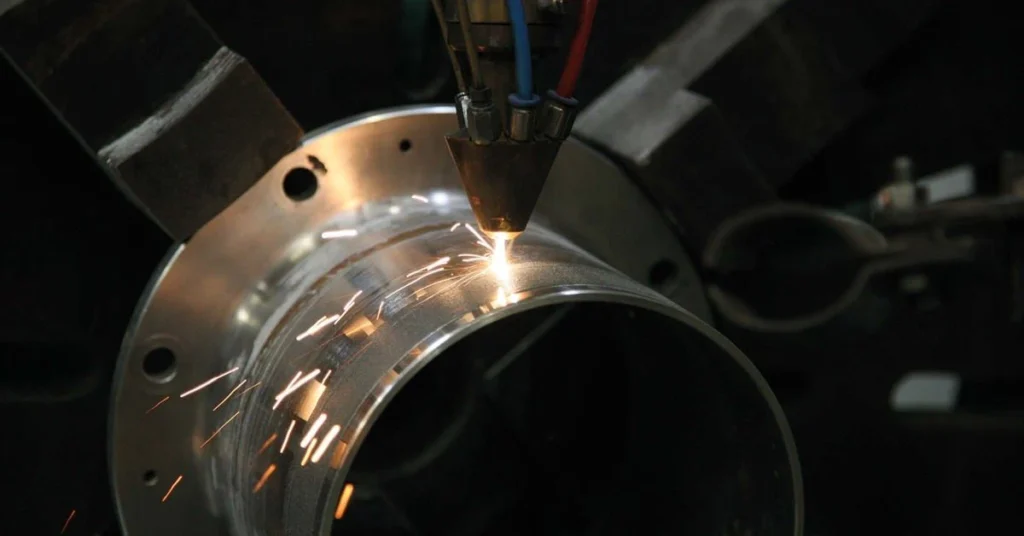
Our automated equipment precisely controls the laser path, powder feed rate, travel speed, and cladding profile to produce a consistent deposited layer.
03
Overlay Dimensional Accuracy
We can achieve overlay dimensional accuracy of up to ±0.003 in., depending on the geometry of the component and the required cladding profile.
04
Wide Material Selection
We process stainless steel, tool steel, Inconel®, cobalt alloys, titanium, and custom alloy powders to meet different wear, corrosion, and operating requirements.
05
Strong Metallurgical Bond
The deposited layer forms a strong metallurgical bond that improves wear resistance, corrosion resistance, and the working life of the component.
06
Quality Control
We inspect cladding thickness, bonding quality, surface condition, and final dimensions to confirm that each component meets the specified requirements.
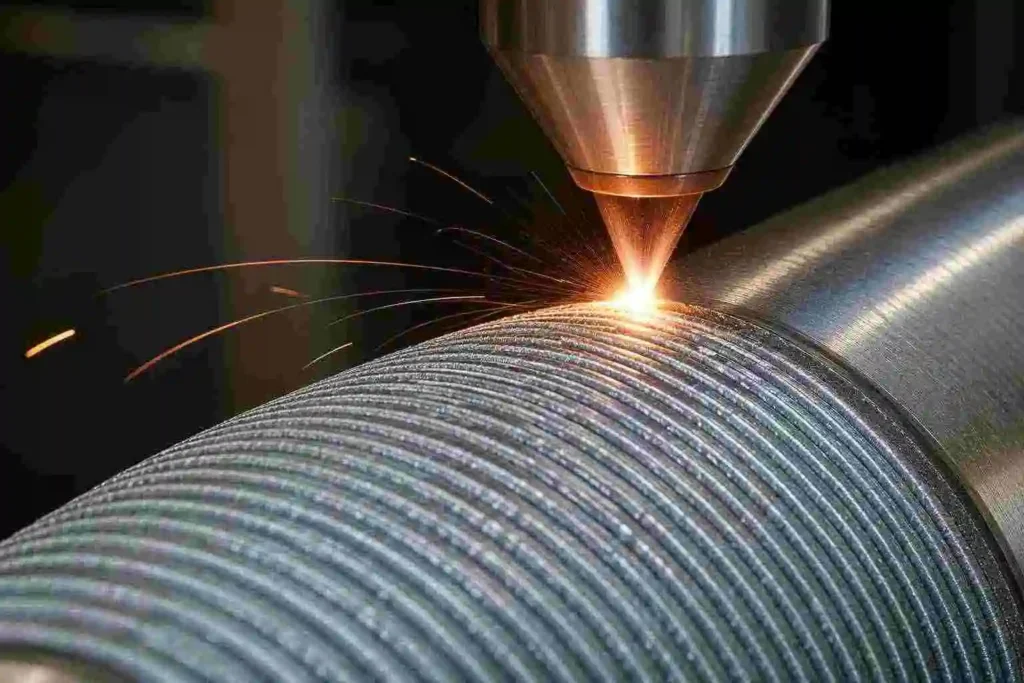
About Laser Cladding
- Applies a functional metal coating to selected surfaces.
- Creates a durable metallurgical bond with the base material.
- Improves resistance to wear, corrosion, erosion, and heat.
- Improves component performance before or during service.
About Laser Cladding
Review the Part and Application
We review your CAD model or drawings, target coating areas, base material, and service conditions. Our engineers select a suitable cladding alloy and coating strategy.
Surface Preparation
The coating area is meticulously cleaned to remove oil, rust, oxide, and contaminants. If needed, the surface is lightly machined and grit blasted before deposition.
Machine Setup
The component is securely mounted. Laser parameters, powder feed rate, travel speed, and cladding path are programmed for its geometry and coating thickness.
Laser Cladding
A focused laser melts a thin base layer while metal powder enters the melt pool. The deposited material forms a dense, uniform layer with minimal heat and distortion.
Cooling and Inspection
The part cools under controlled conditions. We inspect bonding quality, thickness, surface condition, and visible defects before the next operation.
Finish Machining and Final Quality Check
The clad surface is machined, ground, or polished as required, followed by dimensional and visual inspections before shipment.
Why Choose Laser Cladding Over Other Surface Treatment Methods?
| Performance Factor | Laser Cladding | Arc Welding Overlay | Thermal Spray Coating | Hard Chrome Plating |
|---|---|---|---|---|
| Heat Input to Base Material | Low | High | Low | No thermal input |
| Metallurgical Bond | Yes | Yes | No | No |
| Typical Dilution | Below 5% | 10 to 40% | Not Applicable | Not Applicable |
| Coating Hardness | Above 1000 HV | Lower than laser cladding | Up to 1000 HV | 800 to 1000 HV |
| Part Distortion | Minimal | Higher | Minimal | None |
| Heat Affected Zone | Narrow | Wide | None | None |
| Surface Density | Dense, low porosity | Moderate | More porous | Dense |
| Automation Capability | High | Moderate | Moderate | Moderate |
| Typical Coating Thickness | Above 0.020 in. | Above 0.020 in. | 0.020 to 0.040 in. | 0.002 to 0.006 in. |
Materials We Process with Laser Cladding
| Cladding Material | Typical Hardness (HV) | Typical Operating Temperature |
|---|---|---|
| H13 Tool Steel | 500 to 620 | Up to 600°C |
| 316L Stainless Steel | 180 to 280 | Up to 400°C |
| 420 Stainless Steel | 480 to 600 | Up to 550°C |
| Inconel® 718 | 350 to 470 | Up to 700°C |
| Nickel–Chromium Alloy | 250 to 350 | Up to 1,000°C |
| Stellite® 21 | 350 to 450 | Up to 600°C |
| Aluminium Bronze | 180 to 280 | Up to 400°C |
| Inconel® 625 | 220 to 320 | Up to 980°C |
| Nickel–Tungsten Carbide | 1,200 to 2,000 | Up to 650°C |
| Stellite® 6 | 500 to 620 | Up to 600°C |
Surface Performance Requirements Addressed by Laser Cladding
- Abrasive Wear
- Galling
- Erosion
- Cavitation
- Corrosion
- High-Temperature Exposure
- Oxidation
- Surface Hardness
Components We Commonly Laser Clad
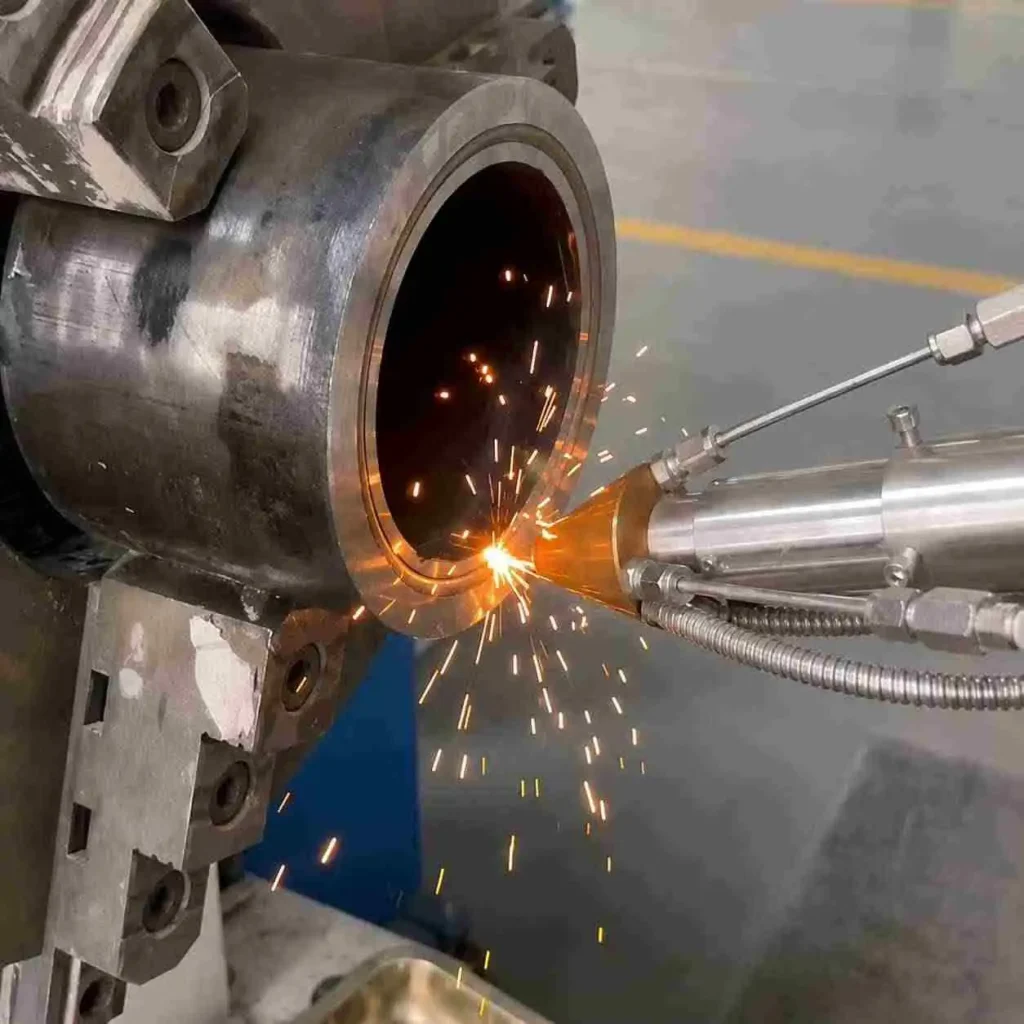
- Pump Shafts
- Valve Seats
- Gearbox Housings
- Seal Journals
- Glass Molds
- Rotor Shafts
- Exhaust Valves
- Flanges
- Rolls
- Mandrels
- Propeller Shafts
- Pump Impellers
- Steel Rings
- Crankshafts
- Wear Sleeves
- Compressor Wheels
- Bearing Journals
- Engine Components
Start With Your Coating Requirements
Define the Coating Your Part Needs
01
Coating material recommendation
02
Coating thickness and process plan
03
Defined coating and inspection requirements
For a faster feasibility review
- Drawing or CAD file with the coating area marked
- Base material grade and heat-treatment condition
- Required coating thickness and target surface property
- Operating temperature, contact media, and service conditions
- Wear, corrosion, heat, erosion, or hardness requirement
- Quantity and target delivery date