
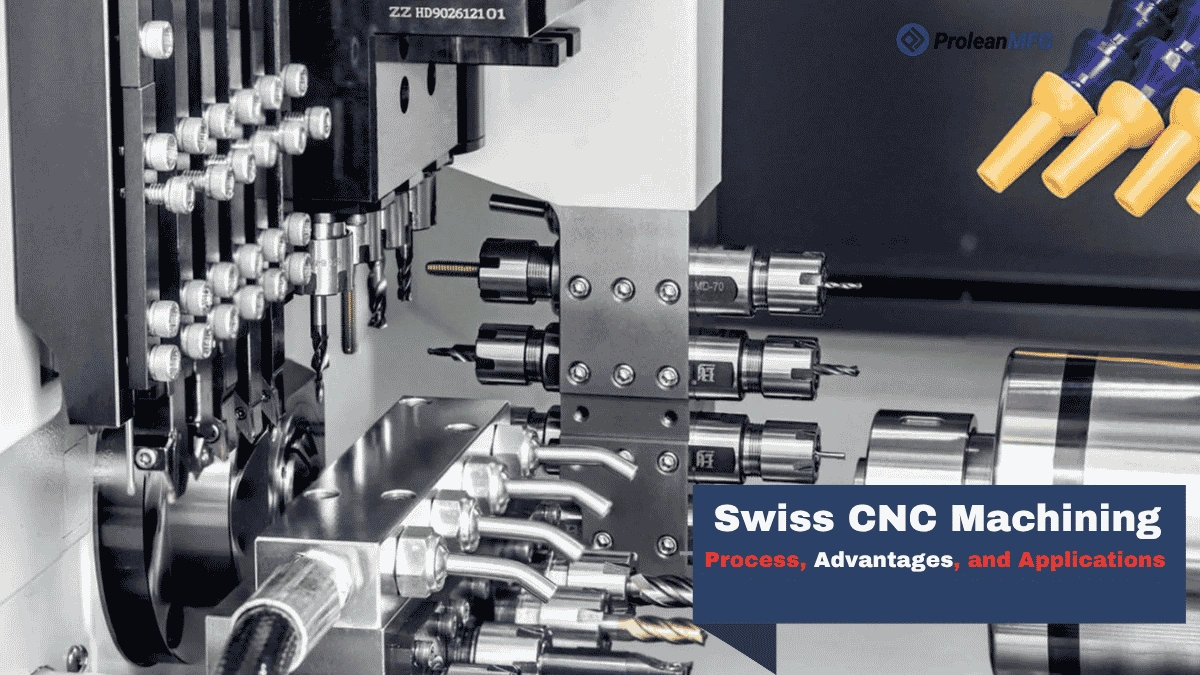

Swiss CNC machining is a precise manufacturing process for small, complex, and slender parts, with tolerances as low as ±0.0001 inches. The sliding headstock feeds the workpiece axially, whereas live tooling allows for performing turning, drilling, milling, and threading.
With the proper setup and chip control, parts such as medical implants, electronic connectors, fuel injectors, and aircraft components can be produced.
If you are an engineer or a small-business owner looking for small, slender parts with a diameter below 32mm or a length-to-diameter ratio above 3:1, conventional CNC machining cannot deliver the precision and customization you need. Here is the role of Swiss CNC machining: it can produce tiny & complex parts with great detail.
This article will explain what CNC Swiss precision machining is, how a CNC Swiss machine works, the industries that use Swiss machining, potential challenges & solutions, and the advantages.
What is Swiss CNC Machining?
Swiss CNC machining is a precision manufacturing process for small-diameter, complex, and tight-tolerance parts. Specialized CNC Swiss type lathes are used, with a guide bushing and sliding headstock providing stability during feeding.
You can use steel, copper, aluminum, titanium, and other materials to produce tiny components with tolerances of ±0.025 to ±0.005 mm, such as medical screws, aircraft fasteners, electrical connectors, and fuel injectors.
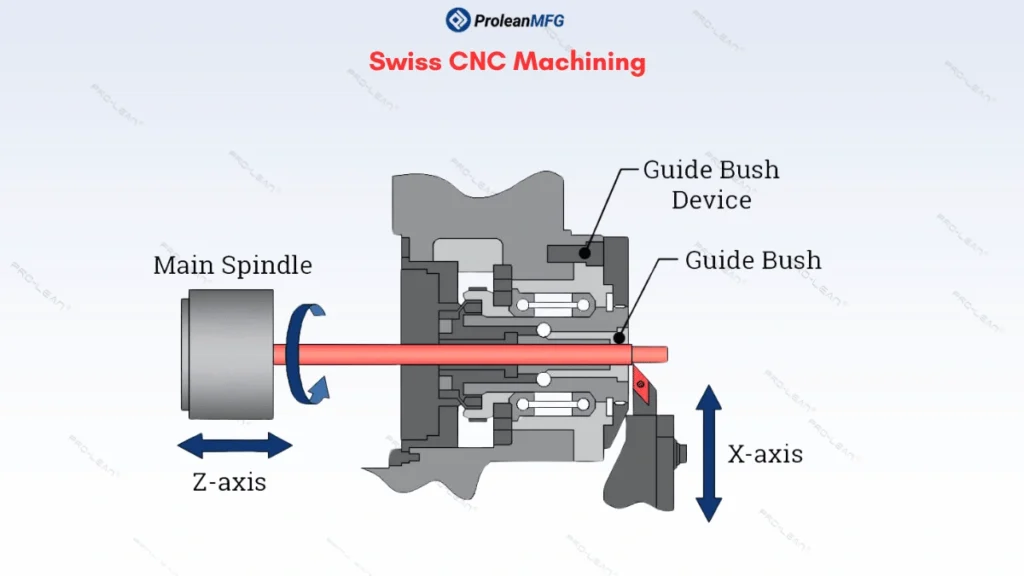
The guide bush is positioned close to the cutting tool, close to the machining area. Sliding headstock remains behind the guide bush, which holds and rotates the thin & long workpieces. During the process, the workpiece slides through the guide bushing. As a result, higher machining stability can be achieved.
What is Swiss Screw Machining?
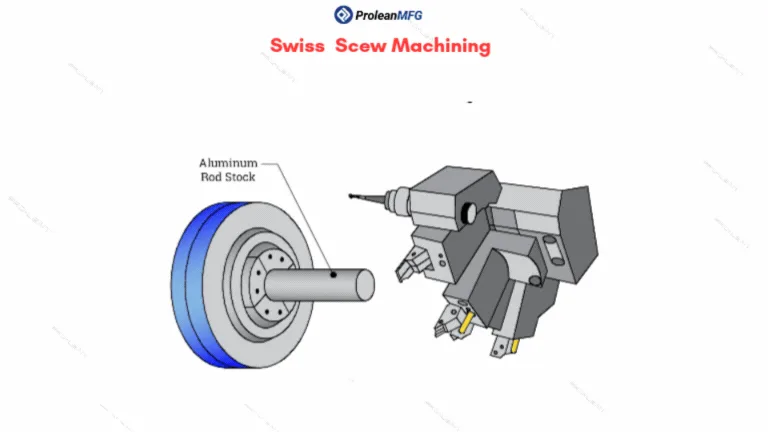
Swiss screw machining is similar to Swiss turning, a specialized precision machining process that produces complex, small-sized components through multiple operations, such as milling, cross-drilling, and tapping. Although the name sounds like it is only used for screw manufacturing, you can also use Swiss screw machining to produce other items, such as control pins, bushings, banjo bolts, sleeves, and shafts.
What is a Swiss CNC Machine?
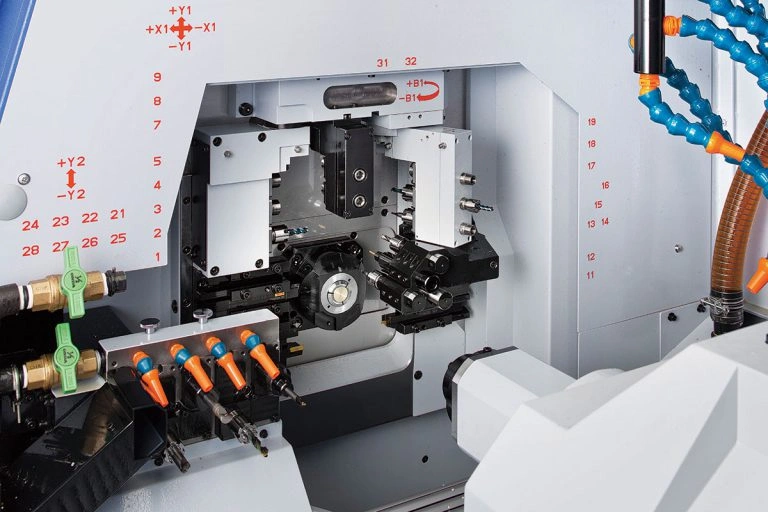
A Swiss CNC machine is specialized equipment for subtractive manufacturing of small, slender, and precise components through computer-controlled instructions. The setup and mechanism of a Swiss CNC machine (or a Swiss-type lathe) can perform milling, turning, and drilling operations in a single machine setup.
Swiss CNC machines are capable of performing multi-axis operations (5 or more) and feature a sliding headstock and guide bushing mechanism. The workpiece moves along the z-axis toward the cutting tool, supported by the guide bushing. So, the workpiece won’t bend or deflect during material removal.
At ProleanMFG, we use 5-axis CNC Swiss machines to create threads, tapers, thin walls, and custom contours with precision. They are efficient and have automation integration for high production speed.
History of Swiss CNC Machine
The development of Swiss-type machining is related to watch manufacturing; the first Swiss machine was developed in 1972 by Jakob Schweizer in Switzerland [1]. It was revolutionary in precision and speed of manufacturing watch screws and other micro-components. Jakob modified the traditional lathes with a guide bushing, headstock, sub-spindle, and live tooling.
How Does a Swiss CNC Machine Work?
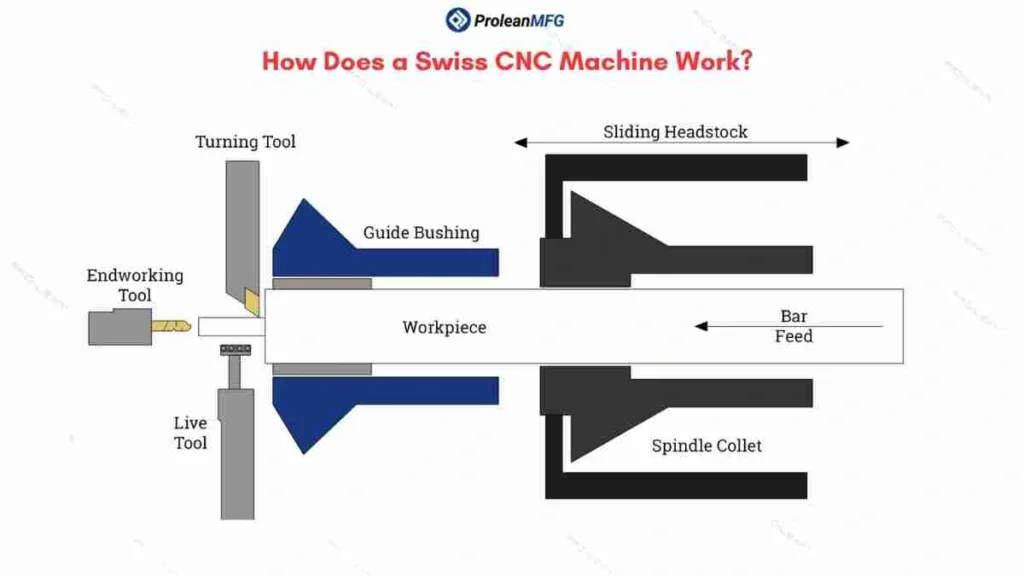
The main working principle of a Swiss CNC machine is “Stable barstock feeding through a guide bushing mechanism, which acts like sleeves and headstock passes the successive length of barstock into the machining area, very near to the cutting tool.”
Let’s break down the working Swiss CNC Machine
Guide Bushing
Guiding supports the barstock of a specific length (~1-3 mm) with minimal deflection. It can provide stability in the machining of slender parts, such as barstock with a length-to-diameter ratio higher than 20:1.
Sliding Headstock
In a Swiss CNC lathe or any other specialized Swiss machine, the sliding headstock moves the clamped barstock along the Z-axis through the support of a guide bushing. It allows passing the specific length of barstock to the machining tool.
Main Spindles and Sub-spindles
The main spindle holds the barstock and rotates at high speeds (~10,000 RPM or higher), allowing the cutting tools to remove material to the desired shape. Consequently, the subspindle picks the part for back-end machining from the main spindle.
Live Tooling & Machining Process
Besides turning, the Swiss machining process performs milling, drilling, tapping, and other operations. The tools are mounted on the machines, and they can perform off-axis machining operations. This multi-operation capability without re-fixturing makes Swiss turning diverse and efficient.
Is Swiss CNC Turning Different from Traditional Machining?
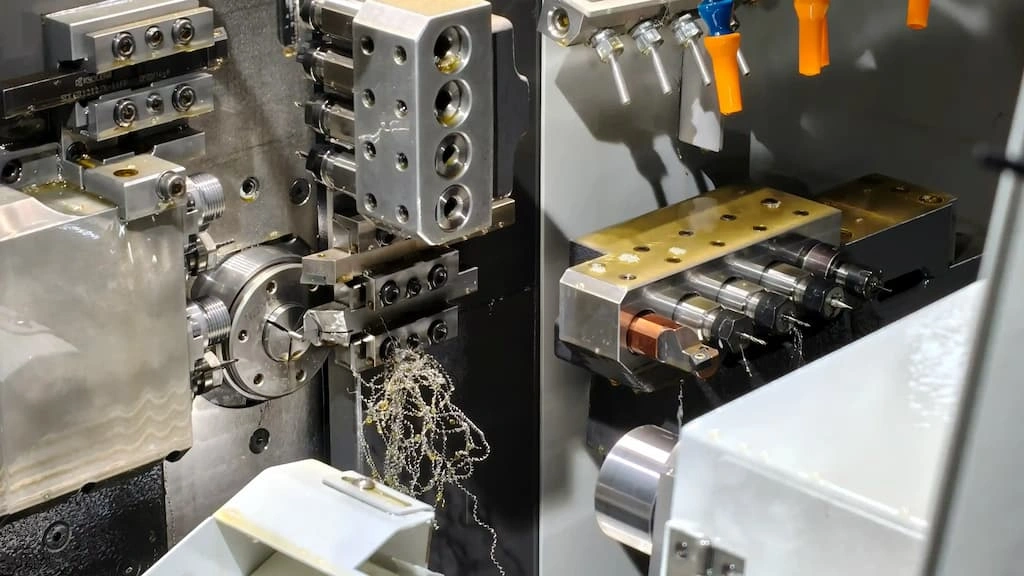
Yes, Swiss CNC turning is different from traditional lathe machining. It is carried out on a specialized Swiss CNC lathe having the capability of 5 to 13+ axes machining. The guide bushing supports material very near to the section being machined.
Swiss type CNC machining is chosen over traditional machining when the part diameter is below 32 mm, or the length-to-diameter ratio is higher than 3:1. Meanwhile, advanced machines can shape bar stocks with L:D up to 30:1.
Swiss vs. Traditional CNC Lathe comparison
A Swiss-type lathe is best for small, slender items that are difficult to machine with traditional lathes due to workpiece deflection and vibration. Traditional lathes are suitable for medium- to large-sized parts.
Let’s look at the decision matrix for choosing between Swiss and traditional lathes.
| Factor | Swiss CNC | Traditional CNC |
| Part Size | ≤32 mm bar stock (Choose for slender parts) | Medium-to-large diameters( Versatile range) |
| Precision | Minimal tool deflection, high precision | Chuck-only support deflects thin workpieces |
| Cycle Time | Simultaneous operations and suitable for large volumes | Suitable for medium-large volumes |
| Setup Complexity | Higher complexity, skilled operators are required. | Simple setup and operation |
| Upfront Cost | High intial investment | Relatively lower upfront cost |
| Axis capabilities | 3-12 axes capabilities | Typically, 3 to 7 axes |
| Best Industries | Medical, aerospace, electronics, watchmaking | Automotive, oil & gas, general manufacturing |
Can I Use Swiss Screw Machining for Precision?
Yes, you can use Swiss screw machining for the precision manufacturing of medical components, aerospace parts, assembly fasteners, and custom components. It offers general tolerances of ± 0.0005” ( ± 0.0127mm) and the tightest tolerance of ±0.0001”( ± 0.00254mm).
The exact tolerances vary with part geometry & complex features, material type, and the equipment you are using.
Industries Using Swiss CNC Machining: What Kind of Parts Can Be Made?
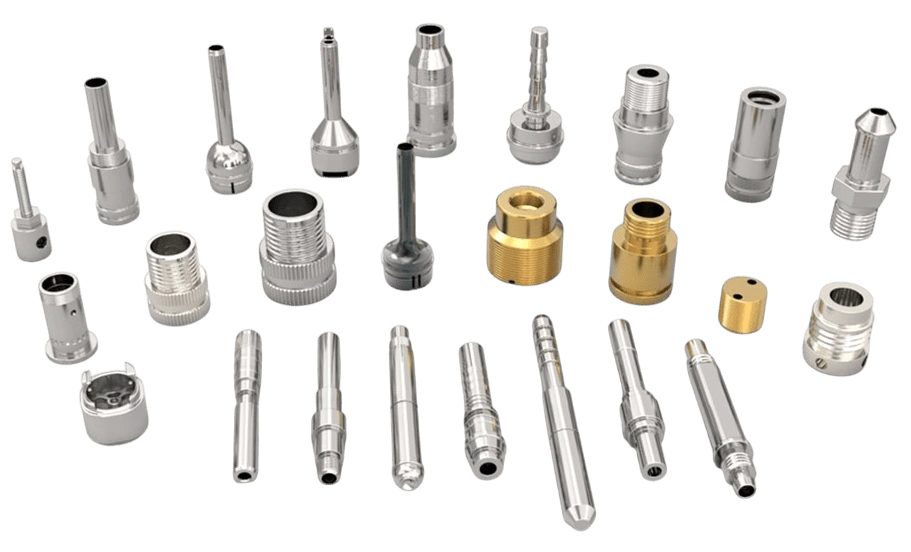
The automotive, aerospace, medical, electronic, firearms, and watchmaking industries rely on Swiss CNC machining to produce small & miniature components that are geometrically complex and require tight tolerances for performance.
Let’s see why Swiss CNC machining is used and what kind of parts can be made across the industries.
Automotive Industry
The high CNC machining tolerances and speed make Swiss lathes useful in automotive manufacturing. It can be used to make suspension springs & control arms, wheel rims, brake parts, shafts, bearings, fuel injectors, fuel supply lines, and exhaust system components.
Materials such as alloy steels 4140, Stainless steel 303 & 316, brass, aluminum, stainless steel, and PEEK plastics can be swiss turned for custom auto parts.
Aerospace Industry
CNC Swiss precision machining is used to produce small, lightweight aerospace parts with tolerances as low as ±0.0025 mm, which are beneficial for precise assembly and flight safety. For instance, engine fasteners, sensor probes, avionics screws, hydraulic fittings, fuel system parts, and gyroscope spindle shafts.
Medical Industry
CNC Swiss machining is used in the medical industry to produce surgical instruments, implants, and components for diagnostic devices. Swiss type lathes offer an as-machined finish up to Ra 0.4 µm, much needed in safety-critical components. The examples include bone screws, orthopedic implants, microfluidic diagnostic channels, dental braces & implants, forceps, and scalpels.
Electronic Industry
Swiss CNC machining produces small & miniature electronic components, such as connector pins, PCB terminals, switch parts, and fiber optic ferrules. Swiss CNC lathe allows machining of complex electronic components with cross-holes, treads, and flat profiles without refixturing the setup.
Firearms & Watchmaking
CNC Swiss turning produces small mechanical parts that can withstand high stress without functional failure, essential for firearms, defense equipment, and the watchmaking industry.
- Firearms & Defense: Firing pins, gun triggers, barrel bushings, pistons & valves, and missile components.
- Watch Making: Gear wheels, winding stems, lever pins, and barrel drums.
Swiss Screw Machining Challenges and How to Solve Them?
Small screw machining is typically carried out through CNC Swiss turning operations; they possess challenges like setup complexity, chip control, tool collision, barstock holding, and design limitations. These problems can be solved by using Swiss-specific CAM software, balanced feed & speed, and an efficient chip breaking mechanism.
| Challenge | Why it occurs | Solution |
| Setup complexity | The programming needs to be done for each spindle, and the sub-spindle must be aligned perfectly with the main spindle | Use Swiss-specific CAM software for programming and perform test runs before actual production. |
| Chip control | The long, stringy chips can nest around spindles, resulting in dimensional errors and a rough finish | Balance feed & speed according to chip thickness and use chip breakers |
| Tool collision | Since multiple tools work simultaneously, the risk of collision increases. | Use the tool path simulation for validations and the Channel Synchronization Manager |
| Bar stock holding | Since guide bushing clearance is fixed by the maximum bar diameter, segmented Swiss turning may lack support, leading to runout errors. | Use centerless-ground bar stock and set the bushing clearance to 0.005–0.01 mm; pre-grind the bar stock [2]. |
| Design limitations | Large-sized features and parts with L:D ratio greater than 4 are not preferred for Swiss machining. | Optimize part design with L/D >3:1. For wide & short parts, do not use guide busing. |
Which Materials Are Suitable for CNC Swiss Turning?
Stainless steel, aluminum, carbon steel, titanium, copper, brass, Nylon, Acetal, and many other engineering materials can be swiss-turned using a swiss type lathe machine. Bar stocks of these materials can be shaped with suitable tooling to produce complex and miniature custom parts.
- Stainless Steel: Grades such as 303, 304, and 316 can be swiss turned for high-strength, corrosion-resistant components in the medical, aerospace, fastening, and watch-making industries.
- Carbon Steel: It is a cost-effective material and offers moderate-to-excellent machinability. Carbon steels 1215, 12L14, 1144, and 4140 are the common grades used in Swiss turning.
- Copper: Copper is used where conductivity and ductility matter, such as in electrical connectors and heat sinks. It has good machinability and can be swiss-turned in C110, C101, and other copper grades.
- Aluminium: It is a lightweight material with high strength, and bar stock with a diameter below 1.5mm can be machined using a Swiss lathe.
- Brass: Brass is a conductive alloy made of zinc and copper. It offers excellent machinability and is used in Swiss turning to produce electrical terminals, precision fittings, and instrument parts.
- Nickel: Nickel alloys provide high thermal stability and fatigue strength. Due to the lower machinability of nickel, Swiss turning tools need to be replaced frequently
- Titanium: Titanium is strong, corrosion-resistant, biocompatible, and offers an excellent strength-to-weight ratio. It is difficult to machine and requires proper coolant flow to avoid heat buildup.
- Plastics: Different engineering plastics, such as PEEK, Nylon, Teflon, and Acetal, can be Swiss-turned into a custom shape with tolerances of ±0.001 inches (±0.0254mm).
Swiss CNC Machining Advantages
Tight dimensional accuracy, the ability to machine slender parts, a smooth as-machined finish, faster speed & efficiency, and flexibility in production volume are the main advantages of Swiss CNC machining. The guide bushing mechanism provides stability and avoids material deflection.
- High Dimensional Accuracy: Swiss CNC machining produces parts with tight dimensional tolerances, typically ±0.001 to ±0.0002 inches (~0.025 to ±0.005 mm), meeting the tolerances specified in ISO 2768(f) [2].
- Slender Parts machining: With Swiss type lathes, you can machine bar stock with a length-to-diameter ratio of 10:1 or higher.
- Smooth As-machined Finish: You can achieve a smooth finish with Swiss machining, typically with a Ra of 16 to 32 µin (~0.4 to 0.8 µm).
- High Production Efficiency: The fast cycle time and the ability to perform multiple operations make Swiss machining highly efficient.
- Suitable for Mass Production: You can use the CNC Swiss machining process for high-volume production (10,000+) of complex, slender parts.
Swiss CNC Machining Disadvantages
High upfront costs, longer setup times, and complex programming are the three main disadvantages of CNC Swiss machining.
- High Upfront Cost: CNC Swiss type lathes or other equipment are more expensive to install, with an industry-standard Swiss machine costing $150,000+.
- Longer Machine Setup Time: The tool and workpiece setup, their alignment, and tool changeover are time-consuming in swiss machining.
- Complex Programming: Due to multiple-spindle motion, CNC programming is more challenging for Swiss lathes than traditional machining.
Summing Up
Swiss CNC machining delivers flexibility and precision in the machining of small, complex, and slender parts. The conventional lathes or CNC machines struggle in machining stability while creating parts with a diameter below 32 mm and an L: D ratio higher than 3:1.
The Swiss-type CNC lathes can work with parts requiring an L:D ratio up to 30:1. The guide bushing & sliding stock mechanism provides stability in machining of such parts.
Although the Swiss CNC machining has extensive capabilities, you need to choose the higher axis machines for complex components and ensure the right type of tooling & machining setup.
At ProleanMFG, we use multi-axis (3, 5, and higher) Swiss CNC machines with sub-spindles, live tooling, and dual-spindle synchronization. Our Swiss CNC machining services are diverse, precise, and cost-effective, providing custom solutions across industries, with a minimum lead time of 1 day.
We can provide you with past project catalogs and accurate estimations. So, upload your design and request a quote now.