
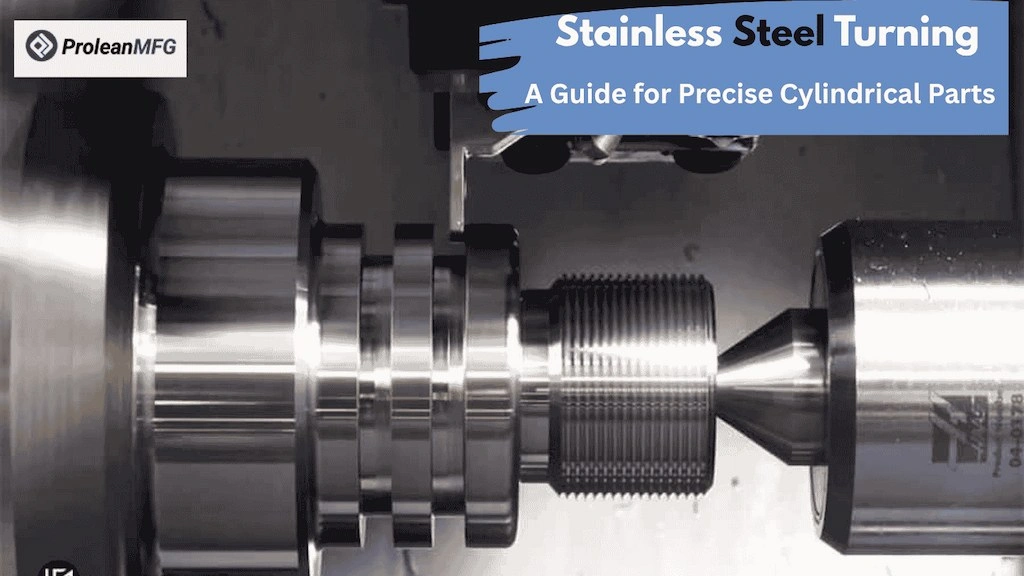

Stainless steel is used across industries to produce axially symmetrical parts, from simple cylindrical shafts to automotive engine components and aerospace parts. With the need for more precise and complex parts, manufacturers are using advanced CNC lathes and multi-axis machining centers.
CNC turning stainless steels requires an understanding of material properties, tooling, machining variables, and many other factors.
This article will guide you through stainless steel grades, the turning process, advantages, applications, and common challenges.
Let’s get started!
What is Stainless Steel Turning?
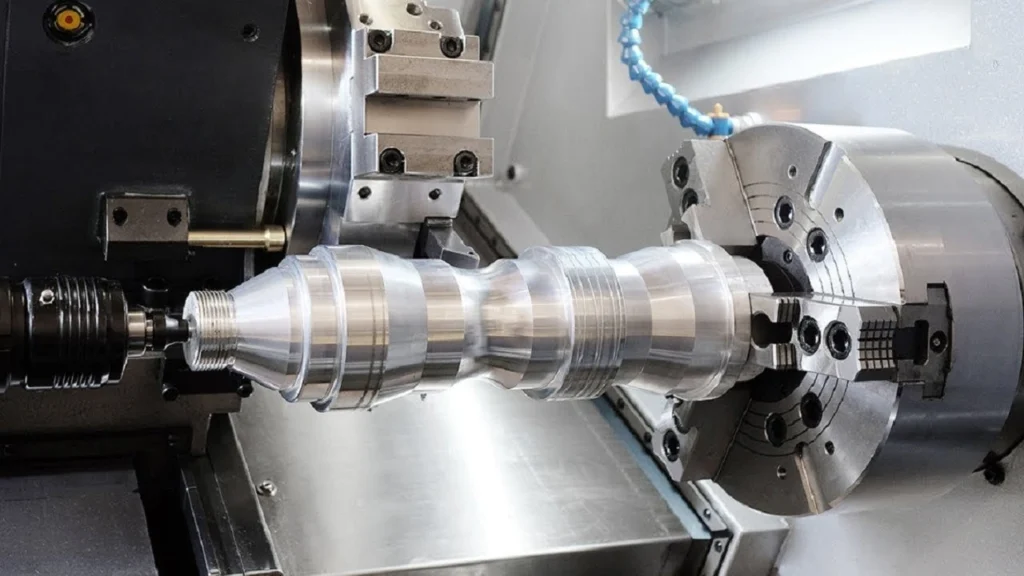
Stainless steel lathe turning
It is a type of stainless steel CNC machining that creates cylindrical shapes and internal & external features on them. Like turning any other material, stainless steel turning involves rotating the workpiece, and a stationary tool that moves along the workpiece for controlled material removal.
“ Stainless turning allows to reduce diameter, and shaping stepped-sections, circular slots, tapers, bores, grooves, and many other features.”
In manual lathes, the operator controls the position and movement of the cutting tool through mechanical wheels & levers, and guides the material feed. On the other hand, CNC turning allows automation in tool movement, feed rate, rotating speed of the workpiece, and auxiliary functions of machines.
Stainless Steel Material as a CNC Turning Material
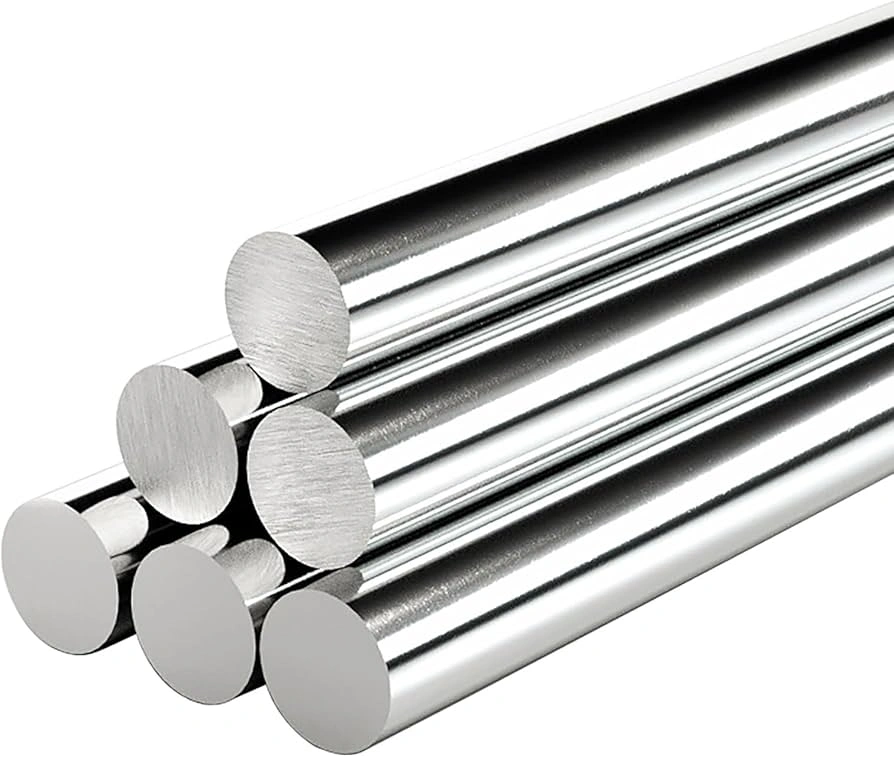
Stainless steel barstock
Stainless steel is a high-performance engineering alloy made of iron, chromium, carbon, nickel, and molybdenum, along with a few other additives in minor amounts.
Alloying elements are melted, mixed in a furnace, refined on a grain level, and cast to produce different shapes of raw material, which are later used in CNC turning.
You also have options for stainless steel parts turning, including 304, 316, and 416. Each of these stainless steel types/grades includes a unique alloying composition and is suitable for distinct applications.
For instance, machining 316 stainless steel is suitable for marine and high-corrosion applications, whereas 304 is used for general machining projects.
Types of Stainless Steel used in CNC Turning
The common types/grades of stainless steel used in CNC turning include Stainless Steel 303, 304, 316, 416, 430, and 17-4 PH.
Stainless Steel 303
SS 303 is an austenitic free-machining stainless steel grade with excellent machining performance. It offers good strength and moderate corrosion resistance, but lower than that of 304.
You can use this to turn precision parts, such as screws, nuts, shafts, valve components, and fittings, where machining efficiency is critical.
- Alloying Composition: ~17–19% of Cr, 8–10% of Ni, and 0.15–0.35% of Sulfur
- Machinability: Excellent due to sulfur presence
Stainless Steel 304
It is an austenitic stainless grade that provides high corrosion protection, good weldability, and durability to turning parts. SS 304 can be turned for shafts, fasteners, architectural parts, and food processing components.
- Alloying Composition: ~ 18–20% of Cr, 8–10.5% of Ni
- Machinability: Poor to moderate & risk of work hardening
Stainless Steel 316
This type of stainless steel is considered to have low machinability due to high toughness and work hardening. However, it offers excellent toughness, high strength, and corrosion resistance in chloride environments.
Machining 316 stainless steel is heavily beneficial for shipbuilding, underwater & offshore equipment, chemical processing, and other applications.
- Alloying Composition: ~16–18% of Cr, 10–14% of Ni, and 2-3% of Mo
- Machinability: Low machinability requires carbide or hard-coating tools.
Stainless Steel 416
Stainless steel 416 is also known as a free-machining martensitic grade. Although SS 416 has only moderate corrosion resistance, it offers good strength and heat-treatment properties. Some common applications include automotive parts, screws, and bolts.
- Alloying Composition: ~12–14% of chromium and a small amount of sulfur
- Machinability: Excellent
Stainless Steel 430
Stainless steel 430 offers moderate corrosion resistance, good formability, and lower costs than other grades. Furthermore, this stainless steel is used in CNC turning to produce automotive trims, exhaust system components, appliance parts, and decorative items.
- Alloying Composition: ~16–18% of Cr
- Machinability: Good, but prone to galling; slower speeds are recommended.
Stainless Steel 17-4 PH
It is a heat-treatable stainless steel that provides excellent mechanical strength, good corrosion resistance, and toughness. You can use 17-4 PH for various aircraft, defense, and vehicle parts.
- Alloying Composition: ~15–17.5% of Cr and 4% of Ni, and 3–5% of Cu
- Machinability: Relatively high machinability compared to other hardened steels.
What is the Easiest Stainless Steel to Machine?
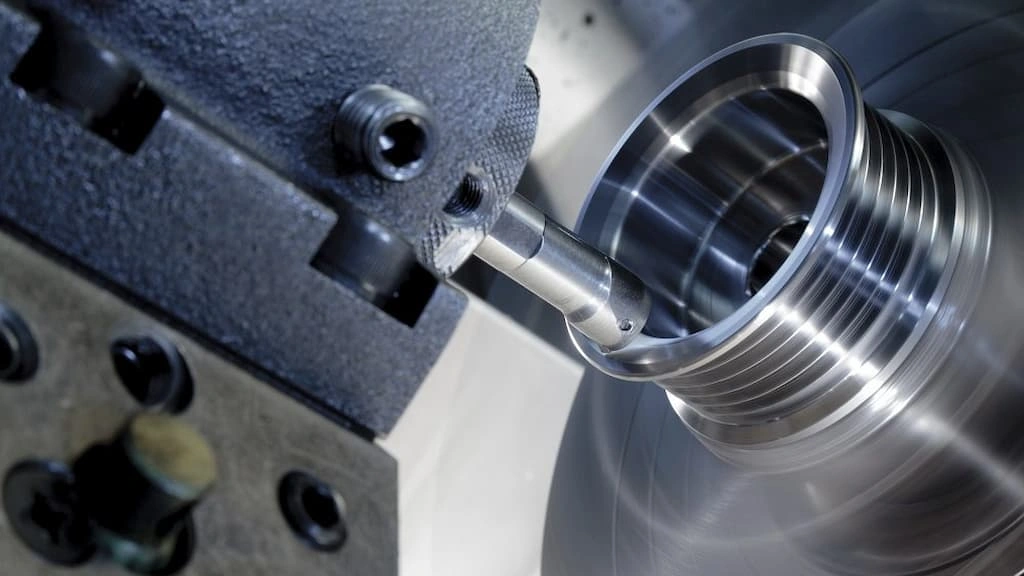
Boring stainless steel in a lathe
The easiest stainless steel to machine is Grade 303. It is often known as a “free-machining grade” due to its high machinability in turning, milling, drilling, and other processes. This is because 303 contains up to ~0.3% sulfur, along with Chromium & Nickel.
As a result, stainless steel 303 produces shorter chips with regular breaks and produces less heat, making the CNC turning process easier
The Step-wise Workflow of CNC Stainless Steel Turning Process
The stainless steel CNC turning process involves several steps, from part design and programming to post-processing.
Let’s look at the step-wise workflow: part design, material selection, CNC programming, machine setup, turning process, and post-processing.
- Part Design: Create a detailed engineering design of the stainless steel component you want to CNC-turn, considering manufacturability and tolerance control.
- Material Selection: Choose the appropriate stainless steel that meets your application requirements and has good machinability.
- Tool Selection: Choose a suitable CNC turning tool based on design complexity and features.
- CNC Programming: Create a CNC program for stainless steel parts turning and upload it into the control unit.
- Machine Setup: Hold the workpiece on the chuck/collet, the cutter on the tool holder, and mount it on the turret. Then, calibrate the alignment and position tool at the initial machining co-ordinates.
- Turning Process: As the program runs, the tool moves and feeds material from the rotating workpiece, following a pre-determined tool path.
- Post-Processing: Once turning is complete, perform finishing operations on stainless steel parts, such as bead blasting, deburring, electroplating, or powder coating.
What Are the Applications of Stainless Steel Turning?
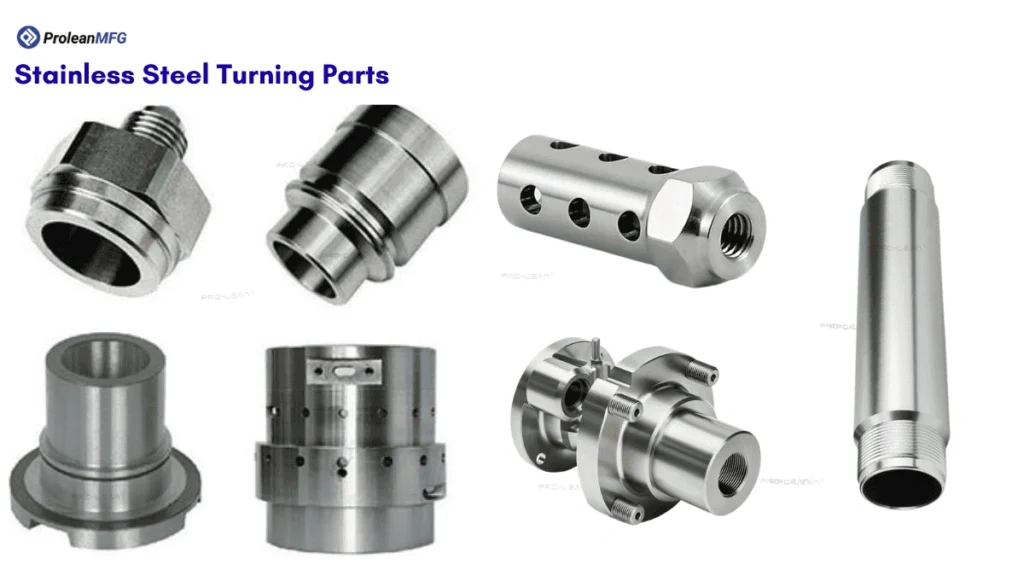
Stainless steel turning parts
Stainless steel turning is used across multiple industries to produce precise cylindrical and conical components with complex geometrical features.
Let’s look at applications for stainless steel parts turning in the automotive, aerospace, marine, food processing, industrial machinery, and medical industries.
| Industry | Why Stainless Steel? | CNC Turned Components |
| Automotive | Durability, heat resistance | Fuel fittings, shafts, and exhaust parts |
| Aerospace | High strength, heat resistance | Fasteners, brackets, hydraulic parts |
| Food Processing | Easy cleaning, non-toxic | Nozzles, rollers, fittings |
| Industrial Machinery | Wear resistance, long life | Gears, valves, shafts |
| Marine | Corrosion resistance in salt water | Valves, flanges, and pump shafts |
| Medical | Biocompatibility, hygiene | Surgical tools, implants, and connectors |
Challenges in Stainless Steel Turning
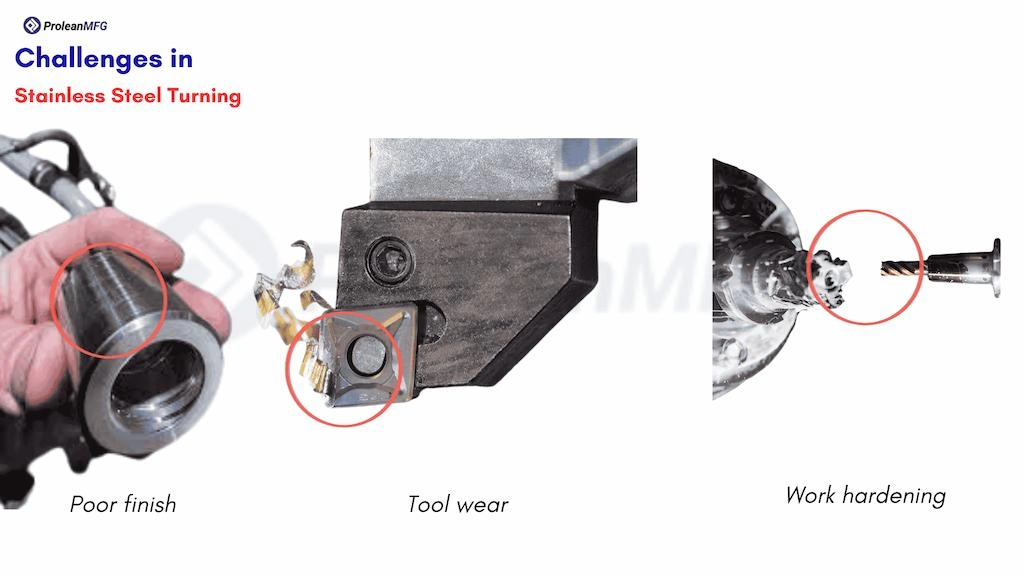
Challenges in steel turning
Rapid tool wear, thermal management, work hardening, formation of long chips, poor finish, and unwanted vibration are the challenges in stainless steel turning.
Let’s break down the challenges and how to avoid them.
Rapid Tool Wear
This challenge is particularly associated with hard stainless steels, such as 17-4 PH. Rapid tool wear leads to dimensional inaccuracies and frequent tool replacements.
How to Avoid: Set right turning parameters, use coated cutters & inserts, and monitor the tool wear periodically.
Thermal Management
The low thermal conductivity of stainless steels leads to heat buildup at the interface between the tool and the workpiece during machining.
How to Avoid: Choose the correct feed rate & spindle speed and apply effective coolants.
Work Hardening
High cutting forces and heat generated during CNC turning cause plastic deformation of the material near the tool engagement, a phenomenon known as work hardening. It increases hardness and makes the turning process difficult.
How to Avoid: Use sharp tools, correct feeds & cutting depth, and choose tool material wisely.
Long and Stringy Chips
Chip control is another challenge in stainless steel turning, as long chips tend to wrap and affect the evacuation.
How to Avoid: Consider tool geometry, coolant flow, and material removal rate.
Poor Finish
Stainless steel CNC turning can result in a rougher as-machined finish on turned parts, especially due to a lack of lubrication, inadequate machining parameters, and poor tool selection.
How to Avoid: Use the right tools, set a small depth of cuts & feeds.
Vibration While Machining
Excessive vibration can occur during stainless steel CNC machining, especially if the setup is not rigid enough, the machining fixturing has issues, or the machine lacks a strong foundation.
How to Avoid: Increase rigidity of the CNC turning system, use lower cutting forces, and choose the correct tool geometry.
What Are the Advantages of Stainless Steel Turning?
The excellent mechanical characteristics of stainless steel materials and the capabilities of the CNC system combinedly offer many benefits, such as high strength, thermal stability, corrosion resistance, dimensional stability, diverse finishing options, impact strength, and availability of non-magnetic grades.
Let’s look at the stainless steel turning advantages:
- Mechanical Strength: The high strength enables CNC-turned stainless components to withstand high loads.
- Thermal Stability: Stainless steel does not lose strength at elevated temperatures up to ~980°C.
- Corrosion Resistance: Stainless steels are corrosion-resistant and can be used in harsh environment applications.
- Hygienic Surface: Stainless steel is easy to clean and maintains excellent hygiene, making it suitable for food-processing applications.
- Dimensional Stability: CNC turned stainless parts maintain dimensional stability over time.
- Diverse Finishing Options: Different finishes, such as polishing, coating, or plating, can be applied to stainless steel turning parts.
- Impact Strength: High impact strength allows stainless steel parts to withstand mechanical shocks and sudden loads.
- Non-magnetic Parts: Austenitic stainless steel grades can be used to produce non-magnetic parts for electronics, telecommunications, and other sectors.
Stainless Steel Turning vs Other CNC Machining Processes
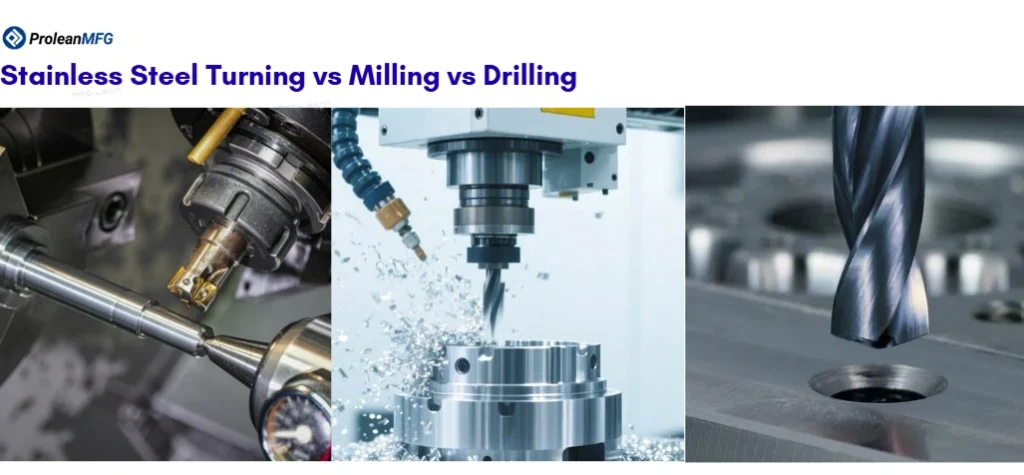
Stainless steel turning vs other machining processes
Milling & drilling are two other stainless steel CNC machining processes; they differ from turning in machining orientation, shape & feature capabilities, tooling, and application preferences.
Next, let’s take a look at the comparison table below.
| Aspect | CNC Turning | CNC Milling | CNC Drilling |
| Working | The stainless workpiece rotates, and the tool moves linearly | A rotating cutter shapes a stationary workpiece | A rotating drill penetrates material to create precise holes |
| Best for Part Geometry | Cylindrical /round /conical parts | Complex, multi-sided shapes | Cylindrical holes |
| Operations | Facing, threading, boring, grooving | Slotting, profiling, contouring, pocketing | Hole drilling, reaming, tapping |
| Surface Finish | Excellent for round surfaces | Smooth Ra ~1.6 to 3.2 µm | Rougher than milling |
| Material Compatibility | Best for bar stock stainless steel | Suitable for hard & complex SS parts | Suitable for most stainless alloys |
| Production Efficiency | Very fast for repetitive round parts | Slower for complex parts, but versatile | Fast for simple hole operations |
| Typical Components | Shafts, bolts, bushings | Engine parts, brackets, molds | Holes in flanges, plates, components |
| Intricate feature capability | Low–Medium | Very High | Low |
Which Factors Affect the Stainless Steel Machinability for CNC Turning?
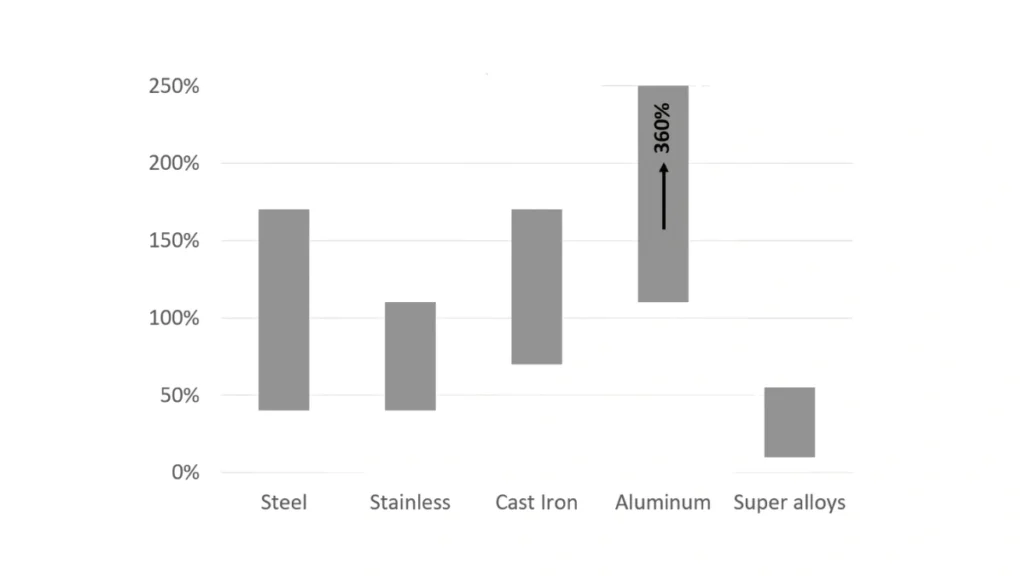
Stainless steel machinability
Hardness, sulfur content, microstructure, heat generation, chip formation, lubrication, cutting edge geometry, toughness, and work hardening rate are the common factors affecting stainless steel machinability.
Let’s further break down these factors.
- Hardness of Stainless Steel Alloy: The harder the stainless steel alloy, the lower the machinability. For turning hard SS grades, choose coated tools and slower cutting speeds.
- Sulfur content: If the alloying composition contains sulfur, it increases the machinability. For instance, ~0.1 to 0.3 % of sulfur makes 303 an easiest stainless steel to machine.
- Microstructure: Microstructures affect chip formation and machinability. For instance, austenitic grades are relatively difficult to machine.
- Heat Generation & Buildup: If heat is generated at the machining interface and does not dissipate away, it can cause workpiece & tool distortion, reducing the machinability of stainless steel.
- Chip formation: If the stainless steel workpiece produces long, continuous chips, it lowers the machinability.
- Lubrication & Coolant Flow: Use of proper coolant flow & lubrication makes stainless steel turning easier.
- Geometry of Cutting Edges: Sharp edges make the turning process easier, whereas worn & dull edges reduce the machinability.
- Toughness: Tougher stainless steel grades possess the risk of fractures & deformation during CNC turning. So, ensure a rigid setup and correct tool selection.
- Work Hardening Rate: Stainless steels with a higher tendency for work-hardening rates cause tool wear and lower the machinability as the machining cycle passes.
Summing Up
Stainless Steel Turning has several benefits for the manufacturing of cylindrical & conical components across industries. It can be used for operations like roughing, facing, grooving, boring, threading, and splitting. This operational diversity gives machining flexibility.
No matter which type of stainless steel you are turning, you must consider material properties, tooling, speed & feed, setup, and heat-generation, coolant strategy, and surface finish for high-quality & defect-free parts.
At ProleanMFG, we offer comprehensive CNC Turning Services for your custom needs. We have multi-axis CNC lathes and Swiss turning machines, along with a specialized quality-control facility. Additionally, our more than a decade of experience in this industry can be helpful for your project success.
FAQs
Is stainless steel hard to turn?
Yes, particularly austenitic stainless steel is harder to machine than other engineering metals like aluminum alloys.
What is the best stainless steel for turning?
Stainless steel 303 is considered the best stainless steel for turning because it has excellent machinability due to the presence of sulfur.
Is 303 or 304 better for machining?
Stainless steel 303 is better than 304 for machining because it has higher machinability due to sulfur content and produces shorter chips during the material removal process.