
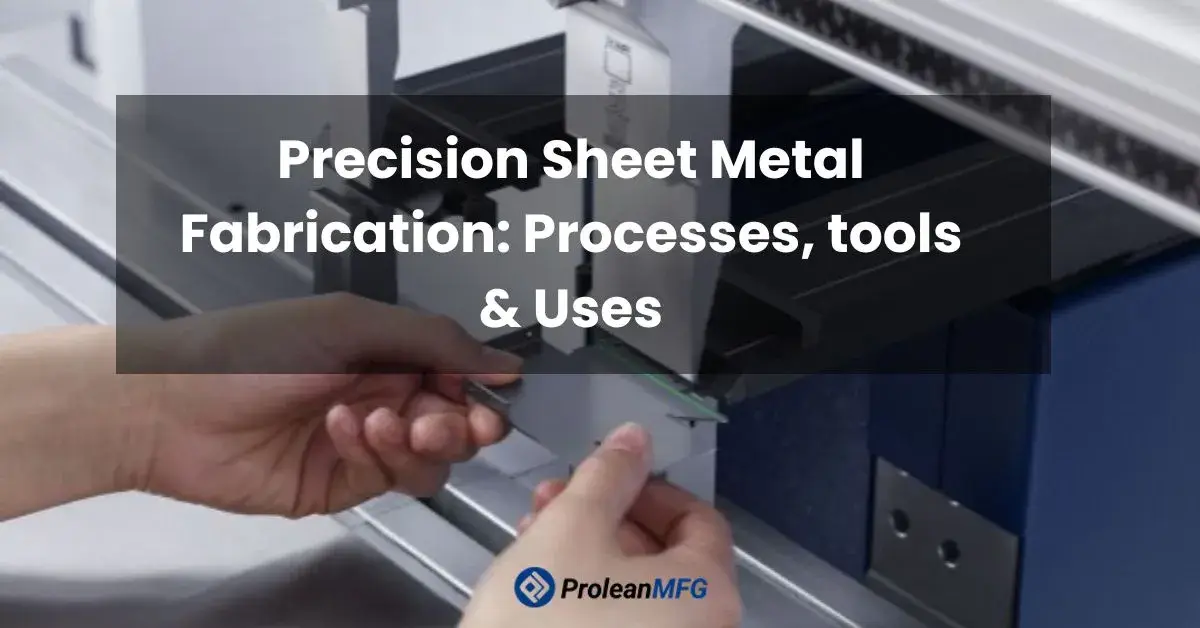

When a product fails on the market, it is usually due to manufacturing tolerances that were not tight enough. Even a fractional millimeter can be detrimental to an assembly in industries such as aerospace, medical devices, and electronics. Precision sheet metal fabrication is a separate discipline from general metalworking. Not only is it about cutting and bending sheets of metal. It’s about getting exact, repeatable results in high-volume production runs. Consistency is not negotiable.
Global sheet metal fabrication is steadily growing, driven by the increasing demand in construction, automotive, and electronics. Manufacturers are being pushed to tighten tolerances and produce fewer rejects as product designs get more complex. To meet the demands of custom sheet metal fabrication, manufacturers are increasingly relying on CNC automation and advanced forming technology, as well as digital quality control.
ProLean MGF works with engineers and manufacturers to provide custom sheet metal fabrication services to those who require precision sheet metal products to be built according to their exact specifications. Understanding the entire fabrication process can help you communicate better with your manufacturing partner and make better decisions when sourcing components.
What is Precision Sheet Metal Fabrication (PSMF)?
This process involves a series of operations that combine cutting, joining, finishing, and forming to transform flat metal sheets into components or assemblies. Dimensional accuracy is the defining characteristic. The final part must match the engineering drawing to within a specified tolerance, usually within 0.1mm, depending on the application.
Precision fabrication requires consistency in every unit of a batch. This is different from general fabrication, where rough dimensions or visual quality are acceptable. The same part that passes the inspection of unit one must also pass the inspection of unit five hundred. It is not enough to have the right equipment, but you also need rigorous process control, skilled operators, and calibrated measuring tools.
Raw Materials used in Precision Fabrication
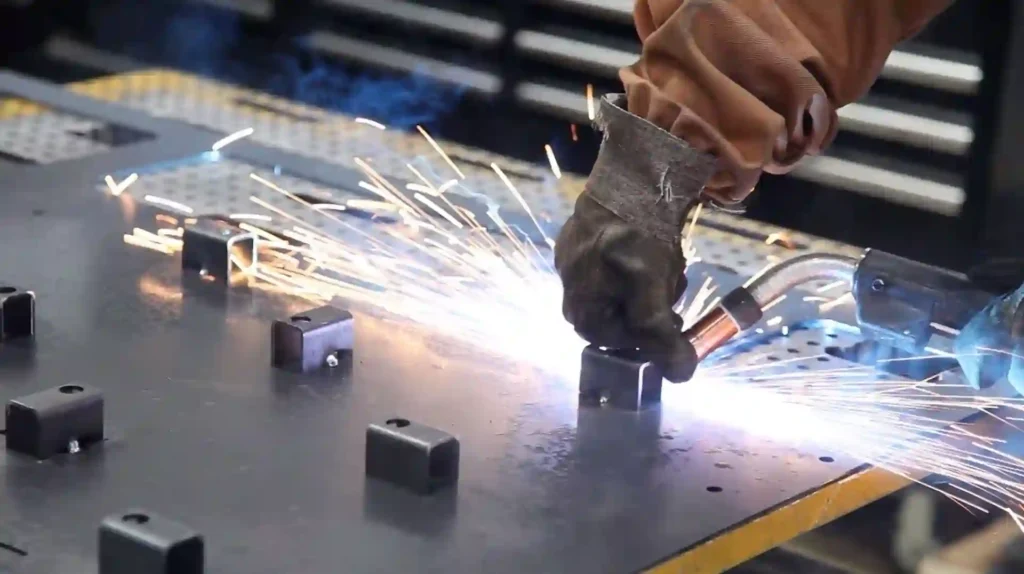
Welding of sheet metal parts
Material choice directly impacts machinability and strength as well as cost. The common types of sheet metal used in fabrication are:
- Mild steel: It is an affordable, easy-to-weld, and suitable material for structural components
- Stainless steel: It is corrosion-resistant and used in the food, chemical, medical, and pharmaceutical industries.
- Aluminum: It is lightweight with an excellent strength-to-weight ratio. Widely used in aerospace, electronics, and other industries.
- Copper and Brass: It provides high conductivity, are used in electrical components, and decorative applications
- Galvanized steel: It is zinc-coated to resist corrosion and is commonly used in HVAC and construction
The material selection process is the first step in any fabrication project. It directly impacts which tools and processes will be used downstream.
Types of Metal Fabrication Techniques
Sheet metal fabrication does not involve a single process. It is a series of processes that each serve a different function to transform raw material into a finished part. Understanding the different types of metal fabrication processes helps buyers and engineers specify the best manufacturing route for components.
Cutting
The first step of most fabrication workflows is sheet metal cutting. The first step in most fabrication workflows is cutting.
Cutting methods that are commonly used include:
- Laser cutting: lasers use a focused beam for complex shapes, with clean edges and high accuracy. Ideal for materials of thin to medium gauge.
- Plasma cutting: It uses ionized gases to cut metals more quickly at high speeds. Ideal for structural steels and heavy plates.
- Waterjet cutting: It uses high-pressure water mixed with abrasive powder. It is suitable for heat-sensitive materials as it has no heat-affected zone.
- Punching: It uses a punch-and-die set to stamp profiles or holes into the sheet. For high-volume runs, punching is a cost-effective and fast solution.
- Shearing: It makes straight cuts in sheet metal. Ideal for trimming and squareing blanks.
Each cutting method is different in terms of speed, edge quality, and material compatibility. Laser cutting is the preferred method for precision applications because of its accuracy and flexibility.
Precision Sheet Metal Forming
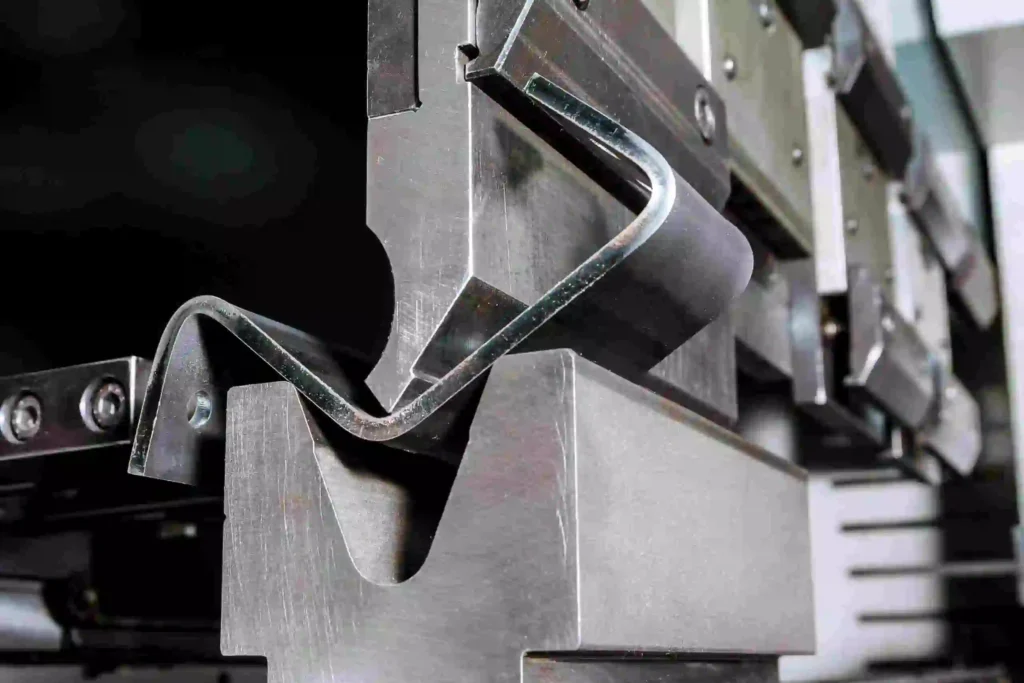
Press brake tool
After the blank has been cut, it must be shaped. Precision sheet metal forming is a process that changes the geometry of a sheet without removing any material.
The following are the key forming operations:
- A press brake bends by applying force in a straight-line direction to create angles and flanges. The bend angle, radius, and springback all need to be precisely controlled.
- In roll forming, a sheet is passed over a series of rollers to create long profiles with a consistent cross-section.
- In deep drawing, the sheet is drawn into a die and shaped to resemble a cup or box. Useful for enclosures and housings.
- Stamping is a set of dies that forms the sheet with a single stroke. High-speed and ideal for large-volume production.
- In hydroforming, the fluid pressure is used to form the sheet in opposition to a die. Produces complex forms with minimal thinning.
Precision sheet metal forming is a complex process that requires meticulous engineering. The final geometry is affected by springback, material anisotropy, and tool wear. These factors must all be taken into account in the setup.
Joining and Assembly
Assemblies are created after components have been cut and formed. The sheet metal assembly process uses a variety of joining methods.
- TIG and MIG: It is used for permanent, strong joints in aluminum and steel
- Spot welding: It’s a fast and easy way for sheet metal assemblies
- Riveting: It is a mechanical method of fastening dissimilar materials together, or in cases where welding is not possible.
- Hardware installation: Before finishing, press-fit nuts and studs are installed.
In assemblies that must carry structural loads or have a clean aesthetic appearance, weld quality and distortion control are critical.
Finishing
Sheet metal finishes protect and enhance the appearance of the component. Powder coating, anodizing, and electroplating are common finishing operations. The material, operating environment, and aesthetic requirements will determine the choice.
The industries that rely on precision sheet metal fabrication
Precision sheet metal is used in a variety of industries. These industries are united by the fact that they cannot tolerate any dimensional variations or inconsistencies.
| Industry | Examples of Typical Applications |
| Aerospace | Brackets, enclosures, structural panels |
| Medical Devices | Instrument frames, surgical trays, and housings |
| Electronics | Chassis enclosures, heat sinks, and EMI shielding enclosures |
| Automobile | Body panels, battery enclosures, and brackets |
| HVAC | Ductwork dampers and air handling units |
| Industrial Equipment | Machine guards and frames. Control panels |
| Construction | Structural components, cladding, and roofing |
The requirements for each industry are different, including tolerances, surface finishes, certifications of materials, and traceability. Precision sheet metal fabricator working in aerospace must adhere to quality and documentation standards that are far higher than those required by general industry.
What makes a precision sheet metal fabricator different?
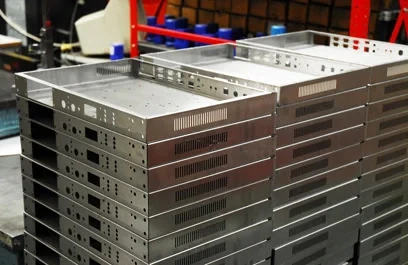
Stacked precision metal racks
Not every metal shop can deliver precision work. Equipment capability, process discipline, and quality infrastructure are the main differences between a general sheet metal fabricator and a precise sheet metal fabricator.
Precision fabricators invest in:
Computer numerical control (CNC) eliminates operator-dependent variations. CNC punching, laser cutting, and press brake machines are capable of executing programs that produce consistent results for thousands of parts.
Tight Tolerances: Precision fabricators work to tolerances as tight as plus or minus 0.01mm, and not just for special cases.
In-Process Checks: Using calibrated instruments such as CMMs (coordinate measurement machines), every part is checked before shipping.
Material traceability: Standard practice for precision work is to use certified materials, mill test reports with lot tracking, and documented process controls.
Skilled Workforce – Operators with a thorough understanding of the material properties, tool conditions, and process parameters are required to maintain tight tolerances.
Ask about the tolerances, inspection equipment, and quality certifications when evaluating sheet metal fabrication. ISO 9001 certifications are a good indicator of the process discipline.
Common Mistakes to Avoid When Sourcing Sheet Metal Fabrication Project
When specifying or sourcing precision metal sheet work, many buyers make mistakes that are easily avoidable. Here are some of the most common mistakes:
Over-tolerancing: Specifying tighter tolerances than the application requires will increase costs unnecessarily. Working with your fabricator, identify the dimensions that are critical.
Design for Manufacturability (DFM), also known as design for manufacture, is the process of evaluating whether a feature can be manufactured. Features that may seem simple to model in CAD software could be expensive or difficult to produce. Cost and risk are increased by thin walls, small bend radii, and complex geometries. A DFM review early with your fabricator can prevent costly redesigns.
The wrong material can have a dramatic impact on cost and lead times. Before finalizing your drawings, confirm material selection with the fabricator.
It is risky to move directly into production without validating the prototype. First article inspection of a small batch will protect you from having to commit to a production run that has a latent flaw.
Don’t underestimate lead times: Precision fabrication requires time. All the costs of tooling, programming, and setup add up. Fabricators can do their job better by utilizing realistic lead times.
CNC Technology has Revolutionized Precision Fabrication
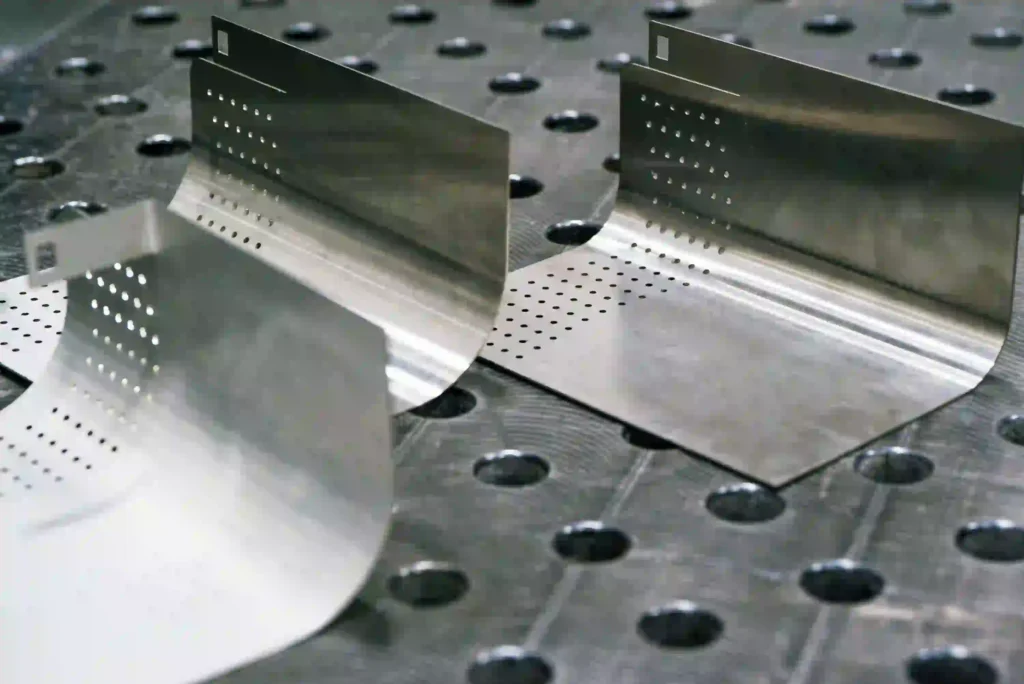
Perforated stainless steel metal parts
CNC technology has revolutionized sheet metal fabrication. Before CNC, the operator’s skill was the main variable for part quality. Good operators produced quality parts. Rejects are produced by an operator who is tired or distracted.
CNC eliminates this variability. After a program has been validated, all parts produced by that program are identical. With a CNC punch press or laser, complex geometries can be completed in a matter of minutes. It would take seasoned operators hours to manually lay out and cut these shapes.
Modern CNC press brakes compensate for deflection of the machine and material springback using real-time angle measurements and automatic crowning. This ensures consistent bend angles, even when material properties change within a coil. CNC punching centres can produce complex patterns, such as holes, slots, and forms, across large sheets of material without having to reposition.
This results in faster production rates, reduced scrap rates, and tighter tolerances than manual methods. CNC is not an extravagance for high-volume sheet metal fabrication. It’s the standard expectation.
Conclusion
Precision fabrication of sheet metal is a multi-step process that involves advanced cutting, forming, and joining operations, as well as finishing to produce components with exact dimensions and quality requirements. Combining CNC automation with stringent quality control, the types of metal fabrication techniques available today allow manufacturers to produce precision sheet metal products in large quantities with consistent results. Understanding the materials, processes, and capabilities helps procurement and engineering teams to make better decisions, as well as build stronger relationships with their fabricators.
ProLean MFG provides sheet metal fabrication services for manufacturers that require precision and repeatability. Contact our team for a quote and to discuss your needs if you’re working on a component with tight tolerances.
Frequently Asked Questions
What tolerances are possible with precision sheet metal fabrication?
Standard tolerances for precision sheet metal fabrication include plus or minus 0.01mm for laser-cut features and plus or minus 0.5 degrees for bend angles. With additional inspection and process controls, tighter tolerances can be achieved, but this will increase cost and lead time.
What is the minimum quantity of custom sheet metal fabrication orders?
Most precision fabricators can accommodate low-volume orders, including single prototypes. Low-volume orders are more expensive per unit due to the setup and programming time. Talk about your volume requirements to get an accurate price.
How long does it take to fabricate precision sheet metal?
Lead times can vary depending on the complexity of the part, the availability of materials, and the current workload. Simple parts made from standard materials are usually ready in a matter of days. Complex assemblies requiring multiple operations and finishes can take up to four weeks.
What file formats are accepted by fabricators?
Fabricators tend to prefer STEP, IGES, or DXF files for 3D models. DXF and DWG files are preferred for 2D punching and cutting programs. To communicate tolerances and specifications, always include a PDF drawing with dimensions alongside the CAD.
What are the different surface finishes?
Powder coating, electroplating (for stainless steel), anodizing, and other paint systems are common finishes. The material, operating environment, and aesthetic requirements will determine the right finish.