

The manufacturing of medical devices is a highly regulated industry. Materials used in surgical instruments, implants, diagnostic devices, and fluid handling systems must perform well under extreme conditions such as heat, pressure, and chemical exposure. They also need to withstand repeated sterilization cycles. The wrong plastic choice can compromise patient safety and shorten the product’s lifespan. It can also create regulatory issues.
Plastics used in medical equipment are different from those found in consumer electronics and industrial equipment. They must adhere to strict biocompatibility requirements, withstand aggressive sterilization techniques like autoclaving or gamma rays, and maintain dimensional consistency throughout their lifetime. Material selection is one of the most important decisions made during the product development process. Many materials must comply with FDA regulations and ISO 10993 biocompatibility tests, as well as USP Class VI requirements.
Understanding your material options is the best place to begin when evaluating manufacturing for a medical component. ProLean MFG has worked with teams that have made these exact decisions. Our resources on Medical Industry Manufacturing and CNC Machining Materials can help you match the right plastic for the right application.
The List of Medical-grade Plastics below is Based on Safety and Durability
Not all plastics are medical grade. This designation is based on a combination of chemical inertness and mechanical performance, compatibility with sterilization, and formal tests under recognized standards. These materials have been used in medical applications for years because they meet these standards.
Engineers consider several factors when selecting plastics for medical components: the contact type of the device (skin, mucosal, or blood-contacting), the sterilization methods used, the operating environment, and the mechanical load the part will be subjected to. The medical industry uses a variety of polymers because no single material is the best in every aspect.
Compare Plastics Used in Medical Devices
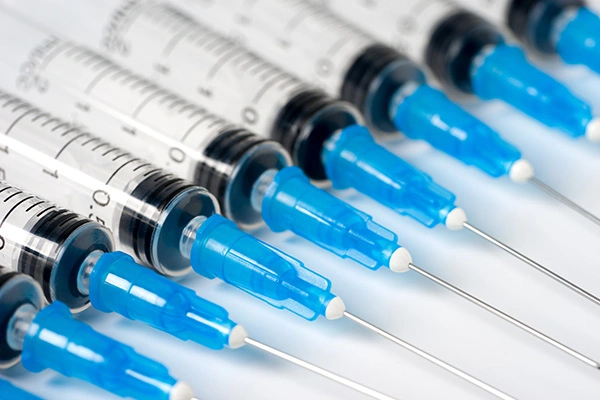
The table below shows a side-by-side comparison of the most commonly used medical-grade plastics. It includes their main properties, sterilisation compatibility, and primary applications.
| Material | Key Properties | Sterilization Compatibility | Common Applications |
| PEEK | Radiolucency, high strength, and chemical resistance | Autoclave, gamma, EtO | Spinal implants, trauma fixation |
| UHMW-PE | Low friction, wear resistance, and toughness | Gamma, EtO | Joint replacements, bearing surfaces |
| PEI (Ultem). | Flame-retardant and high-heat resistant | Autoclave, gamma | Housings for surgical instruments |
| PSU (Polysulfone), | Transparency and heat resistance are linked to hydrolytic stability | Autoclave, EtO | Fluid connectors, sterilization trays |
| PC (Polycarbonate) | Impact resistance and optical clarity | EtO, gamma | Device housings, lenses, and fluid management |
| Silicone | Temperature range, flexibility, biocompatibility | Autoclave, EtO, gamma | Tubes, seals, and implants |
The following sections will explain why each material is best suited for medical applications.
PEEK
For good reason, PEEK (Polyether ether Ketone) is near the top on nearly every list of medical-grade polymers. Its mechanical properties are similar to cortical bones, which makes it an ideal material for implants that bear loads. It is radiolucent and does not interfere with X-rays or CT scans.
Key features of PEEK for medical applications
- The structural implants can be designed with a tensile strength of up to 100 MPa
- Temperatures up to 250degC for continuous service
- Most body fluids and cleaning agents are chemically inert.
- Implant-grade formulations are available that meet ISO 10993 standards for biocompatibility.
PEEK is used widely in spinal fusion devices, orthopedic fixation plate components, dental implants, and trauma device components. It is also a good candidate for plastic for machining workflows, especially when it comes to custom or low-volume components.
UHMW-PE
For decades, ultra-high molecular polyethylene has been used for joint replacement surgery. Its most important characteristic is its exceptional wear resistance. It can withstand millions of load cycles without any degradation. This is what hip and knee replacements require over the years of service.
UHMWPE also has a low coefficient of friction that reduces the generation of wear debris on articulating surfaces. Wear debris is one of the main causes of implant failures and revision surgeries. Therefore, minimizing this wear debris in implant design is important. UHMWPE with high cross-linking has improved wear performance. It is now used in many total joint replacement systems.
This plastic is used in medical applications such as catheter liners, surgical guide surfaces, and bearing surfaces, where low-friction movement is needed.
PEI (Ultem)
Polyetherimide (also known as Ultem) is a polymer that combines high temperature resistance with inherent flame retardancy and dimensional stability. This makes it ideally suited for reusable surgical devices and housings. Components made of PEI are more durable than single-use plastics. They can be autoclaved multiple times without losing their structural integrity, warping, or discoloring.
The following are some of the notable medical properties of PEI:
- Heat deflection temperature above 200 °C
- It is highly resistant to hydrolysis and, therefore, ideal for steam sterilization.
- Excellent machinability and moldability for complex geometries
- Flame retardancy inherent in the material without adding halogenated additives
- Compatible with gamma-irradiation to sterilize single-use devices
The most common uses of PEI are surgical trays, instrument handles, and housings for diagnostic devices. PEI is also used in laboratory analysis and dental equipment, where heat and chemical resistance must be met on a daily basis.
PSU (Polysulfone)
For several decades, polysulfone has been a material that has gained trust in the medical field. This is largely due to its hydrolytic stability. Plastics can degrade if they are repeatedly exposed to steam and hot water. PSU doesn’t. This makes it a good choice for components that need to withstand many autoclave cycles and maintain tight dimensional tolerances.
PSU can also be semi-transparent. This is ideal for components that handle fluids and where the clinical importance of visualizing fluid flow or color is important. Its clarity and sterilization-resistance are used in dialysis equipment, membrane filter housings, surgical instrument trays, fluid connectors, and other applications. It is FDA-cleared and meets USP Class VI standards.
PC (Polycarbonate)
Few other medical-grade materials can offer the same combination of optical clarity and impact resistance as polycarbonate. PC is the material of choice for applications that require a housing to be both transparent and tough, so clinicians can see internal components or fluid levels.
It is used for oxygenator housings and blood reservoir components. It can also be found in surgical lighting, diagnostic device windows, and IV connectors. Polycarbonate is used for equipment and handheld devices that are subjected to or dropped in clinical environments.
Sterilization is a major consideration when it comes to PC. Autoclaving can lead to stress crazing, which may cause property loss. Gamma or ethylene oxide irradiation is the preferred method of sterilization for PC components. When specifying this material, engineers should confirm its sterilization compatibility as early as possible in the design process.
Silicone
Medical-grade silicone is a unique product. Silicone is a flexible elastomer, unlike rigid engineering plastics. It can be used in temperatures from below zero to over 200 °C. The biocompatibility of silicone is one of the best documented among all materials used in medical applications. It’s suitable for both external and long-term contact applications.
The physical versatility of silicone allows for a wide range of uses.
- Flexible tubing to transport fluids and gases in medical equipment
- Seals, gaskets, and membranes for pumps and valves
- Breast implants, cochlear implants components, shunts, and other implantable components are included.
- Catheter bodies, drainage systems
- Instrument handles with soft-touch overmolding
Medical-grade silicone comes in a variety of durometers, which allows engineers to adjust the flexibility according to the mechanical requirements for each application. It is compatible and resistant to radiation, ozone, and most chemical disinfectants.
There are Many Other Options to Consider for Plastics Used in Medical Devices
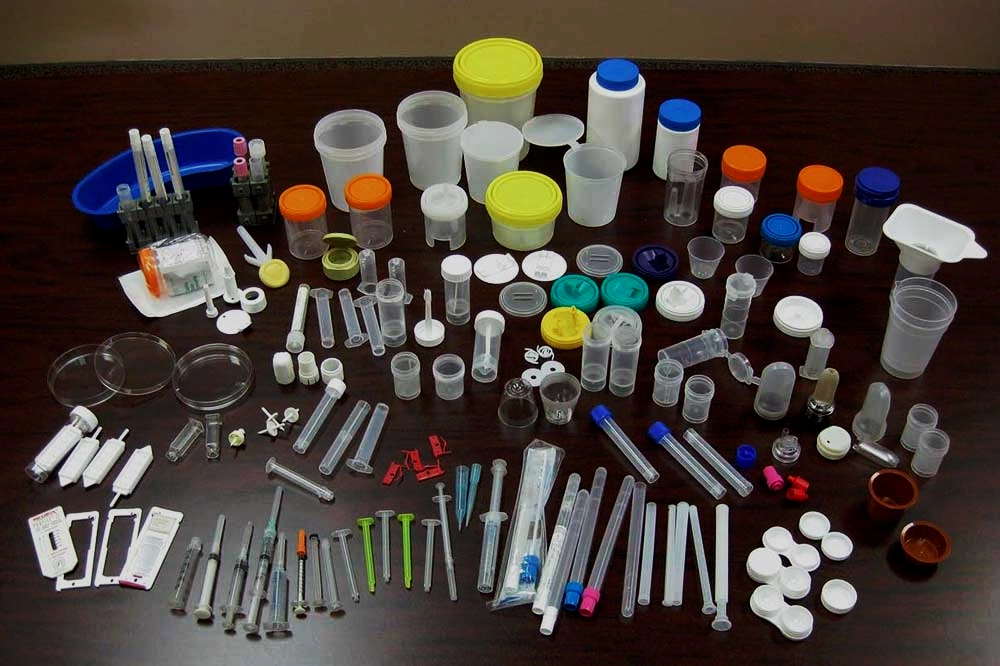
Medical-grade polymers are available in a wide range of materials. The following materials may also be worth considering, depending on the specific application requirements.
PTFE (Polytetrafluoroethylene)
Best known by the trade name Teflon, PTFE offers the lowest coefficient of friction of any solid plastic and exceptional chemical inertness. It is used for catheter coatings and surgical sutures.
Polyvinylidene fluoride (PVDF)
The combination of chemical resistance and piezoelectricity makes PVDF useful for both fluid-handling applications and sensor applications. It is resistant to many acids and solvents, and can withstand gamma sterilisation without any significant loss of properties.
(POM), Acetal
It is an excellent choice for precision mechanical components like gears and cams. Acetal also works well in sliding parts and bushings where low friction and dimensional accuracy are important. The medical-grade acetal formulations are biocompatible for applications that require short-term contacts and can be machined cleanly with CNC machining materials workflows.
HDPE
High-density polyethylene is used for medical packaging, sterile barrier trays, and certain fluid-handling parts. It is easy to process and cost-effective. It also meets biocompatibility standards for a wide range of contact types. However, it is not suitable for sterilization at high temperatures.
Materials Selection and Sterilization Techniques

The choice of a plastic for medical applications cannot be separated from the selection of a method of sterilization. Material that is good in all other dimensions can be a failure if the sterilization method it requires is not compatible with it. Understanding the relationship early can prevent costly material changes later in development.
Plastic components are subjected to different stress levels by the three main sterilization methods used in medical device manufacture.
Steam Autoclaving is a high-pressure saturated steam autoclave that uses temperatures between 121 °C and 134 °C. The process is quick, cost-effective, and efficient, but it can degrade many plastics due to hydrolysis and thermal stresses. PSU, PEI, PEEK, and silicone are all good autoclave materials. PC and Acetal are not suitable.
Ethylene oxide (EtO) sterilization uses chemical exposure at lower temperatures, making it suitable for temperature-sensitive materials. EtO is compatible with most of the medical-grade polymers that are discussed in this article. The residual gas absorption must be considered, and the outgassing period validated before using any device.
Gamma Irradiation penetrates quickly and is non-toxic. This method is ideal for single-use packaged devices. Some plastics, including certain grades of PC and PTFE, can yellow or embrittle under gamma rays. For materials that are known to be sensitive, radiation-stabilized grades can be obtained.
Practical Use Case
If a device is made from PC or a thin-walled silicone component, steam autoclaving is a practical and low-cost choice since these materials handle the heat and moisture well. If the design uses temperature-sensitive materials like certain grades of nylon or ABS, EtO sterilization is the safer option since it works at lower temperatures and does not cause warping or degradation.
Selecting the sterilization method at the same time as the material, rather than after the design is finalized, prevents expensive material changes and requalification later in the development process.
Plastic Medical Devices: Regulatory Considerations

The selection of materials for plastics used in medical devices is not solely an engineering decision. This is a decision that must be made for both regulatory and engineering reasons. The device manufacturers must provide documentation on the biocompatibility of any material that comes into contact with patients directly or indirectly. This documentation must also align with the market standards.
ISO 10993 is the main international standard for biological assessment of medical devices. It outlines a framework of testing that is based on the type and duration of contact. It is not necessary to test every material, but it must be documented and justified.
USP Class VI is a pharmaceutical-origin standard widely adopted in medical device manufacturing as a baseline indicator of biocompatibility. Material suppliers often provide USP Class VI Certification for their medical-grade formulas. This simplifies the documentation process for device makers.
Materials used in devices sold in America are governed by FDA 21 CFR regulations. Plastics used in FDA-cleared devices or FDA-approved products must be sourced from suppliers that can provide the necessary documentation and traceability.
The burden of developing a device can be significantly reduced by working with a manufacturing partner that understands the regulatory requirements, especially for smaller companies that are bringing their first regulated products to market.
The Most Common Mistakes when Selecting Plastics for Medical Machining Parts
Even experienced engineers encounter problems when selecting medical plastics. These mistakes can be avoided, saving time and money.
Use non-medical formulations. There are many plastics available in industrial and medical grades. Industrial grades can contain additives, colorants, or lubricants that are not biocompatible. Verify that the grade and the lot you are purchasing meet the biocompatibility requirements.
Not considering sterilization compatibility in the early stages: The method of sterilization determines material suitability more than mechanical or chemical properties. Sterilization is often overlooked, leading to material delays and changes at the late stages.
Assuming that supplier documentation is enough: Although data sheets and certificates from suppliers are a good starting point, it’s ultimately up to device manufacturers to demonstrate biocompatibility of their device for its particular use.
Ignoring secondary manufacturing effects, plastics with good performance in bulk can have different properties when molded, assembled, or machined. Biocompatibility can be affected by residual stress, surface contamination, and heat exposure. Material selection is not as important as the process validation.
Conclusion
When selecting the best plastic for a medical product, it is important to balance biocompatibility with mechanical performance, sterilization compatibility, and regulatory requirements. This guide covers a wide range of materials, such as PEEK (UHMW-PE), PEI (PEI), PSU, PC (PC), silicone, and a broader selection. Each material has specific strengths, making it suitable for varying device types and environments. Understanding the properties of medical-grade polymers will help you make the best decision.
ProLean MFG provides support to medical device manufacturers by providing material selection, medical machining, and precision component production across the entire range of medical-grade plastics that are discussed here. Our team can help you if you’re moving from design to manufacturing and require manufacturing expertise that is aligned with industry standards. Contact us to get a quote now!