
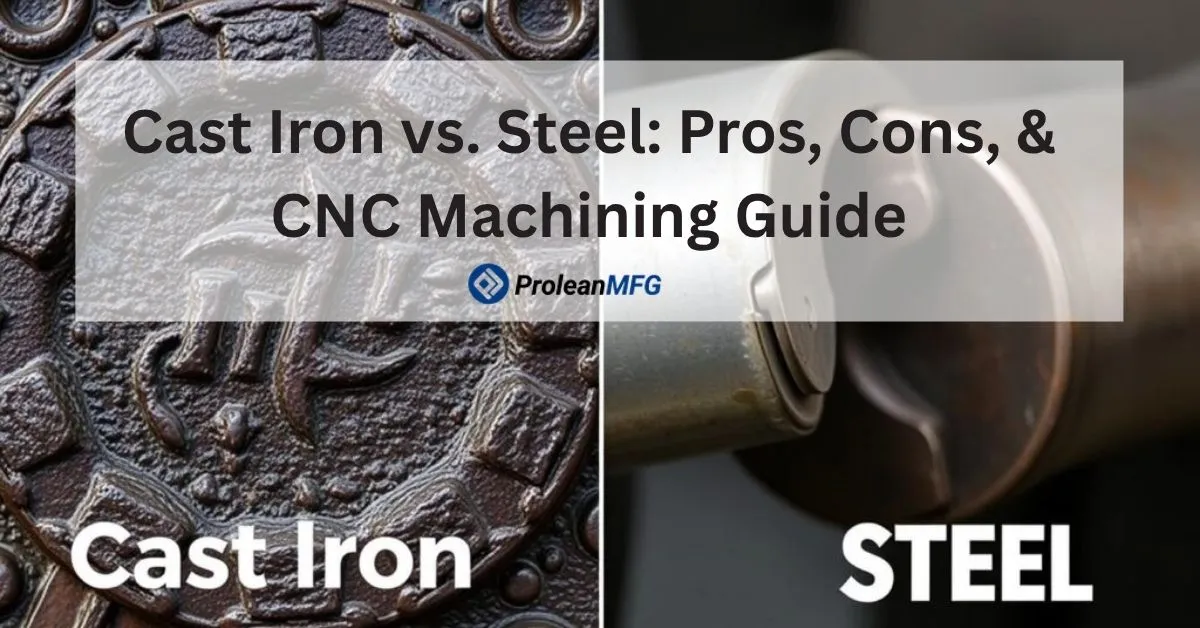

Both cast iron and steel are widely used in manufacturing and are often mistaken for the same metal. Both alloys are based on iron. At first glance, both alloys look the same. Their mechanical behavior, machinability, and cost profiles differ fundamentally. The wrong choice can affect not only part performance, but also production costs and failure risk.
This division is evident in the global CNC machining materials market. Cast iron is the material of choice for engineers who work on structures that are static and prone to vibration, while steel is used by those who build dynamic components with high stress. Both are equally good. Each is suited to a specific set of constraints, including the type of load, complexity in geometry, budget, and production volume.
When sourcing CNC-machined parts, consider factors such as the material’s availability, lead time, and cost implications for your specific application. ProLeanMFG offers competitive quotes for both cast iron machining and steel machining, with material selection advice to ensure you choose the best option of CNC Machining Services for your project’s needs. The right material selection at an early stage can save time and money later on.
Cast iron typically has a higher carbon content (2-4%) compared to steel (under 2%). While cast iron is generally cheaper due to simpler production processes, steel offers superior tensile strength, impact resistance, and versatility. The ideal material for CNC-machined parts depends on factors such as load type, geometry, and production volume.
What is Cast Iron?
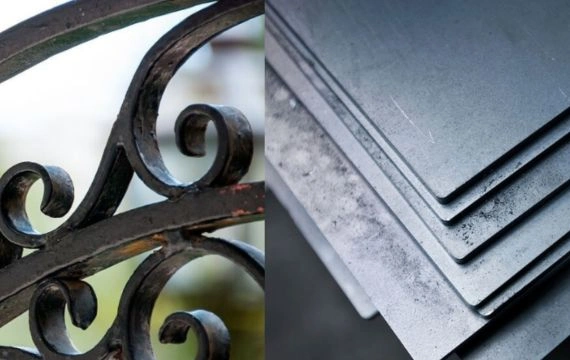
Cast iron decorative gate and steel flat sheets
Cast iron is an iron-carbon alloy that contains between 2% and 4 % carbon. This high carbon content is what makes it different from steel. The name comes from the fact that the metal is poured into molds directly after smelting rather than being mechanically worked.
A silicon content of 1 to 3% enhances the casting performance. Manganese, phosphorus, and sulfur in small amounts are also present. These elements affect the final microstructure as well as mechanical properties.
How Carbon Content Affects Cast Iron:
Higher carbon levels in cast iron reduce its melting point, making it easier and cheaper to cast into complex shapes. However, more carbon also increases brittleness. This is why cast iron is excellent for stationary, load-bearing parts, but not ideal for parts that face repeated impact or bending. In terms of machining, the graphite in cast iron acts as a natural lubricant, which actually makes it easier to machine than many steels. Tools last longer when cutting cast iron because the friction is lower.
Cast Iron Types
Gray iron, white ferret, malleable iron, and ductile iron are the four major types. Each type is the result of different cooling rates and heat treatment during production.
Gray Iron: Most common type. Contains graphite flakes, offering excellent vibration-damping properties.
White Iron: Very hard but brittle, making it less ideal for parts subject to impact.
Malleable Iron: Heat-treated to improve ductility, making it more suitable for applications requiring flexibility.
Ductile Iron: Also known as nodular or spheroidal graphite iron, it provides a better strength-to-weight ratio than gray iron.
What is steel?
Steel is an alloy of iron and carbon with a low carbon content — usually between 0.15% to 2%. Steel’s higher tensile strength and ductility are due to its lower carbon content.
Additional elements are added to improve specific properties. For example, stainless steel’s corrosion resistance is due to chromium. Manganese, silicon, and other elements improve strength and hardenability.
Types of Steel
Carbon steel, alloy steels, stainless steels, and tool steel are the main types.
Carbon steel can be classified as mild (0.05-0.25%), medium (0.25-0.6%), or high (0.6-2%). Alloy steels are enhanced by elements such as chromium or molybdenum. It is highly resistant to corrosion because it contains at least 11 percent chromium. Tool steel is used in dies and cutting tools because of its extreme wear resistance and hardness.
Read more in ProleanMFG blogs to compare the differences between carbon steel, alloy steel, and stainless steel: Alloy Steel vs Carbon Steel, Alloy Steel vs Stainless Steel, Carbon Steel vs Stainless Steel.
Cast Iron vs Steel: Direct Comparison
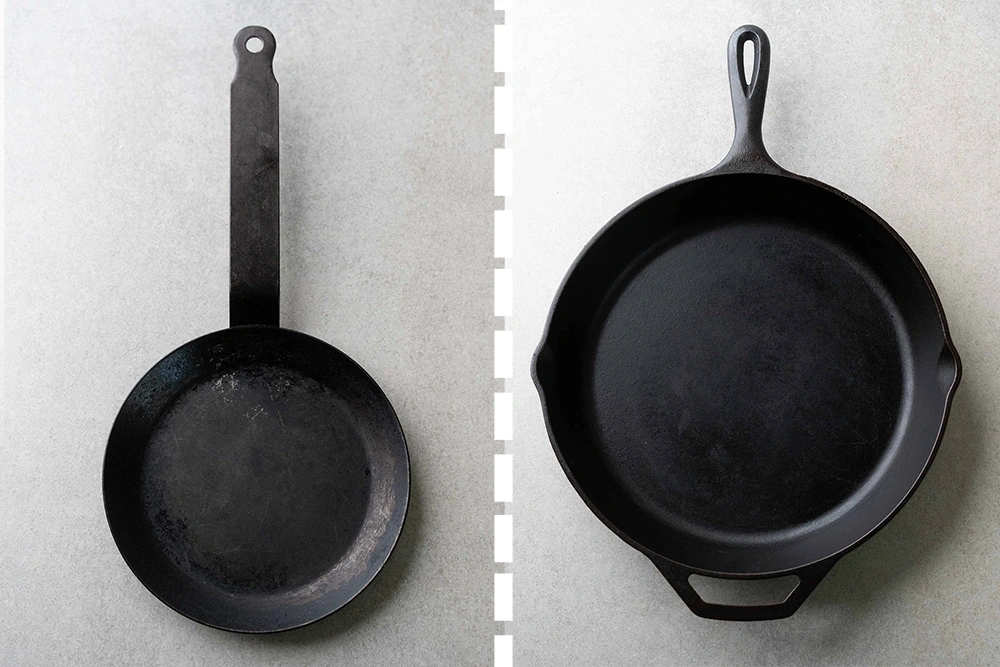
Steel pan vs. cast-iron skillet
Cast iron and steel are different CNC machining materials at every stage of manufacturing, from design through to long-term performance.
| Property | Cast Iron | Steel |
| Carbon content | 2-4% | Below 2% |
| Melting Point | ~1,200degC (2,200degF) | 1,370-1,540degC (2,500-2,800degF) |
| Compressive Strength | 150-400 MPa | Moderate |
| Tensile strength | 100-200 MPa | 400-2,000 MPa |
| Castability | Excellent | Moderate |
| Impact Resistance | Low-cost | High-quality |
| Corrosion resistance | Moderate | Medium to High |
| Machinability | Good (gray iron) | Varys by Grade |
| Cost | Lower Prices | Higher |
Carbon Content
The carbon content makes a difference. Cast iron contains between 2 and 4% carbon. Steel is below 2%. This one variable is responsible for nearly all downstream differences in strength types, castability, and brittleness.
Cast iron with a higher carbon content creates graphite within the matrix. They reduce the tensile strengths but increase compressive strength, damping, and castability. The lower carbon content in steel allows it to bend rather than crack under load.
Strength Profile
When we compare the strength profile of cast iron vs steel, cast iron has a compressive strength between 150 and 400 MPa. It is therefore ideal for parts with heavy static loads such as engine blocks, machine bases, and pipe fittings. Its tensile resistance is only between 100 and 200 MPa. This means that it can fracture under sudden impact or bending.
The tensile strength of steel ranges from 400MPa for mild carbon to more than 2,000MPa for alloys with high strength. Steel is the material of choice for structural components, fasteners, and shafts that are subjected to dynamic or impact loads.
Castability
Cast iron is easy to pour into molds, and shrinkage is minimal during cooling. It is ideal for the large-scale production of complex geometries. Steel is viscous and reacts more aggressively with mold materials. It also shrinks more when it solidifies, which requires tighter controls in the process and more work after casting.
Machinability
The graphite flake in gray cast iron acts as a lubricant. It produces powdery, short chips, which are easy to handle, and tool wear can be kept low. Steel machining requires more effort. The harder grades produce more heat and wear on the tools. Free-machining steel grades with added lead or sulfur can be as easy to cut as cast iron or even better.
CNC machining with cast iron vs steel
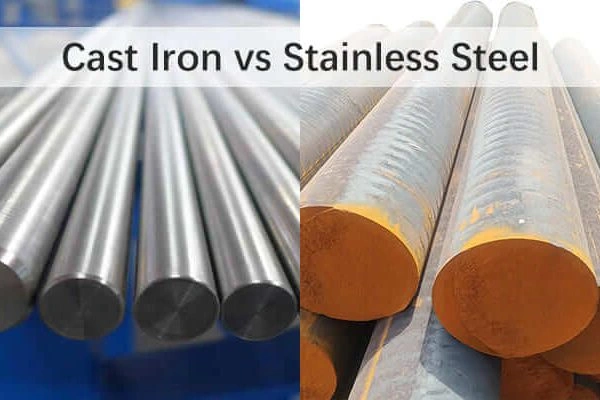
Cast iron vs stainless steel round bars
Material selection for CNC-machined parts directly impacts tooling costs, cycle times, surface finish, and dimensional stability.
Cast Iron CNC-machined parts
Cast iron parts that are CNC-machined are used in many applications requiring compression load resistance and vibration dampening. Examples include machine tool beds, gear housings, and pump casings.
Cast iron is a material that can withstand heavy compression loads and still maintain its original shape. The internal damping reduces chatter when machining and improves the surface finish of secondary operations. Gray iron in particular is predictable and consistent across large runs.
The main limitation of cast iron is its brittleness. Cast iron is not suitable for parts with thin walls or sharp internal corners.
Steel Machining for Dynamic Components
Steel comes in a wide range of grades, which means that steel machining is more versatile. Mild steel is ideal for simple structural components where weldability is important. Alloy steels are used in aerospace and automotive applications that require high stress. In the food, pharmaceutical,l and marine industries, stainless grades are used to handle environments that are corrosive.
Cost and cycle time are the two factors to consider. Steel machining requires more cutting passes, typically better-performing tooling, and a more precise thermal management. The resulting parts are stronger and more resistant to impact.
Summary of Pros and Cons
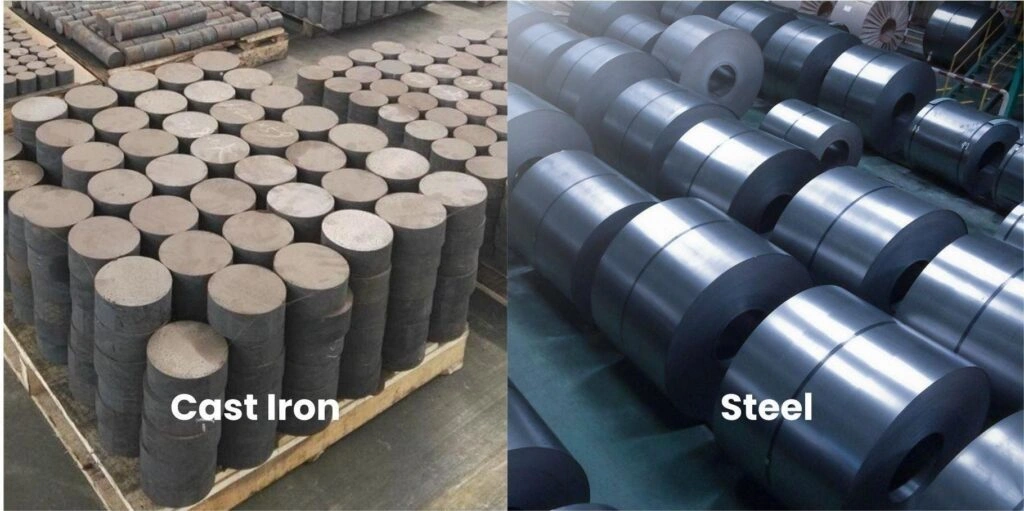
Cast iron billets and steel coils
Cast Iron
Cast iron has many advantages, including excellent castability of complex shapes, low production and material costs, high compressive strengths, good vibration dampening, and consistent machinability for gray iron grades. The material also has good resistance to wear in dry sliding contacts.
Cast iron vs steel has low tensile and high brittle strength. It is also prone to rusting without any surface treatment.
Steel
Steel has many advantages, including high tensile strength and impact resistance, a wide variety of grades and alloys available, improved corrosion resistance (especially with stainless steel grades), and a high degree of design flexibility.
Steel has a number of disadvantages, including higher costs, more complicated machining, and lower compression strength compared to cast iron in certain applications.
How to Choose Between Cast Iron and Steel
Check the Load Type:
- Static or compressive load = use cast iron
- Dynamic load with impact or bending = use steel
Strength and Weight:
- High strength-to-weight ratio needed = use ductile iron or high-strength steel
- Weight not a concern, vibration damping needed = use gray cast iron
Machinability:
- High-volume machining, low tool cost = cast iron is better
- Tight tolerances and fine finishes = steel is better
Environment:
- Moisture, chemicals, or outdoor use = stainless steel or coated cast iron
- High-temperature conditions = alloy steel
Budget:
- Lower upfront cost for complex shapes = cast iron
- Better long-term durability in tough conditions = steel worth the extra cost
Final Rule:
- Part is stationary, handles pressure, needs vibration damping = cast iron
- Part moves, gets welded, faces impact or harsh conditions = steel
Common mistakes in material selection
Cast iron is often used for dynamically loaded parts. This is a common mistake in mechanical design. Cast iron is brittle and will fail under sudden shocks or bending.
It can also happen the other way around. Sometimes, engineers specify steel when casting large parts with complex geometry. This increases the cost of machining. Cast iron is the most cost-effective and best-performing material for parts that will be primarily compressed and have complex geometry.
Thirdly, specifying stainless-steel for corrosion resistance is a common mistake. This can be avoided by using cast iron components that are coated or painted to meet the actual environmental requirements.
Conclusion
Cast iron and steel cannot be interchanged. Cast iron is superior in terms of compressive strength, vibratory dampening, castability, and cost when it comes to geometrically complex parts with high volume. Steel is the best choice for structural and dynamic applications that require high tensile strength and impact resistance. It also offers weldability and versatility. Your load type, operating conditions, part geometry, and production volume will determine the best choice.
ProLean MFG offers CNC Machining Services for both steel and cast iron, with guidance on material selection built into the quote process. The team can assist you in identifying the best material and process to meet your needs, whether you require cast iron CNC-machined components for machine beds or structural steel components. Contact us to get a quote now!
FAQs
Is cast iron stronger than steel for CNC machining?
No, not in terms of tensile or torsional strength. Cast iron is stronger in compressive strength than steel (150-400MPa), but has a lower tensile (100-200MPa) strength. Steel, on the other hand, can reach 2,000MPa for high alloy grades. Steel is considered to be more durable in dynamic applications.
What is the difference between cast iron and steel?
Cast Iron machines are easier due to graphite-lubrication, and gray iron grades produce less tool wear. Steel has more options in terms of grades and mechanical properties, but it requires more stringent tooling and control during the process.
Can cast-iron be welded?
Cast iron can be welded, but it requires preheating as well as post-weld heat treatments to prevent cracking because of its brittleness. Steel, particularly mild and low alloy grades, welds much more easily and is preferred when weldability in design is an important requirement.
Is cast iron cheaper than steel?
Cast Iron is usually cheaper. Cast iron is generally cheaper due to its lower raw material costs, simpler casting processes, and reduced energy consumption. Cast iron is more cost-effective for high-volume, complex-geometry parts.