
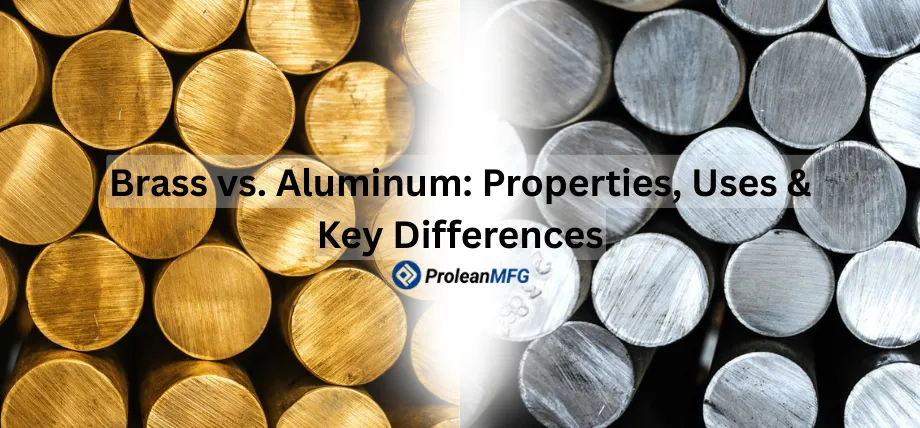

When comparing brass vs. aluminum, differences in weight, strength, and machinability are highly notable. In manufacturing, both are considered popular CNC machining materials. However, they behave very differently during machining as well as in performance levels.
What is Brass?
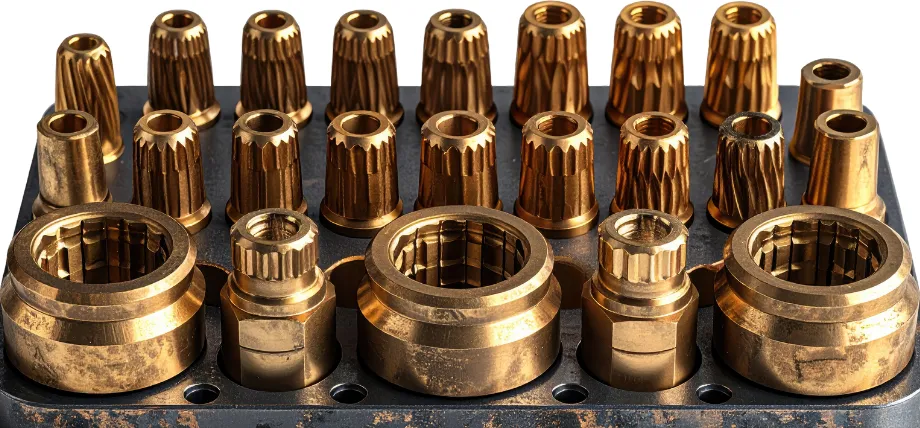
Assorted brass machined components
Brass is a copper-zinc alloy with copper as the base metal. It contains about 55-70% copper and 30-45% zinc, depending on grade and application; the percentages of copper and zinc can vary. It has a typical golden-yellow color.
Zinc is added to copper mainly to improve strength and hardness. Some brass grades also include additional alloying elements in small amounts, such as:
- Lead for better machinability
- Tin for better corrosion resistance
- Aluminum or manganese for extra strength and wear resistance
- Nickel to improve toughness and color stability
What is Aluminum?
Aluminum is a lightweight pure metal known for its high strength-to-weight ratio. Commercially pure aluminum has over 99% purity. But most industrial grades contain around 90-99% of Al, with the rest being other small additions of alloying elements.
Aluminum inherently has strong corrosion resistance due to a natural oxide layer. Its excellent heat dissipation properties are also a huge advantage for certain applications. It’s a favorite choice for mass production because it’s easily and quickly machinable.
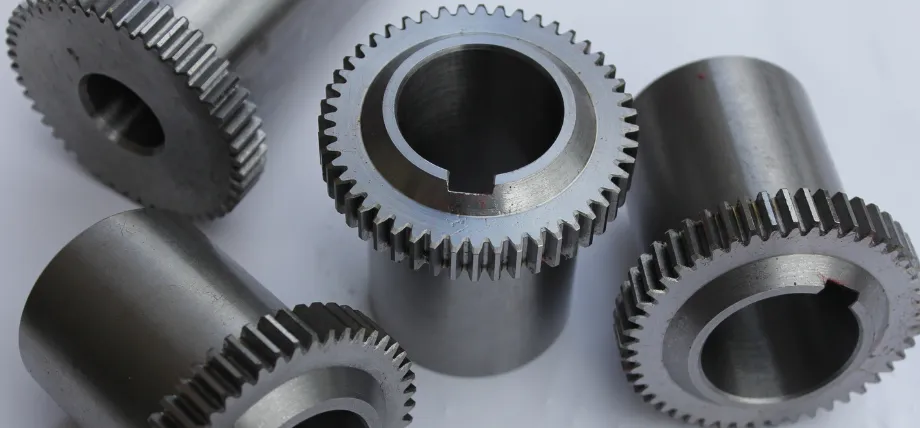
Machined aluminum gear parts
A Comparison of Brass vs. Aluminum Properties
| Property | Aluminum (6061-T6) | Brass (C36000) |
| Density | ~2.70 g/cm^3 | ~8.50 g/cm^3 |
| Tensile Strength | 310 MPa (45 ksi) | 330–400 MPa (48–58 ksi) |
| Hardness Range | 95 Brinell / 60 Rockwell B | 125 Brinell / 75 Rockwell B |
| Electrical Conductivity | ~40-43% IACS | ~26% IACS |
| Thermal Conductivity | ~167 W/m·K | ~115 W/m·K |
Strength and Hardness
One of the most common confusions among buyers is “Is brass stronger than aluminum?” When comparing brass vs aluminum, the practical answer is that it depends on the grade. Anyway, brass mostly feels “stronger” in day-to-day handling because it’s generally harder and more wear-resistant than aluminum.
Another common question is “Is aluminum softer than brass?” In most cases, it’s true. Aluminum is usually softer, and this softness directly affects the scratching, denting, and wear performance of parts.
So, in simple terms:
- Is brass stronger than aluminum? If your priority is wear resistance and a dent-resistant feel, the answer is yes. But if you take the strength per weight, aluminum wins.
- Is aluminum softer than brass? In most cases, yes.
Electrical Conductivity
Both materials are good conductors of electricity. But when you compare them, aluminum has significantly higher electrical conductivity than brass. This is why it is widely used in power transmission and electrical circuits.
You’ll mostly see brass over aluminum in many connectors, terminals, and contact hardware, only where the mechanical properties of brass are more crucial. The reason is that brass balances conductivity with mechanical reliability and corrosion resistance.
Aluminum conducts well and is widely used in electrical systems where weight and cost also matter.
Machinability: Brass vs. Aluminum for CNC Machining
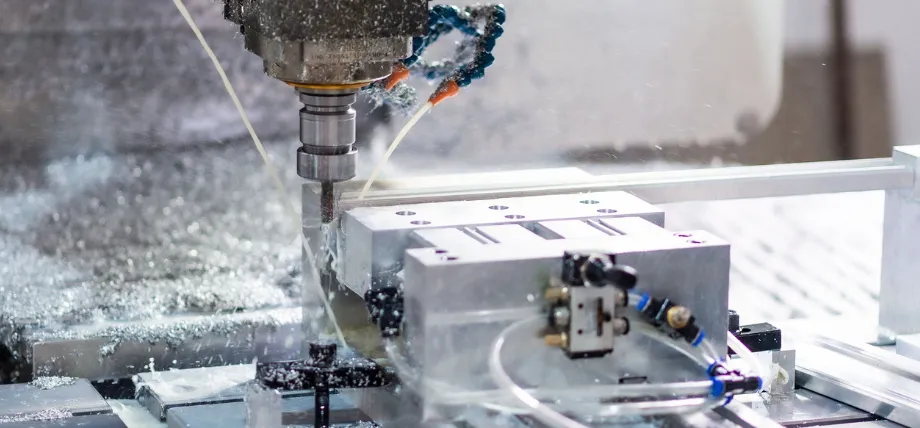
CNC milling aluminum workpiece
- Brass cuts very cleanly. It forms short and easy-to-control chips. Brass also gives a smooth surface finish.
- Aluminum is also easy to machine, but it produces long, stringy chips. It can cause built-up edges on tools (especially if cutting speed, feed, and lubrication are not properly controlled).
In CNC turning, brass machining is incredibly stable if you want to achieve fine finishes and repeatable dimensions. This is a highly useful advantage for precision components. This makes brass CNC-turned parts an appealing choice for you to obtain stable tolerances with an excellent finish.
Brass CNC-turned parts are a popular choice to make connectors and small mechanical components because of their good chip formation and moderate tool wear, which makes the process predictable and consistent
With aluminum machining, you can achieve higher cutting speeds and shorter cycle times. That’s one reason for aluminum CNC machining parts being very common in electronics housings, brackets, and lightweight structures.
Corrosion Resistance
As you might know, aluminum forms a passive oxide layer (aluminum oxide) naturally. This layer gives it strong corrosion resistance in many environments. If you need better protection and appearance, you can also anodize it as well. This is very useful for consumer-facing products.
Brass also resists corrosion well in many applications. But it can tarnish (surface darkening) over time. Tarnishing mostly affects the appearance rather than deeply damaging the structure. However, in some environments, you must evaluate the long-term corrosion behavior.
So, if you compare brass vs aluminum, aluminum is better over time for outdoor applications. Brass is more reliable in many fluid-handling and fitting applications. If you prioritize appearance, you can also apply a suitable coating for brass.
Brass vs. Aluminum Cost Comparison
In the market, brass usually costs more than aluminum because it contains a large amount of copper. Copper is a very expensive metal. Aluminum is cheaper and more widely available.
However, when you analyze the cost factor of a material, you have to think beyond just “price per kg.” You must consider factors like:
- Availability of the metal and the convenience of sourcing
- Cycle time and tool wear during machining
- The need for secondary operations after machining (polishing, anodizing, plating)
- The surface and structural quality
- Shipping costs (this is high for brass since it’s heavier)
Even with its high market price, brass can still be cost-effective due to its machinability. It offers better surface finishes, reducing the need for additional finishing steps. That’s why brass machining services are chosen for precision parts, even if the raw material is expensive.
Aluminum has a lower raw material cost and faster production. If you’re producing large batches of aluminum CNC machining parts, aluminum is advantageous. Also, aluminum parts are lightweight. So, they reduce transportation and handling costs as well.
Applications of Brass and Aluminum
Applications of Brass
- Plumbing Industry use brass in fittings, valves, and adapters because it is naturally corrosion-resistant and water-resistant, along with a great surface finish that reduces friction, which prevents seizing in moving valves.
- Electrical Industry uses brass in connectors and terminals because the mechanical properties paired with electrical conductivity make it great for applications that are a little physically demanding.
- Architecture and Aesthetics uses brass in decorative parts, premium items, and souvenirs due to its unique golden hue and the ease with which it can be polished
- Precision Components – small parts with good wear resistance
- Specialty components and assemblies – brass metal fabrication is used for special components where both durability and appearance are required.
Applications of Aluminum
- Electronics use aluminum for housings, enclosures, and heat sinks for its high thermal conductivity, which efficiently dissipates heat.
- Automotive Components – brackets, mounts, and lightweight structures are made of aluminum alloys, leveraging their high strength-to-weight ratio to improve fuel efficiency.
- Aerospace and UAV Components aluminum is lightweight, which helps with weight-sensitive structural parts and applications with weight constraints.
- Consumer Products use aluminum for aesthetics and convenience, such as in anodized parts and lightweight casings, due to its lightweight.
A lot of modern manufacturing is built around aluminum machining because it supports high-speed CNC, light structures, and efficient heat dissipation. That’s why you see aluminum CNC machining parts everywhere.
How to Choose the Right Material for Your Project?
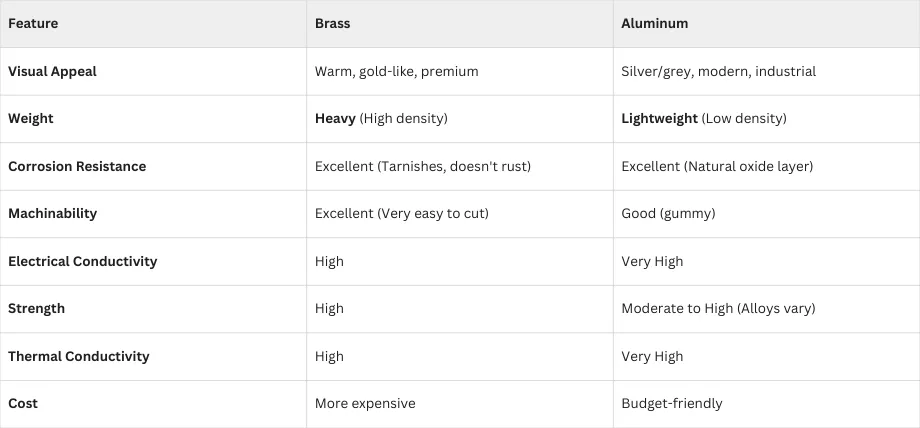
Brass vs. aluminum features
First, you must clearly define the function of the product, expected lifespan, maintenance, and cost constraints. Then you have to consider practical factors such as weight constraints and appearance. One point to remember is that different materials have different densities. So the final part weight and the amount of raw material required will also differ. After reviewing all design requirements, you can choose the material that is beneficial throughout the service life, not the one with the lowest initial cost.
If weight is important, aluminum is the better choice. If durability, wear resistance, and solid threads matter more, brass is usually more suitable. So, if your components are expected to be exposed to friction and repeated contact, brass would be a better choice.
Brass also gives a premium look without extra finishing. Aluminum usually requires anodizing or coating. Precision turning and tight-tolerance parts often favor brass, whereas high-speed milling and lightweight structures are more suited for aluminum.
When to Choose Brass Over Aluminum?
Choose brass when the part needs high wear resistance, stable machining, and excellent surface finish. It is specially suitable for precision components such as fittings and connectors. Brass CNC machining applications are well-known for their consistency in repeatability. In many practical cases, brass is a better choice than aluminum for small, wear-prone parts.
When to Choose Aluminum Over Brass?
Aluminum is a better option when lightweight design, lower cost, and fast production are priorities. It is widely used in aluminum machining for brackets, housings, frames, and thermal components.
Large-scale aluminum CNC machining parts are common because aluminum is easier to machine and more economical. Also, aluminum is generally considered softer, which is a critical consideration during surface protection and finishing decisions. While some alloys are harder than brass, their use depends on application requirements.
Custom Metal Machining
Proleanmfg provides high-quality custom machining for all aluminum alloys, aluminum castings, and brass machining services. We also provide post-machining services like improving surface finishes through mechanical treatments, and available finishes include:
- Brushed Finish
- Polished Finish
- Satin Finish
- Anodized Finish
- Hard Anodized
Standard CNC machining tolerances for aluminum parts are around 0.025 mm, but it depends on part geometry and machining process. Precision aluminum milling can achieve even lower tolerances.
Request a free quote today!
Conclusion
Both brass and aluminum are competitive candidates in the manufacturing field. Both bring their own advantages and also certain drawbacks. You must smartly choose the best one to obtain the best results without unnecessary expenses and maintenance.