

Aluminum stamping has become a widely used manufacturing process in the automotive and aerospace industries. The selection of the wrong process, tooling, and material can cause defective parts, waste investment, and costly production delays. Therefore, aluminum stamping solves this by producing 3x lighter than steel, corrosion-resistant parts. This process reduces the cost per unit in high-volume production.
This comprehensive guide explains how aluminum stamping works, the process, alloys and types of aluminum stamping and what factors affect cost and quality. If you are looking for custom metal stamping, you are trying to understand the right process for your part to achieve the final results.
What is Aluminum Stamping?
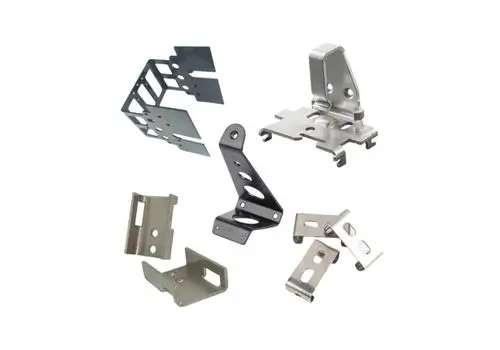
Aluminum stamping is a cold metal forming process that transforms blanks into precise shapes using dies and high-pressure stamping. These flat aluminum sheets become finished products after being cut, bent, drawn, pierced, or coined.
Aluminum is lightweight and more ductile. The metal requires less force to stamp than steel.
Aluminum is the most cost-effective sheet metal fabrication process compared to CNC machining. The aluminum stamping process wastes less material, and the cost per unit is less when high-volume production is required. This process produces parts quickly.
However, a small error can lead to defects. So precision matters here to avoid defects. Hence, aluminum stamping is ideal due to customised tools and settings to get the exact design and perfect fit.
Why Choose Aluminum Stamping Over Steel or Plastic?
Aluminum stamping is an ideal choice because of the properties of aluminum, such as the strength-to-weight ratio, corrosion resistance, good heat and electrical conductivity, flexibility in design, and precision and consistency.
Lightweight but Strong: Stamped aluminum parts are lightweight and strong. Aluminum is about 3 times lighter than steel. The metal provides structural performance where mass is a constraint. Therefore, it’s perfect for automotive lightweighting, aerospace structures, and portable electronics.
Flexible forming capabilities: The ductility of aluminum allows for the flexible forming of the stamped aluminum parts. Therefore, the parts can easily be blanked, deep-drawn, bent, and coined into complex three-dimensional geometries. Rather, an excessive tooling force is needed for other harder materials. That easy-to-form property directly lowers tooling cost and long die life.
Resists Rust Naturally: Aluminum has an oxide layer naturally that works best in air exposure. So it does not require any additional coating for basic rust resistance. Moreover, the 5xxx alloy series adds more resistance protection in severe environments such as marine, chemical, and high humidity.
Good Heat and Electrical Conductivity: Aluminum has good heat and electrical conductivity, as much as copper. But it is much lighter and cheaper. Aluminum can easily maintain its tensile strength and toughness in low temperatures. That’s why stamped aluminum is overwhelmingly used in heat sinks, busbar components, EV charging hardware, and electrical enclosures.
A More Sustainable Choice: Aluminum is recyclable and almost remains the same in its quality. Therefore, stamped aluminum is a procurement checkbox for automotive and electronics OEMs where sustainability rules are strictly followed.
Safe and Non-Toxic: Aluminum is non-toxic. It does not leach harmful substances even when it stays in contact with liquids, food and human tissue for a long time. The natural choice for pharmaceutical packaging, medical device enclosures, and surgical instruments is aluminum stamped parts. The material itself qualifies for food safety or biocompatibility standards in many applications without coating or liners.
Consistent Precision at Scale: The aluminum stamping process offers high consistent precision at scale for stamped aluminum parts. Therefore, once the tool die is set properly, every part, even if there are 500 or 500,000 parts, comes out the same.
Versatile Design Without Compromise:Aluminum works better than steel or plastic with many finishing options like anodising, painting, powder coating, polishing, and plating. This is useful because the same part can be functionally optimised without changing the geometry in aluminum sheet metal stamping.
Aluminum Stamping Operations and Techniques
Aluminum metal stamping is a sheet metal fabrication technique. These types of metalworking processes are blanking, piercing, bending, deep drawing, coining, embossing, and progressive die stamping. Simple components can be created in one step. But complex designs involve multi-step processes.
Among the main techniques for stamping aluminum include:
1. Blanking
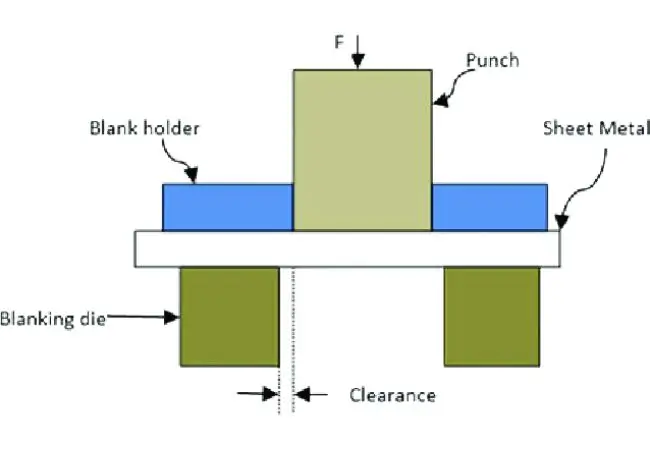
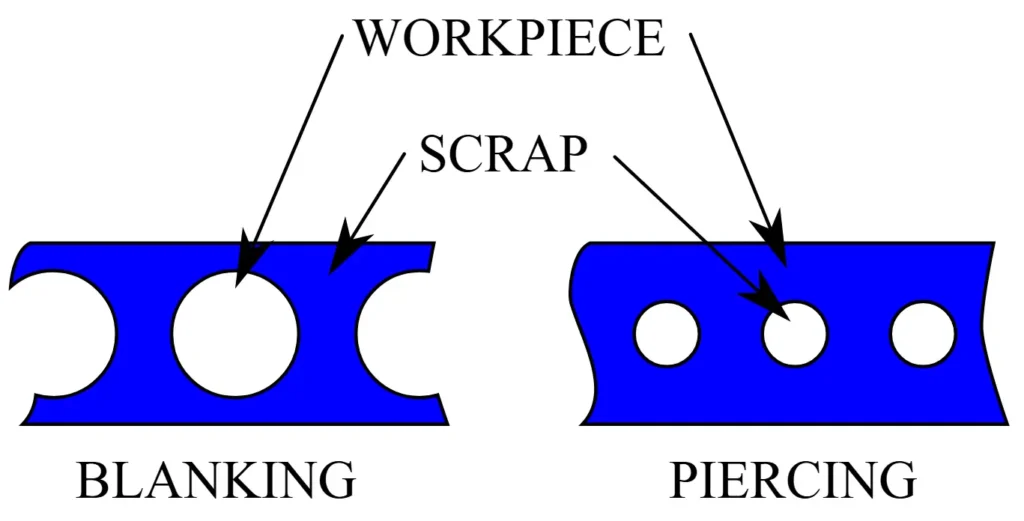
The process of blanking involves the cutting of a section from aluminum sheet metal. It is neatly punched out from the desired design using dies and presses from the workpiece. The piece is a useful piece. Whereas the punching removes the unwanted part from the aluminum sheet. Moreover, precision tools ensure that each component is made perfectly.
2. Piercing
The piercing aluminium process is used to make holes or notches in aluminum components on blank aluminum sheets. Punches and dies are used to make these openings. The key point is that the punch to die clearance must match the material thickness precisely. Because it could deform or tear the metal. Proper clearance creates clean edges and accurate hole sizes to fit and work properly.
3. Deep Drawing
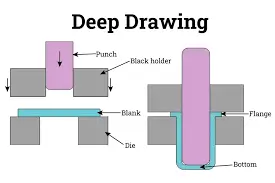
Deep drawing creates hollow or three-dimensional parts from a flat aluminum sheet using a punch and a die cavity. A controlled force is applied to push the blank into the cavity. Stretching and thinning the material can cause defects, so it must be handled carefully. However, the material selection is crucial at this stage; for instance, a higher ductile alloy (1100, 3003) can handle drawing better than high-strength grades. This process is used to form aluminum parts like battery enclosures, cooking vessels, and heat exchangers.
4. Coining
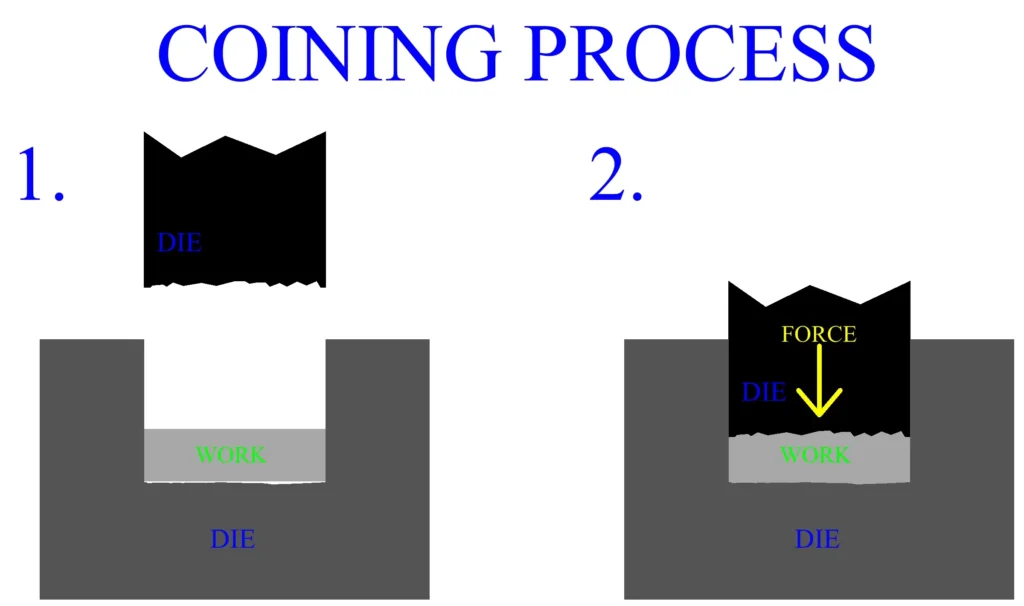
During coining, the stamped aluminum sheet is placed between a punch and a die under high pressure to produce fine surface details, sharp edges, and very tight dimensional tolerances. Therefore, aluminum can also be formed into L-, V-, and U-shapes. The surface of the aluminum is transformed with high pressure to make sharp and clean edges without stretching the material. Coining is used in applications where tight tolerances are needed, such as electronics.
5. Embossing
Embossing is a process where a shaped die raises or depresses a pattern into the aluminum surface. It is used to imprint logos, stiffening ribs, texture patterns, and identification marks by pressing the stamped aluminum sheet between patterned dies. This technique is helpful to create complex designs by repeatedly embossing aluminum. The aluminum flows to form the feature without removing any material.
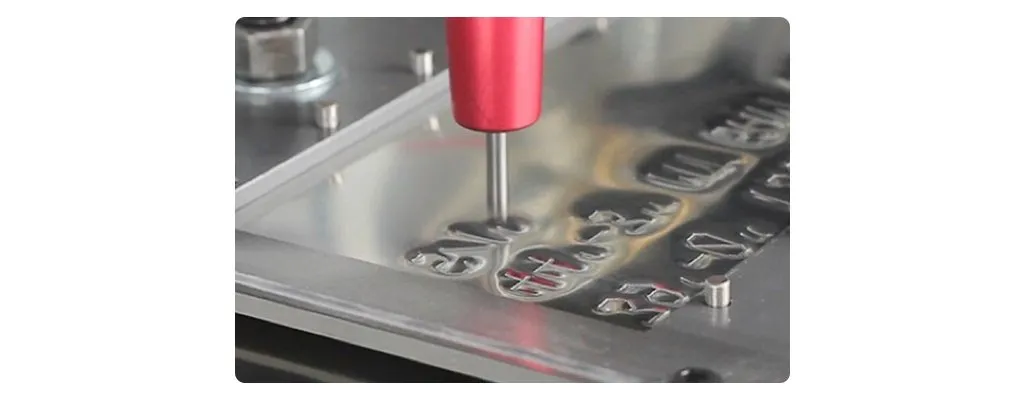
6. Flanging
The flanging technique is used to either flare or flange the aluminum sheet. This aluminum metal sheet stamping process uses specialised tooling to bend the metal outward. The material is easily mounted or assembled into components. This approach creates strong support and connection points directly in the design without needing extra parts. This method is widely used in ductwork, enclosures, and frames.
Types of Aluminum Metal Stamping Operations
1. Progressive Die Aluminum Stamping
Progressive die aluminum stamping feeds the aluminum strip horizontally through different steps in one machine. The metal undergoes each step one by one, such as punching, bending, coining, or drawing. The part is separated from the strip at the last step. Therefore, this step makes production fast, accurate, and efficient.
The initial investment is higher for the tooling, but the per-unit cost reduces if the number of
pieces are above 10,000. The standard capabilities are stripe width up to 24″, and material gauges from 0.010″ to 0.250″. This process is ideal for the parts where efficiency and precision are non-negotiable in continuous manufacturing at scale.
2. Transfer Die Stamping
The aluminium blank is cut from the strip at the first step in transfer die stamping, unlike progressive stamping. Then each blank is moved separately between different stamping stations by robots or conveyors. Every piece can be positioned at each station accurately because each part moves on its own. This technique is useful to create complex shapes and angles.
Moreover, transfer die stamping is best for the making of enclosure shells, automotive structural panels, and aerospace rib sections. It handles the material gauges up to 0.500″. The process is significantly greater in part geometry and size, and slightly slower cycle times than progressive die aluminum stamping.
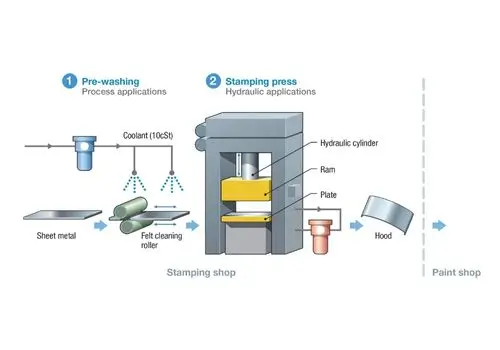
3. Four-Slide (Multi-Slide) Stamping
Four-slide stamping is also known as multi-slide stamping. This technique is used to bend and form aluminum in a single cycle by using four tools moving at the same time from different directions. A normal press pushes force from one axis. But the four slide tooling works from four sides simultaneously to bend, twist and form in one time without repositioning.
This technique is ideal for clips, spring contacts, wire forms, hinges, and small mechanical parts with intricate designs. This process saves cost by doing everything in one step for medium to large-scale production. It works well with part width up to 2–3 inches and material thickness from 0.005″ to 0.080″. Therefore, this method is exceptionally handle your design with multiple bends in different directions at a lower cost per part.
4. Aluminum Fine Blanking
Fine blanking is also known as edge blanking. Fine blanking is a precision process where smooth, square, and virtually burr-free aluminum parts are produced by cutting very cleanly in one step.
This technique gives very straight edges perpendicularity within 0.001–0.002″ with a smooth surface finish of Ra 0.4–1.6 µm. It reduces extra finishing steps, so the parts can easily be assembled.
The fine blanking is the best for the production of precision brackets, sprockets, gears, and locking parts with edge quality. Fine blanking performs well with 1100 and 3003 aluminum. Because these alloys are easy to form without cracking. Hence, the process can get high accuracy around ±0.001–0.002 inches, particularly on cut edges.
Most Common Aluminum Grades And Series Used in Stamping
Choosing the right alloy is a must to avoid cracking during forming, poor surface quality after finishing, or parts that fail in service. Below is a practical guide to the grades mostly used in custom metal stamping.
| Alloy | Series | Main Alloying Element | Key Properties |
| 1100 | 1xxx | 99% pure Aluminum | Very soft, easy to shape, great conductivity |
| 3003 | 3xxx | Manganese | Stronger than 1100, easy to form, corrosion-resistant |
| 5052 | 5xxx | Silicon | Strong, fatigue-resistant, and excellent corrosion resistance |
| 6061 | 6xxx | Magnesium | Heat-treatable, weldable, corrosion-resistant |
| 2024 | 2xxx | Magnesium & Silicon | Very strong, lightweight, moderate corrosion resistance |
| 7075 | 7xxx | Zinc | Extremely strong |
| 8xxx Series | 8xxx | Other Elements | Specialised properties (e.g., foil-grade, good barrier properties) |
Besides these xxx series, there are also temper designations F, O, H, W, and T. These codes are useful to understand which temper or alloy can be chosen as per your stamping requirements.
- F (As Fabricated): For fabricated aluminum grade
- O (Annealed): For annealed aluminum alloy
- H (Strain-Hardened): For strain-hardened aluminum grade
- W (Solution Heat-Treated): A solution-treated aluminium alloy
- T (Thermally Treated): For thermal and heat-treated tempers for aluminum grades
Quick decision logic:
- 1100 or 3003: Forming a complex shape with multiple bends
- 5052: Marine or outdoor exposure
- 6061: Structural part requiring welding
- 2024 or 7075: Aerospace critical path component
- 1100 (annealed temper): Drawing a deep enclosure or housing
The key consideration is that temper matters as much as the alloy grade. For instance, the hard condition (H32) of 5052 aluminum will behave differently from the soft condition O(annealed) temper during forming. So, it’s necessary to mention both alloy and temper when ordering material.
Achievable Tolerances in Aluminum Stamping
Here’s a comparison of standard vs precision capabilities in aluminum stamping to help you choose the right tolerance level.
| Feature Type | Standard Tolerance | Precision Tolerance |
| Linear dimensions | ±0.010–0.015″ | ±0.002–0.005″ |
| Hole diameter | ±0.005″ | ±0.001–0.002″ |
| Hole location | ±0.005–0.010″ | ±0.002–0.003″ |
| Bend angle | ±1–2° | ±0.5° |
| Flatness | ±0.010–0.020″ | ±0.005″ |
Tighter tolerances can increase the complexity and cost. So, use standard tolerances whenever possible, and only choose precision when the part function truly requires it.
Aluminum Stamping vs. Other Metalworking Processes
Selecting the right type of metalworking process helps you see how aluminum stamping compares to others.
| Process | Best For | Typical Volume | Relative Unit Cost |
| Aluminum Stamping | Sheet parts, high-volume, thin–medium thickness | 5,000–millions | Very low at scale |
| CNC Machining | Complex 3D parts, thick material, high precision | 1–5,000 | High per unit |
| Aluminum Extrusion | Uniform cross-section profiles, long parts | Medium–high | Low (after tooling) |
| Die Casting | Complex near-net shapes, high volume production | 10,000+ | Medium (low at scale) |
| Sheet Metal Fabrication | Custom, low-volume parts, large components | 1–1,000 | High per unit |
Therefore, whenever you choose stamping over machining for high-volume production, usually 5,000 to 10,000 units annually. Aluminum sheet metal stamping works best for parts made from sheet metal. Stamping also gives the same accurate results for every piece. However, aluminum stamping is not suitable for low quantities, thick material (>6mm), or highly complex shapes. CNC machinin or die casting is a better choice for such cases.
What Are the Key Applications of Aluminum Stamping?
Aerospace
The aluminum stamping is used in airframe brackets, flap components, landing gear elements and stabiliser panels. The dominating aluminum alloys are 2024 and 7075, where every gram matters and strength cannot be compromised.
Automotive
Stamped aluminum parts are thermal management plates, battery enclosures, charging hardware, and structural brackets. The ideal aluminum alloy is 5052 and 6061 because both are strong and formidable. The surface flatness for the battery housing must stay within ±0.010 inches. Whereas, the accurate positioning of bracket mounting holes is ±0.003 to ±0.005 inches.
Consumer Electronics
5052 and 6061 aluminium are used to make phone frames, laptop lids, tablet bodies, and server panels. The sheet gauge is as thin as 0.020–0.040 inches. Due to this, small marks and uneven areas can easily be seen. Moreover, heat sink fins demand high precision with fin pitch tolerances of ±0.003–0.005″. Even a 5% deviation in fin geometry can reduce cooling performance. Therefore, to maintain consistent quality, the tools must be well-maintained and polished.
Medical Devices
Stamped aluminum parts for medical are diagnostic equipment housings, surgical trays, IV stands, and wheelchair frames. These aluminum parts are made using 6061 and 5052 alumnium by keeping their shape and accuracy very well. These materials are not only safe for medical use but also easily sterilised. Even a hole that is off by just 0.010 inches can affect patient safety. Therefore, safety, high accuracy, and full tracking of materials are very important in medical devices.
HVAC and Renewable Energy
1100 aluminum alloy with a very thin thickness of 0.004–0.006 inches is used to make HVAC heat exchanger fins in high volume. Similarly, 6061-T6 aluminum works well for solar panel mounting rails and brackets due to its strength. This alloy also works well for outdoor use with anodising protection. So, the selection of the right alloy is important for long-term durability.
Industrial and Commercial
The covers of electrical boxes, boat cleats, rail fittings, ladders and the control panel are made from 5052 aluminum because it is corrosion-resistant and provides a clean finish after anodising. Similarly, 3003 aluminum is used in lighting reflectors and cookware-type parts due to its formability. Mostly industrial parts require a normal tolerance of about ±0.010–0.015 inches. That’s why fast stamping methods are more cost-effective.
Aluminum Stamping Problems and Practical Solutions
Springback
The aluminum slightly springs back to its original shape. It can be fixed by bending it a little extra to settle into the correct shape. Modern machines (servo presses) can control than conventional mechanical presses more accurately.
Galling
Galling is called the stickiness of aluminum to the tools like punch or a die, during stamping. This can cause surface tears, drag marks, and rapid tool wear. This is not a material problem, and it can be controlled with synthetic stamping lubricants, TiN, or TiCN die coatings.
Wrinkling in Deep Drawing
During the process of drawing, extra material can fold or wrinkle at the flange. To avoid this, apply the right blank holder forces, setting the correct stretching amount, and well-designed draw beads. Moreover, computer simulation force is used to detect wrinkles early for complex parts before production.
Oxide Layer Buildup (Welding Complications)
Aluminium naturally has a thin layer of oxide that can make welding difficult. Therefore, the surface is cleaned using mechanical or chemical methods before the welding. Otherwise, the right TIG/MIG process is chosen for the alloy.
Cracking at Bend Zones
Aluminum cracking at bend zones occurs due to the material type (temper) not being suitable, tight bend radii, and the grain direction being wrong. To avoid this problem, keep the bend radius at least 1.0–1.5 times the material thickness. When high formability is needed, then use a softer (annealed) material. Moreover, try to bend across the aluminum grain direction.
Prolean MFG’s Capabilities in Stamped Aluminum Parts
Prolean MFG provides custom metal services with extensive knowledge and experience in aluminum stamping. We deliver consistent results from DFM review and in-house tooling design through production stamping.
Our process mainly focused on finishing and quality-certified delivery from a single part to high-volume production. We provide a sample run and prototype before the tooling production commitment and guarantee competitive prices on all fabricated aluminium components.
Frequently Asked Questions About Aluminum Stamping
Can aluminum be stamped?
Yes, aluminum is one of the best metals for stamping because of its high ductility. The less press force is used to blank, draw, bend, and coin into intricate shapes.
How thick of aluminum can you stamp?
Most of the aluminum stamping operations work well with 0.010″ and 0.250″ gauge. The ideal range is between 0.010″– 0.125″ for progressive die sampling. Whereas, heavy stamping machines and transfer dies can work with material thickness up to 0.500 inches in some cases.
But if the material is thicker than this, then forging and machining are the best options.
Why are stamping dies so expensive?
A stamping die is a high-precision machine. Each custom-made die is about ±0.0005 inches with high accuracy using strong steel, and it can withstand millions of uses. However, a complex die needs 8-10 steps that require careful setup with skilled workers.
Conclusion
Aluminum stamping is an effective methodology. This method helps to produce strong, lightweight and accurate components in mant industries. Designs can be optimized when you are aware of the right technique, problems and alloy selection. Moreover, tooling, good handling, and finishing can improve quality and durability.
ProLean MFG is a trusted metal fabricator. We offer standard and custom aluminum stamping to our customers with ultimate support, convenient services and premium quality. You can count on ProLean MFG for expert engineering and prototyping backed by certification and quality control for premium results.