You receive a drawing referencing “SUS 304”; the mill certification refers to “UNS S30400”; and the order says “EN 1.4301.” So, are these the same stainless steel grades?
Stainless steel grade confusion is also possible on the machining floor. A drawing asks for AISI 316 (UNS S31600, EN 1.4401) and also mentions SUS316 machining.
You may match SUS 316 equivalent correctly as 316, but knowing how each material behaves during machining completes the picture.
Several designation systems for steel grades exist globally. Guesswork when dealing with these systems can be detrimental – A part could corrode, or rejections could spiral. There could be alternative steel grades, but they are only good on paper.
Differences in corrosion resistance, machinability, and other properties often expose these guesses. Turning to a credible stainless grade chart replaces guesswork with a five-system match and machining notes.
Before getting into the details, it would be better to know why there are different systems in the first place.
Key Takeaways
- AISI/SAE, UNS, EN, JIS, and GB/T have different naming systems for stainless steel grade designations. Approve a material only after cross-referencing and verifying specifications for the grades.
- Equivalent designations do not always have identical properties. There can be differences in corrosion performance, mechanical properties, and chemical composition, which can affect interchangeability
- Stainless steel grades have significantly different machinability. More machining requirements are seen in options such as 316 and duplex 2205, while free-machining grades are easier to machine.
- Select stainless steel grades according to application requirements – machinability, corrosion resistance, hardness, wear resistance, etc.
Why Five Designation Systems Exist
Five widely used designation systems are AISI/SAE, EN (W.Nr.), GB/T, UNS, and JIS.
The full names for these acronyms are;
AISI/SAE – American Iron and Steel Institute/ Society of Automotive Engineers
EN (W.Nr.) – Euronorm (Werkstoffnummer)
GB/T – Guójiāo Biāozhǔn / Tuíjiàn, translates to Chinese National Recommended Standard
UNS – Unified Numbering System
JIS – Japanese Industrial Standards
These systems are developed under different regional and industrial requirements. None of the systems is a replacement for the other.
The core reason for these designation systems is to enhance cross-border communication, promote engineering precision, and standardize global trade.
While the designations usually match, the allowable chemistry ranges may not always match in every detail. Any cross-reference should always be cross-checked against the local specification.
With the brief background, we can now check the side-by-side comparison of the five systems.
The Master Cross-Reference Table
Stainless steel grades are listed in the master cross-reference table below. As big a family stainless steel is, it is part of a bigger family of materials, which you can learn about in Everything About Alloy Materials and Their Uses.
The main stainless steel grade families are austenitic, martensitic, ferritic, and duplex. The grades are designated by AISI/SAE, EN (W.Nr.), GB/T, UNS, and JIS.
Austenitic (200 / 300 series)
| AISI | EN | GB/T | UNS | JIS |
| 201 | 1.4372 | 12Cr17Mn6Ni5N | S20100 | SUS201 |
| 202 | — | 12Cr18Mn9Ni5N | S20200 | SUS202 |
| 301 | 1.4310 | 12Cr17Ni7 | S30100 | SUS301 |
| 302 | 1.4300 | — | S30200 | — |
| 302 B | — | — | S30215 | — |
| 303 | 1.4305 | — | S30300 | SUS 303 |
| 303 SE | — | — | S30323 | — |
| 304 | EN 1.4301 | 06Cr19Ni10 | S30400 | SUS 304 |
| 304 L | 1.4307 | 022Cr19Ni10 | S30403 | SUS 304L |
| 304 H | 1.4948 | — | S30409 | — |
| 304 N | — | 06Cr19Ni10N | S30451 | SUS304N1 |
| 304 LN | 1.4311 | 022Cr19Ni10N | S30453 | SUS304LN |
| 305 | 1.4303 | 10Cr18Ni12 | S30500 | SUS305 |
| 308 | — | — | S30800 | — |
| 309 | 1.4828 | — | S30900 | — |
| 309 S | 1.4833 | 06Cr23Ni13 | S30908 | SUS309S |
| 310 | 1.4845 | — | S31000 | — |
| 310 S | 1.4845 | 06Cr25Ni20 | S31008 | SUS310S |
| 314 | 1.4841 | — | S31400 | — |
| 316 | 1.4401 | 06Cr17Ni12Mo2 | S31600 | SUS 316 |
| 316 L | 1.4404 | 022Cr17Ni12Mo2 | S31603 | SUS 316L |
| 316 N | — | 06Cr17Ni12Mo2N | S31651 | SUS316N |
| 316 LN | 1.4406 | 022Cr17Ni13Mo2N | S31653 | SUS316LN |
| 316 Ti | 1.4571 | — | S31635 | SUS 316Ti |
| 317 | — | 06Cr19Ni13Mo3 | S31700 | SUS317 |
| 317 L | 1.4438 | 022Cr19Ni13Mo3 | S31703 | SUS317L |
| 321 | 1.4541 | 06Cr18Ni11Ti | S32100 | SUS 321 |
| 321 H | 1.4878 | — | S32109 | — |
| 347 | 1.4550 | 06Cr18Ni11Nb | S34700 | SUS347 |
| 348 | — | — | S34800 | — |
| 384 | — | — | S38400 | — |
Are you looking for the SUS 316 equivalent in the stainless grade chart
above? Check the 316 row to find AISI 316, UNS S31600, and EN 1.4401.
Martensitic (400 series, hardenable)
| AISI | EN | GB/T | UNS | JIS |
| 403 | 1.4000 | 12Cr12 | S40300 | SUS 403 |
| 410 | 1.4006 | 12Cr13 | S41000 | SUS 410 |
| 414 | — | — | S41400 | — |
| 416 | 1.4005 | — | S41600 | SUS 416 |
| 416 SE | — | — | S41623 | — |
| 420 | 1.4021 | 20Cr13 / 30Cr13 (related variant) | S42000 | SUS 420J1 |
| 420 F | — | — | S42020 | — |
| 422 | — | — | S42200 | — |
| 431 | 1.4057 | 1Cr17Ni2 | S43100 | SUS 431 |
| 440 A | — | 68Cr17 | S44002 | — |
| 440 B | — | — | S44003 | — |
| 440 C | — | — | S44004 | — |
| 501 | — | — | S50100 | — |
| DIN 1.4028 | 1.4028 | — | — | SUS 420J2 |
| F-6NM | 1.4313 | — | — | — |
| XM 6 / S41610 | — | — | S41610 | — |
[1]
Ferritic and Duplex
Here is a cross-reference for ferritic and duplex stainless steel grades across five designation systems:
| AISI/Common Grade | EN | GB/T | UNS | JIS |
| 405 | 1.4002 | 06Crl3Al | S40500 | SUS 405 |
| 409 | 1.4512 | 022Cr11Ti | S40900 | SUS 409 |
| 429 | — | — | S42900 | — |
| 430 | 1.4016 | 12Cr17 | S43000 | SUS 430 |
| 430 F | — | — | S43020 | SUS 430F |
| 430 F Se | — | — | S43023 | — |
| 434 | 1.4113 | 10Cr17Mo | S43400 | SUS 434 |
| 436 | — | — | S43600 | — |
| 439 | 1.4510 | — | S43035 | — |
| 441 | 1.4509 | — | S43940 | — |
| 442 | — | — | S44200 | — |
| 444 | 1.4521 | 019Cr19Mo2NbTi | S44400 | — |
| 446 | — | — | S44600 | — |
| 3CR12 / 1.4003 | 1.4003 | — | S41003 / S40977 | — |
| XM 27 / S44627 | — | — | S44627 | — |
| S 44660 | — | — | S44660 | — |
| S 44700 | — | — | S44700 | — |
| S 44735 | — | — | S44735 | — |
| S 41603 | — | — | S41603 | — |
| 329 | 1.4460 | — | S32900 | — |
| S 32304 | 1.4362 | — | S32304 | — |
| F-51 | 1.4462 | — | S31803 | — |
| 2205 / S32205 / F60 | 1.4462 | — | S32205 | SUS 329J3L |
| 2507 / S32750 / F53 | 1.4410 | — | S32750 | — |
| S32760 / F55 | 1.4501 | — | S32760 | — |
| S 32101 | 1.4162 | — | S32101 | — |
| S 32906 | 1.4477 | — | S32906 | — |
| S 32202 | 1.4062 | — | S32202 | — |
| S 32003 | — | — | S32003 | — |
[1]
Matching a stainless steel grade goes beyond designations; an even more important aspect is how it behaves in machining – Cost differences are evident in machining.
Machinability: What Each Family Costs You at the Spindle
Free machining grades such as 416 and 303 are generally easier to cut than standard austenitic grades. Duplex 2205 and 440C (hardened) can pose machining challenges, potentially increasing cycle times and tooling costs. Their machining speeds are slow, and they are prone to abrasive tool wear.
304, 316, and other standard austenitic grades tend to work harden, so they require more careful machining control.
More on SUS316 Machining
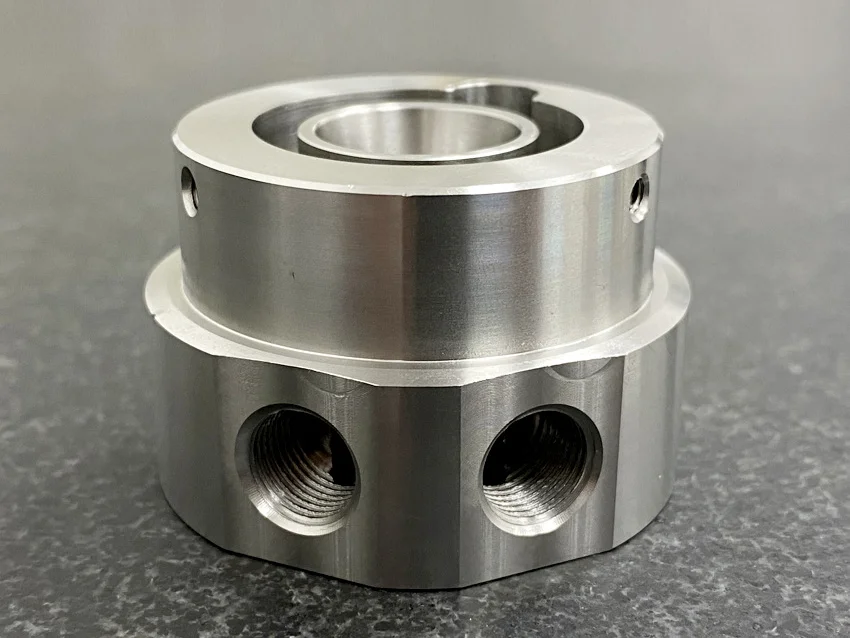
SUS316 machined part
The relatively low machinability of the material and the SUS 316 equivalent, AISI 316, is due to low thermal conductivity, gummy chipping, and work hardening.
The realistic controls in SUS316 machining are;
- Rigid setup
- Consistent feed for work hardening control
- Sharp, positive-rake carbide tooling
- Adequate coolant delivery
- Moderate cutting speeds
Find the recommended parameters in the guide Milling Stainless Steel Speeds and Feeds.
Apart from machinability, grades also differ in corrosion resistance, hardness, and weldability. These elements are explained in detail in the following pairs that cannot be interchanged.
Substitutions That Are NOT Interchangeable
Some stainless steel grades appear interchangeable on paper, but behave very differently when machined, welded, or cut.
Avoid costly mixups related to these pairs:
304 vs 304L, 316 vs 316L, 440C vs 440B vs 440F, and 201 vs 304.
304 vs 304L
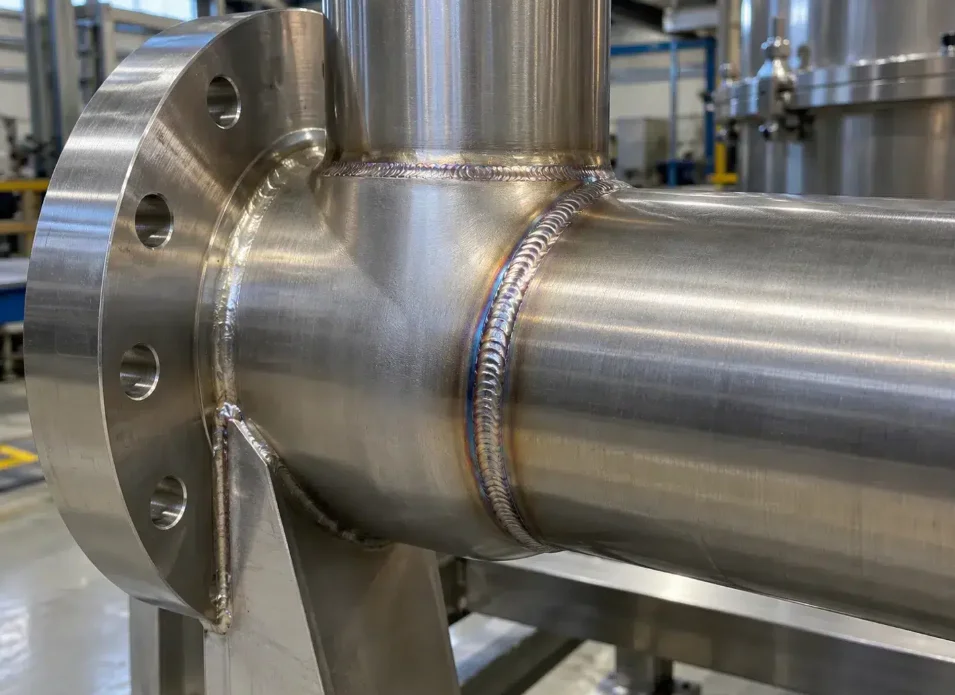
Welded 304L stainless steel
304 (UNS S30400) and 304L differ in carbon content: 304 stainless steel allows up to 0.08% carbon, and 304L up to 0.03%. These differences affect the grades’ structural strength. The carbon content also affects the welding behavior, with 304L being easier to weld.
316 vs 316L
316 steel and 316L steel have maximum carbon of 0.08% and 0.03%, respectively, which gives the two grades different properties. Here are the specific differences between 316 and 316L.
| Property | 316 Steel | 316L Steel |
| Corrosion resistance | Excellent resistance against marine environments, chlorides, and many chemicals | Same as 316 stainless steel, but with lower susceptibility to post-welding intergranular corrosion |
| Common applications | Food contact devices, fasteners, pump parts, marine hardware | Heat exchangers, welded tanks |
For a more thorough comparison, see:
440C vs 440B vs 440F
The main difference between 440C, 440B, and 440F is the carbon content, which determines the maximum hardness.
| Property | 440C | 440B | 440F |
| Carbon content | 0.95–1.20% | 0.75–0.95% | 0.95% – 1.20% (similar to 440C) |
201 vs 304 — Where the Cost Savings End
201 and 304 stainless steels have distinct chemical compositions, which affect properties such as pitting resistance, corrosion resistance, and fatigue resistance.
SAE 201 stainless steel typically contains less nickel than 304. A material cost advantage is possible based on the market conditions.
Reading a Mill Certificate
The key elements to read in a mill certificate are grade and specification, chemical composition, lot number, mechanical properties, heat treatment, and dual certification. These details in the mill test certificate are evidence that the order and material match.
Grade and Specification
Check both the grade and specification of the material against the purchase order. These details should match what was ordered. If there is a UNS number, as is the case with many certificates, use it for cross-checking. For example, you should find UNS S30400 in a mill certificate for 304 stainless steel.
Chemical Composition
Compare the percentages of elements against the grade limits. These elements include nickel, chromium, and carbon.
Lot Number
The heat or lot number is the connection between the tangible material and what is on paper. The lot number identifies the batch, while the heat number points to the original melt.
Ensure that the numbers on the material and certificate match. You should not accept the material if there is a mismatch because then the mill certificate proves nothing.
Mechanical Properties
The lot samples are tested, and the main values provided include;
- Tensile strength
- Yield strength
- Hardness
- Elongation
Compare the specification minimum to the provided values and ensure they match.
Heat Treatment
The material can be delivered as normalized, solution annealed, annealed, or in any other thermal condition. The heat treatment is recorded in the mill certificate, and details such as cooling method and hold times are provided.
Check the thermal condition because it affects the machining process and the strength of the machined part.
Dual Certification
If the mill certificate lists grade pairs such as 316/316L or 304/304L, both limits should be met.
After the mill certificate for material verification, the next thing is to match it to the right application.
Picking a Grade for Your Application
Stainless steel grade selection depends on corrosion service/food/marine, wear and hardness, and machined-only parts with no welding. Use this as a guideline to narrow down the choice of grade quickly.
Corrosive, Food-Grade, and Marine Environments
The chloride level in the application environment is a key decision factor. 316 and 316L are commonly specified for washdown chemicals and other high chloride environments. However, considering temperature and chemical concentration beforehand is critical.
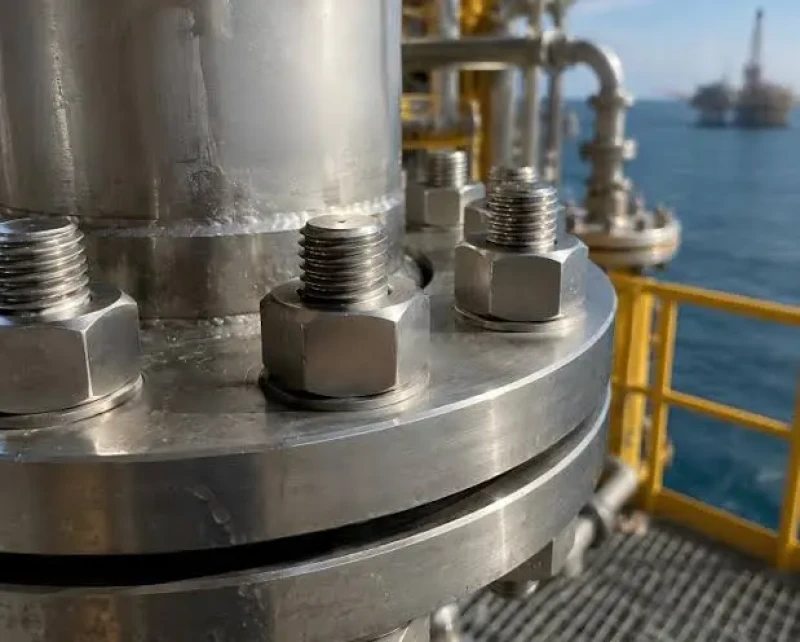
316 stainless steel fasteners in marine environment
Use duplex 2205 when you want more strength together with chloride resistance. Low carbon L grades are commonly recommended for welded parts prone to intergranular corrosion and sensitization.
Copper-nickel alloys are material options for some seawater applications.
Hardness and Wear Resistance: Bearings, Tooling, and Cutting Surfaces
Heat-treated 440C stainless steel provides high hardness and wear resistance. Choose the grade for applications that require such properties, such as cutting surfaces and bearings.
This metal hardness chart compares 440C stainless steel with other materials.
420 is a good choice for pump shafts, cutlery, and other general hardened components. 17-4 PH combines strength with good corrosion resistance in many industrial environments, depending on its heat-treatment condition.
No welding after machining? Emphasis shifts to cutting efficiency.
Machinability: Machined-Only Parts With No Welding
303 and 416 make reliable machined parts where machinability is the focus. They have higher sulfur content, which promotes tool life and chip control. Parts machined from 303 and 416 stainless steel work best in indoor mild environments.

416 stainless steel parts
Teflon-coated stainless steel can suit applications requiring extra corrosion protection.
304 and 316 stainless steel, along with other common austenitic grades, are prone to work hardening; their machinability is average. SUS316 is harder to machine because of work hardening and low thermal conductivity.
To Summarize
Stainless steel grades have different terms, but the fundamental checks for a material never change. It doesn’t matter if it’s 304 vs 304L or any other pairing. Match designations, verify chemical composition, and never assume interchangeability for look-alikes are the steps to take.
Follow this sequence to approve a stainless steel grade: Check the environment, consider the welding and wear requirements, consider the material’s machinability, verify the mill certificate, and indicate the designation on the drawing.
Still unsure which stainless steel grade to use for your machined parts? The team at ProleanTech is ready to help. Our CNC milling service in China offers professional machining solutions for stainless steel parts with demanding tolerance requirements.
Contact us for expert material selection guidance and receive a quote within 24 hours.
FAQ
Is 304 the same as 304L?
No. They share the alloying composition, but have different carbon limits. The “L” in 304L indicates low carbon content. This grade has a maximum carbon content of approximately 0.03%, compared to 0.08% for 304. 304L has higher corrosion resistance, while 304 is stronger.
Is 440C rust-proof?
No, all stainless steels can still rust. Two factors make 440C prone to rust: The martensitic structure and high carbon content. The structure is less corrosion-resistant than the austenitic structure.
A high carbon content makes 440C more wear-resistant, but the reduction of chromium translates to poorer corrosion performance.
What is SUS 304 in AISI terms?
The SUS 304 AISI designation is AISI 304. AISI 304 is a widely used austenitic stainless steel. It is also called 18/8 stainless steel due to its chromium (about 18%) and nickel (about 8%) contents.
Resources
[1]https://www.laxconsteels.com/grades/equivalents/
[2]https://www.mitsubishicarbide.net/contents/mmus/enus/manual/material_cross_reference.pdf
[3]https://gengfeisteel.com/stainless-steel-grades-cross-reference-table/