
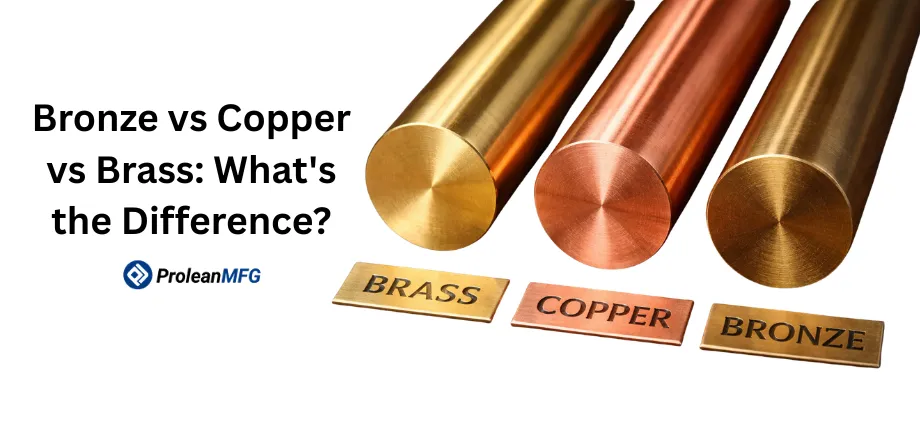

If you have ever been confused about the bronze vs. copper vs. brass comparison, you must know how much those three are similar to our eyes. These three are usually grouped as “red metals.” Even if they can look similar, their composition, properties, cost, and use cases are largely different. That’s why a proper study of these three alloys is important for both buyers and manufacturers.
An Introduction to Red Metals: Copper, Brass, and Bronze
The term “red metals” is used to classify a special group of copper-based metals. All of them have a reddish-golden appearance. However, each of them has a different composition and applications.
Table 1: An Overview of Copper, Brass, and Bronze
| Metal | Alloy Type | Main Alloying Element |
| Copper | Pure Metal | – |
| Brass | Copper Alloy | Zinc |
| Bronze | Copper Alloy | Tin |
With the above table, you can see that copper is the base metal for both brass and bronze. However, they are engineered with other alloying elements to improve specific mechanical and chemical properties (zinc for brass and tin for bronze). Therefore, the brass vs. bronze vs. copper properties largely differ from each other.
A Comparison of Copper vs. Brass vs. Bronze
To get a basic understanding of the bronze vs. copper vs. brass comparison, you must first compare them across their compositions, colors, and cost factors.
Brass vs. Copper vs. Bronze Composition
Composition is the primary factor that determines all the properties of these metals.
Table 2: Copper vs. Brass vs. Bronze Comparison
| Alloy/Metal | Composition | Main Goal of Adding the Main Alloying Element |
| Copper | 99%+ Cu | Copper is purely for high conductivity, ductility, and corrosion resistance. |
| Brass | (55 – 95% Cu) + (5 – 45% Zn) | Zinc is added to increase strength, hardness, and machinability. |
| Bronze | (88 – 95% Cu) + (5 – 12% Sn)(sometimes small amounts of Al/P/Si) | Tin is added to improve hardness, wear resistance, and corrosion resistance. |
Brass, Bronze and Copper Color Difference
Color is the first and the quickest method to spot the difference between these red metals. However, you have to confirm that they’re uncoated and observe under neutral light to see the right color. These color differences mainly occur because of their alloying elements.
- Copper – Has a reddish-brown color. A warm metallic shine can be observed. However, it can darken or turn into a greenish color with age.
- Brass – Has a yellow to gold color due to zinc. It’s brighter and more decorative than copper. However, it may tarnish to dull yellow-brown.
- Bronze – Appears dull gold to brown due to the presence of tin. You’ll see it as a slightly earthy color. It can be developed to a deep brown patina over time.

Comparing red metal alloys
Copper vs. Brass vs. Bronze Properties
Understanding the brass vs. bronze vs. copper properties is critical for proper engineering selection.
Corrosion Resistance
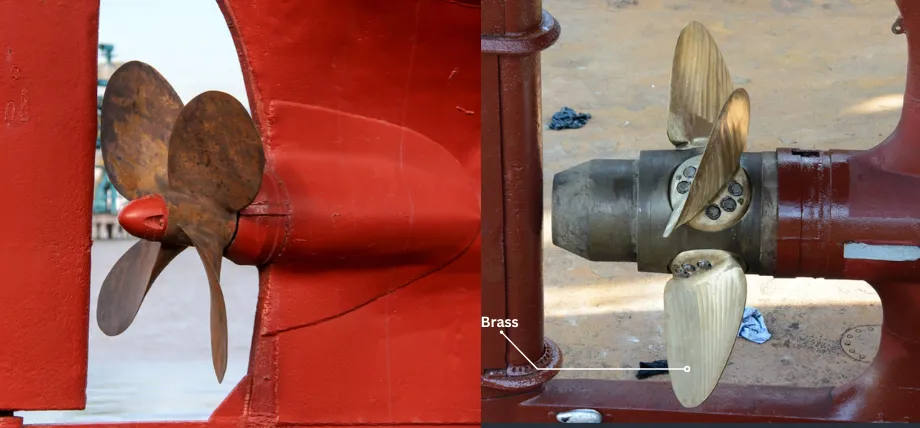
Brass marine propeller durability
Copper naturally has good corrosion resistance. It forms an oxide layer to protect the metal from continuous corrosion. In extreme conditions, it can develop a green patina that further protects the surface. It usually gives adequate corrosion performance under many atmospheric and water-contact conditions.
You can also achieve good corrosion resistance with brass. But under certain conditions (especially warm or chloride-rich), zinc can slowly dissolve out and weaken the part. This is called dezincification.
Bronze is generally the most corrosion-resistant alloy among them, with the exception of some brass and copper grades that are tailored for corrosion resistance and outperform bronze. It can perform well even in marine and chemically aggressive environments. That’s why bronze is the ideal choice for long-term applications such as fittings, bearings, and parts exposed to moisture and salty environments.
Strength and Hardness
Copper is very soft since its crystal structure allows easier slip. Therefore, copper has high ductility and lower strength.
Brass is stronger than copper due to the presence of zinc. Zinc atoms distort copper’s lattice and block dislocation movement, improving strength and toughness.
Bronze is considered the strongest out of the red metals because of tin and other alloying elements. These elements create a stronger solid solution and can form harder phases, boosting hardness and wear resistance. Therefore, bronze can handle load and friction better in bearings and bushings.
Electrical Conductivity and Thermal Conductivity Compared
One of the most searched comparisons is copper vs. brass vs. bronze conductivity. Copper is the metal with the highest conductivity among the three metals. It always dominates electrical and thermal applications. Because of the alloying elements in brass and bronze, their electron flow efficiency is low.
Table 4: Copper vs. Brass vs. Bronze Conductivity
| Metal | Electrical and Thermal Conductivity |
| Copper | Very High (Best) |
| Brass | Moderate |
| Bronze | Lower (generally) |
Bronze has the lowest conductivity. The reason is its additional alloying elements, like aluminum and silicon, largely disturbing the electron flow within the structure.
Machinability
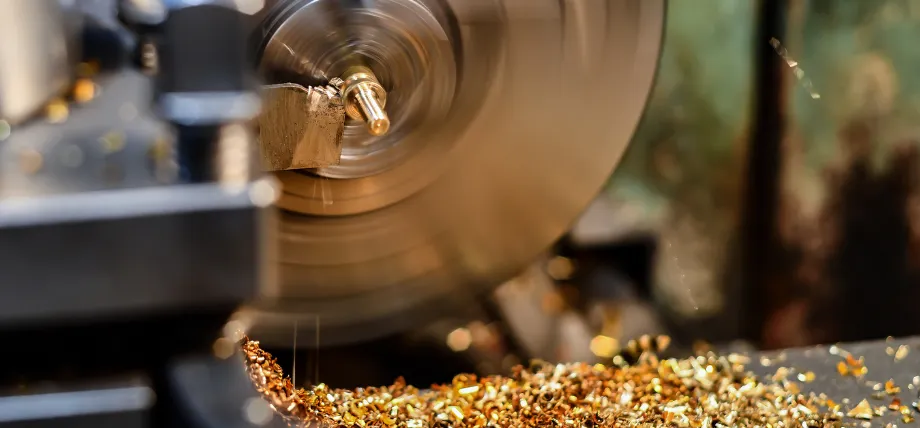
Precision brass lathe machining
Machinability is a highly critical factor for CNC machining and other manufacturing scenarios. Brass has great machinability because zinc improves chip formation and reduces tool resistance, making brass metal fabrication and brass machining easier. Therefore, you can buy brass, especially in free-cutting grades.
Bronze is a bit harder and more wear-resistant. Pure Copper grades tend to be gummy and sticky during machining. Therefore, even if it’s highly ductile, machining of copper is more challenging.
Brass vs. Copper vs. Bronze Cost
Generally, the brass vs. copper price is lower because brass contains zinc (zinc is cheaper than pure copper). Similarly, the bronze vs. brass price is often higher due to the improved strength, wear resistance, and alloy processing requirements of bronze.
Table 3: Copper vs. Bronze vs. Brass Cost Comparison
| Metal | Relative Cost | Reason |
| Copper | Highest | High purity and demand |
| Bronze | Medium to High | Difficulty and complexity of the alloy-making process |
| Brass | Lower | Zinc reduces overall cost |
However, when you’re considering these metals for an application, lifecycle cost should be analyzed. Sometimes, a slightly expensive metal like bronze can be beneficial over cheap brass due to its durability. Bronze can greatly reduce the maintenance and replacement expenses over time.
Applications of Copper, Brass, and Bronze
The applications of bronze vs. copper vs. brass depend heavily on their mechanical properties.
Electrical Wiring and Electrical Applications: Why Copper Leads
Copper’s superior conductivity and reliability make it the first choice for electrical and thermal systems. Copper has high electrical conductivity, which is great for electrical wires, and its wear resistance and low friction play a crucial role in bearings.It is the all-time leader in:
- Wiring and electrical conductors
- Motors and generators
- Circuit boards
- Power transmission systems
- Heat exchangers
Musical Instruments: The Role of Brass and Bronze
Bronze has a good resonance, durability, and tonal stability which allows for smooth resonance in musical instruments for the best audio and play quality. Therefore, it is commonly used in cymbals and bells. Brass is widely used in:
- Trumpets
- Trombones
- Saxophones
Bronze also has good acoustic properties and corrosion resistance. Due to these properties, you can also see many applications of bronze in the musical instrument industry.
Bearings and Bushings: Why Bronze Is Commonly Used
Bronze has a low friction coefficient and high wear resistance, which is great for bearings and load-bearing capacity, offering great performance in bushings and gears. These properties make it ideal for mechanical systems. This is the main reason why you should choose bronze over brass or copper in high-friction applications. Bronze is the industry standard for:
- Bearings
- Bushings
- Gears
- Wear plates
Industrial Applications Across All Three Metals
When compared with each other, copper, brass, and bronze are used for diverse types of applications across many industries. Even if they look similar, how they mechanically perform has significant differences from each other. The most common applications are:
- Copper: Electrical systems, plumbing, roofing, electronics
- Brass: Valves, fittings, fasteners, decorative hardware
- Bronze: Marine hardware, heavy machinery, industrial components
This diversity is the reason why a proper red metals comparison is compulsory before CNC machining materials selection.
Choosing the Right Metal for Your Application
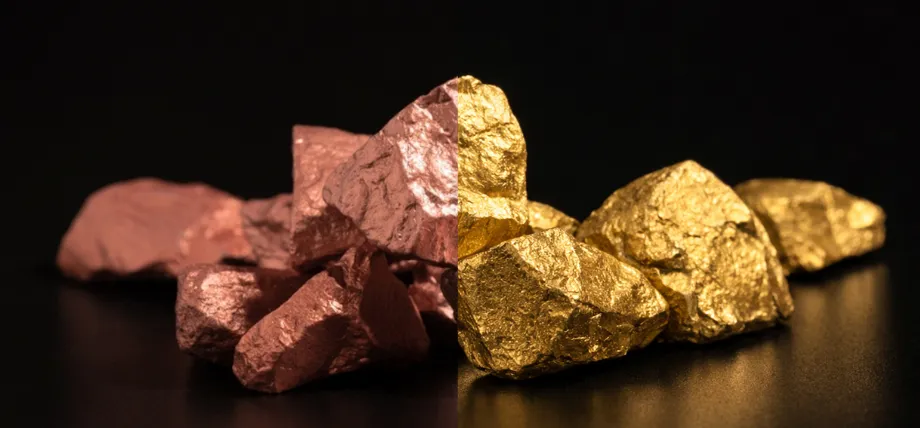
Raw copper and bronze
When doing a proper red metal selection, you need to consider many factors, such as:
- Load conditions
- Environmental exposure
- Friction levels
- Budget constraints
- Manufacturing process
Bronze for Corrosion Resistance
Bronze is the best candidate to use in moist and corrosive environments. Brass also offers moderate corrosion resistance but can denzify in aggressive environments.
Copper for Thermal and Electrical Conductivity
Copper has the best electrical and thermal conductivity among the three. Brass and bronze have lower conductivity due to their alloying elements.
Bronze for Wear Resistance
For high-friction and moving parts such as bearings and bushings, bronze is the best candidate. Brass provides moderate wear performance. However, copper is too soft for wear-intensive applications.
Bronze for Strength
If you need strength and high load-bearing capacity for your parts, bronze is the ideal option. Brass can also provide moderate strength with good toughness.
However, copper is not usually recommended for strength-focused applications. Copper is the softest and most ductile metal out of the red metals. So, it is more suitable for forming and conductivity-focused applications rather than structural use.
Custom CNC Machining Service
At ProleanMFG, we provide custom brass machining with tolerances as tight as ±0.005 mm that support your complex project geometry. We have in-house 3-axis, 4-axis, and 5-axis CNC milling and Swiss machining facilities that can process any metal, including ferrous and non-ferrous metals like copper, brass, and bronze.
Reach out to us to get a reliable, high-quality instant quote today!
Conclusion
With this red metals comparison, you can see that there is no universally superior metal. You must do proper research for a well-informed material selection. You can accurately do this by carefully analyzing them based on performance, lifespan, and cost efficiency. By understanding the true differences between brass, bronze, and copper, you can make smarter decisions for long-term advantages.