


When it comes to materials that will be used for parts that are going to be subjected to a lot of friction, exposed to corrosive effects, or used in extreme conditions, bronze is a wonderful option. The machining process of bronze through CNC means that purchasers and engineers gain access to a material that is self-lubricating, has a long wear life, good dimensional stability, and is suitable for a variety of applications. Because of these characteristics, bronze is an ideal material for manufacturing bushings and bearings.
Having knowledge of how bronze will respond to the CNC machining process can lead to the development of more desirable parts and more prudent decisions. ProLean Manufacturing is the best option for those working with custom metal machining of various bronze types and grades to gain a partner with alloy-specific expertise and process control.
This guide will provide the information needed to successfully design a new part or to replace an existing part.
Why is Bronze an Ideal Material for CNC Machining and Bronze Components?
The term bronze refers to a metal alloy predominantly consisting of copper and tin. Bronze is one of the highly versatile CNC machining materials, available in a wide and varied range of compositions and variants. These can be used for a wide array of applications, from high-strength aluminium bronze to ultra-free machining lead bronze.
The following five characteristics explain why engineers select bronze for their CNC projects:
Leaded bronzes (e.g., C93200, C93700) are optimized for bearing performance and machinability, not corrosion resistance. Aluminum bronze and phosphor bronze typically offer better corrosion performance. They have low friction against steel, good thermal and electrical conductivity, high durability under cyclic loading, and self-lubricating properties.
Additionally, bronze is far more machinable than stainless steel and can achieve much more precise tolerances. Materials for components like sleeve bearings, worm gears, and pump impellers don’t get better than this.
Why is Bronze Different than Other Metals?
When compared to other commonly machined metals, bronze has distinct advantages:
- Great Resistance to Corrosion: When compared with iron and steel, and especially in marine applications, bronze demonstrates far greater corrosion resistance.
- Non-Sparking: When struck, bronze does not create sparks. This makes it especially suitable for hazardous environments.
- Most bronze alloys can be easily machined, making them desirable for the efficient construction of components.
- Gears and bushings can be made from bronze alloys due to their excellent resistance to wear.
Bronze alloys used in CNC machining
Bronze is not all the same. Your alloy choice directly affects your machinability, mechanical characteristics, corrosion resistance, a nd cost. Here are the most commonly used grades of precision-machined parts of bronze.
Bronze Alloy for CNC Machining Comparison
| Alloy (UNS). | Common Name | Machinability (%) | Tensile Strength (ksi) | Best for |
| C93200 (SAE 660) | Bearing Bronze | 70% | 30 | Bushings and washers |
| C93700 | High-Lead Tin Bronze | 80% | 35 | Heavy-load bearings, pumps |
| C95400 | Aluminum Bronze | 50% | 85 | Structural, marine, gears |
| C51000 | Phosphor Bronze | 30% | 55 | Electrical contacts |
SAE 660 is the most common bronze grade. This bronze grade is self-lubricating and can be machined on CNC mills and lathes. Aluminum bronze (C95400), while harder to machine, delivers performance similar to steel when used in high-stress situations.
CNC Machining Bronze – Key Processes & Capabilities
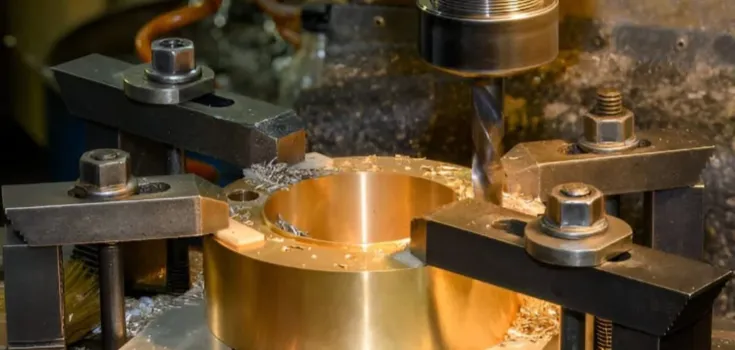
Bronze’s unique properties enable it to be machined at higher speeds and with longer tool lives than ferrous metals.
CNC Turning
The primary method of turning bronze components, such as bushings and shaft sleeves, is to turn them. CNC lathescano hold bronze tolerances as tight as +-0.001″. With carbide inserts, high-lead grades such as C93700 can be turned at speeds of up to 400 SFM.
CNC Milling
Milling is used to produce flat plates, brackets, and valve bodies. CNC machining bronze with a 5-axis CNC machine center or 3-axis CNC machine allows for complex geometries and consistent results. Bronze is easier to keep clean due to its chip-breaking behaviour. Aluminum produces stringy chips.
Drilling and tapping
Bronze is a good material for threading. For production quantities, cobalt or carbide drill bits are preferable. To avoid tap breaking, thread milling for blind holes is preferred over tapping in aluminum bronze grades.
5-axis CNC Machining
The 5-axis CNC machining of complex bronze components, such as valve bodies, impellers,s or housings with multiple features, eliminates the need for multiple setups and fixturing errors. This is particularly useful when machining any bronze components with tight tolerances between features in different planes.
What surface finishes are available for bronze machined parts?
Bronze machined components can be finished in a number of ways to improve their aesthetic appeal, increase corrosion resistance, or meet certain functional requirements. Here are some of the most common finishes for bronze.
1. As-Machined Finish
Bronze after CNC processing is left with a basic surface finish. This finish is suitable for applications that do not require additional cosmetic or ultra-smooth surface finish
2. Precision Ground
Precision grinding produces a highly smooth and uniform surface finish on bronze parts. This finish minimizes surface roughness, improves dimensional accuracy, and is ideal for components requiring tight tolerances and consistent surface texture in functional or mechanical applications.
3. Bead Blasting
Beadblasting is the process of hurling glass or ceramic particles at high pressure onto the surface. This produces a uniform matte finish which can conceal tool marks and imperfections on the surface of the bronze.
4. Electroplating
Through an electrochemical procedure, bronze is coated with a thin coating of another metal, such as silver, gold, or nickel. It can not only improve the appearance, but also increase the surface hardness and resistance to corrosion.
5. Patination
The patination process involves the application of chemical solutions to bronze in order to simulate a natural ageing process. This finish is used in architectural and art elements. It comes in a variety of colors, from greens to tans.
6. Polishing
The high-gloss surface of bronze is enhanced by polishing the parts. This finish is perfect for decorative parts or items that are exposed to their operating environment and require a visually pleasing surface.
7. Brushing
By using a hard-bristled brush to make fine lines, bronze is given a matte finish. It is used to create architectural components with a textured and less reflective surface.
8. Sanding
Bronze parts can be sanded to remove minor imperfections. The finish of bronze parts can range from coarse to fine, depending on the sandpaper grade used. This directly impacts the smoothness of the surface.
9. Chemical Coating
Bronze is coated with chemical solutions to increase corrosion resistance, improve appearance, and change color. These coatings are formed by chemical solutions reacting with the surface of bronze to form a protective film.
Surface Finish and Tolerances
The dimensional accuracy of machined parts over sintered or cast bronze is one of the main advantages. The standard CNC tolerances of bronze are +-0.005″ in general and +-0.001 ” for critical bearing bores or journal diameters.
For machining of bronze components, surface finishes include: as-machined (typically at 125 Ra), precision-ground (16-32 Ra) for bearing surfaces, lapped (8 Ra and better) for sealing faces, or polished (for cosmetic or fluid-dynamic purposes). The standard for bushing bores is a finish between 32 and 63 Ra. In sliding contact applications, tighter finishes can reduce the break-in period and increase service life.
Fixtures and in-process gauges can be used to achieve precision machining of bronze with tolerances as low as 0.001″. It is important for press-fit assemblies, where interference fits must be controlled to prevent bore distortion.
Design Tips for CNC-Machined Bronze Parts
To get the best out of CNC-machined parts of bronze, it is important to start with the design of your parts. Design changes can be made to reduce machining times, lower costs, and improve the performance of parts.
Wall Thickness
When possible, keep wall sections as uniform as possible. Even in slightly softer grades, thin walls can cause deflection during machining. For most grades, a minimum wall thickness is 0.060″. C95400 Aluminum Bronze can be supported by 0.040″ wall thickness, but requires careful fixture support.
Tolerating Strategy
Tolerances should only be specified where they are functionally important. Tolerating bronze parts too much increases cycle time and inspection costs without improving performance. While a bearing bore may need to be +-0.0005″ in accuracy, clearance holes for fasteners need only +-0.010″.
Radius of Internal Corners
Avoid sharp internal corners. Bronze can be machined well with an internal radius of at least 0.030″, which matches standard end mill geometries. Sharp corners are best achieved by EDM or broaching. If the design allows for a fillet, neither is necessary.
Thread Standards
For cost-efficiency, thread callouts must match standard taps. Bronze threads can be made custom, but they add to the tooling costs and lead times. UNC and UNF are the most common threads in bronze machining shops.
Quick Design Reference for CNC-Machined Parts
| Design Features | Standard Practice | Notes |
| Minimum wall thickness | 0.060″ (general) | Support fixtures allow 0.040″ of possible machining. |
| Internal Corner Radius | 0.030″ min | The end mill is matched to the standard geometry |
| Bore tolerance | +-0.0005″ up to +-0.001.” | In-process Gauging is required |
| General tolerance | +-0.005″ | Not critical features |
| Thread standard | UNC/UNF preferred | Cost and lead-time increase with custom threads |
| Surface finish (bearing hole) | 32-63 Ra | 16 Ra for high-speed applications |
| Chamfer entry features | 0.015″ 45deg | Assembles easily and without burr |
How can I Optimize the Cutting Conditions?
To optimize cutting conditions for bronze machining, you need to adjust various parameters to maximize quality and efficiency. Here’s how you can do it efficiently:
Cutting Speeds
Bronze alloys do not significantly work harden during machining the way stainless steels do. This is important for the life of the tool and the quality cut.
Feed Rates
The feed rate must be adjusted according to the hardness level of the bronze alloy. Harder alloys require lower feed rates, while softer alloys can tolerate higher feed rates.
Use of Coolants
Many bronze alloys, especially leaded bearing bronzes, are commonly machined dry. Coolant is optional depending on grade and surface finish requirements.
A recent project involved phosphor bronze. The optimal cutting conditions were a 200 feet per minute cutting speed with a feed of 0.02 inches per revolution using emulsion coolant. This setup improved not only the machining speeds but also the surface finish. It demonstrates the effectiveness of precisely tailored cutting conditions.
Bronze CNC Parts are Used in a Variety of Industries and Applications
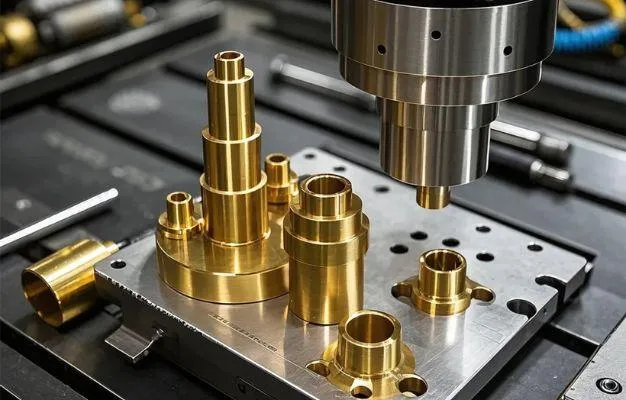
Bronze parts are used in almost every industry that deals with moving machinery, fluid handling, or marine environments. Low friction, corrosion resistance, and long fatigue life are all properties of bronze that make it a practical solution in situations where plastics and steel both corrode.
Oil and Gas
Bronze valve seats, pump wear rings, and stem guides are used in the oil and gas industry because they resist corrosion from sour gases and seawater. CNC-machined bronze components are used heavily in offshore drilling and subsea gear. These components must be able to withstand high pressures and cyclic stresses.
Marine
Propeller shaft bearings are used in marine applications, as well as rudder bushings and through-hull fittings. Seacock valves also feature. C95400 aluminum and C93200 bearing are the predominant grades.
Industrial Machinery
Bronze bushings and thrusters are used in industrial machinery to keep machines running between maintenance cycles. These wear components can be custom-machined in bronze to extend the intervals of use compared with equivalent steel parts that do not require external lubrication.
Aerospace and Defense
Precision machining is used to produce bronze components that meet the highest standards of dimensional accuracy and surface finish.
Safety Considerations when Machining Bronze
Bronze’s unique properties, as well as the machining environment, make it a metal that requires extreme caution when working with. Safety guidelines are provided to help you minimize risk and prevent accidents.
Proper Ventilation
Make sure that the area where you are machining is properly ventilated. Bronze machining may produce fine particles that, if inhaled, could be dangerous.
Protective Gear
Wearing protective gear such as safety glasses, gloves, and earplugs will help protect against noise, metal particles, and eye injuries caused by the machining process.
Machine Maintenance
Check and maintain your machining equipment regularly to avoid mechanical failures, which could cause safety hazards.
Fire Safety
Firefighting materials should be readily available, as the machining operation can generate sparks that could ignite flammable material.
How to Source CNC-machined Parts of Bronze Effectively?
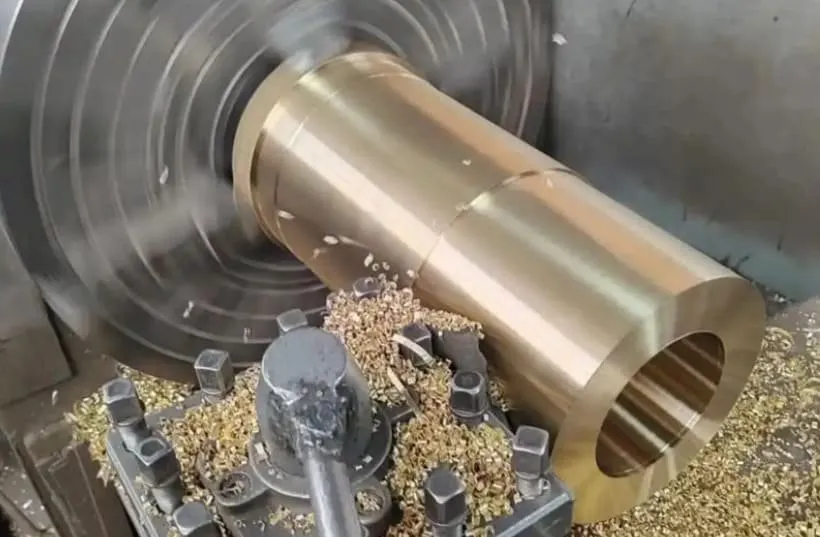
To quote bronze components accurately, there are a few variables that will influence machine sourcing: material, complexity, volume, and lead time.
Prototypes & Small Quantities
Bar stock is a standard starting material for prototype runs of 1-5 pieces. SAE 660, C95400 brass is available from most industrial distributors in hexagon, rectangular, and round shapes. Most machine shops will begin machining the stock within 1-3 business days.
Production Volumes
For high-volume production runs, castings that are near net shape require less machining and optimize material savings. For bronze bearing part castings, sand or centrifugal casting will require less material to be removed during CNC machining, thus less expense.
What to include in your RFQ
If you are quoting bronze components for CNC machining, send a complete 3D CAD and 2D drawing that includes all the tolerances, surface finish requirements, and UNS numbers for the material, as well as any testing or certifications (material certifications, hardness certifications, dimension reports). This will prevent back and forth, and ensure you receive an accurate quote quickly.
As opposed to general job shops, specialized metal machining establishments can guarantee greater quality and shorter timeframes for machining of copper and bronze alloys. Having alloy-specific expertise is crucial. The machining parameters differ for each grade of bronze and include tool selection, machining speeds and feeds, and even different types of coolants.
Cost Considerations for Bronze CNC Machining
The cost per pound of bronze, while certainly higher than that of steel or aluminum, also depends on the degree of complexity, volume, and grade of the alloy. Bronze is more expensive, and its greater cost per pound comes as a result of both the machinability and volume.
Material Costs
The cost of material is significantly dependent on its grade. C93200 bronze is about 2 to 3 times more expensive than 6061 aluminum. Greater alloy content in C95400 aluminum bronze results in a more expensive material. The premium material can be justified in instances where a bronze bushing is 5 times more durable than a nylon counterpart.
Machining time and cost
The majority of costs that result from the CNC machining of bronze parts come from the time spent on machining. Leaded grades are easier to machine and result in less time spent on machining.
Volume Breaks
The need for volume breaks is self-explanatory. As order volumes increase, the cost of tooling, setup, and programming gets spread across a larger quantity. For instance, a bushing that costs $45 for five pieces could be $8 for 500 pieces. The quickest means of minimizing costs while sustaining quality is to obtain production volume quotes.
Legal and Regulatory Considerations
Legal and regulatory concerns when machining bronze metal in the aerospace and maritime industries are paramount. Components in these industries have defined safety, quality, and regulatory compliance standards.
Aerospace Standards
Aerospace standards deal with the tensile strength and tolerances of parts that are designed to operate in extreme and adverse environments.
Maritime Regulations
Maritime regulations address the strength and corrosion resistance of components that operate in saltwater and corrosive environments.
Quality Standards for Machined Bronze Parts
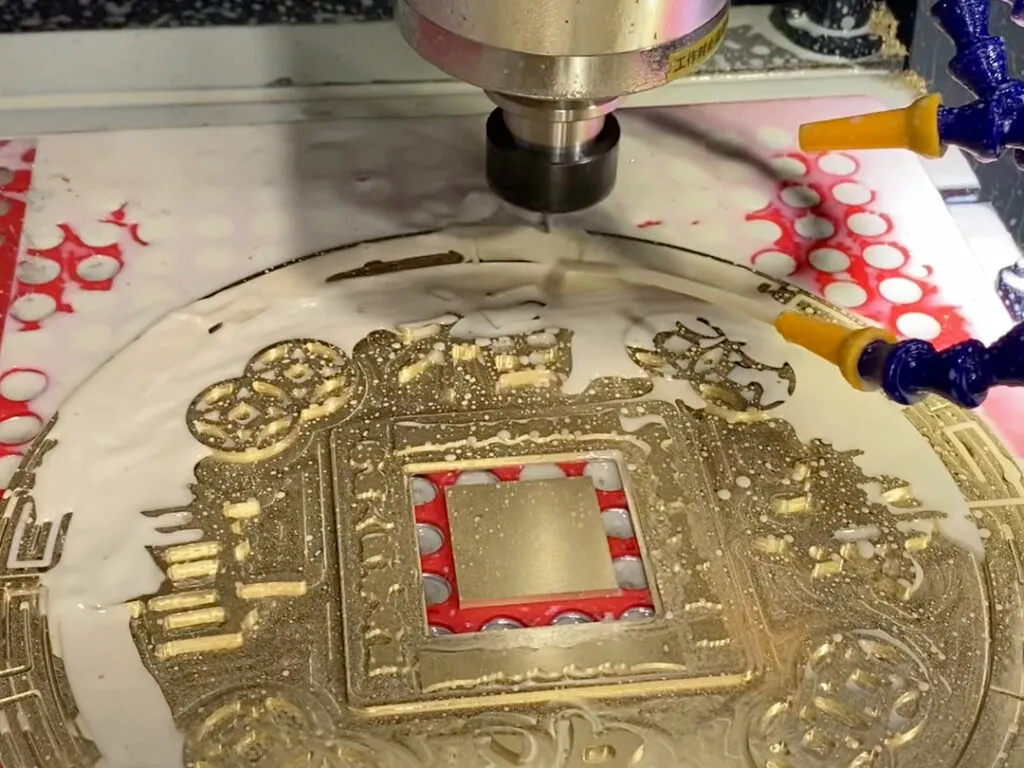
Quality assurance for CNC-machined bronze components is comparable to that of other pieces with specific, precision machining, but with other considerations unique to the material.
Material Certification
The first step is obtaining material certification. MTRs, in the context of a specified alloy, confirm compliance with the chemistry of the alloy to ASTM or SAE standards. For applications that are critical to aerospace and defense, complete traceability is mandated from the mill to the final part.
Dimensional Inspection
Dimensional inspection involves standard measurements. These include the use of micrometers, specially designed bore gauges, CMMs, and optical comparators. Air gauging, which measures the bores’ tolerances and clearances, is the most effective solution for values of less than +-0.001”. This method of gauging has the added benefit of checking compliance with no risk of gauge error.
Surface Finish Verification
Surface finish is verified using a contact profilometer. As a method of verifying the control of the machining process, roughness measurements are taken at various locations on the bearing surfaces. The identification of the material can be verified by hardness testing, which is an acceptable substitute in instances where MTRs cannot be acquired and the testing is of Rockwell B and Brinell hardness.
Conclusion
The machining of metal in bronze yields components that have a longer lifespan and better functionality under severe working conditions. For custom bronze bushings and simple aluminum bronze structural components, the most important factors are choosing the right alloy and having a suitable design with practical tolerances. Additionally, working with a vendor who understands copper alloys would be indispensable.
ProLean MFG has expertise in alloy-specific precision CNC machining of bronze and offers fast turnaround times. We guarantee tight tolerances with each grade we work on, including SAE 660, aluminum bronze, phosphor bronze, etc. Get a free quote and have your bronze parts machined the first time perfectly.