
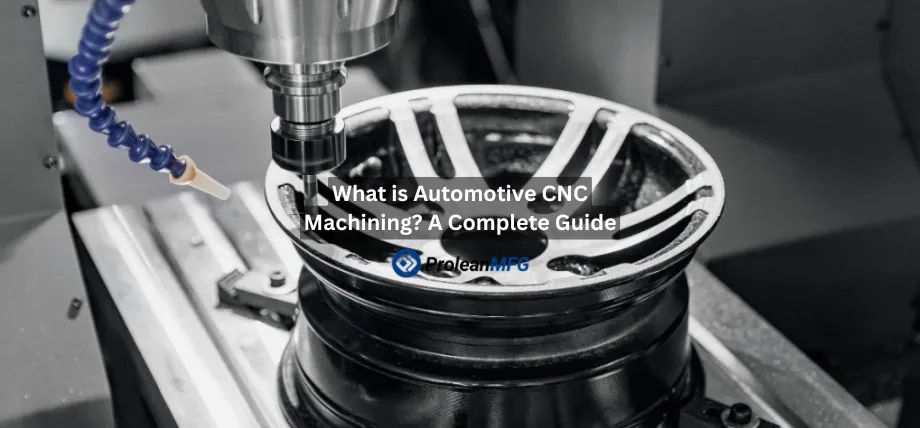

Automotive CNC Machining is a manufacturing process through which the production of auto parts is achieved at the highest possible repeatability and consistency. Automotive machining is slightly different from normal CNC machine shops due to its dedicated workflow and staff expertise. Automotive CNC machining supports prototype validation, scaling to production parts, and high-tolerance critical features like cylindrical bores.
You can design complex metal and plastic parts with consistent quality scale using computer-controlled machining systems. This article provides a full guide on automotive CNC machining for you.
What Is Automotive CNC Machining?
Automotive CNC (Computer Numerical Control) machining is the production of metal and plastic vehicle components precisely using computer-controlled machine tools. You can provide instructions to cutting tools via CAD/CAM software through programmed paths. Therefore, parts can be produced using operations such as milling, turning, drilling, boring, and grinding using CNC machining through controlled material removal.
CNC lathes and mill-turn systems that operate on 3-, 4-, and 5-axis machining centers are available for automotive machining. 5-axis machines can move the cutting tool in multiple directions simultaneously. This allows you to create complex designs in a single step, reducing handling time, improving production efficiency, and minimizing dimensional errors.
Key Advantages of CNC Machining for Automotive Applications
Exceptional Precision And Tight Tolerances (±0.01 Mm)
Automotive CNC machining allows you to manufacture critical auto parts with exceptional precision and tight tolerances. Some parts are generally produced through automated machining, including automotive fasteners, valve seats, gear shafts, and bearing bores, with consistent tight tolerances of ±0.01 mm.
Even safety components like brake calipers rely on CNC machining because it can provide critical tolerance control up to ±0.05 mm. This reduces the chances of misalignment and any durability issues that can come with uncalled vibrations.
High-Volume Repeatability For Mass Production
You can manufacture thousands of components repeatedly with consistent accuracy after a CNC program is tested and the fixtures are configured properly. But it is essential to maintain tooling and calibrate regularly. Statistical Process Control (SPC) systems are beneficial to maintain accuracy during the manufacturing process to track dimensional accuracy, detect tool wear early, and prevent the production of defects.
Automation And Reduced Manual Dependence
You can use CNC machining with minimum manual involvement. Automated systems such as pallet changers, robotic loading units, and automatic tool changers enable continuous overnight operations without on-site supervision, thereby maximizing productivity. Therefore, you can minimize the overall cost by reducing labor cost per component, increasing production efficiency, and minimizing inconsistencies caused by humans.
Complex Geometries And Design Freedom
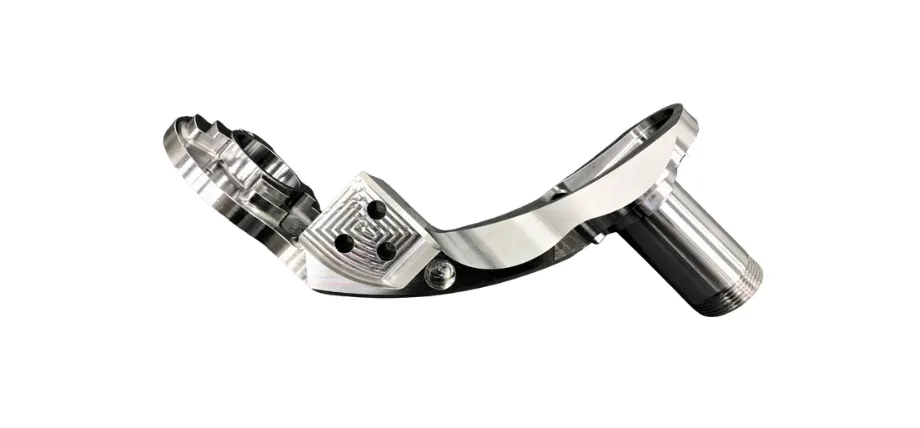
A 3-axis system requires secondary operations to create complex designs such as design curves, undercuts, and multi-angle features. But you can achieve this using 5-axis CNC machines. Manufacturing complex components using multi-axis automotive CNC machining can be achieved through two to three setups. Therefore, you can reduce the overall cost by improving efficiency, reducing handling time, and minimizing alignment errors between operations.
Shorter Lead Times From Design To Production
You can create prototype components more quickly by directly generating CNC toolpaths from a CAD model. You can update the CAD model and revise the CAM program simply when designing modifications are required, so that you can produce new versions of the components without changing physical tooling. This allows you to eliminate the need for new molds and extensive retooling while minimizing the lead time.
Limitations of Automotive CNC Machining
CNC machining is not the perfect process for every automotive application. Therefore, you should identify the limitations of the automotive CNC machining process before starting your project to reduce the cost while increasing the efficiency.
| Limitations | Explanation |
| Material Waste | CNC machining is a subtractive process. Therefore, the production of waste chips from raw material is higher. This causes an increase in overall cost due to increased material cost and the requirement of efficient chip and coolant management systems. |
| Tooling and setup expenses | Initial investment for CNC machining is higher due to the installation of cutting tools, fixtures, and toolholders. Furthermore, for small production runs such as prototyping, time for setup and programming requires more time than the actual machining process. Therefore, the per-part cost increases significantly compared to alternative manufacturing methods. |
| Geometric limitations | Complex designs require specialized tooling or secondary operations such as Electrical Discharge Machining (EDM), increasing the lead time and the cost per part. |
| Machining hard materials | Some materials, such as hardened steels, ceramics, and superalloys, are more difficult to machine. Therefore, applying slower cutting speeds, using specialized coatings, and replacing tools more frequently increase costs compared to soft materials such as aluminum. |
| Inefficiency for thin-walled structures | Stamping or casting are useful to produce large thin-sheep parts such as automotive body panels efficiently. But, producing them using solid stock can increase the material waste and production cost without improving the product quality. |
Efficiency Improvements in Automotive Part Production Using CNC Technology
Efficiency improvements in automotive part production using CNC technology have been achieved by the industry over decades through increasing cutting speed, minimizing non-productive machine time, and reducing the number of setups needed for each component.
Reducing Cycle Times And Machine Downtime
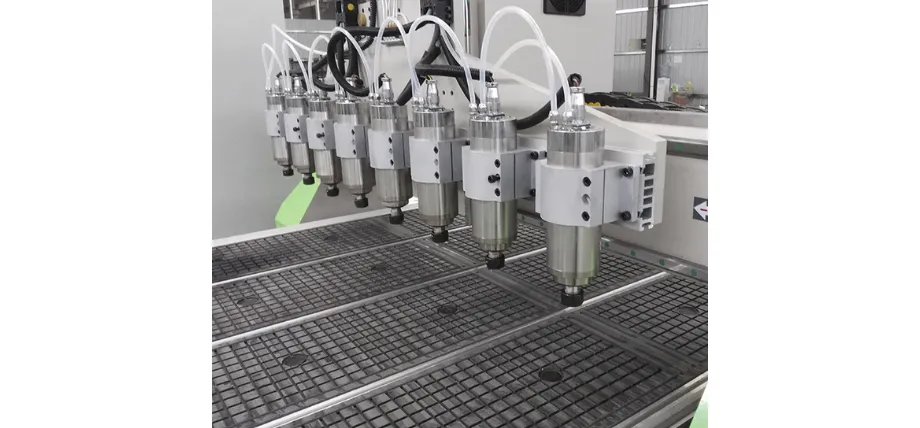
CNC machining with 5-axis systems can reduce the total production cycle time for vehicle components by 30% compared to traditional 3-axis CNC machining. This is achieved by reducing setup changes, steps, and repositioning operations that are required during 3-axis machines.
You can improve the efficiency through predictive maintenance technologies, also. Built-in vibration and thermal sensors in mid-range and advanced machines monitor machine condition continuously. Therefore, you can maintain productivity while reducing the overall cost and downtime as you can detect issues such as spindle bearing wear, tool holder runout, and coolant system problems early.
Automated Tool Changes And Multi-Axis Machining
CNC machining can provide dimensional accuracy and stability during machining because the machining is automated. CNC machines come with tool capacity, which means advanced machines can hold up to 30 tools to change the cutting profile, texture, and type of operation without changing the machine. This allows automated transitions of tooling between roughing, semi-finishing, and finishing operations.
You can reduce the handling time, minimize repositioning errors, and improve production efficiency using mill-turn machines. These are machines that combine both turning and milling functions, allowing parts to be completed within one machine and one setup.
Consistency At Scale: From Prototype To Assembly Line
You can reduce the cost and time to redevelop or relearn the machining process when scaling from prototyping to mass production. This can be achieved by CNC machining, as you can use the validation data of CAM programs generated during early production for mass production.
In automotive CNC machining, faster market entry of products affects profitability directly. Therefore, you can shorten the process of transition from final design approval to production launch by using validation data of CAM programs.
Automotive Part CNC Machining: Prototyping to Full-Scale Production
From product development to the full-scale production process, you can get the support of automotive part CNC machining.
Rapid Prototyping And Concept Validation
You are able to produce a fully functional metal prototype identical to the final product using CNC machining within a short timeframe to evaluate a CAD design. These prototypes are able to exhibit mechanical and thermal properties identical to the final product, unlike 3D-printed models.
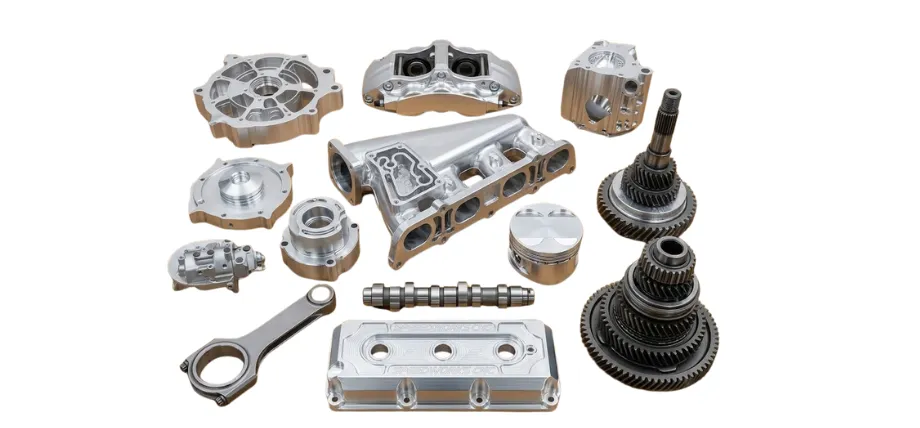
Engine Components: Cylinder Heads And Engine Blocks
Engine components such as cylinder heads and engine blocks are complex designs that require precision. These CNC machined automotive components are produced as rough casting initially. Then these components undergo extensive finishing operations. You can use multi-axis machining centers to maintain high production efficiency, precision, and tight tolerance standards.
Brake System Parts: Rotors, Calipers, And Components
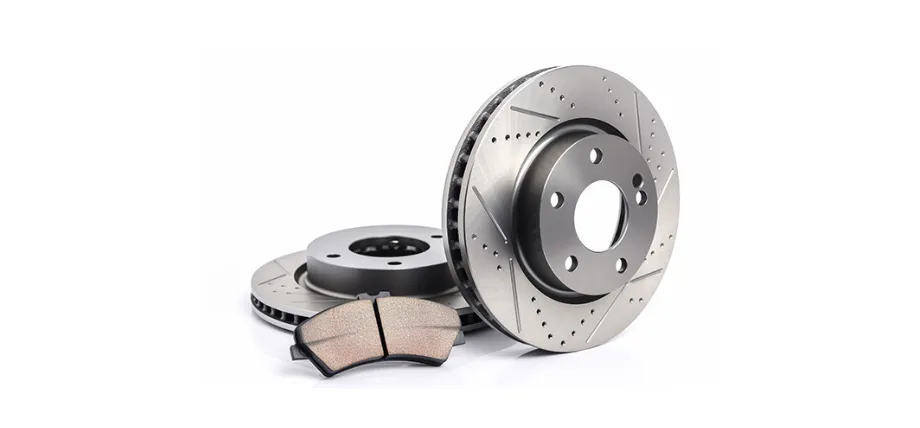
The brake rotors are CNC-machined precisely to achieve the desired surface roughness. You can ensure proper brake pedal response and brake pad wear by maintaining lateral runout below 0.05 mm. For the automotive industry, brake caliper bodies are machined to obtain tight tolerance standards using cast iron or aluminum.
Transmission Parts, Gearboxes, And Drive Axles
You can achieve precise concentricity and runout of gear shafts and transmission housings through high-accuracy CNC turning and grinding operations. The DIN quality standards of gear teeth influence load capacity, vibrational levels, and transmission noise. You can achieve this by producing them through hobbing or precision grinding processes. To ensure accurate gear meshing and reliable performance across a range of temperatures, you should maintain the center distance between gear shafts within ±0.015 mm or tighter, as bore alignment is critical in transmission housing machining.
Steering Components And Control Arms
Maintaining torsional rigidity is required for reliable steering performance. Precise bore geometry is required for the installation of rack seals properly. Therefore, to achieve them, machining tie rod ends and steering knuckle castings precisely at ball joint mounting points and interface surfaces is required.
To maintain consistent internal diameter tolerances, machining control arm pivot bushings is required. This allows press-fit retention to be secured throughout the process because variations in these dimensions can affect the suspension behavior, ride comfort, and NVH characteristics.
Starter Motors And Electrical Drive Units
CNC machining of electric motor housings and rotor shafts requires precise bearing bore concentricity and smooth journal surface finishes. This helps reduce friction, improve efficiency, and minimize energy losses during high-speed motor operations.
Interior, Exterior, And Custom Body Components
Automotive part CNC machining involves achieving both mechanical reliability and refined aesthetic quality of the product.
You can use CNC-machined aluminum for components that require both dimensional accuracy and high-quality surface finishes for appearance and fitment. Furthermore, you can obtain exact design requirements of custom components in motorsport and high-performance automotive applications with CNC machining.
Exhaust System Components
You should ensure proper assembly and leak prevention of exhaust manifold flanges and turbine housings. This can be achieved by using precisely machined sealing surfaces and accurately aligned bolt hole patterns. To maximize efficiency, control thermal performance, and ensure containment in the event of turbine blade failure safely, you should maintain exact clearances between the housing and the rotating turbine wheel.
Materials Used in Automotive CNC Machining
Aluminum offers a balance of strength, low weight, and high machinability. Furthermore, it can be machined at cutting speeds three to five times faster than steel. Therefore, aluminum has become the preferred material for automotive CNC machining due to reduced machining cycle times and lower tooling expenses. The demand for aluminum has increased as the demand for lightweight electrical vehicles is increasing.
The following table represents the variations of different materials used in automotive CNC machining. Therefore, you can choose the material that is best suited for your industry depending on its key properties.
| Material | Key properties | Common automotive applications |
| Aluminum alloys (6061,7075 and A380) | Low density (~2.7g/cm3), good machinability, and corrosion resistance | Engine blocks, transmission housings, brake calipers, EV battery enclosures, and structural brackets |
| Steel (440,4340 and 1045) | High tensile strength, wear resistance, and weldability | Gear shafts, drive axles, crankshafts, control arms, steering racks |
| Cast iron (grey ductile) | Excellent damping, wear-resistant, and low cost | Engine blocks, brake rotors, and cylinder heads |
| Titanium (Ti-6Al-4V) | High strength-to-weight ratio, corrosion resistance, and more difficult to machine | Connecting rods, valve retainers, performance suspension components |
| Engineering plastics (PEEK, Nylon, Delrin) | Lightweight, chemically resistant, and self-lubricating | Bushings, bearing cages, fluid system components, and interior fixtures |
| Magnesium alloys | Lightest structural metal (~1.7g/cm3)Therefore, specialized cutting conditions are required for flammable chips | Gearbox casings, instrument panel structures, and EV powertrain components |
Quality Control in Automotive CNC Machining
Tolerance management and surface roughness standards
Tolerance control is an important factor in automotive CNC machining. Critical functional components such as bearing bores, sealing surfaces, and gear contact areas should be machined with higher tolerance. But, machining efficiency and reducing cycle time are important for non-critical components.
Measurement and inspection methods
To verify the dimensions of CNC-machined automotive components, coordinate measuring machines (CMMs) are the primary inspection systems. CMMs use contact probes or optical sensors to measure coordinates on the surface of a part precisely by comparing them with the original CAD design specifications. Furthermore, you can verify the consistency of the production process before starting full-scale production. Quality validation procedures such as First Article Inspection (FAI) and the Production Part Approval Process (PPAP) support this verification.
Certifications: ISO 9001 and IATF 16949
These standards and certifications focus on preventing defects and minimizing the process verification. Therefore,
- ISO 9001 is a quality management system that focuses on establishing requirements for areas such as document control, corrective actions, and process auditing in the industry.
- IATF 16949 is a certification that OEMs and Tier 1 automotive suppliers should obtain before initiating production. This provides additional standards specifically designed for the automotive industry. This includes Failure Mode and Effects Analysis (FMEA), control plans, measurement system analysis (MSA), and material traceability from raw material to finished product.
CNC Machining for Electric Vehicles
To improve efficiency and reduce electromagnetic losses in electric vehicles, bearing bore concentricity of motor housings must be precise to within 0.025 mm, along with smooth stator bore surface finishes. It is important to maintain the tight running clearances in electric vehicles as motors operate at speeds between 10,000 and 20,000 rpm.
5-axis horizontal machining centers with pallet automation are applied to produce the complex design of battery enclosures precisely. Furthermore, cooling plates, manifolds, and heat exchanger housings are produced from aluminum by CNC machining. CNC drilling, milling, and post-machining operations are used to create complex internal cooling channels precisely.
Therefore, the involvement of CNC machining has increased when shifting towards electric vehicles, as design complexity and components that require precision have increased.
CNC Machining vs. Additive Manufacturing for Automotive Parts
Although CNC machining is involved in the automotive industry, additive manufacturing (AM) technologies, including metal powder bed fusion and directed energy deposition, are also involved. AM is involved during the early-stage design validation when creating complex prototypes. CNC machined automotive components are used for final production while machining precision critical surfaces.
Although both methods are valuable, you can choose the most appropriate method for your requirement according to the details mentioned in the following table.
| Criterion | CNC Machining | Additive Manufacturing |
| Dimensional accuracy | Can achieve tolerances between ±0.005 mm and ±0.05 mm, depending on the part | Ranges between ±0.1 mm and ±0.05 mm. Require secondary machining for precision fits |
| Surface finish | Standard surface roughness values range between Ra 0.8 and 3.2 µm. Grinding is required for finer finishes | Surface roughness values range between Ra 6 and 25 µm. Available with visible layer patterns on curved surfaces |
| Material characteristics | Produces isotropic properties consistent with the original raw material | Available in layer-by-layer bonding, which creates directional weaknesses. Therefore, exhibit anisotropic behavior |
| Geometric capability | Making enclosed cavities and undercuts is difficult due to the access limitations of the cutting tool | Suitable for the production of complex internal structures. |
| Cost efficiency | For high-volume production, the cost per part decreases | The cost per part is stable and suitable for low-volume production |
| Lead time | Using CAD data, parts can be produced within hours to days | Build duration increases with part size and quality. But have a similar lead time |
| Applications | High-volume structural components, precision-fit parts, and production-grade automotive components | Prototypes with complex designs, tooling inserts, lightweight structures, and low-volume custom designs. |
Automotive Industry Service
Automotive parts require precision at the micron scale when you’re looking for peak performance and avoiding mechanical failures. ProleanMFG delivers the quality certainty you require.
We have produced critical powertrain components, gears, and cylinder heads, and we provide high-tolerance prototyping for next-generation electric vehicles at our facility. We also provide high-tolerance prototyping supported through CMM inspection and FAI/PPAP documentation.
Ready to start your automotive project? Request a completely free quote today!
Conclusion
Automotive CNC machining is important in the production of vehicle components that require precision from engine and braking systems to electric vehicle powertrain structures.
- Choose CNC machining for functional testing, critical fits, and components with high tolerance.
- Use additive manufacturing for complex lightweight prototypes and design validation, and use CNC post-machining to finish the part.