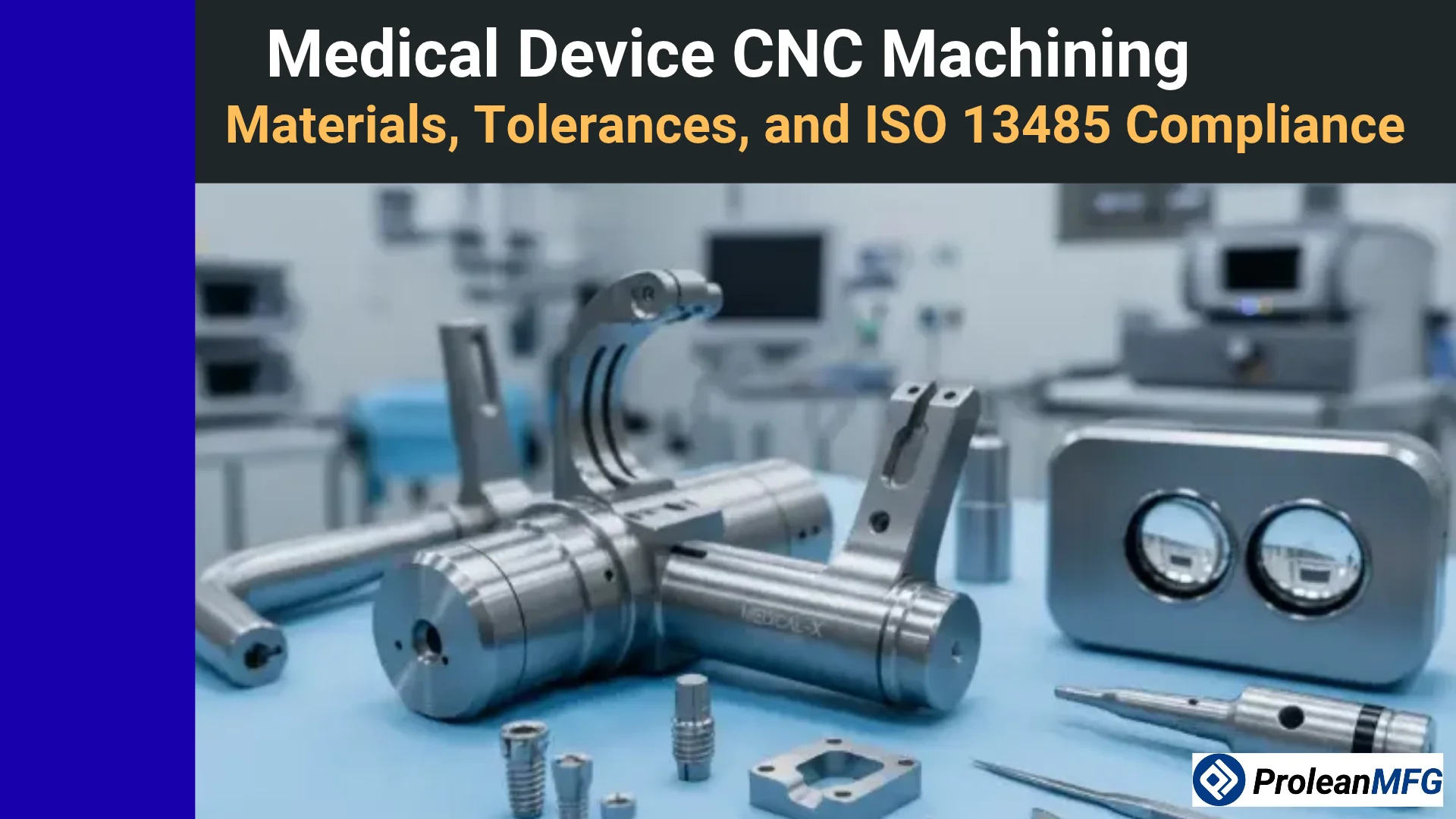
Medical CNC machining manufactures implants, surgical instruments, and housings to meet Food and Drug Administration (FDA) and ISO 13485 requirements for tolerances, materials, documentation, and more.
A machined medical device can meet all dimensional requirements but still fail an audit for a missing heat number or a misplaced grade specification.
Procurement teams are more accustomed to dimensional correctness than to compliance. Documentation, surface finish, sterilisation technology, and material grade must align.
After reading this guide on medical machining materials, practical tolerances, common mismatches, and crucial documentation, you’ll know how to specify for honest prices from service providers.
Key Takeaways
- Every machined medical device must pass the traceability test
- Specific grade details are critical – 316 and 316L are distinct materials in an audit
- The FDA regulates the medical device manufacturer; the machine shop only indirectly
- Implant tolerance in medical device manufacturing depends on the feature – Bore fits ±0.005 mm, functional features ±0.010–0.025 mm
- Select sterilization method first, followed by type of material and surface finish
- CoCrMo and titanium are expensive because they are abrasive to cutting tools and cut slowly
Why Medical Machining Is a Different Discipline
Medical machining is different from general precision machining in process validation, lot-level traceability, and the seriousness of the consequences of a part failure. A manufacturer that holds tight tolerances for electronics is not automatically ideal for medical device machining.
Machining control is the biggest differentiator in medical device CNC machining, not just the cutting process.
Check the table below for summarized differences between medical machining and general precision machining.
| Element | Standard precision machining | Medical machining |
| Materials | Typically general purpose; chosen for cost-effectiveness, machinability, and strength | Biocompatibility required – trace element release, autoclave cycles, reliable cleaning |
| Documentation | An invoice and delivery docket often enough | OEM expects a range of documents – material certificate (mill cert), First Article Inspection, Certificate of Conformance (CoC), In-process and final inspection records |
| Consequences of errors | An error in tolerance of 0.4mm in the industrial setting is mostly just an inconvenience | Tolerance errors can trigger regulatory nonconformance, safety issues, and functional problems |
Suppliers have no choice but to adhere to these control levels; three layers of regulations make this an obligation.
Regulatory Framework in Plain Terms
The regulatory framework in medical device CNC machining applies three layers: ISO 13485:2016, FDA 21 CFR Part 820 / QMSR Transition, and what the FDA actually regulates.
Collectively, these layers cover what your business should control and what the service provider must deliver or prove. They work together, with the standard defining the system, regulations reiterating the legal requirements, and the contract incorporating the supplier.
- ISO 13485:2016
The ISO 13485 was developed to safeguard safety and quality in the medical devices industry. All entities involved in the design, manufacture, installation, and servicing of medical devices can use these regulations. [1]
There are several categories of ISO 13485 requirements, including general requirements, documentation requirements, management responsibility, resource management, and product realization.
The requirements for the actual medical machining are captured under product realization, which is the broadest part of the ISO 13485 standard.
The requirements under product realization are as outlined in the table below.
| Product realization requirement | Details |
| Planning of product realisation | Quality objectives for the medical deviceInfrastructure and resources requiredDocuments, processes, and associated tasksPersonnel training |
| Customer-related processes | Determine customer needsReview the needs before committing to productionMaintain clear communication with the customer |
| Design and Development | Document proceduresReview, verify, and validate the designTransfer to manufacturing only after completion of these steps |
| Purchasing | Set requirements for supplier and item evaluationAssess supplier reputation and product qualityMaintain supplier controls |
| Production and Service Provision | Ensure product meets specifications – planning, monitoring, & controlDocument cleanliness and contamination proceduresMaintain identification and traceability |
| Control of Monitoring and Measuring Equipment | Verify measuring and monitoring equipmentEnsure standards are met for calibration and verification Record equipment details |
- FDA 21 CFR Part 820 / QMSR transition
This layer answers the question of what must be implemented for medical devices to be marketed in the US. It is a US regulation that refers to ISO 13485 and binds device manufacturers.
The Quality Management System Regulation (QMSR) from the FDA came into force on February 2, 2026. It effectively replaced the earlier Quality System Regulation (QSR). So, any medical device being manufactured today falls under this new standard. [2]
The incorporation of ISO 13485:2016 by reference reduces duplication between FDA requirements and ISO 13485 requirements.
Given that OEMs are regularly asking for ISO 13485 certification, it is important to consider this certification as the baseline.
- What the FDA Regulates
The FDA regulatory scope can be confusing, so it’s worthwhile to get this clear. Machine shops are not under this scope; medical device manufacturers and marketers are.
QMSR compliance is expected for OEMs and contract manufacturers. These entities get the pressure from supplier audits, purchase orders, and quality agreements.
For a CNC machining shop, the pressure comes in the form of a quality agreement and the purchase order.
With the requirements outlined, the next question is the material the medical devices are produced from.
Biocompatible Materials
The most commonly machined materials in the medical field include 316L/ 316L, Ti-6Al-4V ELI, PEEK, CoCrMo, 17-4PH, and 6061 aluminum. Each has its typical use and requirements.
Note that none of these materials is outright biocompatible; biocompatibility is measured by how the finished part matches the ISO 10993 requirements. Suppliers often incorporate USP Class VI test results to enhance their cases.
Standards such as ASTM F138, ASTM F75, ASTM A564, and ASTM B211 are commonly used in machining these materials. Ensure compliance with the standards when specifying the materials, not relying on the alloy name alone.
316L and 316LVM
316 is a widely used material in medical machining, backed by its affordability, corrosion resistance, and capability to be sterilized.
316LVM has been ‘vacuum melted’ to achieve a cleaner microstructure that suits implantations. These materials are regulated by ASTM F138 and F139 for bar and wire, and sheet and strip, respectively. [3][4]
The tendency for 316L to work harden during machining calls for steady cutting speeds and sharp tooling.
Ti-6Al-4V ELI, Grade 23
Ti-6Al-4V ELI, also called grade 23 titanium, is safe, flexible, and tough. Its blend of strength, crack resistance, and biocompatibility is suitable for surgical tools and medical implants.
For safety and consistency of medical devices, grade 23 titanium is processed according to ISO 5832-3 and ASTM F136 standards.
After the initial shaping, grade 23 titanium undergoes precision machining – CNC turning, milling, drilling, and other processes. Final inspection and quality control ensure all grade 23 titanium machined parts from ProleanTech meet global standards for safety and reliability.
Popular applications of machined grade 23 titanium:
- Bone screws and plates
- Knee implants and other joint components
- Dental implants
- Surgical instruments
PEEK (USP Class VI), CoCrMo
PEEK (Polyether ether ketone), a popular high-performance engineering thermoplastic, is highly tolerant to harsh conditions. It can retain its structure up to 260°C, so it can be used in steam and hot liquids. [5]
PEEK exhibits good resistance to most inorganic and organic chemicals. Only sulfuric and nitric acids damage the thermoplastic.
For properties such as these, PEEK machining is preferable for implants and sterilizable manifolds.
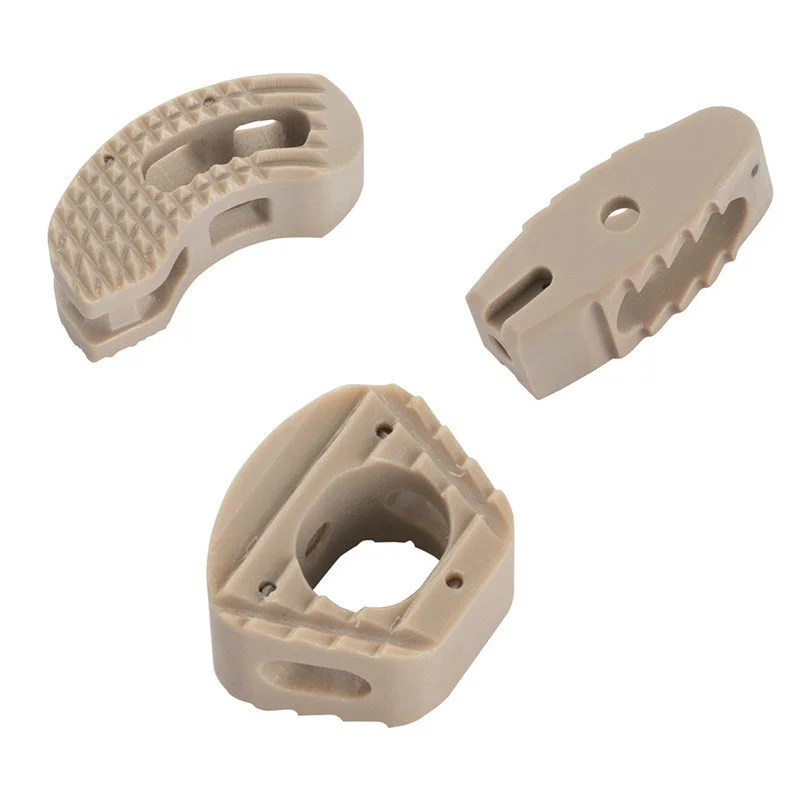
Implant-grade PEEK
17-4PH, 6061 — where they are acceptable
6061 aluminum and 17-4PH stainless steel are not for implanting, but have a function in the chain. 6061 aluminum can be used for fixtures, enclosures, and equipment frames. 17-4PH parts are acceptable for reusable surgical instruments for their strength and corrosion resistance.
Material, Sterilization, and Surface Finish
Material, sterilization, and surface finish of machined medical parts are intertwined. The three elements should be chosen together to avoid disappointment from failures during the validation run.
The material depends on the sterilization method. The type of material limits the possible surface finish methods. The surface finish affects the effectiveness of cleaning a part.
Let’s see how these three interlink in the table below.
| Material | Steam autoclave | Ethylene oxide (EtO) | Gamma / e-beam radiation | Hydrogen peroxide plasma |
| ABS | Softens at around 100 °C – So, avoid | Requires validation | Requires validation | Requires validation |
| PEEK | Compatible | Compatible | Compatible | Compatible |
| Ti-6Al-4V ELI | Compatible | Compatible | Compatible | Compatible |
| 316L, 17-4PH | Compatible | Compatible | Compatible | Compatible |
| CoCrMo | Compatible | Compatible | Compatible | Compatible |
The best practice is to choose the sterilization method first, then the material. The surface finish comes last.
Surface Finish
The surface finish of a machined medical device affects the cleaning process, interaction with the mating surface, and corrosion resistance. There must be a balance; not too smooth or too rough for the application.
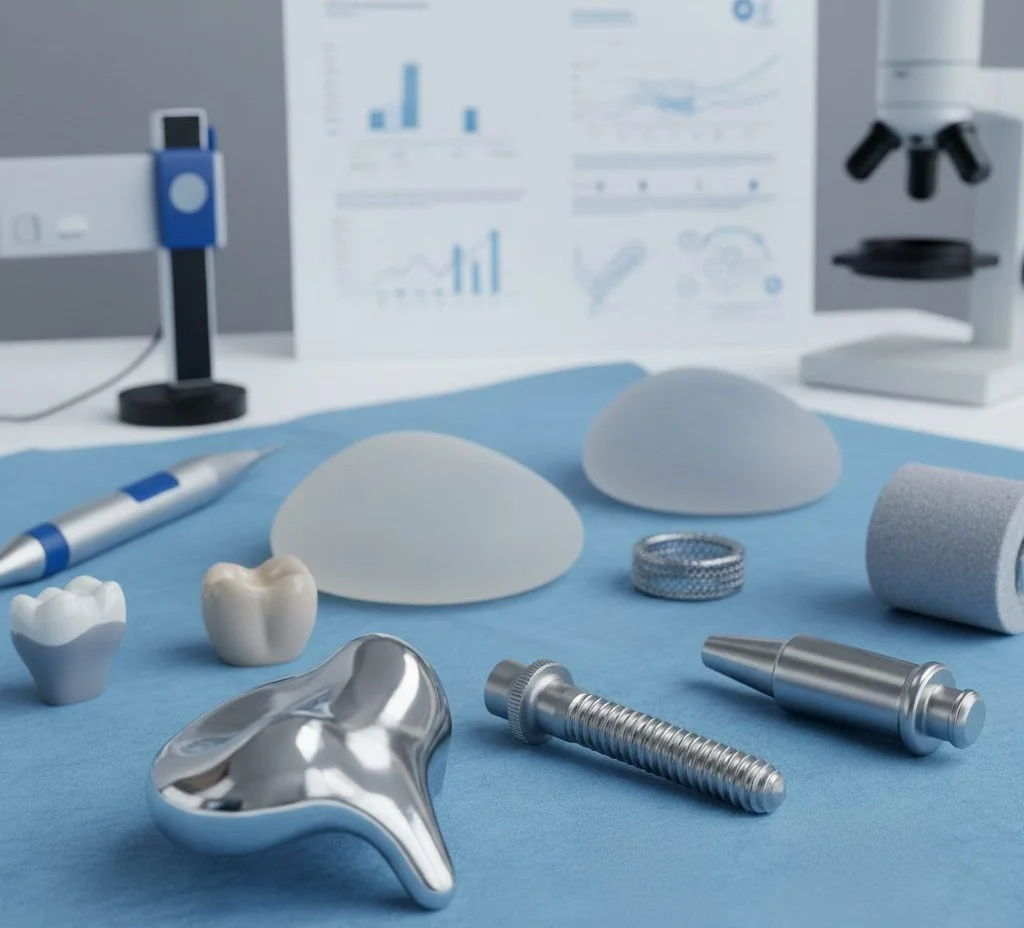
Surface finish for medical implants
A too-smooth finish is undesirable for an implant, while a rough surface traps biofilm and residue.
Consider these finish types depending on what the medical device is designed for.
| Surface finish type | Commonly used on | Results |
| Bead blasting | Stainless steel, titanium | Uniform textured surface |
| Electropolishing | Nitinol, stainless steel, titanium | Smooth microscopic peaks |
| Polishing | Titanium, CoCrMo | Minimized roughness |
| Type II anodizing | Titanium devices | Colored oxide layer |
| Passivation | 17-4PH, 316L | Restoration of protective oxide layer |
Tolerances: What Is Realistic?
Implant tolerances for medical machining typically lie between ±0.05 mm for non-critical features and as low as ±0.005 mm for bore fits. The realistic figures are approximately ±0.010–0.025 mm on functional features, ±0.005 mm for bore fits, and sealing surfaces at Ra 0.2–0.8 µm.
A manufacturer can deliver tolerances tighter than these, but there would be cost implications for enhanced honing and grinding, and tighter temperature inspection.
- ±0.010–0.025 mm on functional features
- Bore fits at ±0.005 mm
- Ra 0.2–0.8 µm on sealing surfaces
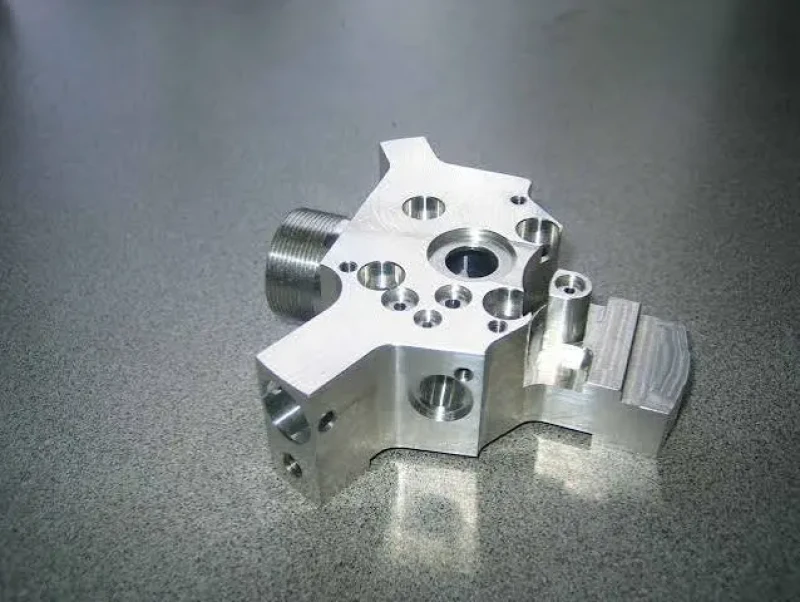
Medical part with smooth surfaces
Insist only on tight tolerances if the function demands. For every additional tolerance, expect longer machining and higher cost. To avoid unnecessary tolerance requirements, specify tolerance on the affected feature or part, not the full drawing.
Documentation You Must Receive
For a machined medical device, expect these documents from the manufacturer: Mill certs tied to lot/heat number, Certificate of Conformance (CoC), dimensional report, First Article Inspection (FAI), process validation reports, and a device history record (DHR).
- Mill certs tied to lot/heat number: A document that the material mill provides as a confirmation of an alloy’s mechanical properties and chemical composition.
- Certificate of Conformance (CoC): A statement delivered by the manufacturer indicating that the machined medical parts meet the stipulated standards, drawing requirements, and purchase order.
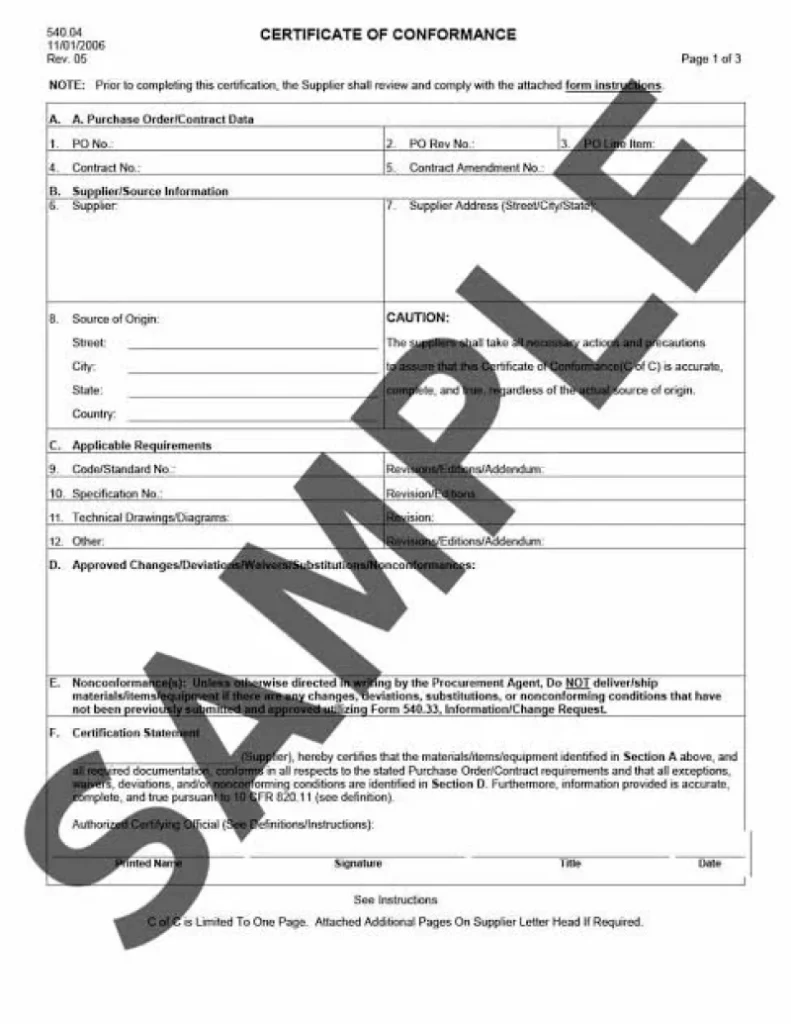
Sample certificate of conformance
- Dimensional Report: A document detailing the critical dimensions of a machined medical part. The drawing tolerances are also shown for comparison.
- First Article Inspection (FAI): Measurement and verification details of the first part to be produced. These details are done and compared with the drawing requirements. It is a requirement before the full production run proceeds.
- Process Validation Reports: Reports that show the consistency of manufacturing processes in delivering parts that meet requirements.
- Device History Record (DHR): A record for a specific batch that details the production process.
Mismatches That Fail Audits
Some of the fatal or costly failures in medical devices emanate from specific mismatches, not dimensional mistakes. A specification may appear perfect on paper, yet fail the audit process.
Consider mismatches such as: Implant-grade PEEK/Industrial PEEK, ABS housing/Steam autoclave, Body-contact stainless/303 free-machining, Ti Grade 23 (F136)/Ti Grade 5, and 316L/316.
Such could slip past inspection because the cert mentions “PEEK” and everyone is satisfied. Always ask for concrete information, including lot traceability, USP Class VI documentation, and material grade.
Considering the price can also lead to mismatches that can affect part performance and acceptability. Cost-effective grades like stainless steel 201 may appear suitable on a drawing, but they cannot stand continual sterilization.
Conclusion
Successful medical machining results from balancing material type, sterilization method, documentation, and tolerances. When failures occur, it is often due to poor specifications. For instance, using 316L instead of 316.
Specify the standard, request the heat-number certificate, and acknowledge that some materials cost more to machine than others due to factors such as processing time and tooling cost.
If you can get this information from the supplier, you are working with a genuine one. Their quote can be trustworthy.
Are you looking for an experienced CNC machining team to handle your medical device part manufacturing project? Whether it’s aluminum, stainless steel, or engineering plastics, our machine shop can match your precision and industry compliance requirements through world-class medical CNC machining services.
Call us or contact us online for a free quote within 24 hours.
FAQ
What materials are biocompatible?
The commonly machined biocompatible materials include PEEK, CoCrMo, 316LVM stainless steel, and Ti-6Al-4V ELI. USP Class VI test results and ISO 10993 evaluation apply to polymers.
What surface finish do implants need?
The best surface finish for implants depends on the specific function. While articulating surfaces should be smooth, bone-contacting surfaces require roughness of about 1.0 µm and 2.0 µm. Refer to the device finish specifications and drawing details.
Does the FDA regulate machine shops?
It does, though indirectly. Device manufacturers contract machine shops to produce parts. The FDA requirements still trickle down to machine shops through the contracts.
316 or 316L for a surgical instrument?
316L is preferable for its low carbon content, which suits welded and corrosion-prone parts. Implants should be made from F138 or 316LVM for cleanliness, biocompatibility, and corrosion resistance.
Resources
[1]https://www.iso.org/iso-13485-medical-devices.html
[3]https://store.astm.org/f0138-19.html
[4]https://store.astm.org/f0139-19.html
[5]https://www.ensingerplastics.com/en/thermoplastic-materials/peek-plastic