
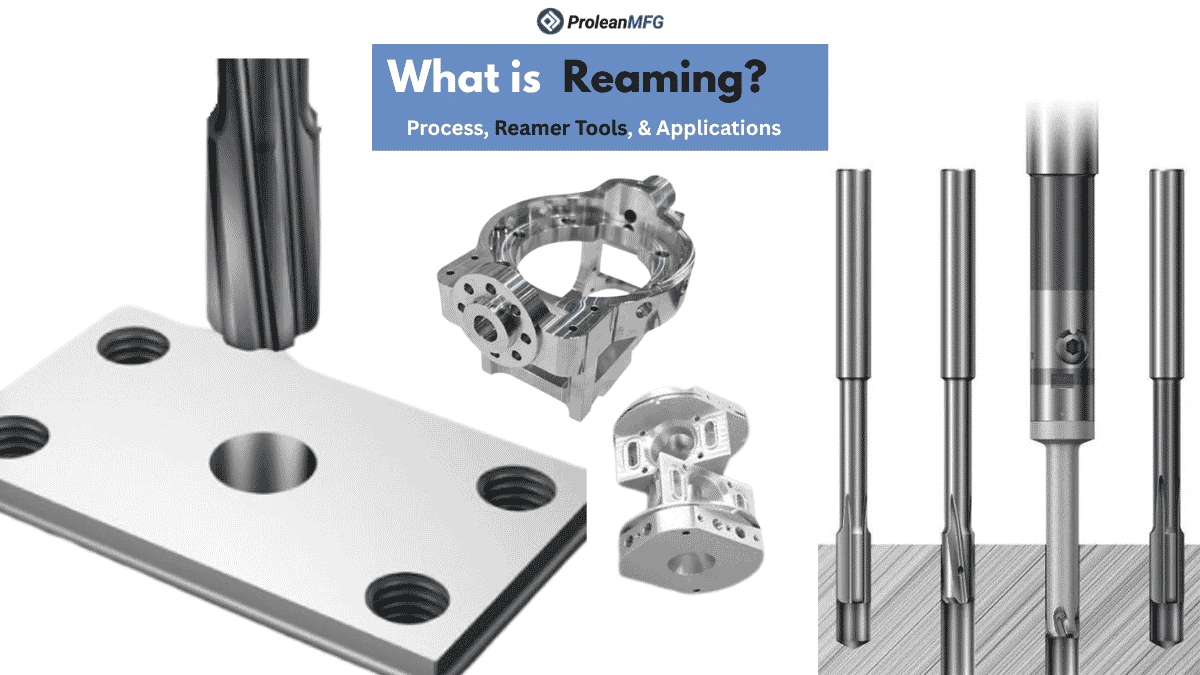

Reaming is a precision CNC machining operation used to finish, enlarge, and round pre-drilled holes, with Ra 0.4 to 3.2 μm and tolerances ± 0.005 to 0.020 mm, complying with ISO-286 H7 and H8 hole fits [1]. A multi-edge rotating cutter removes a minor amount of material (~2-5% of the total stock) from the hole.
Remaing produces perfectly rounded holes with tight tolerances & smooth finish for assembly fittings, dies & molds, firearms, and other engineering applications. However, incorrect tooling, misalignments, and work-hardening issues can impact the final results.
This article will elaborate on the CNC reaming process, Tools, considerations, and industry practices.
What is the Reaming Operation in Machining?
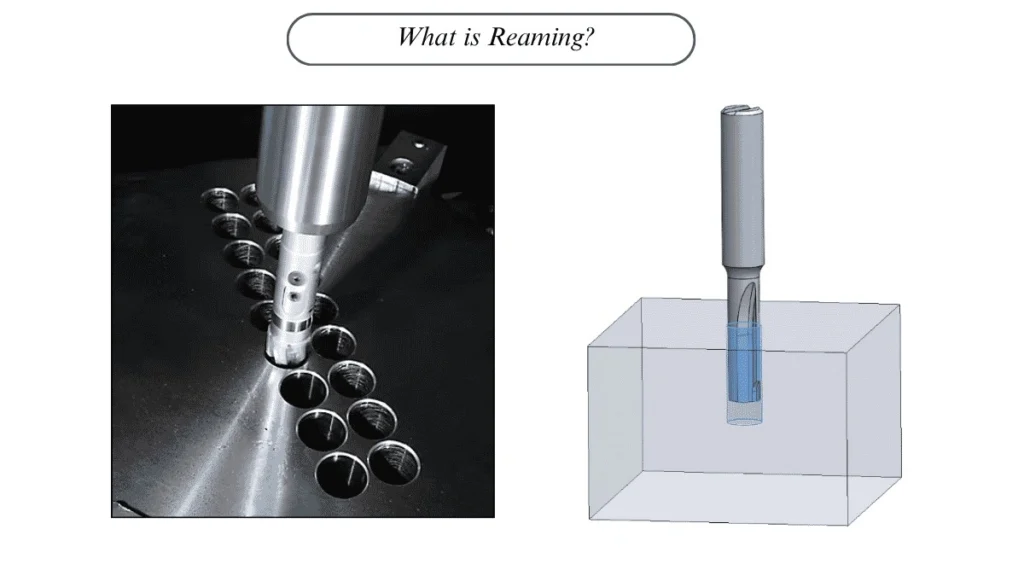
Reaming is a post-processing operation that involves finishing a slightly undersized hole to achieve the desired hole dimensions, surface finish, and roundness. For instance, end holes in connecting rods are reamed to a finish of < Ra 1.6 µm, so the piston pins fit perfectly during engine assembly.
Sometimes, it is difficult or impossible to machine the hole with the specified requirements, and reaming is performed after drilling & boring. A suitable reaming tool is chosen based on the hole size and geometry, which removes a very thin layer of material and takes multiple passes.
Is Reaming Operations the same as Reamer Machining?
Yes, reaming is also known as reamer machining. Both represent the same machining operation in manufacturing, removing the material from the hole using specialized tools, “reamers”. Reaming can be performed on both milling machines and lathes.
The Working of the Reaming Process
A reamer tool contains multiple cutting edges around its circumference. As it rotates and advances axially towards the hole in the workpiece, the lead chamfer of the tool first engages and gradually enters the hole. After material removal, the reamed holes must be measured to ensure the dimensions and finish.
Reaming a hole involves several steps, including hole preparation, reamer selection, workpiece clamping, machine setup & alignment, reaming machining, and post-reaming verification.
Drilling, Boring, and Hole Preparation
For reaming, you need a hole in the workpiece, which can be drilled, bored, or cast. If you are reaming casting holes, directly choose the suitable reamer. For drilled and bored holes, you need to leave about ~2-5% of material stock. A standard industry practice is 3%.
Example: If you need final dimensions of 10 mm after reaming, drill a hole with ~ 9.7 mm diameter.
Reaming Tool Selection
There are different types of reamers available for hole refining, such as hand reamers, taper pin reamers, carbide reamers, adjustable reamers, and shell reamers. Adjustable reamers are best for fine hole-tuning, manual operations need hand reamers, and
You also need to consider the previously used drill bit size when determining the reamer size, along with the tool material and coating.
Does Reamer Selection Impact the Hole Accuracy and Finish?
Yes, reamer selection impacts the hole accuracy and finish. First, the tool and flute type must be aligned with the hole type, such as blind or through holes. Secondly, the flute number should be cross-referenced to the desired reaming quality and the material volume to be removed.
Workpiece Clamping and Machine Setup
Clamp the workpiece securely using fixtures, vices, or chucks. The workpiece must be able to withstand the vibration and chatter. Then, secure the reaming tool and align the spindle with the hole centreline.
Standard collet, precision collet, shrink-fit, and hydro-expansion chucks are the available tool clamping options.
Set the feed rate and cutting speed into the machine, based on the amount of stock to be removed, material type, and desired finish. Typically, the speed is ~ 50% less compared to drilling.
Hole Lubrication & Coolant
Based on the material type and risk of heat buildup, lubricate the hole with a suitable coolant, ensuring the required flow into the machining area.
Hole Reaming
Feed the rotating reamer tool linearly into the hole, ensuring the tool does not reverse during rotation. The cutting edges gradually chip away the remaining stock from the hole until the final diameter is achieved.
While reaming a hole, you need to regularly check the diameter and roughness level.
Post-Reaming Verification
After reaming, clean the hole to remove small chips, debris, and coolant contamination. Then, verify the hole diameter using gauges, micrometers, or other advanced measuring instruments. Consequently, measure and verify the surface roughness and roundness.
9 Types of Reaming Tools
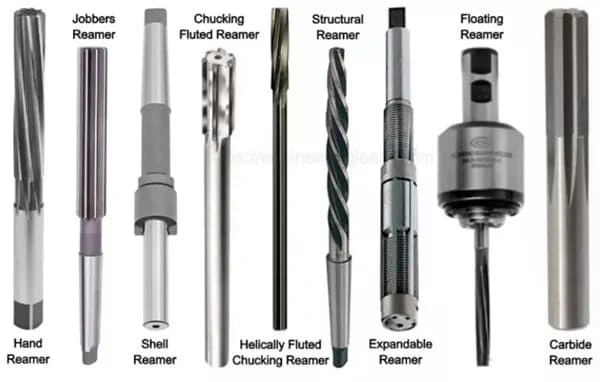
There are several types of reaming tools, including straight-fluted, spiral-fluted, shell, adjustable, hand, tapered, counterbore, expansion, and HSS & carbide reamers. Each of these is designed for specific reaming tasks.
Let’s break down the 9 key types of reaming tools;
1. Straight Flute Reamers
Straight flutes mean cutting edges are parallel to the axis of the tools. These reamers are best for soft materials, producing shorter chips, such as brass and cast iron.
2. Spiral Flute Reamers
The spiral-flute design on reamers facilitates efficient chip evacuation compared to straight-flute reamers. They work well with materials producing long & continuous chips.
3. Shell Reamers
Shell reamers are designed to fit them perfectly into large-diameter holes, using an arbor. These are typically used while working with hole diameters higher than 0.75″ (~19mm).
4. Adjustable Reamers
Adjustable reaming tools are characterized by their ability to use different sizes of cutting blades (inserts). They are useful when you need to make small dimensional corrections and finish existing holes.
5. Hand Reamers
Hand reamers are designed for manual reaming operations and are not suitable for heavy material removal. They include a long lead taper and have spiral or straight flutes.
6. Tapered Reamers
Tapered reaming tools feature a tapered flute design; they gradually remove material, refine the hole surface, and correct the diameter. Tapered reamers are widely used when precise fitting alignment is required.
7. Counterbore Reamers
Counterbore reamers involve enlarging and finishing the hole’s top section( small depth) and creating a flat-bottom recess required to enclose the fastener heads.
8. Expansion Reamers
Expansion reamers are not fixed-sized tools; instead, internal screws expand to match the final dimension.
9. HSS and Carbide Reamers
HSS and carbide reamers are classified by tool material. Reamers made from tungsten carbide, titanium carbide, and other carbides are suitable for hard materials and precision results. On the other hand, HSS reamers are popular for general hole-finishing tasks.
How to Choose the Right Reamer?
The choice of reaming depends on the workpiece material type, hole diameter, specified reaming tolerances & finish, and remaining material stock. Once you decide which type of reamer is suitable, you must consider the flute type.
- Choose Carbide tools for hard materials, carbide reamers with aggressive cutting for soft materials, and CBN-coated reamers for stingly workpieces.
- Look at the tolerance class specified in the engineering drawing/3D model, such as H7, H8, and H9.
- Consider the type of machine you are using: a CNC mill, a lathe, or a drill press.
- Right-hand helix flutes are suitable for through holes, left-hand helix flutes for blind holes & gummy materials, and straight flutes for short holes.
- Also, consider the reamer manufacturing company; prefer reamers manufactured by reputable companies that are trusted in the industry.
Common Reaming Challenges and Solutions
Although reaming seems a simple process, it presents several challenges that directly affect the quality of the final results, machining time, and cost. It includes poor surface finish, tool wear, vibration & chatter, poor chip evacuation, heat buildup, and low roundness.
1. Poor Surface Finish
After reaming, if the tool can leave small marks, scratches, and wavy patterns on the surfaces, this occurs due to excessive clearance for the tool, tool deflection, and machining vibration. Therefore, ensure a rigid setup and calibrate the alignment properly to achieve a high reaming surface finish.
2. Tool Wear
If worn tools are not replaced immediately, it damages the hole accuracy and can lead to reaming failure.
3. Vibration and Chatter
Especially when reaming deep holes, vibration & chatter occur due to misalignments in the setup, incorrect tool selection, and imbalances in feed & speed.
4. Chip Evacuation
If chips are not evacuated from the holes, the buildup there causes recutting or, occasionally, tool breakage.
5. Heat Build-Up
If chips are not evacuated efficiently and low coolant flow is applied, it can build up the heat in the machining area, causing work-hardening and rapid tool wear.
6. Deformed or Tapered Holes
If you use higher cutting forces and feed rates, the reamer tool compromises hole roundness, resulting in a slightly tapered hole.
Best Practices and Tips for Reaming Machining
First, you need to choose the right type of cutter and prepare the hole for reaming. Then, use coolant, set correct feed & speed, apply consistent pressure, check hole-size frequently,
- Choose the right type of reamer, considering material type, desired finish & accuracy, and stock material volume.
- Clamp the workpiece securely and calibrate the alignment of the tool’s axis with the hole centreline.
- Ensure proper coolant flow into the machining area to prevent excessive heat and chip buildup.
- Set feed rate, cutting speed, and depth to avoid tool twisting and machining inaccuracies. You can test cycles for optimization.
- Prioritize thin cuts, as machining thick layers increases tool load and surface roughness.
- While reaming, apply a uniform pressure. Otherwise, the tool can wobble, causing dimensional errors.
- Use feed-out cycles (such as G85 if you’re using CNC machines).
- After reaming, remove minor burrs and clean the hole properly.
Advantages and Disadvantages of Reaming
Reaming offers high hole precision and superior finish, diverse material compatibility, consistent hole geometry, and cost-effectiveness in high volumes. On the other hand, it also has disadvantages, such as the need for pre-drilled holes, the risk of work-hardening, and setup-sensitivity.
Let’s compare the reaming advantages and disadvantages in a table below.
| Reaming Advantages | Reaming Disadvantages |
| Reaming is precise, providing the finish and tolerances required for function fits ( IT7–IT9) | You need pre-drilled holes for reaming, which increases the overall manufacturing time. |
| The reaming process works on both soft & hard metals, composites, plastics, and other engineering materials. | Risk of work-hardening when working with hard metals. |
| Reamers are one of the most cost-effective CNC machining tools for hole finishing. | A minor deviation in tool alignment and setup leads to accuracy failure. |
| CNC reaming ensures consistent hole geometry across multiple batches. | Reaming is not suitable to correct the positional accuracy of holes. |
Applications of Reaming Across Industries
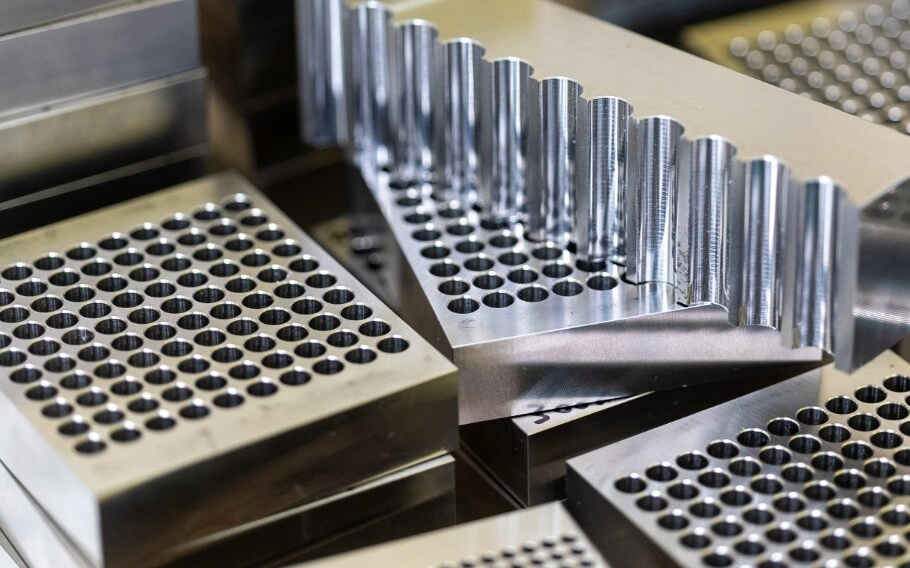
The use of reaming ranges across multiple industries, including aerospace, automotive, medical, defense, and general manufacturing. These industries require remaining to ensure precise fits.
Aerospace Industry
Various aircraft parts need reaming machining to finish the hole for reliable fittings, such as turbine blade holes, wing spars, jet engine mounts, and fastener holes in structural components.
Automotive Industry
Various automotive parts rely on reaming operations for precise hole enlarging, including structural parts, engine assembly, transmission, and braking systems. For instance, valve guide bores of a V6 engine are reamed to achieve Ra ~ 0.8 µm, so that oil consumption can be controlled.
Medical Industry
Diagnostic equipment, surgical instruments, implants, and other medical devices require holes with tight tolerances for reliable results and patient safety. Therefore, reaming is widely used in the medical industry.
Some examples include bone plates, hip stems, tibial trays, scalpel handles, MRI machines, and prosthetics.
Defense Industry
Defense is another industry where hole-precision and alignment directly influence the functionality of systems or devices. CNC reaming is used in the manufacturing of thermal camera modules, tank turret rings, radar housings, firearm parts, and more.
General Manufacturing
CNC reaming operations are used in the manufacturing of bearings, press-fit bushings, hydraulic valves, molds & dies, support brackets, etc.
How Reaming Compares with Drilling and Boring?
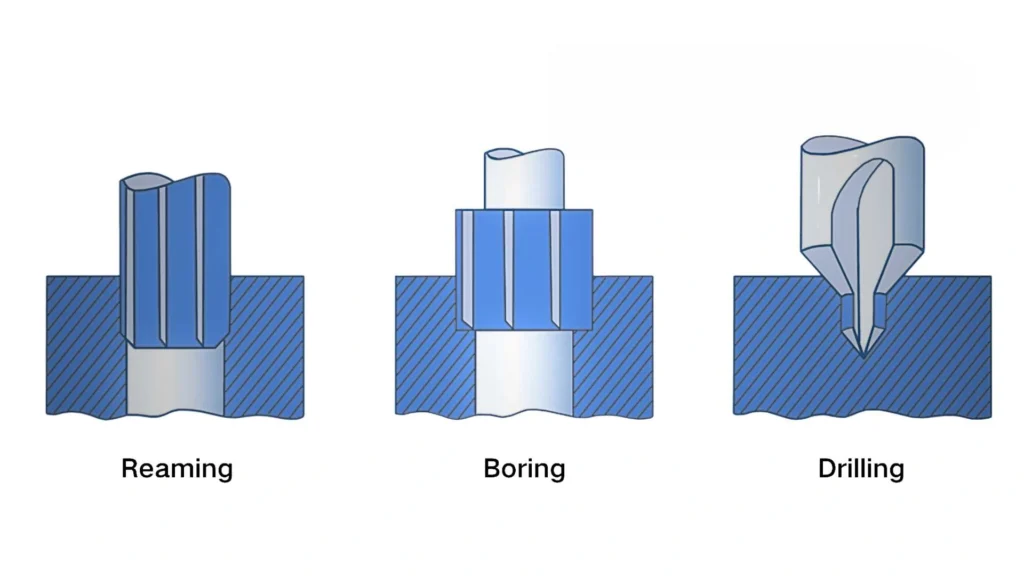
Reaming and boring are two different processes, but both of them are performed on already drilled holes. Boring enlarges the holes, improves the finish, and corrects alignments, whereas reaming involves less material removal and is used to correct dimensions and finish.
Next, the table below compares reaming vs boring vs drilling.
| Criteria | Drilling | Reaming | Boring |
| Tooling | Twist drill bits (HSS, carbides) | 4-8 flute reamers | Boring bars with indexable inserts |
| Used for | To create a hole of the desired size (blind & through) | Hole finishing to the desired precision | Hole enlargement, geometry correction, and straightness |
| Tolerance | ± 0.03 to 0.05 mm | ±0.005–0.025 | As low as ~ ±0.0025 |
| Roughness (Ra) | 3.2–12.5 µm | 0.4–3.2µm | Boring surface finish is superior (~1.8–3.2 µm). |
| Material removal | Highest( Involves the majority of material removal) | Lower ( up to ~5 %) | Moderate, controlled cuts per pass |
Summing Up
Reaming is used when the desired hole precision is not achievable with drilling and boring, when consistent alignment is required for the shaft to be paired, or when industry-standard reamed hole tolerances are required. So, reaming is best for H7, H8, and other close-tolerance, roundness, and consistent diameter.
To leverage the full capabilities of the reaming process, choose the right type of reamers, ensure efficient chip evacuation and coolant, and use advanced CNC machines. Additionally, the skill level of engineers and machinists handling the reaming process affects the final results.
At ProleanMFG, we provide CNC Machining Services that include drilling, boring, reaming, and other processes. Our multi-axis CNC machines can produce complex parts with features like reamed holes, slots, channels, custom profiles,3D contours, and deep pockets.
We are not only flexible in customization of intricate features, but also in production volume. Consequently, our streamlined manufacturing facility and a decade of experience allow us to become cost-competitive while delivering quality. If you want a cost estimation and DFM feedback, upload your design here and request a quote now.
FAQs
Reaming is not a hard process to carry out; however, it might need more careful setup and strategies than boring. The use of the right tool, cutting speed, feed rate, and coolant flow allows you to produce reamed holes without any defects.
No, a reamer can not straighten a hole; instead, it corrects the roundness, dimensions, and surface roughness. The reamer follows the same location as the drill bit or boring bar used in the hole-making process.
The 4 key tips for using a reamer are as follows;
1. Set the cutting speed to ~50 % of drilling speed
2. Ensure proper coolant flow
3. Use a floating holder to avoid reamer deflection
4. Inspect tool wear frequently.