
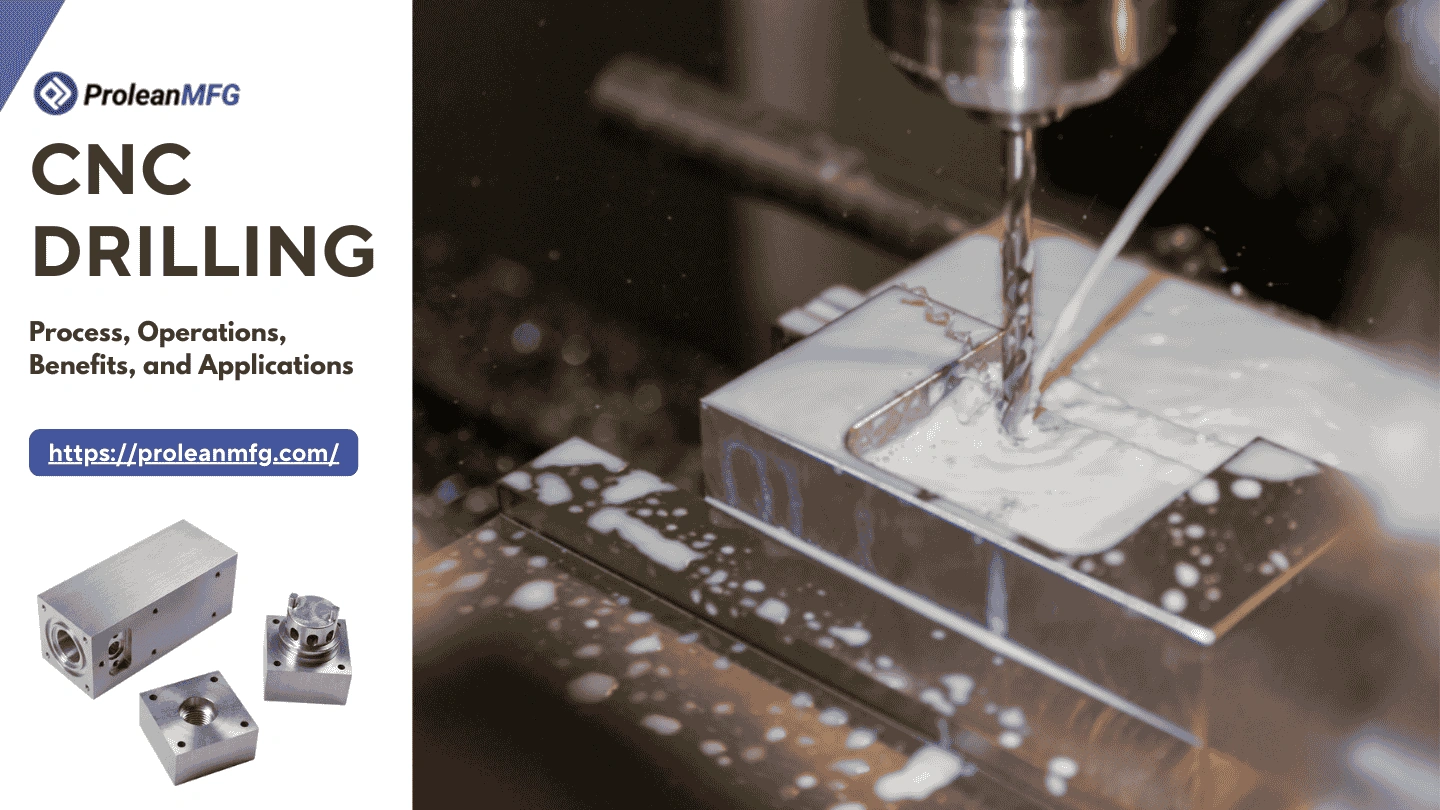

Holes are critical features in mechanical parts, used for alignment, fastening, complex assemblies, fluid passages, or for specific functionality. In most of the machined items, CNC drilling creates such holes.
Although drilling seems a simple CNC machining process, it demands proper design, selecting the correct machining centers for drilling, setup & calibration, and many considerations for achieving precision results.
This CNC drilling guide will elaborate on the drilling process, different operations, types of drilling machines, design rules, advantages, and applications.
Let’s get started.
What is CNC Drilling?
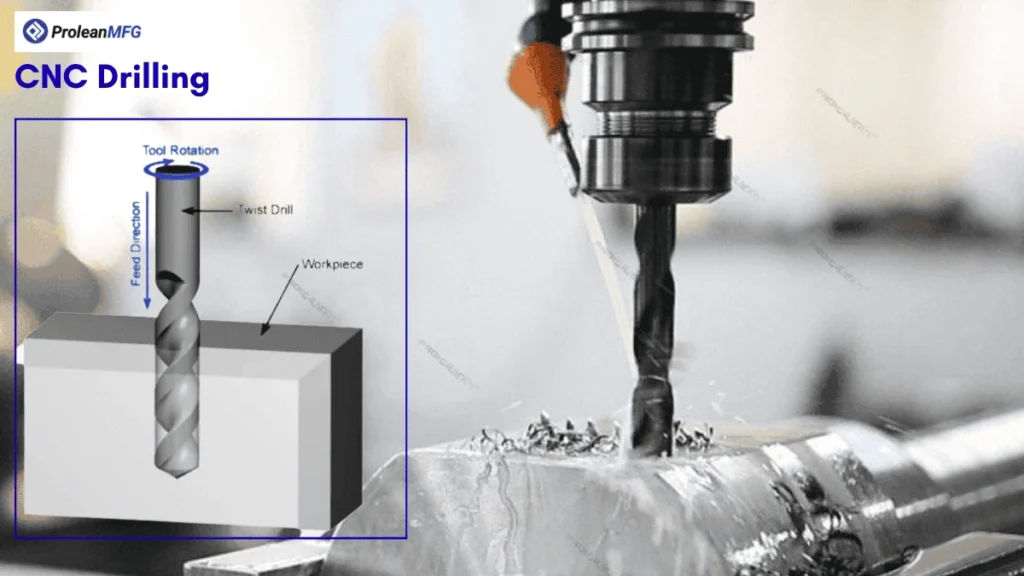
CNC drilling is a machining process for hole creation that relies on computer programming to dictate the tool position, drilling specifications, speed, feed, and hole depth.
This drilling automation provides high precision, finish, production speed, consistency, and cost-benefit in the manufacturing of industrial components. Subsequently, hole precision facilitates strong fits and assemblies.
You can perform drilling on standard CNC lathes, mills, machining centers, or specialized drilling machines using suitable CNC drill bits.
How Does CNC Drilling Work? Stepwise Workflow
CNC drilling involves multiple steps, each of which must be executed carefully. It starts with creating a detailed engineering design & corresponding CNC program and ends with post-drilling treatments for hole enlarging or finishing.
Let’s break down the CNC drilling workflow into 9 major steps.
Step 1: Create a Design
First, create a design of the part you want to machine, clearly defining the holes, their sizes, positions, tolerances, and other parameters. You can use CAD software like AutoCAD, Fusion 360, and SolidWorks for designing & 3D modelling.
Step 2: Optimize the CAD Model
Optimize the part design for manufacturability, speed, and precision. Consider the capabilities of drilling equipment and tooling for DFM optimization.
Step 3: Select the Workpiece Material
Based on the end-use requirements & ease of drilling, choose a suitable material.
Step 4: CNC Programming & Tool Path Simulation
A CNC program contains multiple lines of G and M-codes. G-code defines drilling cycle movements. M codes control auxiliary functions, and they also start & stop the spindle. In this stage, create a CNC drilling program and simulate the tool path for optimization.
Step 5: Drill Bit Selection
The hole diameter defines the size of the tool. But you still need to choose the right drill bit material, geometry, and coating.
Step 6: Machine Setup and Calibrations
Upload the CNC program to the control unit, install the drill bit on the spindle, clamp the workpiece, and calibrate the alignment and initial co-ordinates.
Step 7: Drilling Process
Perform the drilling operation by starting the machine. Although the process is automated, continuous monitoring is mandatory.
Step 8: Post-processing
Once drilling cycles are complete, process the parts with secondary operations, such as boring & reaming, if needed.
Step 9: Quality Control Inspection and Measurements
At the end, perform quality control inspections and measurements to verify dimensional & positional accuracies, surface finish, and desired properties. You can use micrometers, CMMs, pin gauges, and other measurement devices.
Drilling Operations
There are several types of CNC drilling operations, each with distinct capabilities for hole-making & post-treatment, or operating on a distinct working mechanism.
The 12 most common drilling operations include standard drilling, spot drilling, peck drilling, gun drilling, micro drilling, vibratory drilling, boring, counterboring, counter-sinking, reaming, and tapping.
Standard Drilling
Standard drilling involves using standard drill bits corresponding to the size of the hole you want to create. This operation is suitable for general-purpose applications and for simple cylindrical holes.
Spot Drilling
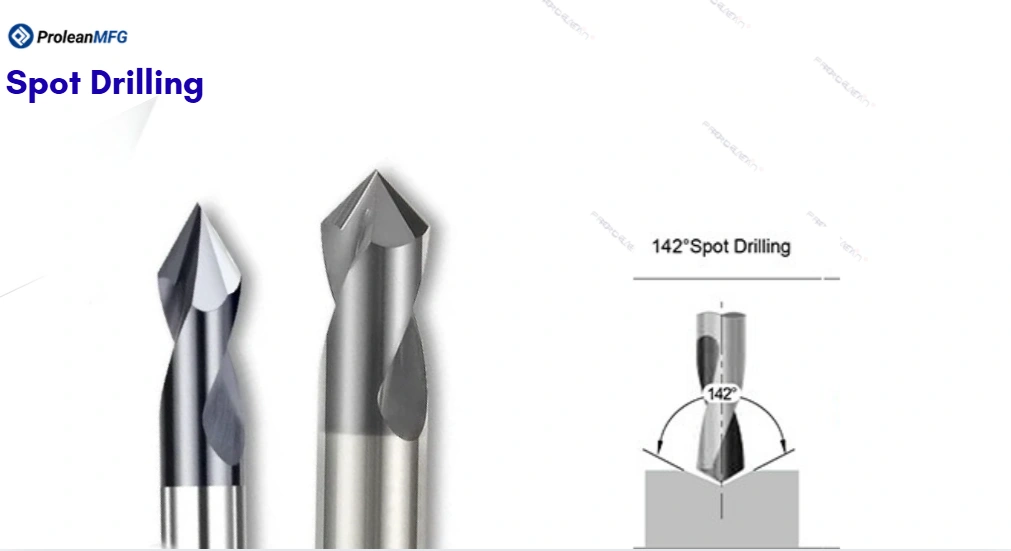
As the name suggests, spot drilling involves defining a spot for drilling, where further operations can be performed based on that spot. This type of operation is beneficial for accurately positioning holes in workpieces.
Center Drilling
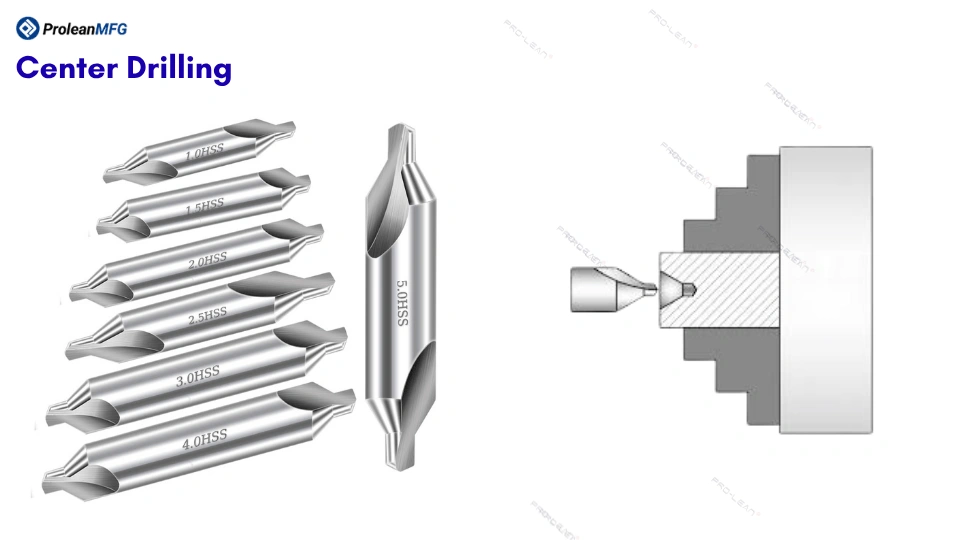
Like spot drilling, it also serves as a preparatory step to guide subsequent drilling operations, but center drilling produces conical-shaped holes instead of cylindrical ones.
Peck Drilling
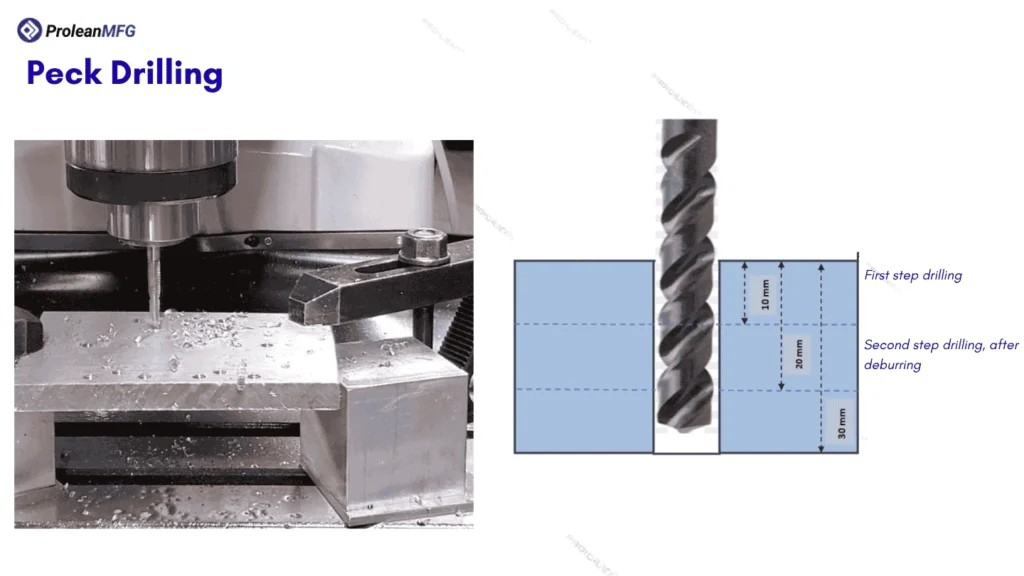
This drilling process involves a slightly different mechanism compared to regular or other types of operations; the drill bit advances into the workpiece in small depth increments, called pecking. It facilitates better chip evacuation and more effective heat management. As a result, deep holes can be created.
Gun Drilling
It is another specialized operation for deep hole drilling with a length-to-diameter ratio greater than 15:1. For gun drilling, a thin & long bit is used. Moreover, gun drilling is favorable for making holes in hydraulic cylinders, gun barrels, injection molds, etc.
Micro Drilling
As its name suggests, micro-drilling is characterized by its ability to create extremely small holes, often < 1 mm.
Vibratory Drilling
This operation uses vibration to drill the holes. A vibrating bit with a predetermined frequency controls material removal.
Boring
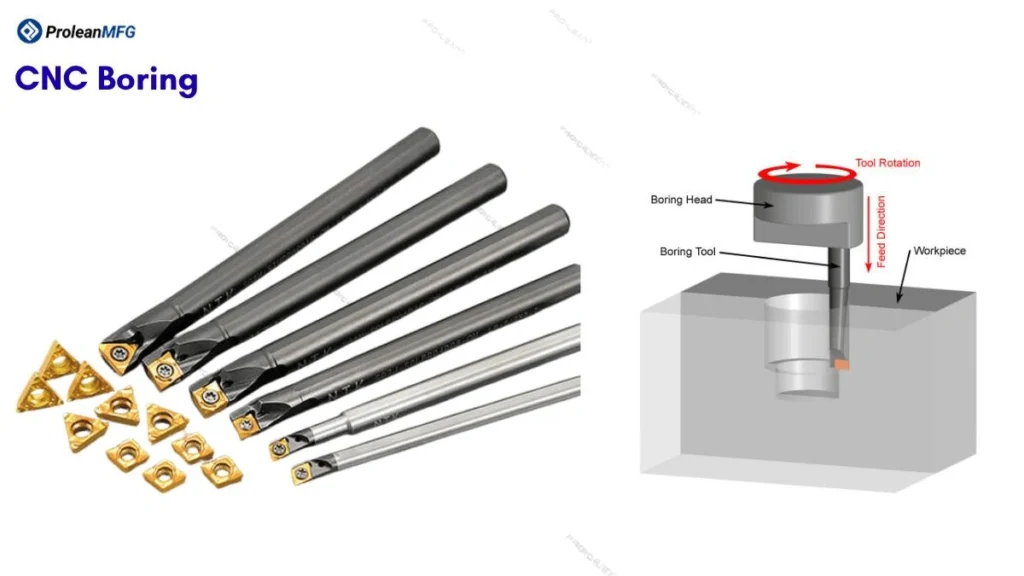
Boring is performed with a single-point bar, which has a cutting edge at one end. The difference between drilling vs boring is that boring uniformly removes the material from pre-drilled holes to enlarge, finish, or correct dimensioning.
It is widely used in the manufacturing of heavy machinery, automotive parts, aerospace parts, and large-sized fixtures & assembly fittings.
Counterboring
Counterboring produces a hole with a larger diameter (flat recess) at one end to fit the corresponding screw/ fastener head. Subsequently, counterboring helps for aesthetic reasons, as it avoids protrusion on the part’s surface.
Countersinking
Countersinking produces conical holes for easy, secure seating of the fastener head. Like counter boring, it is essential for screw functionality & aesthetic after installation.
Reaming
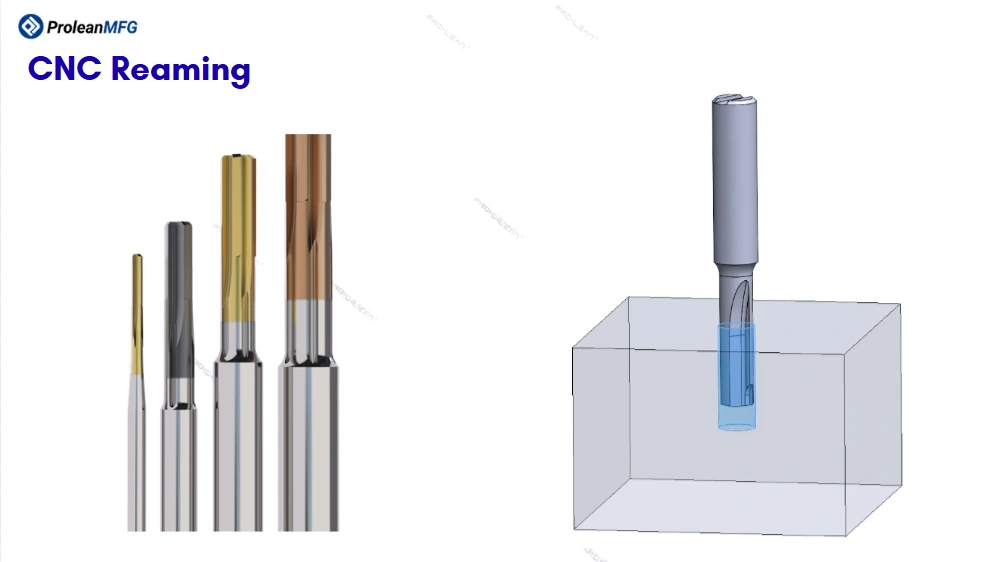
Reaming involves removing minor material from an existing hole to correct dimensional tolerances and surface finish quality. A tool called “reamer” with straight or spiral cutting edges and a small chamfer at the end is used for this operation. ( Read more: fillet vs chamfer)
Thread Tapping
Technically, tapping is not a primary drilling operation; rather, it is an after-drill process in which taps create internal threads by cutting or forming. Meanwhile, thread size, length, pitch, depth, or other parameters depend on the tapping tool used.
The main difference between a tapped hole vs threaded hole is that a threaded hole is any hole with internal threads, while a tapped hole is a specific type of threaded hole created specifically using a tap tool.
Advantages of CNC Drilling
Tight tolerance, material diversity, complexity, drilling speed, enhanced safety, scalability, and cost-effectiveness are the main advantages of CNC Drilling.
- Tight Tolerances: Due to automation, CNC drilling services offer a general tolerance of ±0.127 mm, which can be as low as ±0.01 mm for precision drilling or with post-process treatments.
- Diverse Materials: You can create holes in metal, alloys, thermoplastic, thermosets, composites, ceramics, and other engineering materials.
- Production Speed: After tool setup, drilling cycles can be run quickly, enhancing speed & efficiency.
- Complexity: CNC drilling offers high complexity regarding the location, size, and pattern of desired holes.
- Repeatability: CNC drilling produces consistent holes throughout machining cycles.
- Enhanced Safety: As CNC significantly reduces the operator interaction with the machine, the process becomes much safer to handle.
- Scalability: You can easily scale production with CNC drilling services, which is especially beneficial for prototyping and small-volume projects.
- Cost-benefit: Although the initial setup & tooling costs are higher than manual drilling, they are offset by savings in long runs.
Disadvantages of CNC Drilling
CNC drilling also has limitations, including high upfront cost, the need for expert operators, tool wear, and costly maintenance.
- The initial cost of CNC drilling equipment and tooling is higher than for conventional drilling.
- Due to the complexity of the machine and operations, highly skilled CNC operators are needed.
- Although CNC drilling can run fast cycles, it increases heat generation & promotes rapid tool wear.
- CNC machining centers for drilling require frequent maintenance, which is also costlier.
CNC Drilling Applications Across Industries
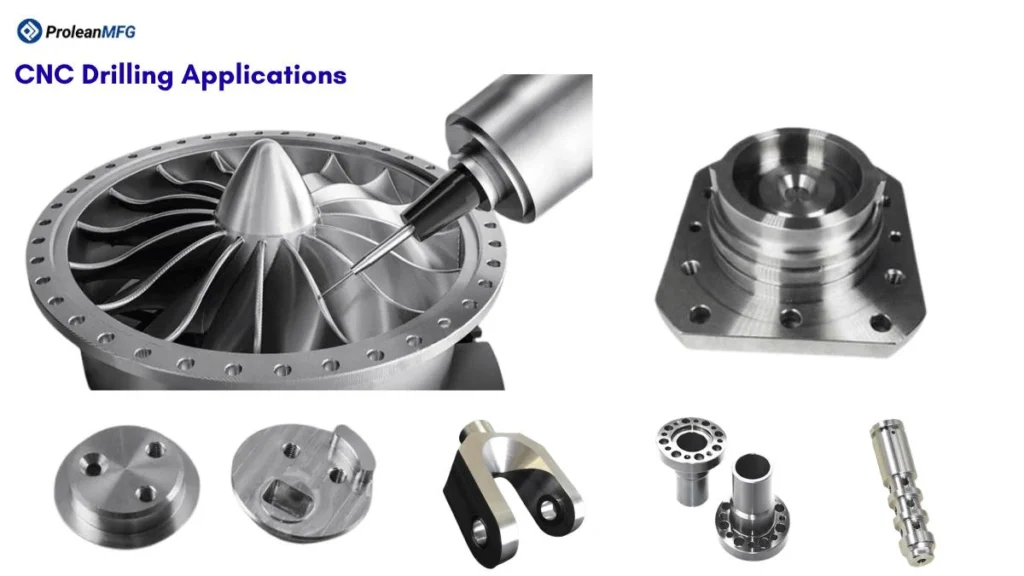
CNC drilling is used in automotive, aerospace, heavy machinery, electrical, electronics, medical, construction, oil & gas, renewable energy,
Let’s further discuss the applications across these industries with examples.
Automotive
Accurate and smooth holes on automotive engine parts, transmission housing, chassis, wheel hubs, etc., for assembly, flow channels, alignment, or fasteners.
Aerospace
Precision CNC drilling services play a significant role in the manufacturing of various aerospace components, as even slight deviations from the desired specifications can affect aircraft performance & safety. E.g., turbine casings, mounting brackets, structural components, and landing gear parts.
Heavy Machinery
Different drilling & boring operations are used in heavy-machinery parts, such as hydraulic cylinders, large bearings, excavator arms, and mining equipment parts.
Electrical & Electronics
Drilling micro holes in electronic enclosures, frames, assembly plates, circuit boards, busbars, mounting brackets, etc.
Medical & Healthcare
Precision, repeatability, and the ability to make micro-holes and channels make CNC drilling essential in the manufacturing of medical devices, surgical tools, implants, furniture, etc. Additionally, the process does not affect the properties of biocompatible materials.
Construction
Drilling on structural & architectural components of stainless steel, cast iron, and other materials without losing strength. Application examples include door & window frames, anchors, bolts, and architectural parts.
Oil & Gas
Drilling precision holes on valves, ground drill tools, pipeline flanges, pump components, pressure vessels parts, etc.
Renewable Energy
CNC drilling operations are used in renewable energy manufacturing due to their ability to handle large parts and help with precise structural assembly. E.g., wind turbine hubs, tower pipes, generator casings, and solar panel brackets.
10 Different Types of CNC Drill Bits
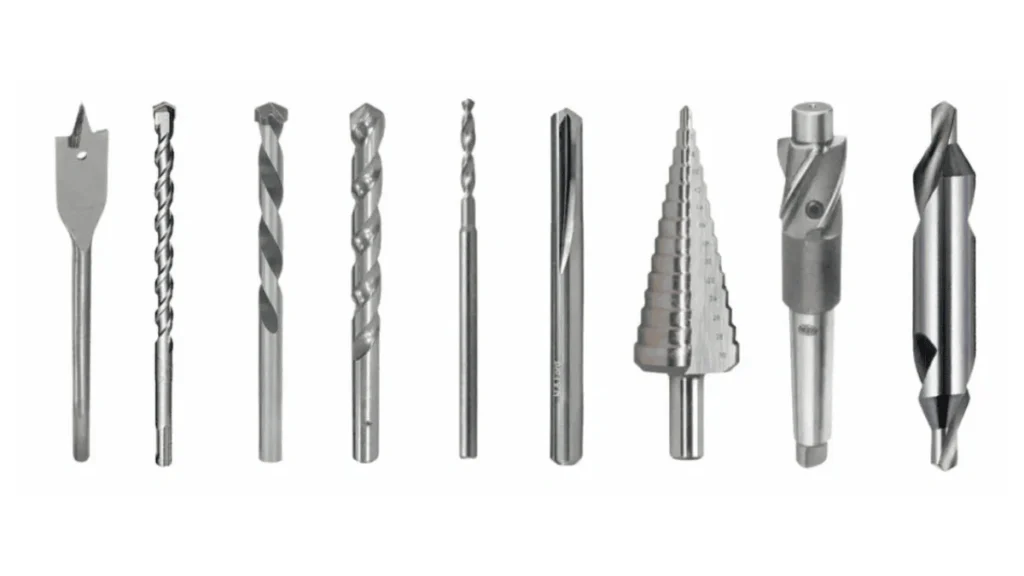
Why do you need different types of drill bits? Standard drilling tools cannot work with all hole types, related features, and workpiece materials.
The following are the 10 common types of CNC drill bits.
1. Center drills
Rigid tool with helical flutes, which create a pilot hole that guides secondary drilling or finishing operations.
2. Twist Drills
These are general-use drill bits with a cylindrical body and helical flutes.
3. Spot Drills
Spot drills are shorter than twist bits and consist of wide-point angles. These are useful for creating guiding impressions during drilling.
4. Indexable Drills
These are characterized by replaceable inserts, suitable for high-volume production.
5. Peck Drills
Peck drills create deep holes by advancing them in small increments. This mechanism avoids heat buildup and optimizes the chip evacuation. Meanwhile, their helix point angles range up to 135°.
6. Spade Drills
Spade drills are flat tools with a blade-shaped cutting edge. They are used in boring large holes.
7. Carbide Drills
Carbide drill bits are made from tough materials like tungsten carbide and are used for drilling hard workpieces.
8. Step Drills
Step Drills allow you to create a hole with a gradual change in diameter. It involves cutting edges on the conical body.
9. Coolant-feed Drills
These drills feature micro-channels to deliver coolant to cutting edges & the machining area, beneficial for deep holes & drilling material prone to excessive heat generation.
10. Gun Drills
Gun drills are long and have only one cutting edge, making them suitable for deep & precise holes.
Next, let’s look at a table below for an overview of these tool bits.
| Drill Bit Type | Typical Applications |
| Centre Drill | Starting holes, lathe center holes |
| Twist Drill | Standard holes in metals, plastics, and wood |
| Spot Drill | Pre-drilling guide marks in CNC machining |
| Indexable Drill | High-volume industrial production |
| Peck Drill | Deep holes in metals (≥5× diameter) |
| Spade Drill | Large-diameter holes (>25 mm) |
| Carbide Drill | Hard materials (Tool steel, titanium alloys) |
| Step Drill | Holes with gradual changes in diameter |
| Coolant-Fed Drill | Deep-hole drilling, aerospace components |
| Gun Drill | Deep precision holes (e.g., shafts, hydraulic parts) |
CNC Drilling Machine Components
An industry-standard CNC drilling machine comprises several components, each with a unique role in the process. Subsequently, some components are closely related to each other and need to be properly synchronized.
Here is the list of CNC drilling machine components.
- Drilling machine base
- Column structure
- Servo motors
- CNC control unit/interface
- High-speed spindle
- CNC drill bits
- Work table
- Cooling system
- Drill head
- Linear guideways
- Chip removal tray/conveyor
Types of CNC Drilling Machines
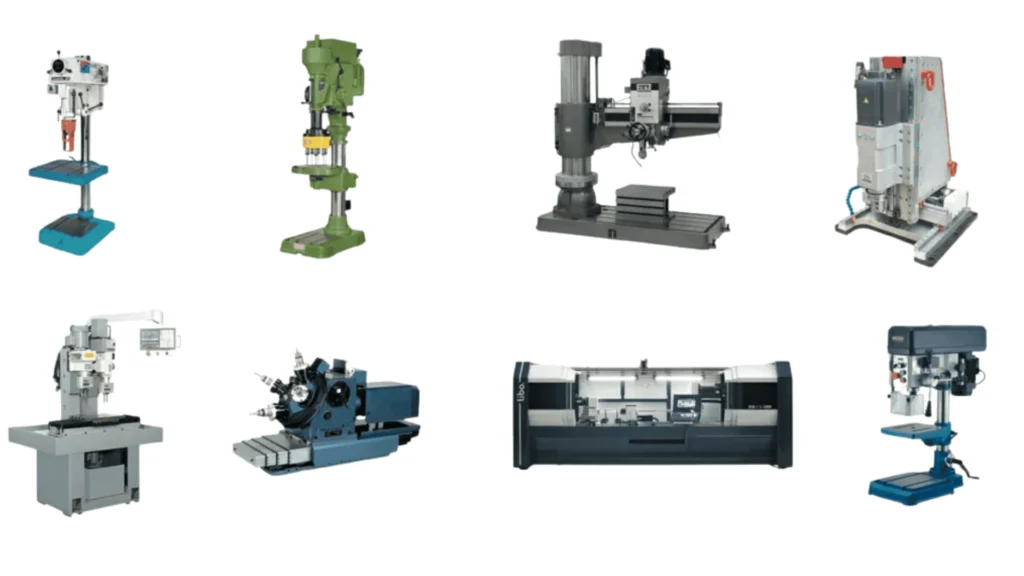
For diverse drilling needs, there are several types of CNC drilling machines, including upright, radial-arm, turret-type, bench-top, gang, multi-spindle, deep-hole, EDM, and portable CNC drilling machines.
Let’s further elaborate on them.
Upright CNC Drill Press
It is a general-purpose drilling machine that features a simple Up-down motion of the spindle. Additionally, it accommodates a wide range of drill bits and can handle workpieces from small to large sizes.
Radial Arm CNC Dill Press
This type of drilling machine involves the motion of the spindle along the radial arm. The movable arm allows drilling holes at specific angles. Radial arm drill presses are suitable for drilling holes in complex locations.
Bench-top CNC Drill Press
Bench-top drill presses are designed for space efficiency; their compact size and versatile capabilities make them suitable for drilling small and medium-sized parts. They are precise and provide detail in hole creation.
Turret-type CNC Drill Press
Like other turret-type CNC machines, it includes a rotating turret disc that can accommodate 6-16 different CNC drill bits. So, you don’t need to change over the tools while performing multiple operations on a single workpiece.
CNC Gang Drilling Machine
Gang drilling machines feature multiple drill press heads arranged on a single workbench, allowing separate tooling to be installed to perform multiple drilling operations simultaneously. Although the machine requires complex CNC programming, higher production speed & versatility can be achieved.
Multi-spindle Drilling Machine
This drilling machine includes multiple spindles, each of which is capable of performing a drilling operation one after another. What makes it different from a gang drilling machine is that the multi-spindle is used to perform the same operation i
On a large scale rather than multi-operations.
Deep Hole Drilling Machine
As the name suggests, this type of machine is used to create deep holes, typically when the length-to-diameter ratio is high, such as 10:1. This deep-hole drilling machine features specialized tooling, pressurized cooling systems, and precise motion control.
Portable CNC Drilling Machine
It is a compact drilling machine used to make holes in large workpieces on site. Portable drilling machines can be easily set on the workpiece and perform multiple operations.
CNC EDM Drilling Machine
EDM uses controlled electrical discharges and does not involve direct engagement between the tool and workpiece. It is suitable for hard, difficult-to-drill materials or for creating extremely small & precise holes.
What Are the Key CNC Drilling Parameters?
Cutting speed, spindle speed, feed rate, feed/revolution, hole depth, and peck depth are the key parameters for the CNC drilling process. These parameters directly influence the drilling precision, efficiency, and tool life.
You need to set the right drilling parameters, based on workpiece material, tool material, and hole size.
| Parameter | For HSS Drill | For Carbide Drill |
| Cutting Speed (m/min) | 15 – 30 for steels, 60-100 for Al alloys | 60 – 120 for steels and 150-300 for aluminum |
| Spindle Speed (rpm) | 300 – 3000, based on diameter | 1000 – 10,000+ |
| Feed Rate (mm/min) | 50 – 300 | 100 – 800 |
| Feed per Revolution(mm/rev) | 0.05 – 0.20 | 0.08 – 0.30 |
| Hole depth | Up to 3×D without pecking | Up to 5×D |
| Peck Depth | Equal to the hole diameter | up to 2 x Dia. (D) |
How Long Does the CNC Drilling Process Take?
Typically, a CNC drilling process takes a few seconds to several minutes to create a hole. If you are drilling large and complex holes in hard materials.
The exact cycle time varies with hole size, depth, material hardness, tooling, used equipment, and required tolerances. In addition to cycle time, machine setup, programming time, and quality control inspections are also added to the cycle time to calculate the exact time taken for CNC drilling.
CNC Drilling Design Guidelines
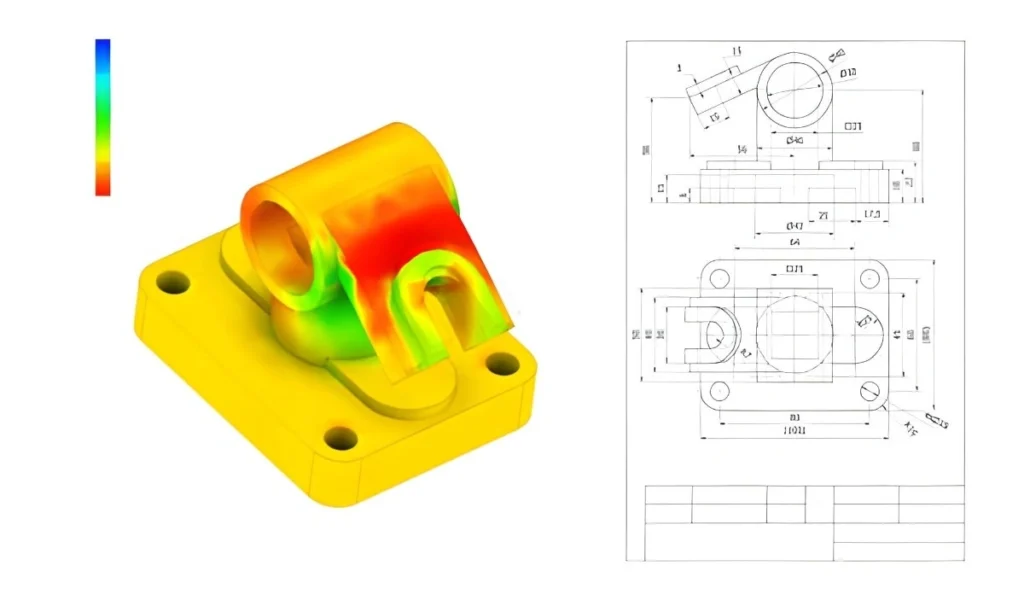
CNC drilling design requires considerations for both the general drilling part design and the design of holes. Let’s take a look at the hole and part design guidelines.
- Hole Size: Choose hole size based on the size of standard drill bits. It is best to choose above 2.5 mm for standard drilling.
- Depth-to-diameter Ratio: Limit this ratio below 4 to 6 times the hole diameter for standard drilling and below 20xD for Peck or Gund drilling.
- Hole Spacing: Maintain a minimum distance of 1 to 1.5 times the hole diameter between two holes.
- Hole-to-Edge Spacing: Maintain a minimum distance of 1.5 x hole diameter between hole and part’s edge.
- Set Practical Tolerances: Overtolerancing the holes increases drilling time and cost. Even the precision applications, such as snap fits and press fits, need ±0.01 mm of positional accuracy.
- Avoid Hole Intersection: Unless it is necessary for functionality, avoid hole intersection.
CNC Drilling Vs Milling Vs Turning
CNC Turning and Milling are more versatile machining processes capable of shaping complex 3D geometries with intricate features.
Milling is used for contouring, profiling, pocketing, slots, undercuts, and machining features. On the other hand, turning excels at machining axially symmetrical components, such as cylindrical shafts.
Both milling & turning can drill holes, but they might struggle when you need to create holes in hard-to-reach areas or when you need efficient drilling for large volume production.
Can CNC Drilling Work with All Types of Materials?
CNC Drilling has a wide range of material compatibility, but it cannot work with all material types. Especially, you cannot drill brittle & extremely-hard materials, such as hardened tool steel and thin brittle glass.
Next, let’s look at the list below for engineering materials compatible with CNC drilling operations.
- Metals & Alloys: Soft aluminum & its alloys, stainless steels, iron, copper, titanium, tool steel, etc.
- Thermoplastics: ABS, Polycarbonate, Delrin, Polyamide, Teflon, PTE, and PVC.
- Thermosets: Polyurethane, Phenolic, FR-4, and G10.
- Composites: Carbon fiber composites, fiberglass, and fiber-reinforced plastics.
Is CNC Drilling Expensive?
CNC drilling is considered a cost-effective method for creating precise, consistent holes in parts you are producing in medium-to-large volumes. For small volumes, it can also be cost-competitive when tight tolerances, finish, and complex hole patterns are mandatory for the part’s functionality & performance.
Next, the following factors determine the CNC drilling cost.
- Cost of CNC drill bits & tooling fixtures
- Raw material cost
- Machinability of raw material
- Required CNC drilling equipments
- Desired tolerances and finish quality
- Production volume and part complexity
How Can I Reduce CNC Drilling Cost?
You must consider DFM, optimal use of standard tooling & setup, tool entry & exit, effective cooling, and the right type of drilling equipment.
Design hole sizes corresponding to drilling tools (drill bits, reamers, boring bars, etc) of standard sizes available in the market. For instance, metric drills with Φ3,4, 5mm, etc.
Prioritize the through holes instead of blind holes, unless they are desired for specific functionality or performance.
Next, use the right type of drilling equipment, based on hole specifications. Choosing higher axes or advanced machines for simple holes can also increase the drilling cost. Meanwhile, ensure perpendicular entry & exit of the tool.
Conclusion
CNC drilling is an essential machining process in manufacturing that creates precise cylindrical holes with varying diameters & depths on a variety of materials. Saying that, you must choose the right type of CNC equipment, tools, and drilling parameters.
This versatile process not only allows for standard hole drilling, but you can also perform boring, hole finishing, threading, and other related operations.
If you are looking to outsource machined parts where holes are critical for their functionality, performance, alignment, or assembly, ProleanMFG can be a one-stop solution. Our CNC Machining Services include milling, turning, drilling, and several other processes.
We have multiple advanced & AI-integrated machine shops and a decade of experience, which can help turn your ideas into reality.
So, upload the design file and get a quote for your parts.
FAQs
Dimensional accuracy, repeatability, high drilling speed, and diverse operation capabilities are the key advantages of CNC drilling.
Yes, a CNC machine can drill holes using suitable drill bits.
CNC drilling can drill holes as deep as 10 times the tool diameter. It can be further increased with specialized machines & tooling.