
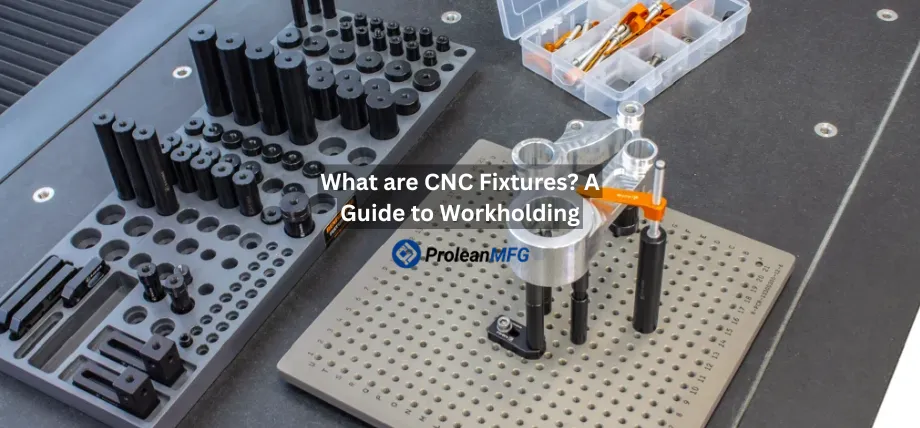

CNC fixtures are fixed, workholding devices that clamp workpieces during the machining process. This is beneficial during machining because not only does it minimize vibrations, but it also ensures the metal part remains fixed during high-speed cutting. This ensures dimensional accuracy, high repeatability in part production, and uniform surface finish.
This guide covers the main types of CNC fixtures, how to use datums, and a quick workholding selection guide for CNC machinists and designers.
What Are CNC Fixtures?
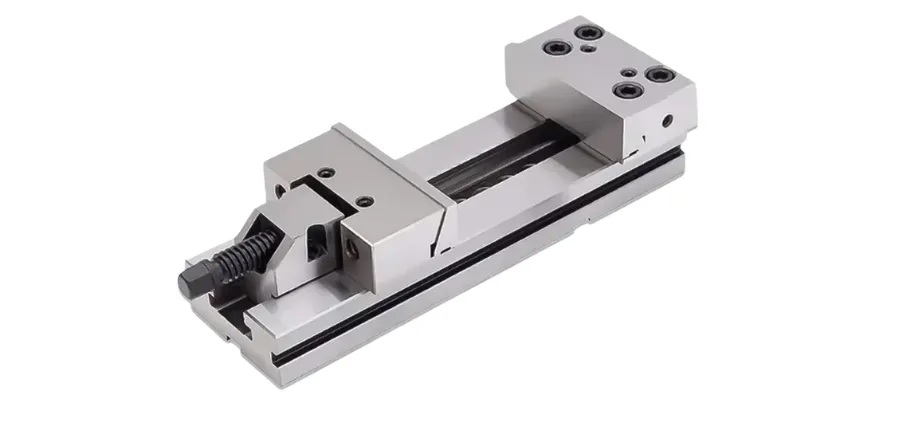
CNC fixture is anything that can keep a part fixed, supported, and clamped during machining. Many workholding fixtures are DIY setups in machine shops, but dedicated workholding devices support and maintain the tool and the workpiece in the proper cutting position.
A CNC fixture is different from a jig. A jig guides the cutting tool, and a fixture holds the workpiece. For CNC machining, the fixture securely locates and clamps the workpiece against defined datums (which are fixed starting points or lines) to restrict movement.
Machining along datums restricts unwanted movement, prevents shifting, vibration, and deflection during CNC cutting because the smallest part movement can result in inaccurate hole locations, poor non-uniform finishes, and tolerance variations for critical part features.
Bad fixtures, or no fixtures, can cause chatter marks, dimensional variation from the design, and irregular cutting lines, which produce variable surface finish.
Types of CNC Fixtures
The CNC Fixture varies with the machining operation, part shape, production quantity, and tolerance. The right fixture can ensure that the workpiece stays in place and enable the tool to cut all the necessary surfaces without interference.
1. Milling Fixtures
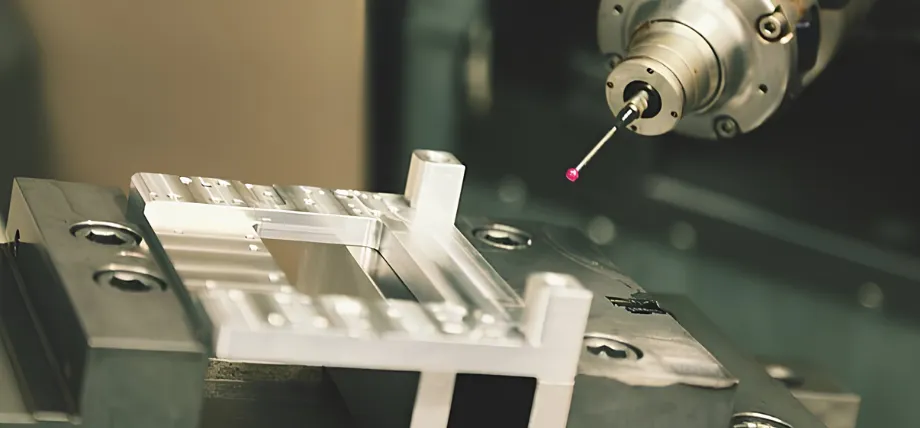
- A Milling Fixture is a type of fixturing that is used to hold the work during a milling operation in which cutting forces are applied in several directions. Milling tools exert a side pressure along with downward pressure on the piece, so the fixture should offer strong lateral and vertical support.
- A plate fixture is the simplest form. It uses a flat base plate with locating pins, clamps, and threaded holes for mounting prismatic parts. This is very beneficial when the part is flat and requires reliable support during face milling or pocketing.
- An angle holding fixture is a device that secures the workpiece at a specific angle (typically 90°). It can be helpful when side face machining or angled features are required on the part without changing the setup on the machine.
- An indexing fixture enables the part to be rotated to specific fixed angles. It is employed when applying bolt circles, slots, gear-like characteristics, or any portion that requires multiple machining operations in a rotational direction about a central axis.
- Vice jaws or soft jaws are jaws that can be machined and installed on a standard CNC vice. Their shape adapts to the part profile, and these can be applied in a second operation, machining, or irregular workpieces.
- A custom-made milling fixture is constructed for a particular part or part family. It has the highest initial capital cost, but provides increased repeatability, faster setup times, and increased production volumes.
2. Modular CNC Fixtures
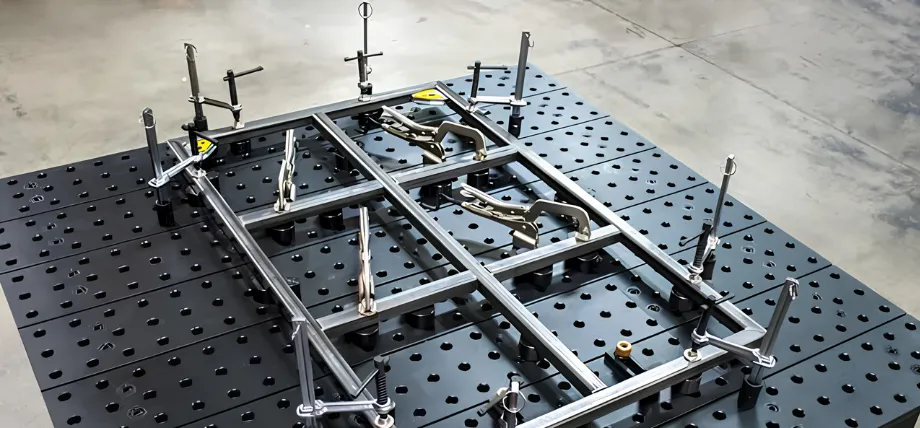
Modular CNC fixtures have a large base that can be used for different types of fixtures. These fixtures are constructed using reusable components, including base plates, locating pins, clamps, step blocks, and support elements. The advantage of doing so is to increase the use of the fixture for different geometries by slight modifications instead of machining entirely new fixtures.
This makes modular fixturing ideal for prototypes and low-volume production parts, specifically if your designs will undergo frequent iterations and changes. It reduces tooling lead times because the fixture is built from existing components.
3. Tombstone Fixtures
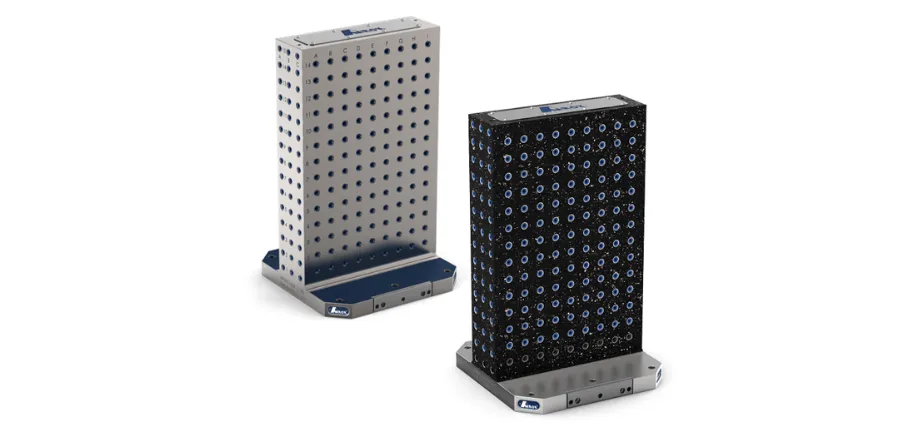
Tombstone fixtures are called so because of their tombstone-like shape. It has many holes drilled on all sides and is commonly used on horizontal machining centers. Several faces of the tombstone have workpieces attached to them, and this entire fixture can be turned so the tool can access each face, reducing machining time.
This means multiple parts can be machined in a single setup and single machining cycle, reducing idle time in high-speed machining. It also reduces downtime because a part can be removed without interrupting the machining cycle or operation code.
These fixtures are expensive one-time investments and are reserved for large volume manufacturing and repeated designs of similar size that require machining from several orientations.
4. 3D Fixtures
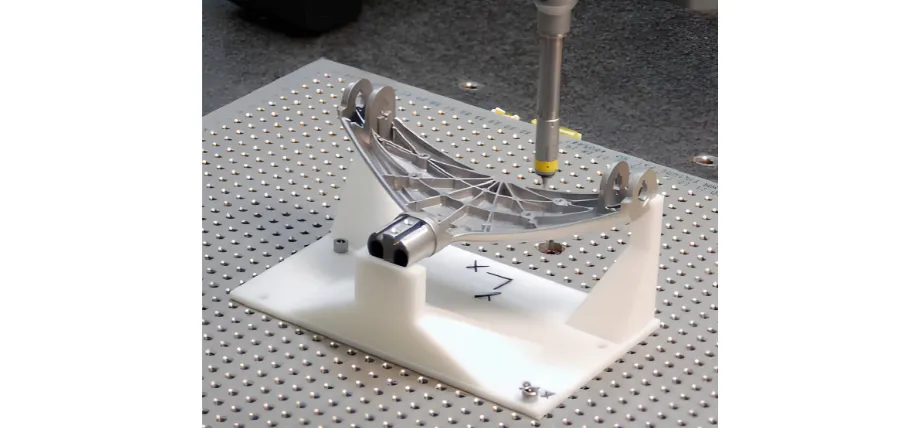
3d fixtures are workholding devices that are fabricated additively via 3D printing. They are convenient when the part has complicated curves, or organic surfaces, or strange shapes that would be costly to support in a traditional machined fixture.
These fixtures are particularly useful in prototyping and short-run production as they can be produced rapidly. Surface features such as contour matching, lightweight structures, and vacuum or coolant channels can also be incorporated into a printed fixture.
Its strength and accuracy limit it. Polymer 3d fixtures are not recommended for heavy cutting, hard steel parts, and tight tolerance production. They are suitable for light machining, inspection support, soft materials, and rapid development work.
5. Pallet Fixtures
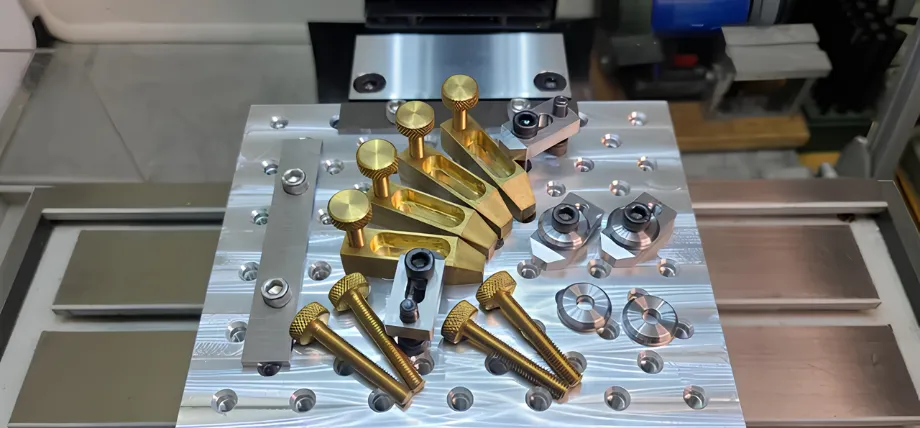
Pallet fixtures utilize standard plates or pallets, which can be loaded remotely and then secured by means of a reproducible locating system. Many automated factories use zero-point pallet systems, which help them rapidly switch between pallets without having to re-indicate each part.
This type of CNC workholding is useful when setup time is a significant expense. After the location of the pallet is known, the machine can reproduce this position every time the pallet is installed.
Pallet fixtures are frequently used in high-mix production, lights-out machining, and automated machining cells. They enhance repeatability and enable operators or robots to set up the next job without stopping the machine.
6. Turning & Lathe Fixtures
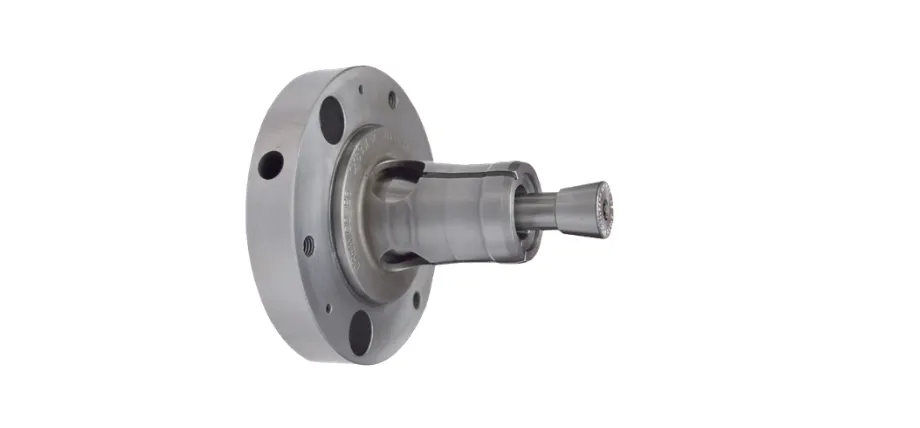
Turning and Lathe Fixtures are used to hold parts that are rotating against a stationary cutting tool. Main requirements include concentricity, balance, and secure clamping, as any runout and imbalance can cause vibration during rotation.
Three-jaw chucks, four-jaw chucks, collets, and faceplate fixtures are common workholding devices used on lathes. Chucks are used for general round work, and collets are used for smaller precision parts to give better concentricity.
Shafts, rings, sleeves, and non-standard cylindrical parts are turned using custom turning fixtures. They keep alignment and minimize vibration for better surface finish and longer tool life.
7. Drilling & Boring Fixtures
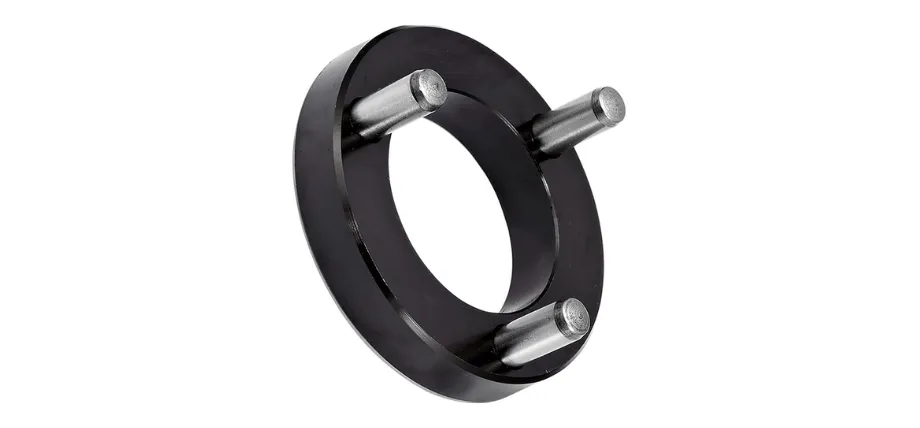
When the drill is inserted into the material, it generates an axial thrust that can cause the workpiece to become unstable. The drill may push the part out of alignment or drill an incorrect hole if it is not supported properly.
Even greater stability is needed for boring fixtures, where boring is used to complete holes to an accurate diameter and location. Any movement or vibration can affect bore accuracy.
These fixtures will sometimes have strong locating surfaces, support pads,s and clamp points near the hole location. This minimises hole deflection and ensures hole straightness, hole roundness, and hole dimensional accuracy.
8. Grinding Fixtures
Grinding fixtures are used to secure the workpiece for CNC grinding operations. The high-pressure contact between the grinding wheel and the part surface needs to be maintained for a smooth finish. If the part moves during grinding, which is an operation specifically designed to remove any micro-abrasions, it can result in roundness errors and critical dimensional accuracy.
9. Welding Fixtures
Welding fixtures are used to hold assembly components in the correct alignment during the joining process using welding. Welds are permanent joints, so it is important to ensure joints form at the correct angles and position. These fixtures are a common sight in automatic welding plants using robotic welding machines.
10. Broaching Fixtures
Broaching fixtures support the workpiece against the cutting forces generated as the tool removes material. Broaching is a single-stroke machining process with high cutting impacts that need to be balanced using broaching fixtures.
11. Tapping Fixtures
Tapping fixtures come in various sizes. These tools are used to locate and hold workpieces during thread-cutting operations. Their main use is to keep the part stable as the cutting tool or shaping tool presses against the part. Misalignment between the tap and the hole axis can be detrimental because tapping is usually a high-volume production process, which can lead to inconsistency.
12. Hydraulic Fixtures
Hydraulic fixtures refer to pressureized fixtures that use fluid to generate a high clamping force. These types of fixtures eliminate variability that you would otherwise see in manually tightened fixtures or DIY fixtures.
13. Pneumatic Fixtures
Pneumatic fixtures use compressed air to clamp the part. The advantage of pneumatic fixtures is their rapid response and quicker clamping, which can be important for short cycles like tapping or drilling operations.
14. Electric Fixtures
Electric fixtures generate their clamping force using servo motors that are electronically controlled. These types of fixtures are used to produce delicate parts and handle soft materials because the clamping force can be adjusted using the servo motor turn levels.
15. Magnetic Fixtures
Magnetic fixtures rely on a very strong electromagnetic or permanent magnetic force that is used to hold down the material without mechanical clamps. There is very little clamp pressure on the perimeter of the part or edges, making this an effective clamping method for thin and flat components where clamp distortion needs to be eliminated.
What CNC Fixtures Improve?
| Workholding Quality Tier | Dimensional Accuracy | Typical Scrap Rate | Suitable Production Volume |
| Poor setup | ±0.5 mm or worse | 10–25% | One-off only |
| Basic vise | ±0.1–0.2 mm | 5–10% | Low volume |
| Dedicated fixture | ±0.02–0.05 mm | 1–3% | Medium/high volume |
| Precision fixture | ±0.005–0.02 mm | <1% | High volume |
The table shows the reasons for fixture selection. While a basic vice can handle simple low-volume parts, tighter tolerances and repeat production typically require dedicated or precision CNC Fixtures. Better workholding for CNC ensures variation is reduced, as each part is loaded from the same reference points each time.
CNC Fixture Design: Principles, Rules & Best Practices
In CNC manufacturing, the design of a good fixture begins with a single objective: fixing the workpiece to the same location from the first cut to the final inspection. A fixture needs to find the part, hold it in place against cutting forces, but not bend or move the material.
3-2-1 Locating Principle
Reliable CNC Fixtures are based on the 3-2-1 locating principle. It has three contact points on the primary surface, two contact points on the secondary surface, and one on the third surface controlling the six possible movements of the part.
This is important because a part can move in X, Y, and Z, but it can also rotate around each axis. The 3-2-1 approach prevents that movement without putting the part into an unstable position.
Over-constraining occurs if too many locating points are used. Additional contacts can lead to part variation while loaded, but do not increase accuracy. This results in irregular seating, poor repeatability, and dimensional variations between parts.
Clamping Rules
Clamping should only be performed after the part has settled against the locators. If it is applied too early, the clamp will keep the part lifted or twisted up, influencing all machined features.
When using the clamp force, it should push the workpiece towards the locator and not sideways across the locator. Side pressure may cause friction and move the part a bit before cutting. Clamps should also be installed over supported portions, as clamping on thin or unsupported sections can cause them to bend during machining operations.
Datum Selection
Datum selection determines how the machine, fixture, and inspection process relate to the part. Ideally, a datum should be a functional machined surface that is stable, repeatable, and relatable to the function of the part.
Whenever possible, the machining datums should be the same as the inspection datums. This ensures that a part does not measure properly in a machine and is later rejected in inspection for being checked from a different surface.
Chip and Coolant Management
Chip control is an important consideration when designing CNC fixtures because the movement of a workpiece caused by chips under it can be minimal but significant. A thin chip placed under a datum surface can impact flatness, hole position, or part height.
Fixtures should feature channels for chipping relief, drain ways, and open areas where the flow of coolant can wash away debris. Any flat pockets that can hold the chips should be avoided, because they decrease the repeatability, and the risk of loading in the production is high.
Key Decisions in CNC Fixture Design
Every fixture decision can impact cost, accuracy, fixture set-up, and production efficiency. The selection of the proper choice depends on both the part volume, tolerance, and material behaviour, and the machine setup.
| Design Decision | What It Affects | Best Choice When |
| Dedicated vs modular fixture | Accuracy, flexibility, and setup time | Use modular fixtures for prototypes and small batches; use dedicated fixtures for repeat production |
| Steel vs aluminium fixture material | Rigidity, weight, wear resistance, and cost | Use aluminium for light-duty or short-run work; use steel for high-volume or heavy cutting |
| Manual vs hydraulic clamping | Set up speed and clamping consistency | Use manual clamps for low volume; use hydraulic or pneumatic clamps for production runs |
| Single-part vs multi-part fixture | Cycle time and throughput | Use single-part fixtures for large or precision-critical parts; use multi-part fixtures to increase production output |
| Fixture cost vs production volume | Return on tooling investment | Simple fixtures work for short runs; higher-cost fixtures make sense when savings repeat across many parts |
When it comes to CNC workholding, it is not simply a case of just holding the part tightly. It’s about grip, repetition, and distortion-free holding. A good fixture minimises the need for retooling, maintains tolerances, and optimises tooling usage for an entire production run.
CNC Fixture Design for Specific Operations
CNC Milling
Fixture rigidity and tool clearance are the most important considerations in CNC milling. A milling fixture should not allow the part to shift or vibrate under the side forces of end mills, face mills, and slotting tools.
Tool clearance is also a factor, as clamps, pins, or fixture walls may block the tool movement path. A good CNC fixture design should hold a part near the area being cut and provide sufficient space for the tool to clear all surfaces to be cut.
CNC Turning
Concentricity and balance are more important than flat support for CNC turning. The part is spinning during operation, and any runout or unequal clamping effort can cause vibration, poor surface finish, and increased tool wear.
Chucks, collets, or custom-made mandrels are typically used to centre cylindrical parts in turning fixtures. This type of CNC workholding is essential for shafts, rings, sleeves, and other round parts that require accuracy in diameter.
CNC Drilling
CNC drilling fixtures should be able to support the part from axial thrust. As the drill goes into the material, it exerts a downward force; the material at the hole location must be well supported.
The hole produced by the drill will be inaccurate, burring will result, or the material may be pushed away if it is not supported. With proper support, the drill path will remain stable, and the hole quality will be enhanced.
CNC Boring
CNC boring is used to achieve precision in hole diameter and hole locations, and thus, strong vibration control is required. Surface finish, straightness, and roundness are influenced even by slight motion during boring.
A boring fixture should hold the part as close as possible to the bore area and minimise overhang. This will provide greater stability and ensure the cutting tool cuts evenly without chatter.
5-Axis Machining
If a 5-axis machine is to be used, the fixture should provide access to the tool from various angles. The problem is to fix the part securely, yet minimise the fixture footprint.
Large clamps or high fixture walls may be a block, cutting into the advantage that 5-axis machining brings to the table. Low-profile CNC Fixtures, Zero-point bases, and small supports are frequently used to allow access while still keeping the parts stable.
How to Select the Right CNC Workholding Solution?
Choosing the right CNC workholding solution will depend on part geometry, tolerances, production quantity, machine type, and setup time. A prototype can be as simple as soft jaws, and a high-volume production run might need hydraulic clamping, pallets, or Tombstone Fixtures.
The geometry of the part should be the first consideration. A plate-style milling fixture is suitable for flat prismatic parts; curved or irregular parts may require contour supports or 3d fixtures. Fixture rigidity is more important than flexibility for tight-tolerance parts.
The production volume is also a factor in the decision. Modular CNC Fixtures can be helpful if the design of the parts frequently alters, while dedicated fixtures can be beneficial if the same part is being repeated numerous times. The answer is simple: dedicated fixtures reduce setup time and improve repeatability over long production runs.
| Production Scenario | Recommended CNC Workholding | Best Fixture Type |
| One-off prototype | Standard vise + soft jaws | Soft jaw / modular |
| Small batch | Modular system | Modular CNC Fixtures |
| Medium volume | Dedicated plate fixture | milling fixture |
| High volume | Hydraulic fixture/tombstone | Tombstone Fixtures |
| Complex geometry | Contour fixture | 3d fixtures |
| Automated cell | Zero-point pallet | Pallet fixture |
A good fixture choice will minimize set-up time while maintaining accuracy. Flexibility is more important for low-volume work. Repeatability, cycle time, and reduction of scrap become more critical than the fixture cost for production machining.
| Factor | Consideration |
| Production Volume | Low volume favors flexible fixtures; high volume requires durable, repeatable solutions |
| Part Geometry | Complex shapes may need custom fixtures with multiple support points |
| Tolerance Requirements | Tight tolerances demand rigid, high-precision workholding |
| Fixture Type | Modular, dedicated, or soft jaws based on application |
| Material | Part material affects clamping force and support needs |
Even if the CNC Fixture has been designed well, it can fail if the workpiece has not been located, supported, or clamped properly. The primary issues that cause fixturing issues are movement, vibration, poor datum control, and the obtaining of chips during the machining process.
| Problem | Root Cause | Fix |
| Part movement during cutting | Weak clamping or poor location | Add stronger clamps, support pads, or secondary locators |
| Chatter and vibration | Unsupported span or low fixture rigidity | Add rest pads, jack screws, or reduce tool engagement |
| Poor repeatability | Worn locating pins or chips under the part | Clean datum surfaces and replace worn locating elements |
| Over-constraint | Too many locating contacts | Apply the 3-2-1 locating principle |
| Chip packing | Chips trapped in fixture pockets | Add chip relief channels and coolant drain paths |
| Datum conflict | Different datums are used across operations | Match machining datums with inspection datums |
| Part distortion from clamping | Excessive clamp force on thin sections | Reduce clamp load and support the clamping area |
One of the most common CNC workholding problems is part movement. If the clamping force is insufficient or the locating position is incorrect, the workpiece is likely to move during cutting. This results in holes, pockets, or milled spots that are out of tolerance.
Chatter occurs when the part or fixture shakes under cutting pressure. A poor setup can cause marks on the piece and shorten tool life. For thin areas that lack support, the addition of support reduces force transmission and provides stability.
Common causes of poor repeatability are dirty datums, worn pins, and inconsistent loading. A small piece of dirt under the part can alter its height or angle. That’s why fixture cleaning and locator maintenance are crucial for production machining.
Clamp distortion occurs when clamps squeeze too hard or put pressure on areas with no supports. A good CNC fixture design determines position and support, preventing bending before the machining process begins.
CNC Machining and Workholding Support
For precision machining, proper fixture planning is as important as toolpath programming. We are able to design custom fixtures, prototype part machining, production machining, and tight-tolerance parts. From basic milling fixtures to Modular CNC Fixtures or production-ready Tombstone Fixtures, the selection of the appropriate workholding system can minimize scrap, setup times, and part variation from prototype to full production.
CNC Machining Service
ProleanMFG provides high-quality CNC metal machining for custom parts and precision components. We specialize in a wide range of part types: single prototypes, complex internal features, and high-volume production parts with consistent dimensions.
We have dedicated advanced CNC fixtures tailored for different aprt geometry and support a broad range of materials, including steel and carbon steel options.
Why work with ProleanMFG
- Advanced CNC machining capabilities
- Large alloy variety and material selection
- Fast turnaround and prototype to high-volume manufacturing support
- Competitive pricing
Get a free quote online today!
Conclusion
CNC fixtures are important tools for CNC machine shops because they allow parts to be machined without vibration and impact the repeatability of parts. These fixtures can also change the amount of scrap produced, so they are a worthwhile investment in the long run. There are many types of CNC fixtures, and part repeatability is only ensured if you use the right one.