
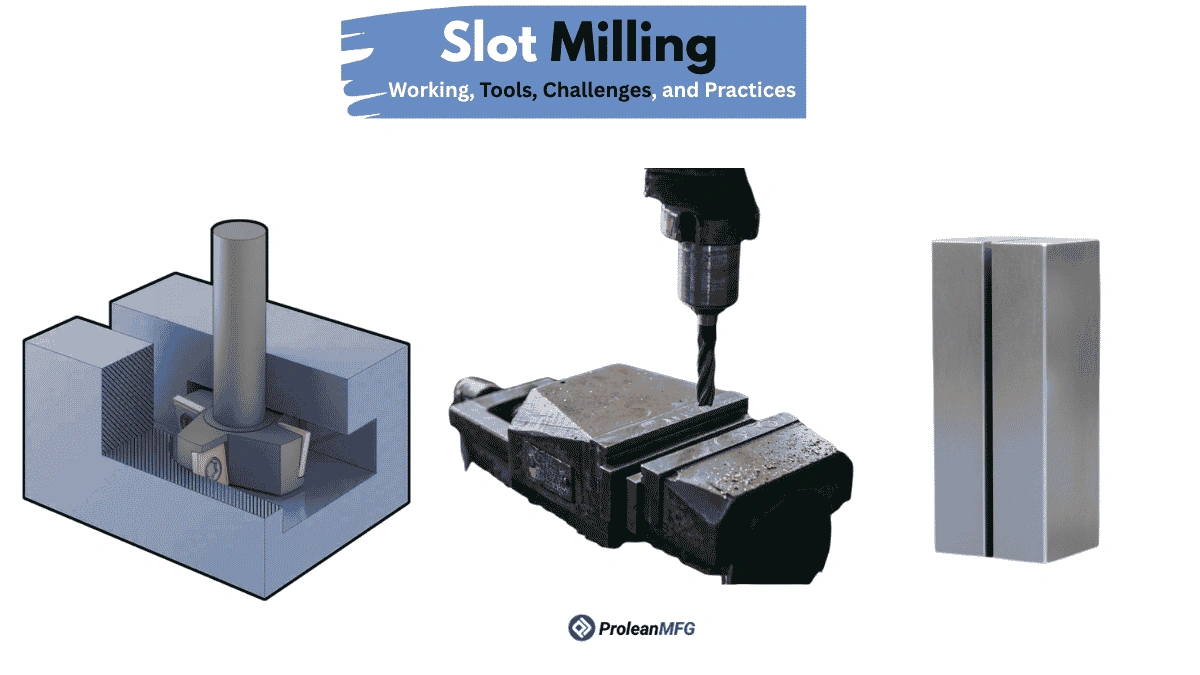

Slot milling is a machining technique that uses rotating cutters to create grooves, channels, and keyways of custom shapes & sizes. A slot milling cutter follows the programmed path and removes material to create the desired slot on aluminum, copper, steel, composites, plastics, and other workpieces. With efficient chip evacuation, thermal management, and cutter stability, a high precision of ±0.02 mm can be achieved for CNC-milled slots.
Are you struggling to decide which CNC milling operation is fast, efficient, and cost-effective for fixture plates, assembly guides, dovetail grooves, T-slot channels, keyways, and retention features? Slot milling can be the ideal choice for you. However, you must consider the capabilities of this technique, its preferred applications, milling challenges, and industry practices before making a selection.
This article discusses the slot milling process & tools, compatible materials, potential challenges, tooling strategies, costs, and industry practices.
What is Slot Milling?
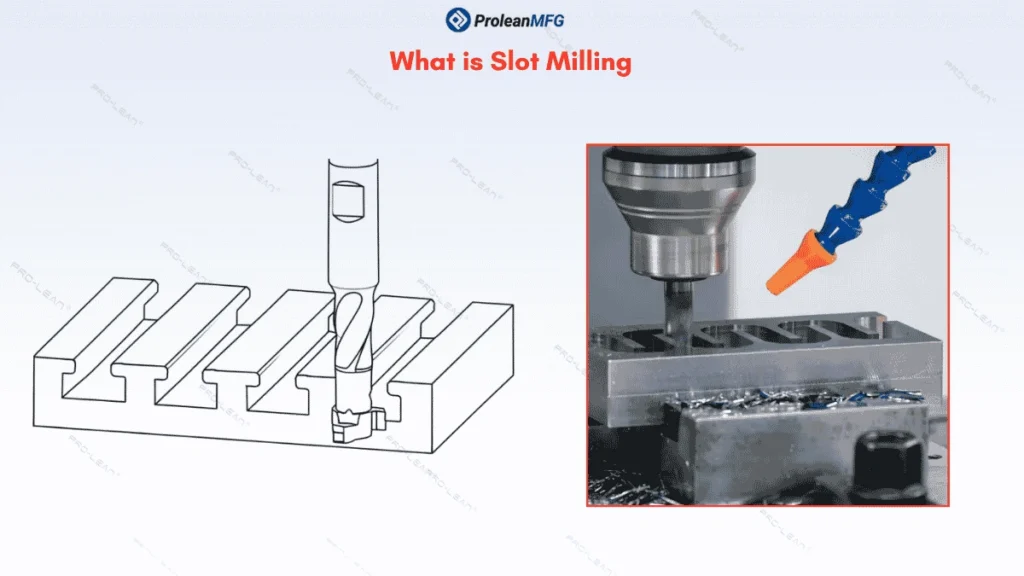
What is a slot? A narrow and elongated channel, groove, or recess on the workpiece. Slots are used for fastener assembly, part guiding, or specific functionality. Slot milling is a machining operation carried out to create a designed slot, which can be opened, closed, long, short, deep, shallow, straight, or curved.
Horizontal and vertical, both types of milling machines can cut the slots with a general tolerance of ~ ±0.127 mm and roughness Ra below ~ 1.6 µm. With precision milling machines, a milled slot can be as precise as ±0.02 mm ( ±0.0007 inches).
If you are in the engineering industry, you must have noticed T-slots in machine work tables, which are responsible for sliding and securing material for machining. Another example is keyway slots in gear shafts, which hold and lock gears to the shaft. Both are made using a CNC slot milling process that provides accurate control of depth and width for precise fits.
Ket Features of Slot Milling
- A main distinction of slot milling from other types of operations is its near full-width radial engagement characteristic.
- CNC-milled slots comply with ISO 286-2 H7 tolerance, required for sliding assemblies across industries.
- Slot milling can produce open, closed, curved, straight, profile, and other types of slots.
- Slot depth and width ratio depend on tool diameter, chip clearance, and other factors. It typically ranges up to 4: 1 (D/W).
- Several tools can be used in slot milling: slot drills, end mills, face cutters, etc.
How Does Slot Milling Work? The Step-wise Process
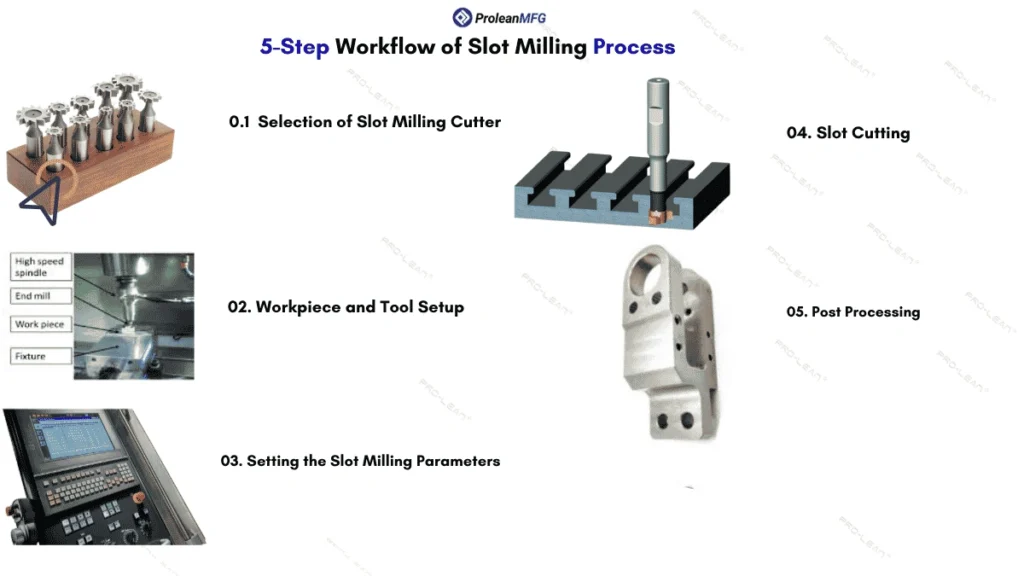
The working of slot milling involves a cylindrical-shaped rotating cutter that removes material through near full-width engagement. It has multiple steps, including selection of slot milling cutter, machine setup, speed & feed setting, slot cutting, and post-processing.
1. Selection of Slot Milling Cutter
Choose the right type of slot milling tool, such as slot drills, Woodruff Cutters, T-slot cutters, and dovetail cutters, based on the work material and slot geometry. You also need to match the cutter diameter with the slot width. For typical use, choose a slot drill tool with 2-3 flutes, and use 4-6-flute end mills for heavy slot machining.
2. Workpiece and Tool Setup
Secure the workpiece on the machining table and the tool on the spindle. They must resist machine vibration and chattering. Additionally, choose the right type of tool path in the CNC program: conventional, Plunging, or Trochoidal
3. Setting the Slot Milling Parameters
Setting the right feed, speed, cutting depth, coolant flow, and other milling parameters ensures precision, finish, and longer tool life. These parameters can differ based on the machinability of the workpiece material.
- Aluminum (AA 6061): Cutting Speed 200-400 m/min, feed 300-500 mm/min, cutting depth 1-2 mm
- Mild Steel (AISI 1018): Cutting Speed 80-150 m/min, feed 200-400 mm/min, cutting depth 0.5-1 mm
- Copper: Cutting Speed 150-300 m/min, feed 250-450 mm/min, cutting depth 0.5-2 mm
- Composites (GFRP/CFRP): Cutting Speed 150-350 m/min, feed 400-800 mm/min, cutting depth 0.5-2 mm
4. Slot Cutting
As the machine starts, the rotating cutter moves along the programmed path along with the machine spindle. The cutter’s cutting edges gradually enter the workpiece and cut the material along the slot width and depth.
5. Post Processing
Perform deburring, sanding, and polishing operations to remove sharp edges, burrs, and tool marks. Subsequently, rinse the slot-milled parts to remove attached chips and coolant residues.
What Type of Materials Can be Slot Milled?
Various metals, alloys, plastics, woods, and composites are compatible with slot milling. You can use aluminum alloys, cast iron, stainless steel, copper alloys, low-carbon steels, titanium, ABS, PC, Acrylic, nylon, carbon fiber, and fiber-reinforced thermoplastics.
Based on the type of workpiece material, you must choose suitable tool coating, feed, speed, and cutting depth. For instance, hard metal slotting requires carbide, TiN coating, and slower feeds.
Next, which materials can not be slot milled? Ceramics, highly reinforced fiberglass, and pure copper can not be slot-milled. Harder materials like Inconel and titanium are also challenging and require proper milling strategies.
Best Practices for Successful Slot Milling
Select the appropriate cutter type, size, material & coating, and set the optimized feed rate and cutting speed. Choose a ramp entry of the cutter, and ensure correct spindle engagement. These tips help achieve the desired precision and finish while reducing vibration & tool wear.
- Ramp Angle for Tool Entry: Instead of radial tool entry, set a 45° ramp angle for general slotting work and 180° axial plunge for deep slots on hard materials.
- Ensure Effective Chip Evacuation: Use multiple tool passes or end mills with variable helix angles to avoid chip clogging and ensure efficient evacuation.
- Choose Down Milling: The down-milling approach uses the same direction of feed and cutter rotation, allowing better chip clearance with minimal vibration during slot milling.
- Spindle Engagement: During the process, ensure that at least one cutting edge is always engaging with the material.
- Select Large Tool Diameter: Especially when milling deep slots, choose large-diameter tools to avoid deflection & vibration.
- Balance Cutting Speed & Feed Rate: Choose feed rate based on cutting speed and material type. Higher feeds result in a rougher surface & rapid tool wear, whereas slower feeds cause heat buildup.
Slot Milling Challenges and How to Solve Them?
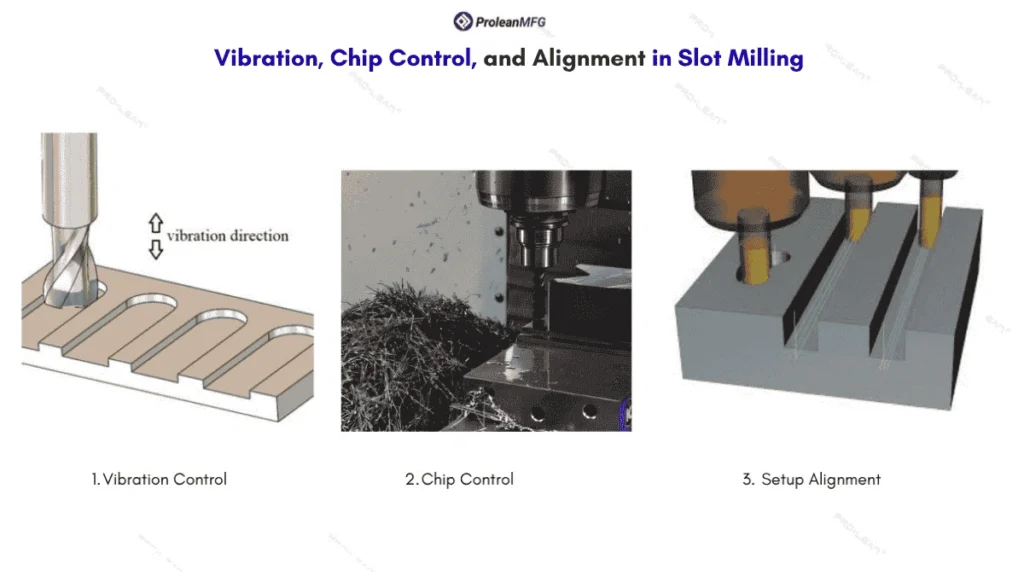
Chatter & vibration, poor chip evacuation, heat buildup, tool deflection, burrs, and rougher surface finish are the main challenges for slot milling. These can be solved by using rigid tools with suitable diameters, setting balanced feed & speed, applying required coolant flow, and avoiding excessive tool overhang.
Let’s break down 5 key challenges and how they can be solved or avoided.
Challenge 1: Chatter and Vibration Due to Near Full-width Engagement of Cutter
To solve this, use rigid tool holders, optimize milling parameters, and employ variable-flute cutters.
Challenge 2: Poor Chip Evacuation
If chips get trapped in machining slots, it leads to recutting, clogging, and even tool breakage. So, apply compressed air flow as a coolant.
Challenge 3: Heat buildup
Slot cutting is prone to excessive heat generation, leading to heat buildup and reduced tool life. To solve this challenge, use carbide-coated cutters, reduce the feed rate, and ensure proper coolant flow.
Challenge 4: Tool Deflection
While machining deep slots, the tool can deflect, affecting accuracy. So, reduce tool overhang, use larger-diameter tools, apply multiple passes, and reduce axial cutting depth.
Challenge 5: Burrs and Poor Surface Finish
Burrs and rougher finishes affect fit, assembly alignment, and sliding performance. Therefore, use sharp tools and set the feed & speed based on the tool diameter and the workpiece’s machinability.
Types of Slot Milling Cutters and Techniques
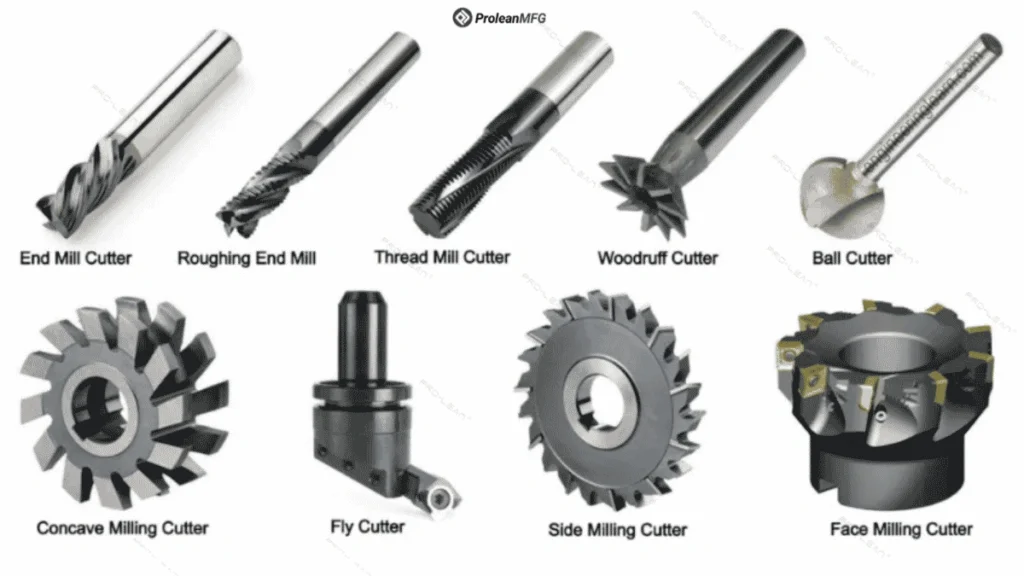
There are different types of slot milling cutters, designed for various slot profiles and complex tasks, such as end mills, face milling cutters, side milling cutters, T-slot cutters, Woodruff cutters, and gang milling cutters.
End Mills
An end mill cutter has a cylindrical shank with 2–6 helical flutes, allowing it to cut on both the end face and the periphery. End milling is versatile and can be used for angled, straight, and complex & closed slots. It can also be used for other machining features, such as pockets & profiles.
Face Milling Cutters
A face milling cutter incorporates indexable carbide inserts, positioning the cutting teeth around the periphery and on the faces. You can use face milling for straight-sided slotting, particularly shallow, wide liner slots. For instance, face grooving on cylinder heads.
Side Milling Cutters
Side milling cutters are disc-shaped and include cutting edges on the periphery and both side faces. The cutter, mounted on an arbor, can create slots in a single pass. You can choose side milling for deep and long slots on drive shafts, machine bases, etc.
T-Slot Cutters
T-slot cutters are used to create horizontal arms of “T-shape” on an already milled groove. The geometry involves a narrow shank and an enlarged head with side-cutting flutes. Choose T-slotting when you need grooves/slots beneath the workpiece surface.
Woodruff Key Slot Cutters
Woodruff is a circular cutter with concave-sided peripheral teeth, typically made with HSS M2 grade. It is plunged radially to create a narrow semicircular keyway. You can use this tool for standard Woodruff keyways in gears, couplings, and transmission shafts.
Gang Milling Cutters
Gang milling cutters consist of multiple cutters mounted on the same arbor and cut on surfaces simultaneously. You can combine two or more types of cutters based on your desired results. For instance, combining side-and-face cutters with a slab mill allows for the creation of complex profiles in a single pass.
How To Choose Slot Milling Cutters?
Choosing a suitable slot milling cutter depends on the specifications of the slot in your part design. You need to consider slot size, desired accuracy, tool material, and chip-evacuation efficiency.
End mills are suitable when you need simple, straight, open, or semi-open slots. Face mill cutters excel in stable cutting of shallow slots. If you need deep, narrow slots, side mill cutters are good options, whereas T-slot cutters are best for cutting T-shaped undercut slots.
What Are the Applications of Slot Milling?
Slots are used for alignment & joining, fluid passage, air vents, and weight reduction. The slot milling applications range across multiple industries, including automotive, aerospace, electronics, medical, tools & fixtures, and general manufacturing.
Next, let’s look at examples of parts that include slot features.
- Aerospace: Narrow slots on ribs, turbine blade profiling, actuator fluid channels, gas turbine sealing slots.
- Automotive: Drive shaft keyways, brake rotors, O-ring grooves in engine, suspension mounts, etc.
- Electronics: Heat-sink fin slots, retention slots in enclosures, key slots on connectors, actuator assemblies, and guide channels for semiconductor wafers.
- Medical: Sensor mounts for diagnostic equipment, precision guide slots in medical robots, lead-screw tracks in insulin pumps, orthopedic implants, etc.
- Tools & Fixtures: Cooling channels in molds, ejector passages, and T-slot fixture plates.
- General Manufacturing: Gear teeth, DIN 650 T-slots on machine bases, linear guiding slots, hydraulic cylinder seals.
What Are the Advantages and Disadvantages of Slot Milling?
Slot milling offers efficient material removal, tight dimensional accuracy, helps complex feature machining, and provides custom fitting solutions. On the other hand, it has a few disadvantages, such as higher vibration & chatter, risk of heat build-up, and tool deflection.
Slot Milling Advantages
- Efficient and precise milling of slots, grooves, and channels on different materials.
- Slots help the machining of complex internal features without intricate tool paths.
- Slot milling offers higher repeatability and dimensional accuracy, up to ±0.05 mm or ±0.002 inches.
- Slot Milling provides custom fits, a guiding mechanism, and assembly guidance.
Slot Milling Disadvantages
- It is more prone to vibration and chatter when it comes to hard materials like Inconel and Titanium.
- A minor error in setup and machining parameters can cause excessive heat generation & buildup in the machining interface.
- There is a high risk of tool deflection while cutting deeper slots.
What is the Difference Between Slot Milling and Pocket Milling?
Unlike slot milling, pocket milling involves a larger area of machining, removing material within a closed boundary to create cavities and recessed areas. They differ in machining rigidity, cutting depth, and tool path complexity. Choose slot milling for precise grooves & slots, whereas pocket milling is better for recesses and cavities.
Slot Milling Vs Pocket Milling Comparison
| Parameter | Slot Milling | Pocket Milling |
| Process | Near full-width engagement of the tool removes material to make slots of the designed depth & width | The tool follows zigzag, spiral, or trochoidal toolpaths and clears a closed-boundary cavity. |
| Tools | 2-flute slot drill, face cutter, T-slot; Woodruff, etc. | 4–6 flute carbide end mill, ball nose, corner-radius end mill |
| Pros | Simple G-code, tight width tolerance, fast for linear slots & grooves | High MRR, complex cavities, toolpath flexibility |
| Cons | Risk of chip recutting, heat management, tool deflection, and limited geometry | CAM complexity, corner radius limit, chattering, and longer cycles |
| When to Choose | For keyways, T-slots, grooves, channels | For cavities, relief pockets, housings, dies |
Toolpath Strategies for Slot Milling Process
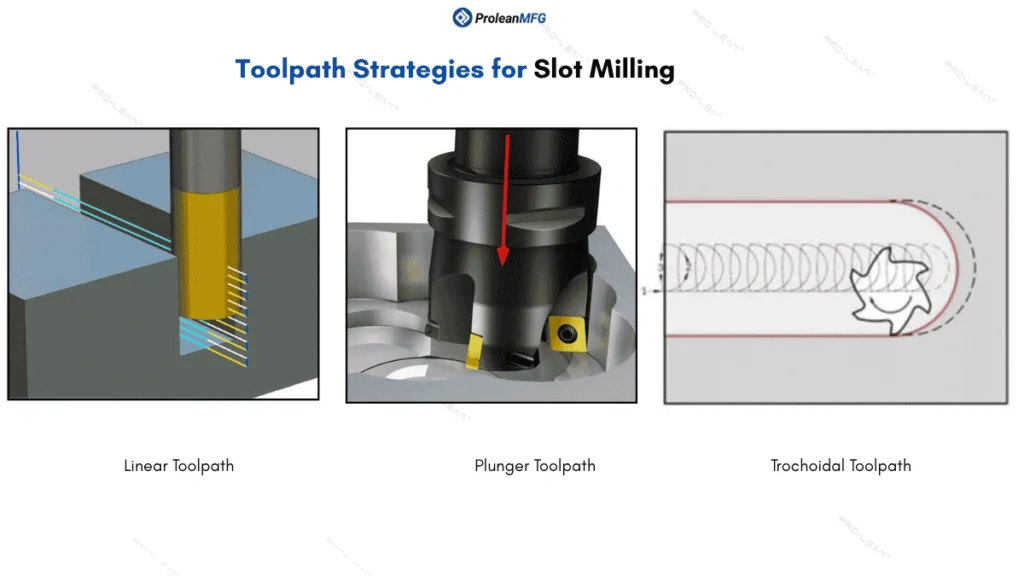
Conventional, plunging, and trochoidal are three types of toolpath strategies in slot milling. Conventional is simpler and used for shallow slots, plunging is less precise but allows cutting deep slots, and trochoidal is preferred when deep slots are required on hard materials.
Conventional Toolpath
Linear tool path along the slot-axis, simple and easy for CAM programming. Use this for shallow slots with depth less than 3 times the diameter (both straight and curved).
Plunging Tool Path
Using plunging instead of ramping allows for deep slots on workpieces with lower machinability, but compromises the precision.
Trochoidal Toolpath
Trochoidal is a complex tool path for slot milling, which involves a spiral path and a tool that makes repeated shallow cuts, lowering the effect of cutting forces on edges. You can choose a trochoidal tool path for cutting deep slots on hard materials.
Tips to Optimize Slot Milling for Production Efficiency and Tool Life
You can optimize the slot milling process for productivity and tool life using the right machining strategies, CAM simulation, a balance of feed & speed, and frequent tool replacement. Additionally, too much wear is directly related to finish and production efficiency, as worn tools cause quality failure.
Here is the list of tips;
- Do a CAM simulation to predict the tool path and avoid tool collision. It also helps in the automatic adjustment of feed & speed.
- Use the right type of slot milling cutter and ensure cutting edges are sharp and clean.
- Based on the machinability of the workpiece, consider tool coating.
- Replace the tool before the remaining 20% of cycles mentioned by the tool manufacturer. For instance, if an end mill is recommended for 10,000 cycles, replace it after completing 8,000 cycles.
- Employ a real-time monitoring system and adjust the process if any error found.
What Are the Key Slot Milling Parameters
Spindle speed, feed rate, cutting depth(axial), coolant flow, coolant pressure, ramp angle of tool entry, and tool overhang are the key slot milling parameters. These parameters directly influence tool stability, heat generation, chip buildup, the machining time, and surface-finish quality.
While choosing the slot milling parameters, consider workpiece hardness, setup rigidity, finish requirement, cooling method, and chatter tendency.
| Parameter | Recommendation / Formula |
| Spindle speed (RPM) | n = (vc × 1000) / (π × D) |
| Feed rate (mm/min) | vf = fz × z × n |
| Cutting depth (axial) | 0.5–1.0 × D for soft, and 0.3–0.5 × D for hard |
| Coolant flowQ (L/min) | Vary on different factors: coolant type, slot depth, etc. ( 5–20 L/min for light machining) |
| Coolant pressure | Based on material type, coolant type, slot geometry, slot depth, and other factors. |
| Ramp angle (°) | Generally α = 1°–3° |
| Tool overhang(L/D) | Typically, L/D ≤ 3–4 , L/D ≤ 3 for precison slotting |
How to Inspect and Measure Slot Milling Quality?
Slot width, slot depth, straightness, parallelism of slot walls, positional accuracy, roughness (Ra) value, and other parameters are measured to verify the desired slot milling quality. Additionally, you can perform part inspection (visual or digital scanning) to detect tool marks, built-up edge, burrs, and other minor defects.
The following are the instruments needed to measure the slot milling quality.
- Coordinate measuring machines (CMMs)
- Vernier caliper
- Micrometer
- Gauges
- Optical comparator,
- Stylus profilometer, etc
Cost of Slot Milling: Is it Expensive?
Per-hour slot machining cost typically ranges from $30 to $150, depending on factors like desired precision, finish, tooling, production volume, and the machine used to mill the slots.
If you need simple slots for PCB guides in electronic enclosures, a 3-axis CNC milling machine is cost-effective ($30- $75 per hour). But for slot milling in precision-sensitive parts like bone-plate systems, you must use 5-axis (or higher-axis) machines, which cost more than $100/hour.
Summing Up
Slot milling shows the importance of precision, stability, and customization in part machining for alignment, fitting, linear guides, and fluid passes. Different tools like end mills, side milling cutters, T-slot cutters, and Woodruff cutters are used based on the specifications of desired slots.
Milling custom slots on metal or other workpieces requires chip control, efficient heat management, speed & feed balance, and the right tool path strategy. Furthermore, equipment capabilities and operator skills also impact the precision and overall quality of milled slots.
At ProleanMFG, our CNC milling services are precise and cost-effective, offering tolerances down to ±0.001″ (± 0.0254 mm) and Ra 3.2 µm. We use advanced multi-axis CNC milling machines capable of creating complex slots, pockets, grooves, undercuts, and other features.
If you are looking for an experienced manufacturing partner for custom CNC-milled parts, we can provide prototyping and production services for your business or research needs. Not only precision & customization, but we are also competitive in your project budget. So, upload your design and request a quote now.
FAQs
An end mill is more versatile than a slot mill, as it can be used for contouring, side cutting, profiling, and other operations. But the slot mill is specifically designed for cutting slots of different shapes & sizes.