
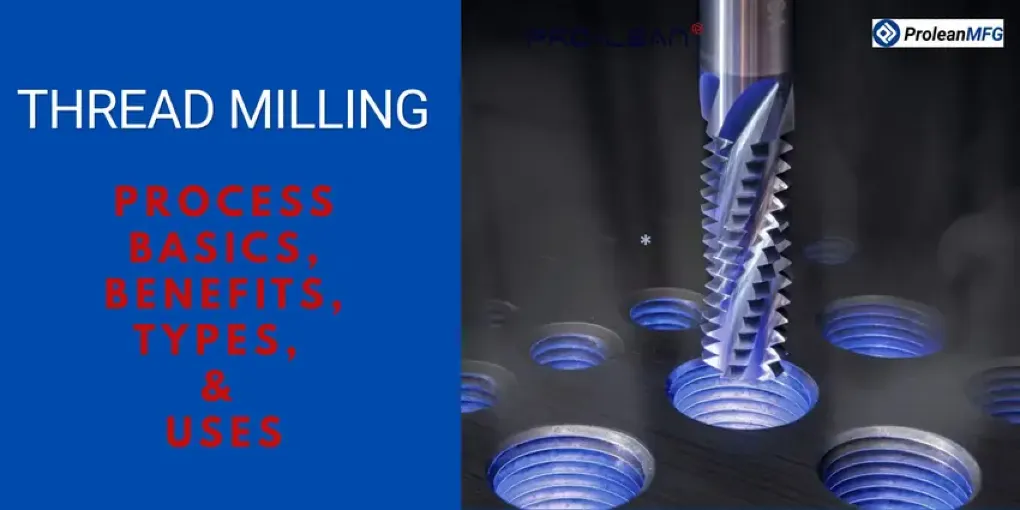

Thread milling is a fundamental method of creating machine-based threads. This crucial CNC milling thread generation method relies on multi-axis motion. A specialized tool called a thread mill is used to create the thread profile.
This specialized machining process is valued for its versatility for large and complex threads. The method can be used to make internal threads very effectively.
Engineers and machinists have different types of thread milling cutters to choose from, including single-profile thread mills and multi-profile thread mill cutters. Elements that guide this include the batch size and hole parameters.
Understanding the relevance of thread milling, especially in relation to thread turning, helps businesses decide if this is the best method for thread production in a project.
This guide covers the definition, working principle, benefits & limitations, and applications of thread milling.
What Is Thread Milling?
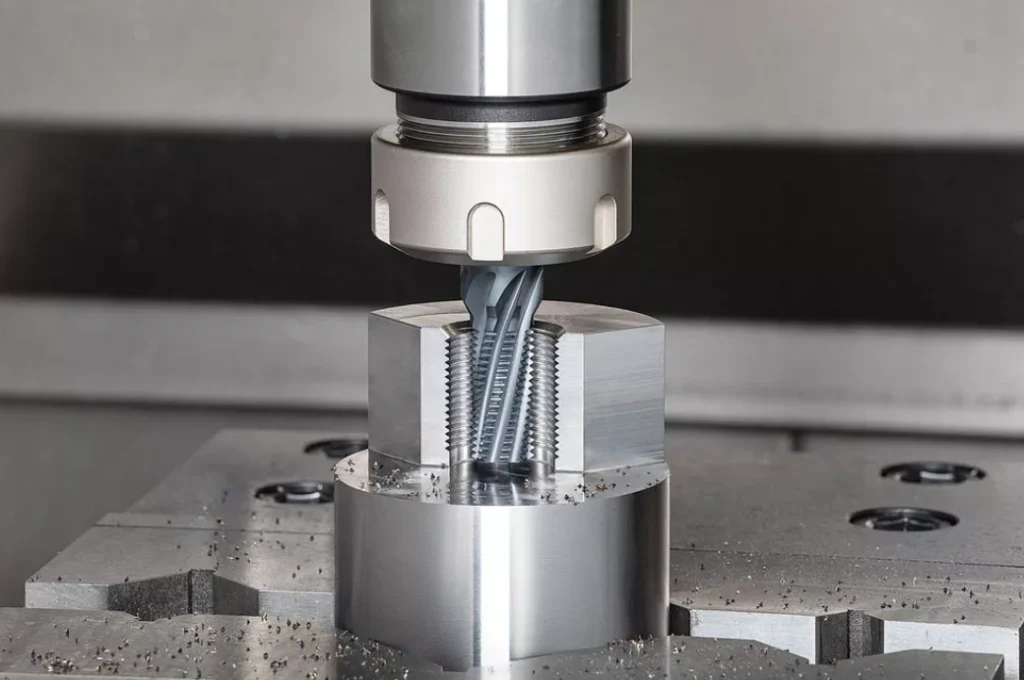
Thread milling is the movement of a rotary tool in a circular ramping movement to produce threads. The rotating cutter moves linearly in the Z-axis and circularly in the X-Y plane.
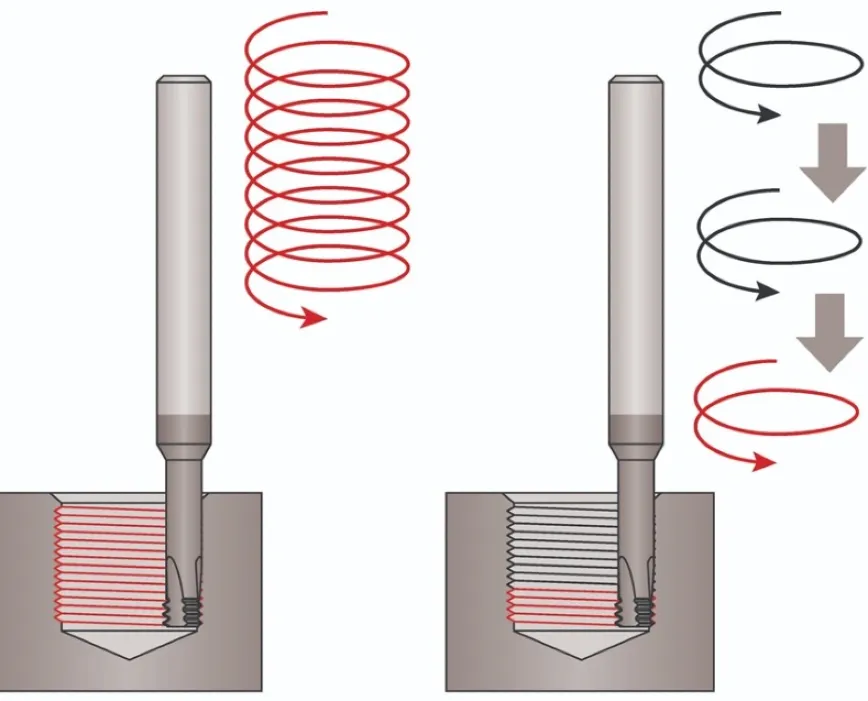
The use of a cutter that moves in a helical path controlled by a CNC machine is a unique technology that is different from tapping. The method is preferable to tapping for custom threads, hard materials, blind holes, and other instances where tapping would be impractical.
Thread milling produces both internal and external threads on a wide range of materials – composites, metals, and plastics.
What Is Thread Milling Used For in Industrial Manufacturing?
Industrial manufacturers use the precision and versatility of thread milling to produce large and complex threads. The method is often chosen for such instances, especially where tapping is likely to fail due to limited size and tool breakage.
Machinists widely use thread milling to make non-standard thread sizes, usually on machining centers.
If a part is already being processed on the milling machine, using a thread milling cutter for blind holes and complex features is a practical step.
Advantages and Disadvantages of Thread Milling
Like other machining processes, thread machining on the milling machine has its benefits and limitations. It all depends on the machine in use and the specific application.
Here are the main benefits and limitations of the process.
What Are the Advantages of Thread Milling
- High thread quality and precision
- Can produce large-diameter threads
- The CNC program can be adjusted to produce different types of threads from the same tool.
- Can produce both external and internal threads
- Machines hard materials
What Are the Disadvantages of Thread Milling?
- Helical interpolation capability is required in the machine
- Longer machining time
- Higher machining cost due to advanced tooling and complex programming
- May not suit the economics of high-volume production
Thread Milling Compared to Other Threading Methods
It is important to compare thread milling to alternatives such as tapping and form milling. These evaluations help determine if the option is cost-effective and reliable for the project.
Thread Mill vs Tap Method
While simple and swifter, tapping uses a concentrated load. This exposes the tapping tool to a higher risk of failure.

Thread milling may last slightly longer, but it is preferable for the thread mill vs tap scenario when the manufacturer wants to prevent scratches or damage to the part.
We would recommend thread milling when;
- There is a requirement for different toolpath radii
- Multiple sizes from a single tool
- Deep features with effective chip evacuation
- Threads in large-diameter holes
Is thread milling faster than tapping?
No, tapping is generally faster than thread milling. Tapping is a single-operation process, while thread milling has to gradually follow a helical interpolation path.
Is Thread Milling Better Than Form Milling?
It depends on the project requirements. The full-thread profile in form milling makes it possible to produce threads in a single pass.
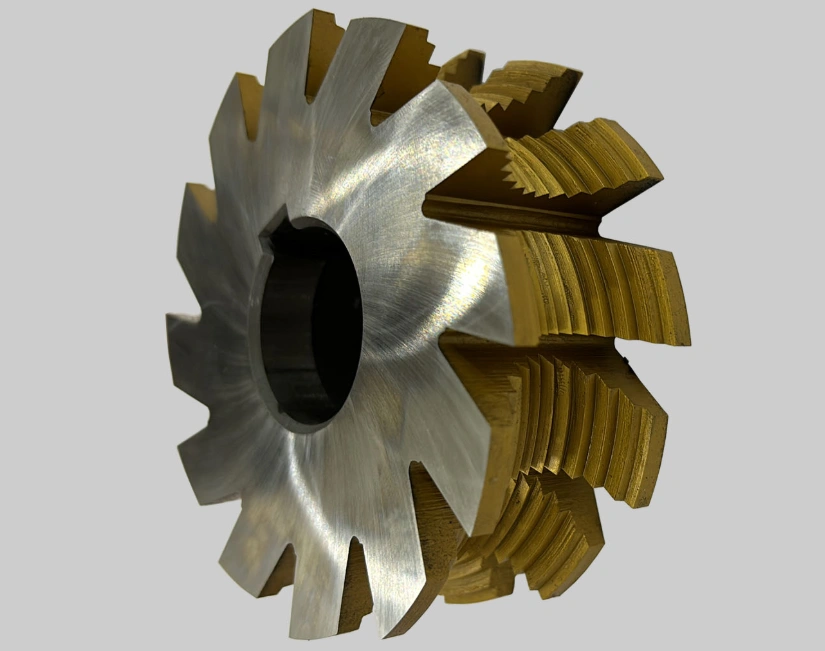
However, the thread milling cutter uses a gradual approach. The helical cutting motion is systematic and takes more time.
So, form milling would be preferable where faster machining is required. Thread milling offers higher precision.
Comparison table for thread milling vs tapping vs form milling
Below is a comparison table for thread milling vs alternatives on different aspects, covering speed, suitable materials, thread size, precision, surface finish, and cost.
| Aspect | Thread milling | Tapping | Form milling |
| Speed | thread mill speeds and feeds are Slower | Very fast | Fast |
| Suitable materials | Hard materials and super alloys | Standard materials and softer metals | Materials that can accommodate stable single-pass cutting |
| Thread size | Custom size, large-diameter sizes | Depends on hole size and tap diameter | Typically standard thread sizes |
| Precision | High precision due to CNC capability | Depends on the tap accuracy, but it can achieve good accuracy | High-dimensional consistency |
| Surface finish | Excellent surface finish | Good surface finish if chip packing is well managed | Good surface finish under stable conditions |
| Cost | Higher programming and tooling cost | Lower tooling cost for common threads | Mostly average cost, but it depends on the equipment complexity |
How Thread Milling Works?
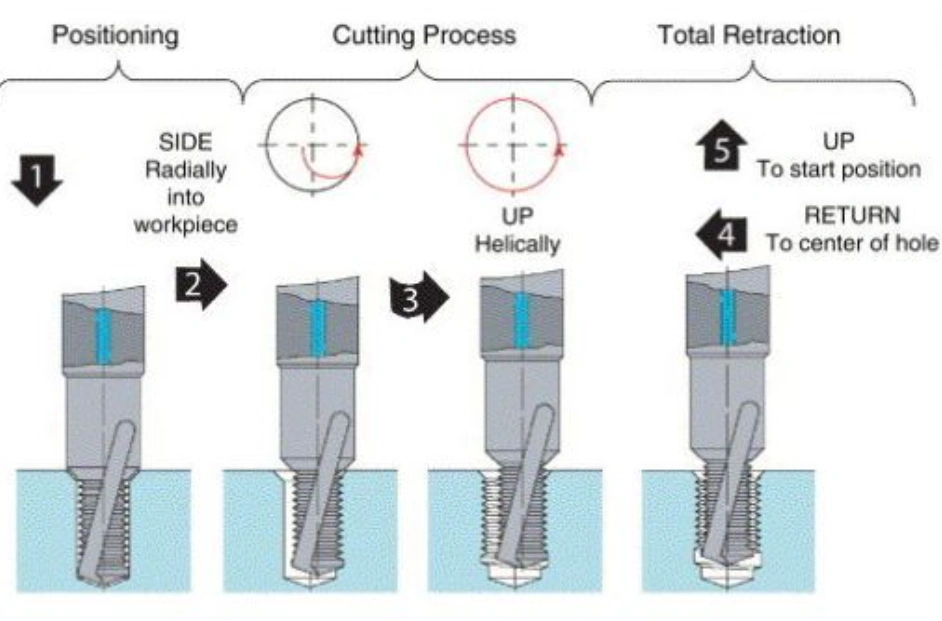
As the goal of thread milling is to produce a thread helix, at least three motions are involved. The spindle rotates the rotary tool, and the milling machine follows a circular path. The machine is also concurrently advancing in the Z direction.
These movements are controlled by the CAM system of the CNC milling machine. More on the thread machining sequence is explained next.
Thread Milling Process: Step-by-Step Overview
The steps of performing the machining process are as follows;
- A bore or pilot hole is drilled according to the required minor diameter
- The thread mill is positioned, and a lead-in toolpath is followed for initial entry into the hole
- Helical interpolation is performed – the cutter is moved in the X-Y plane as it also advances in the Z direction. This generates the thread profile systematically.
- Once the thread path is complete, a controlled lead-out is performed. The thread milling cutter is then retracted.
Thread Milling Cutting Parameters
Producing quality, precise threads depends on several factors, including the depth of cut, feed rate, and surface speed.
- Depth of cut – The recommended radial depth of cut is between 0.1 and 0.2 times the thread pitch
- Feed rate – If the length-to-diameter (L/D) is more than 3, the feed rate should be re reduced by between 25 and 35%
- Surface speed – It should be adjusted according to the chip management and the aluminum alloy being machined.
Types of Thread Milling Cutters
Machinists choose from four main types of thread milling cutters – single-profile, multi-profile, solid carbide, and indexable thread milling cutter – based on the material, thread size, and production volume.
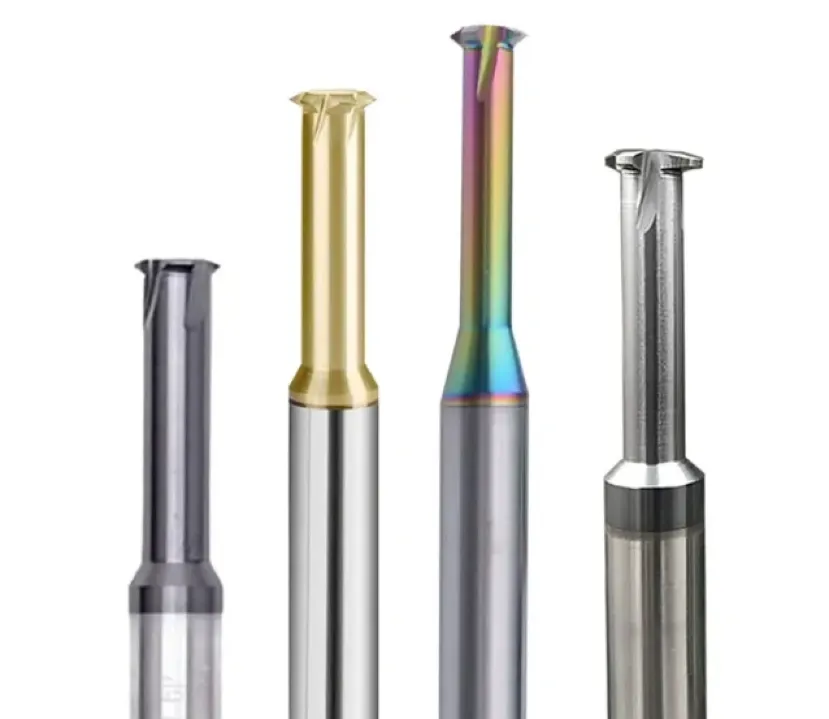
Single-Profile Thread Mills
These thread mills can produce different thread diameters, but for only one thread form at a time.
Multi-Profile Thread Mills
The cutting edge of this type of cutter has several thread forms. Therefore, the milling cutter is ideal for high-volume production.
Insert vs. Solid Carbide Thread Mills
The choice between insert and solid carbide thread mills depends on considerations for cost, precision level, production volume, and thread size.
Solid Carbide Thread Mills
These single carbide tools are precise and rigid. Machinists prefer the thread mills for high-tolerance applications. The mills are suitable for small to medium thread sizes, delivering unmatched dimensional accuracy and surface quality. However, the user must be prepared to deal with high replacement costs.
Indexable (Insert) Thread Mills
The “insert” in the indexable thread milling cutter refers to the replaceable cutting features that are attached to the tool body. Indexable thread milling cutters make larger threads and can support high-volume manufacturing.
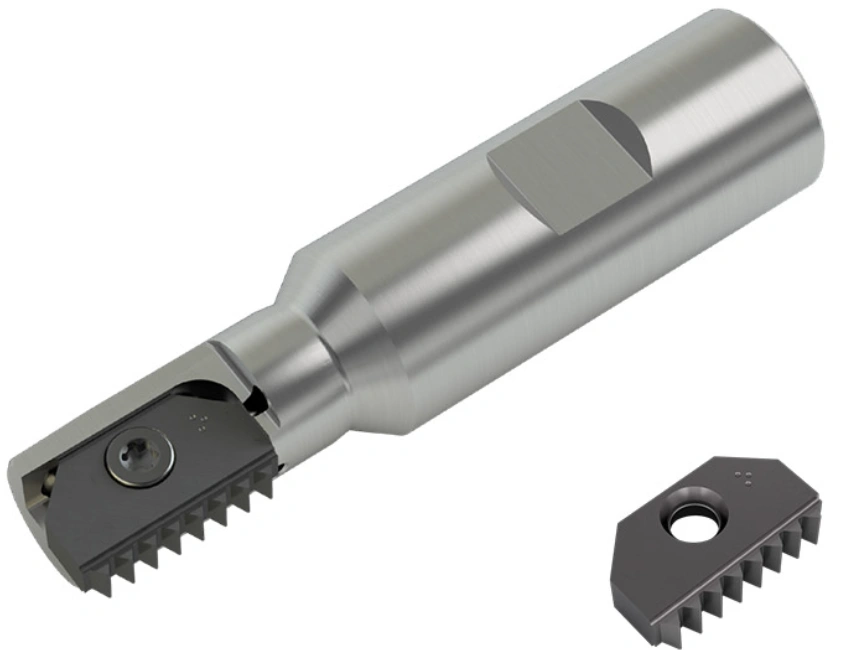
While these thread mills are slightly less rigid, they are more cost-effective in the long term.
Importance of Choosing the Right Thread Milling Cutter
Any experienced machining professional knows that the right thread milling cutter is the secret to achieving high thread accuracy, enhancing the cutter’s durability, and optimizing the machining time.
Therefore, the machinist will always consider the following factors when choosing a cutter;
- Material type
- The type of hole to be threaded
- The thread parameters – pitch, diameter, and so on
- Manufacturing volume
What Materials are Suitable for Thread Milling?
Thread milling is compatible with various engineering materials, including aluminum alloys, stainless steel, cast iron, titanium & super alloys, and composites & plastics.
Aluminum Alloys: The benefits of aluminum alloys in thread milling include easy machinability and effortless chip evacuation. The material performs excellently in high-speed milling.
Stainless Steel: Thread milling is suitable for thread machining in stainless steel because of controlled forces. We know that stainless steel is prone to work hardening, and cutting tools can break; thread milling reduces this risk.
Cast Iron: Provided the correct thread cutter is used, cast iron can be used to produce threads with a good surface finish.
Titanium & Super Alloys: In titanium and super alloys, you have materials with incredible strength and heat resistance. Thread milling thrives is a popular machining alternative for these materials, which cannot be handled by tapping.
Composites & Plastics: When it comes to this material category, deformation and cracking can be major issues. Thread milling is a reliable method against these challenges.
Common Thread Milling Techniques
The most common thread milling methods are external thread milling, internal thread milling, single-pass thread milling, and multiple-pass thread milling. Selecting any of these depends on the part’s requirements and thread geometry.
External Thread Milling

This is a milling technique for producing threads on shafts and other cylindrical components. It is usually used where thread turning may be challenging, for instance, on large parts.
Internal Thread Milling
Internal thread milling is usually more common than external thread milling, especially in CNC machining environments. Threaded holes are common in machined parts. Milling these threads is safer than tapping.

Single-Pass Thread Milling
This technique uses a multi-profile cutter to produce the thread in one pass. It is a cost-effective and fast method in high-volume production.
Multiple-Pass Thread Milling
Unlike in single-pass thread milling, multi-pass thread milling uses a single profile thread mill. This means that the milling process is slower and requires multiple passes.
Thread Milling Applications
Thread milling is widely used in various industries, including aerospace, oil & gas, automotive, medical, and general industry. Usually, these are applications where materials are difficult to machine, or the risk of scrap is too high.
Aerospace – Used to produce engine and structural components
Oil & Gas – Used for threads in controlled fit applications
Automotive – For transmission parts and engine blocks
Medical – Precision threaded holes are common in surgical devices and implants
General Industry – Manifolds and housings
How Much Does Thread Milling Cost?
Compared to tapping, thread milling costs more upfront. Two things that contribute to this higher cost are programming and tooling. However, the general picture is that thread milling can machine different thread sizes at a go, offers better thread quality, and doesn’t involve tap breakage inside parts.
Other cost factors for thread milling are machining time, labor and supervision, and consumables.
Here’s a table summarizing the cost factors.
| Cost factor | Description |
| Programming | Toolpath programming and initial setup |
| Tooling | The specialized thread milling cutters are typically expensive |
| Machining time | Longer cycle times compared to tapping |
| Labor & supervision | Setup and monitoring may require skilled personnel |
| Consumables | Toolwear and replacement |
Thread Milling Tips
For the most cost-effective and dependable threads, we perform precision machining with the following thread milling tips in mind.
- Chips should be removed properly from blind and deep holes
- Runout on small tools should be handled carefully
- The CNC machine should be calibrated regularly
- Regular tooling inspection and prompt replacement
- The CNC machine should be capable of machining diverse materials
- The toolholder should be rigid.
Latest Innovations in Thread Milling
Thread milling technology’s most recent development is on three fronts: Machining flexibility, tool life, and efficiency.
Below is a table summarizing the innovations:
| Category | Innovation |
| Machining flexibility | Hybrid thread milling tools, which help reduce setup requirements. They also enhance adaptability Advanced CAM strategies |
| Tool life | Optimized tool geometriesAdvanced tool coatings |
| Efficiency | Improved CAM strategies to reduce cycle timesDigital integration for real-time adjustment of cutting parameters |
Wrapping Up
Based on a rotating tool’s ramping circular movement, thread milling delivers high-precision and quality threads. As we have learned, this cost-effective and versatile process is preferable for custom thread machining, threads in blind holes, and threading in hard materials.
The main thread milling techniques, comparison to tapping and form milling, applications, and tips are some of the highlights of this article. Applicable materials, including stainless steel and aluminum, have also been discussed.
With the right milling tool and following other thread milling tips, the machinist can have control of the machining process and deliver excellent external and internal threads. Of course, this is only possible with the right CNC machining partner.
Call and request an instant quote from the best CNC milling services provider today to get precise threads for different materials and designs.