
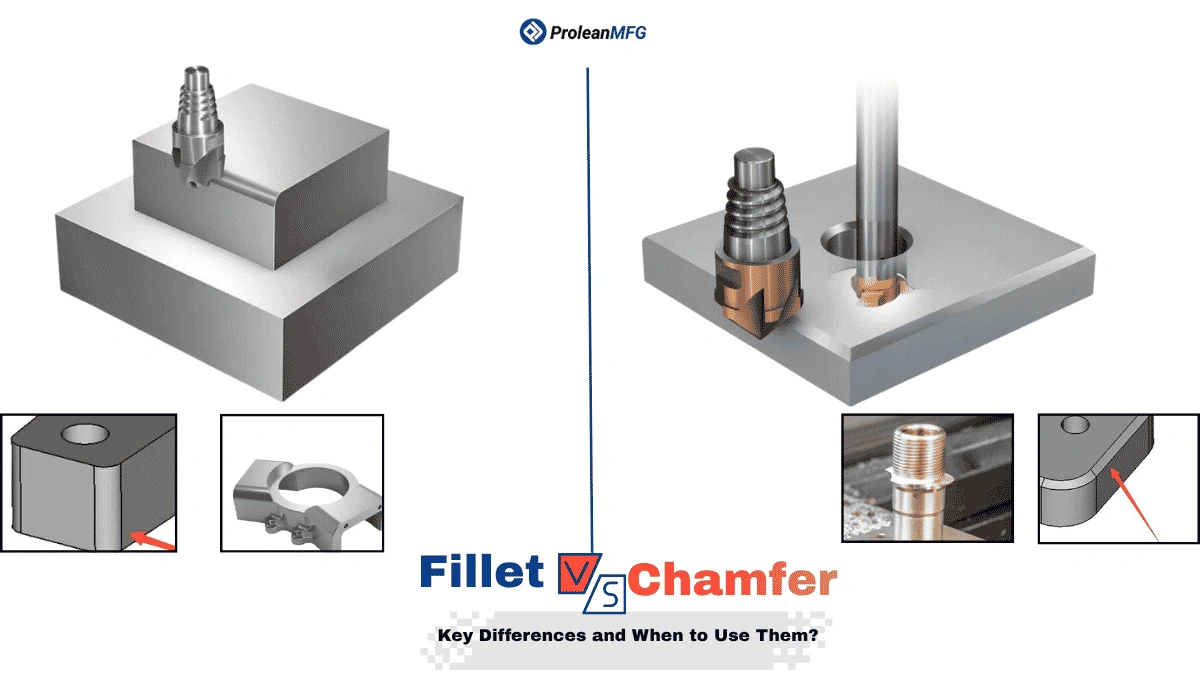

A fillet is a round and smooth curvature applied to edges to achieve excellent stress distribution and aesthetic appeal. It is ideal for seamless transition of surfaces on parts under load, motion, and edges or corners of consumer products. Chamfer gives a flat, angled edge break and guides mating and assembly steps, but it initiates cracks under high load. Choose fillet for applications where load matters, choose chamfer for cost-effective edge finishing.
CNC machining a chamfer in a place of fillet (or vice-versa) results in dimensional inaccuracy, handling safety, lowered performance, and functionality failure. Even small design elements can affect manufacturability, stress concentration, load-bearing capacity, precision, and the performance of machine parts.
Are you a designer or engineer struggling to decide between fillet vs. chamfer on the edge and corner finishing of your part? A fillet is a rounded surface on load-bearing parts, and a chamfer is a flat, angled surface, best for assembly guidance. Filleting is costlier and typically uses ball-nose end mills, whereas chamfer or countersink mills are used for chamfering. For selection, consider stress, assembly & aesthetic needs, and cost.
This article provides a comprehensive comparison of chamfers and fillets, including what they are, their design rules, and when to use them.
What is a Fillet in Engineering? (Definition and Purpose)
Fillet in engineering
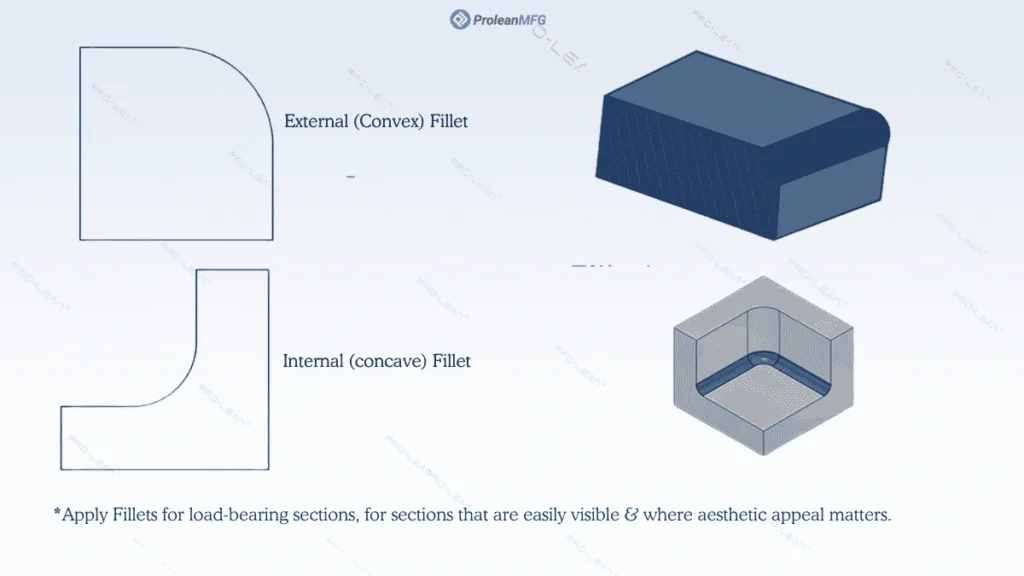
The fillet engineering definition states as a smooth, rounded transition at edges or where multiple surfaces meet. Fillet feature design provides finishes and transitions, reduces stress concentrations, and provides structural reinforcement. Not only in CNC machining, but fillets are also used in casting, forging, and molding part designs.
Adding fillets by CNC machining is a common method. They can be machined with an end mill, a ball-nose end mill, or a corner-radius cutter. Meanwhile, the tool must follow a radial path.
What are the key purposes of adding fillets?
- Fillets are added to mechanical parts to provide a smooth transition between the surfaces(exterior and interior).
- A fillet reduces friction and distributes stress uniformly. So, the fatigue strength and durability of parts increase.
- Parts with filleted edges are easier to machine (or manufacture) than those with sharp corners, and also reduce tool wear.
What is a Chamfer in Engineering?
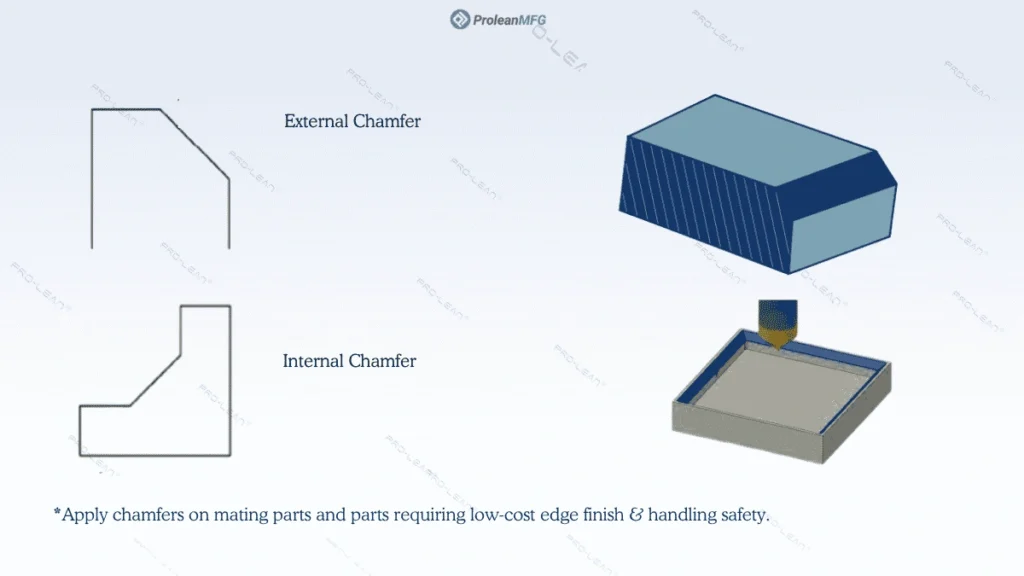
Chamfer in engineering
A chamfer is an angled or beveled feature applied to the intersection edges of two surfaces; typically, where two surfaces meet at 90 degrees. It is used for both interior & exterior surfaces. Chamfered edges provide aesthetic appeal, facilitate transitions at edges & corners, improve handling safety, reduce burrs, and help prepare edges for welding.
Unlike a fillet, a chamfer is straight-angled and less effective at distributing stress. Still, engineers choose it for ease of machining, assembly alignments, and precise edge controls.
What are the key purposes of adding a chamfer?
- A chamfer breaks the sharp corners in mechanical parts and improves edge finish quality.
- Parts with chamfered edges are easier and safer to handle.
- Chamfer facilitates the seamless joining of parts. A 45° chamfer angle provides movement and interaction between parts during assembly.
Fillet vs. Chamfer Appearance: How Do They Look?
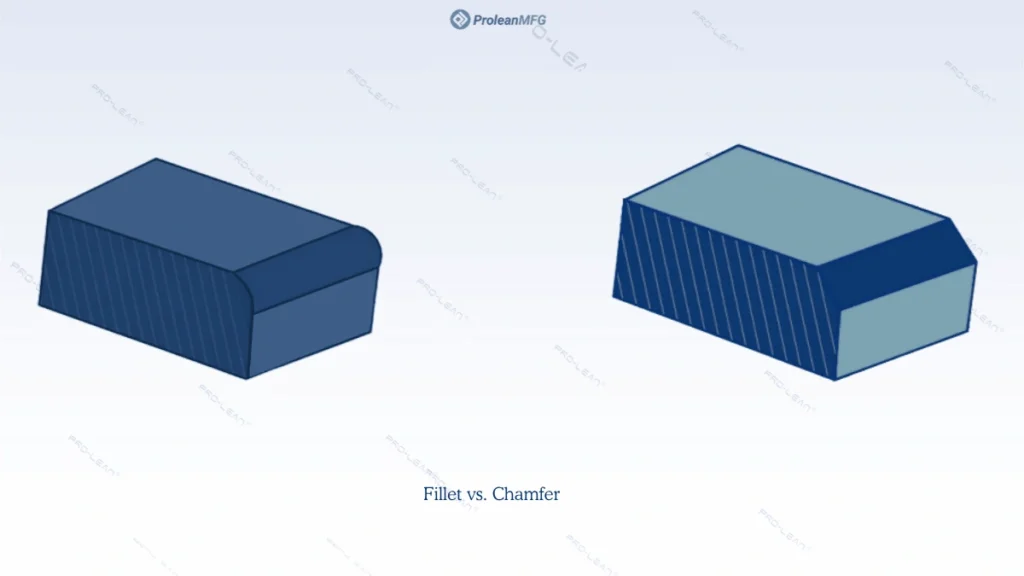
Fillet vs chamfer appearance
How do a chamfered and a filleted edge look? Chamfered edges look like a straight and angled cut, providing a flat, beveled edge appearance. On the other hand, filleted edges appear smooth, rounded, and continuous, creating a soft, seamless appearance.
Concave fillets are added to the interior edges where surfaces meet, and the curves blend inward. Convex fillets are for the exterior edges of parts and the curved belt outward. Meanwhile, full-round fillets are applied where three surfaces meet.
Let’s compare shape, edge transition, aesthetic feel, and typical use of chamfered edges vs filleted edges.
| Feature | Fillet Appearance | Chamfer Appearance |
| Geometry/Shape | Smooth and rounded curve geometry | Flat and angled edge geometry |
| Edge Transition | Gradual and seamless | Abrupt but beveled |
| Aesthetic Feel | More ergonomic; polished | Clean and precise feel |
| Typical Use | Consumer-friendly refined designs | Industrial/minimal designs |
Which is more Aesthetically Appealing? Fillet or Chamfer
Fillet and chamfer are both more aesthetically pleasing than sharp edges, whereas fillet is considered a more ergonomic feature than chamfer and provides a seamless transition between surfaces. On the other hand, chamfer is still a good aesthetic option when the desired style is edgy or a minimalist look.
Fillet vs. Chamfer Design: AutoCAD Specifications and Commands
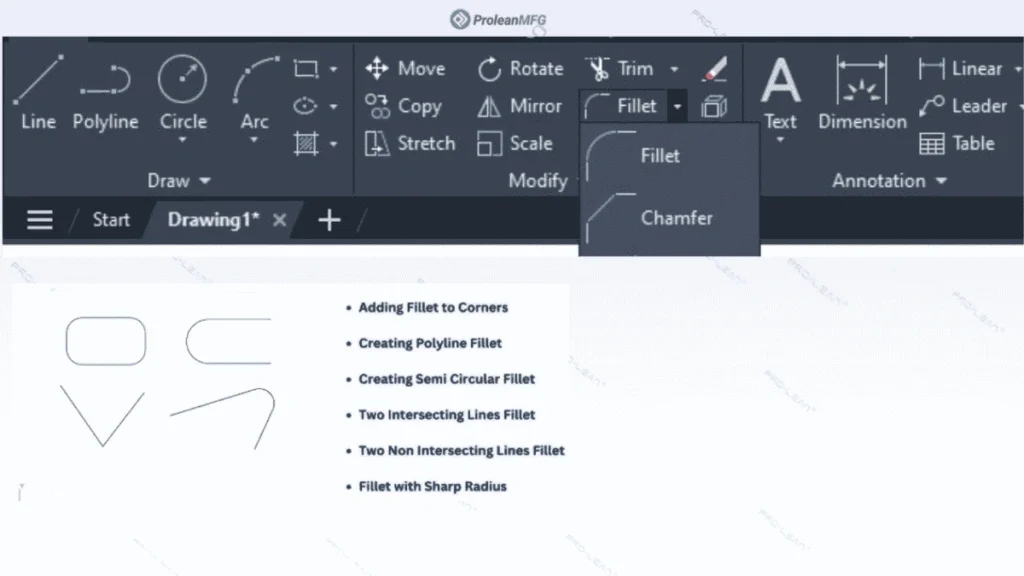
Fillet commands
The command for a fillet in AutoCAD® is “FILLET’, and for chamfer is “CHAMFER”. You simply need to type these letters in the command line, and then it will allow you to select associated lines or edges and input the feature parameter.
How to Apply a Fillet?
- Go to the modify panel under the home tab; you can see a fillet icon (curved corner arc on two lines), or directly use the “FILLET” command.
- Select two lines that connect the corners, one after another.
- Specify the fillet radius.
- AutoCAD® will automatically generate the fillet.
How to Apply a Chamfer?
- Go to the Modify panel under the Home tab; you can see a chamfer icon (a 45° angled bevel on two lines), or directly write “CHAMFER” in the command tab.
- Select two lines that need to be connected by a chamfer.
- Specify the chamfer angle and distance from the flat surface. You can also specify it by two chamfer distances.
- AutoCAD® will automatically chamfer the edge.
Fillet Vs. Chamfer: Stress Concentration
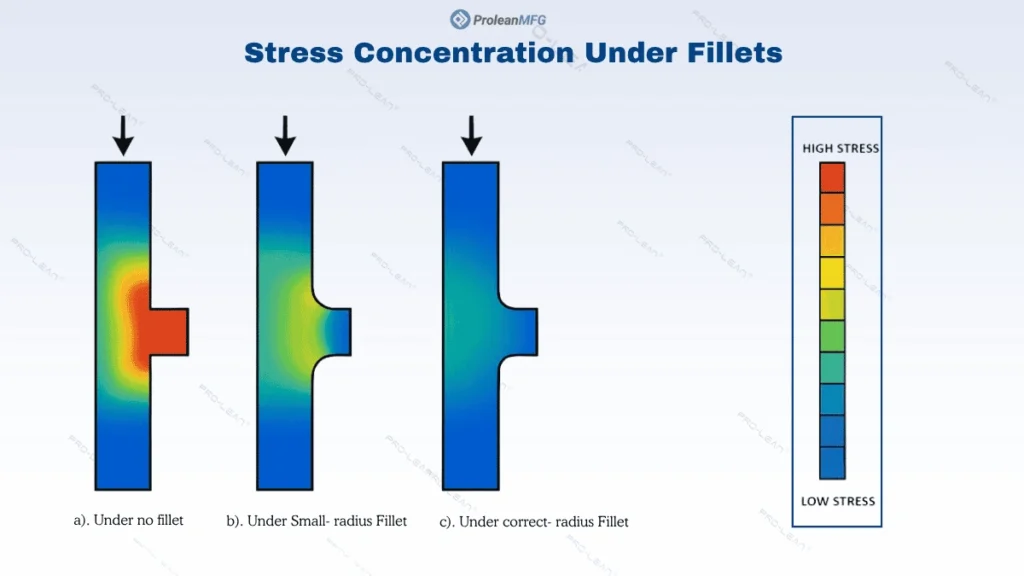
fillet stress concentration
Is a chamfer or fillet stronger? A fillet is stronger than a chamfer because it provides better stress distribution, reduces peak stress, and supports higher loads. Filleting is a superior choice where the structural integrity of parts affects functionality & performance.
The curved radius in a fillet facilitates the smooth distribution of concentrated stress, helping to avoid deformation and support the load-bearing section. On the other hand, stress is concentrated along a line in chamfered edges due to an abrupt change in distribution. Comparing fillet stress concentration factor vs chamfer, it is ~2.96 for chamfer and ~1.65 for fillet (shafts under tension) [1].
Fillets provide higher structural performance and are suitable for load-bearing sections. When the part is subjected to stress, the fillet resists deformation. Meanwhile, chamfered edges can deform easily under loads, so use them for non-critical areas. The size of fillet radius also impacts the stress-distribution capability; less rounded edges result in poor distribution.
Fillet vs. Chamfer Machining: Tools, Machining Process, and Cycle Time
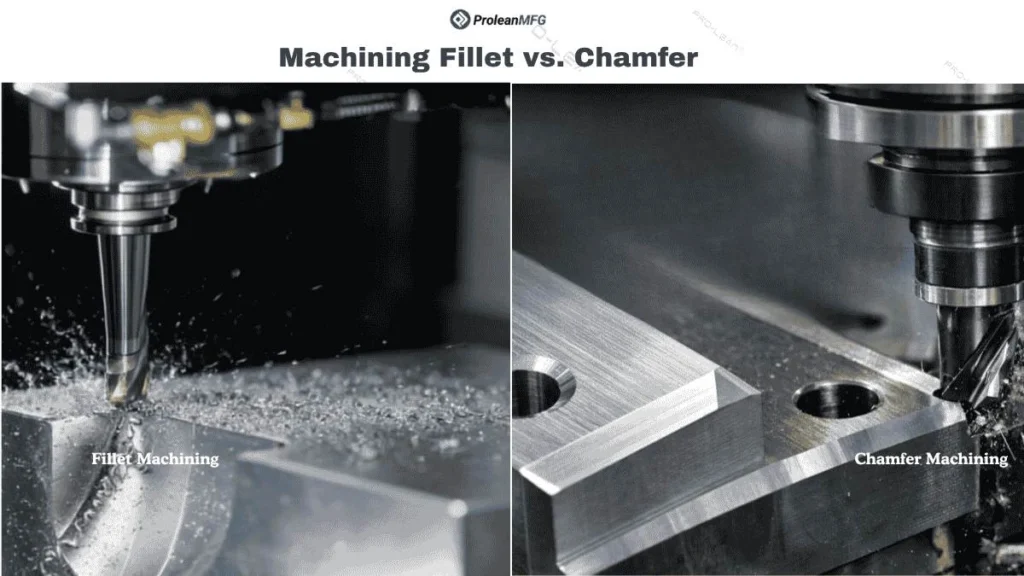
Fillet vs chamfer machining
Fillet machining is more complex than chamfering as it involves curved geometry. Milling & turning are two major machining processes for these features. Subsequently, a chamfer can also be made with a drilling operation, and fillets can be made with grinding machining as well. You need to choose the right type of tool, tool path, and feed & speed, based on desired specifications.
The table below compares tools, machining processes, feed & speeds, and cycle time of chamfer vs fillet machining.
| Parameter | Chamfer Machining | Fillet Machining |
| Machining Processes | Milling, turning, and drilling(deburring) | milling, turning with form tools, and grinding machining |
| Tools | Chamfer mills, countersinks, and lathe tools | Ball nose end mills and form tools |
| Toolpath Complexity | Simple and linear toolpath | Complex toolpath, including curved 3D contour |
| Speed | High machining speeds | Moderate to low |
| Feed Rate | High feed rates | Lower feeds |
| Cycle Time | Shorter | Longer, depending on precision |
Fillet Vs. Chamfer: Industry Standards
ISO 13715:2017, ISO 2768-1:1989, and ISO 582:1995 are some industry standards that can be applied to chamfers & fillets in engineering. These standards define manufacturability, precision, safety, and interchangeability. You can refer them for the design & machining and quality control stages.
ISO 13715:2017 governs the indications & dimensioning of edges with undefined shapes. ISO 2768-1:1989 specifies linear and angular tolerances for chamfers and fillets when they are left undefined on engineering drawings. ISO 582:1995 is an application-specific standard that defines the maximum chamfer dimensions of a rolling bearing for proper fit.
Fillet Vs. Chamfer: Handling Safety
Although both fillets and chamfers improve the safety of manufactured parts, the rounded edges of fillets make them safer to handle than chamfers. According to BLS injury data (2020), sharp-edge-related injuries averaged $45,931 in medical costs in the U.S.[2].
Chamfers reduce the sharpness of edges that workers come into contact with during assembly. Although chamfering can still leave defined edges difficult to deburr. Fillets provide the smooth, injury-free profile, offering a higher level of protection.
Fillet Vs. Chamfer: Overall Cost
Chamfers are more cost-effective than fillets because they are simpler to add and can be machined with a standard tool in a single pass. On the other hand, fillets are more complex and slower to machine. The overall cost of adding a single chamfer ranges from $0.25–$0.50, whereas adding a single edge costs $1–$3.
Typically, manufacturers add these costs to the quote for any CNC part-machining project.
Is Adding a Chamfer Cheaper than Fillet?
Yes, adding a chamfer is cheaper than a fillet because of its design simplicity, linear tool path, and faster cycle times. On the other hand, fillet requires a complex tool path, specialized radius tools, and longer machining times. Consequently, the equipment and labor costs associated with filleting are also higher.
If your parts or sections are not subjected to load-bearing functions and not-everyday use items, chamfer the edges for economic benefit.
What is the Difference between a bevel and Chamfer?
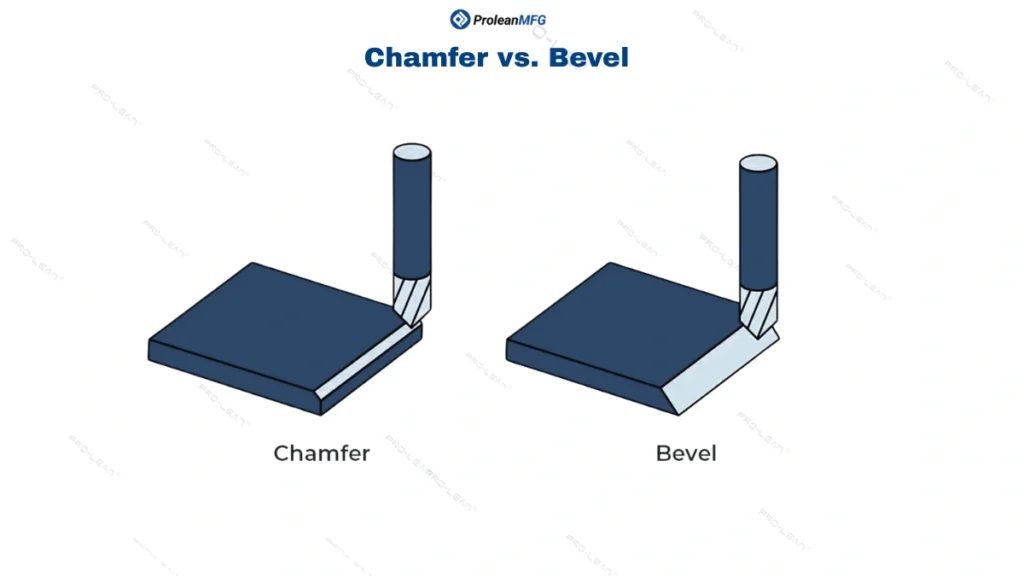
Chamfer vs bevel
What makes a bevel different from a chamfer is the angle at which the plate is cut, whereas a chamfer is typically cut at 45°. Beveling gives flexibility in designing gradual transitions between adjoining surfaces. Choose a bevel for structural purposes, but it costs more & takes more time. Choose chamfer for assembly & mating alignments, and fast edge breakings.
Next, the table below compares differences between bevel and chamfer, including geometry, purpose, machining process, cost-effectiveness, and application examples.
| Aspect | Chamfer | Bevel |
| Geometry | Typically, a 45° angled cut at a corner of two right-angled surfaces. | A 30°–60° bevel edge between parallel or non-perpendicular surfaces |
| Purpose | Low-cost edge finishing, or edge breaking for safe handling, mating/assembly leads | Functional and structural edge finishing |
| Machining process | CNC milling with a chamfer end mill, turning | Grinding, milling, specialized plate or pipe bevelling |
| Cost | Lower cost | Higher cost |
| Application examples | Fasteners, shaft–hub assemblies, auto engine parts, etc. | Bevel gears, EV powertrain joints, and weld preparation |
When to Use Fillet and When to Use Chamfer?
Use fillets for parts under load, for parts that require mechanical performance, and for edges or corners that are frequently interacted with. On the other hand, choose chamfering as a Low-cost option for mating sections of parts that are not subject to high-stress applications.
Using incorrect edge/corner features not only affects aesthetics but also impacts performance and safety. The choice depends on the desired purpose and the intended applications of the components to be filleted or chamfered.
Next, let’s break down the conditions: when to use a fillet vs. a chamfer.
When to Use Fillet?
Load Bearing Parts
Use fillets for high-stress and load-bearing parts. Fillet distributes surface loads through its curvature, thereby preventing crack initiation—for instance, automotive connecting rods.
Parts for Cyclic Loading Conditions
Choose fillets for the sharp corners and edges of parts that undergo cyclic loads and are sensitive to fatigue life—for instance, structural brackets for aircraft.
Ergonomic Consumer Components/Products
Exterior fillets on consumer products’ edges provide a smooth, comfortable grip and an aesthetically pleasing appearance. For instance, the handles of medical instruments.
When to Use Chamfer?
Edges of Mating/Assembly Parts
Use a chamfer on the edges of a part that needs to be moved or connected with other parts. This angled feature guides the part without misalignment and reduces friction during insertion. For instance, countersunk screw seats and bolt head recesses.
Cost-sensitive Machining Projects
Chamfer machining is cheaper than filleting, so choose chamfers if you want cost-effective edge finishing in large volumes and if the parts will not be used under heavy load conditions.
Safety Edge Deburring
The edges of freshly machined metal parts can have extremely sharp burrs. A .010″ x 45° chamfer helps to avoid hazardous edges on parts that are frequently handled, either during packaging or at the time of installation.
Fillet vs. Chamfer: Which One to Apply on Part Edge, Exterior Edges, and Holes
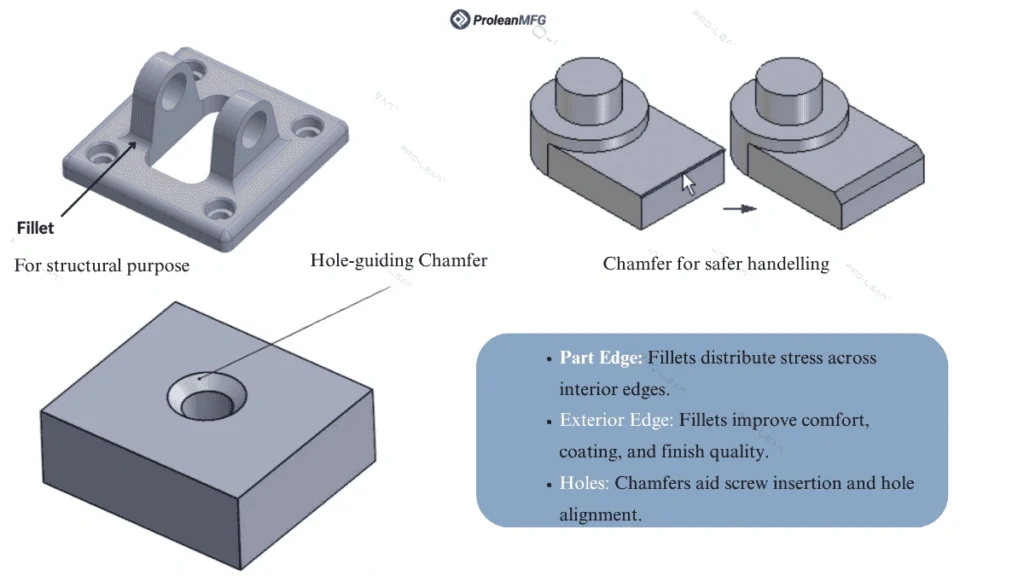
Chamfer and fillet selection
Use fillets on parts’ edges if they need to be interacted with on a frequent basis. Fillets offer a smooth touch and safer handling. Only opt. Chamfer if you are only looking for simple edge breaking. For exterior edges, use fillets for ergonomics; chamfering is sufficient if aesthetics is not a priority. Furthermore, chamfering is best on screws, bolts, and pin insertion holes.
- Part Edge: On interior transition walls, junctions, and similar edges, fillets are recommended. This is because fillets provide a large surface area to distribute the stress.
- Exterior Edge: Choose fillets for ergonomic comfort, uniform coating adhesion, and a polished finish. You can still go with chamfer, if visual appearance is not important.
- Holes: Chamfers are recommended for drilled, tapped, and countersunk holes. They offer angled lead insertions for screws, bolts, pins, etc. Still, fillets are suitable for applying to the base of a blind bore.
Industry-Specific Preferences of Fillet and Chamfer
Fillet is favoured in the industries requiring parts with high structural integrity and aesthetic, such as automotive, aerospace, medical, fluid system, and consumer products. On the other hand, chamfer is preferred in industries requiring assembly, speed, and cost-effectiveness.
Based on the industry for which you are producing the parts, the choice of fillet and chamfer can be made. Let’s look at the table outlining preferred options between fillet & chamfer for various application sectors,
| Industry | FIllet vs. Chamfer | Why? |
| Aerospace | Fillet | Stress distributuon in wing, structual performance of engine pats and frame components |
| Automotive | Fillet/Chamfer | Fillets for fatigue strenght & chamfers for ease of assembly |
| Electronics | Chamfer | Connector insertion, fast edge finishing, and compact assembly |
| Fluid Systems | Fillet | Laminr fluid flow and lower turbulance |
| Medical | Fillet | Wear resistance and longer lifespan |
| Industrial Fabrication | Chamfer | Production speed and cost efficiency over aesthetic |
| Injection Molding & Casting | Fillet/Chamfer | Smooth cornerts (fillet) & clean external edges (chamfers) |
| Structural performance | Fillet | Load-bearing capacity and fatigue resistance |
| Corrosion-prone Applications | Fillet | Provides surface for uniform coating/paint |
Summing Up
Choosing between a fillet and a chamfer in your product design is vital for aesthetics, performance, and durability. It depends on the purpose of finishing the edges and corners, load-bearing requirements, application conditions, and desired aesthetic.
You can apply chamfers on mating parts and parts requiring a low-cost edge finish & handling safety. Meanwhile, Fillets are preferred for load-bearing sections because they reduce stress concentration, for sections that are easily visible & aesthetic appeal matters.
If you have your design ready and need professional assistance? ProleanMFG can help you choose between fillet & chamfer, and machine them exactly to your desired specifications. We have 10+ years of experience in design optimization and CNC manufacturing, providing ISO 9001:2015-certified CNC machining services at competitive prices.
At our machine shop, metals, plastics, and composites can be machined into custom components, regardless of the type of corner/edge finishing required. Our 5-axis CNC machines can produce complex parts with features such as slots, channels, contours, and irregular profiles. Additionally, a precision of ± 0.0254 mm (±0.001″) is achievable with them.
FAQs
Is a chamfer or fillet stronger?
A fillet is stronger than a chamfer because it involves a round curvature that provides a smooth stress flow and significantly reduces the concentration at one point. Parts with filleted edges support heavy loads and cyclic motions. Therefore, apply them to shafts, structural joints, auto engine components, and other load-bearing applications.
Is chamfer cheaper than fillet?
Yes, a chamfer is cheaper to machine than a fillet. It costs ~$0.25 to $0.50/chamfer and ~$1.00 to $3.00/fillet. This is because a chamfer can be machined in a single pass, taking only about 5 to 15 seconds. However, the exact cost varies depending on feature size, geometry, production volume, workpiece material, and precision.
When to use fillet and when to use chamfer?
Use fillets when load-bearing is the primary application of the machined part, and use chamfers where assembly and cost efficiency matter. If a part needs both features, apply fillet at stress-critical transitions and chamfering at entry points to the hole, or exterior edges.
Does a chamfer prevent chipping?
A chamfer reduces chipping risk by distributing cutting forces along an angled surface and reducing localized stress at the edge. Therefore, chamfer the ends of holes before threading or inserting a fastener.