
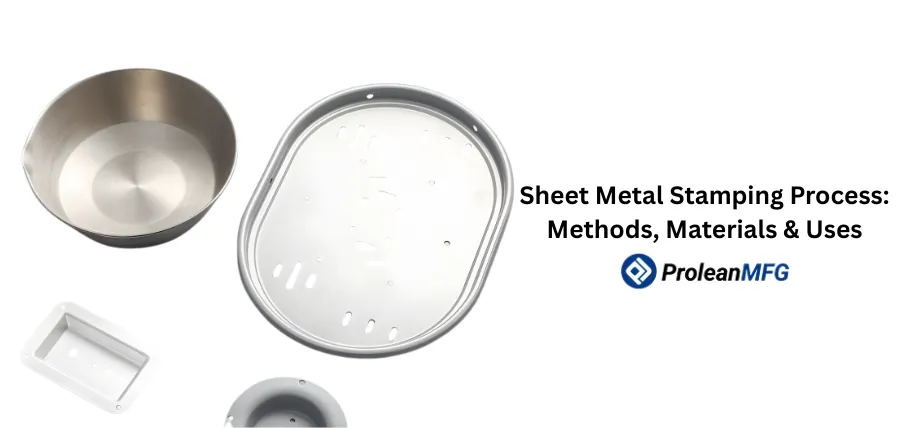

Sheet metal stamping is a popular and efficient method of sheet metal fabrication that produces metal enclosures. Electromagnetic protection housings and many identical small parts like base plates. With this process, you can produce functional components using flat metal sheets, with the use of pressure and specific tooling. You specially choose the sheet metal stamping manufacturing process when you need a fast, consistent, and cost-effective method to produce precise metal parts in large volumes.
What Is Sheet Metal Stamping?
Sheet metal stamping is a manufacturing process where you can create desired shapes using flat metal sheets (or sometimes coil stock). The process uses a combination of pressure and tools to create precise shapes and contour cutouts on a metal sheet. This is usually carried out as a cold-working process.
You can use sheet metal stamping when you need to:
- Cut parts out of sheet metal
- Create holes or cut-outs in metal parts
- Bend or form sheet metal into simple shapes
- Add marks, texts, logos, or textures on the metal surface
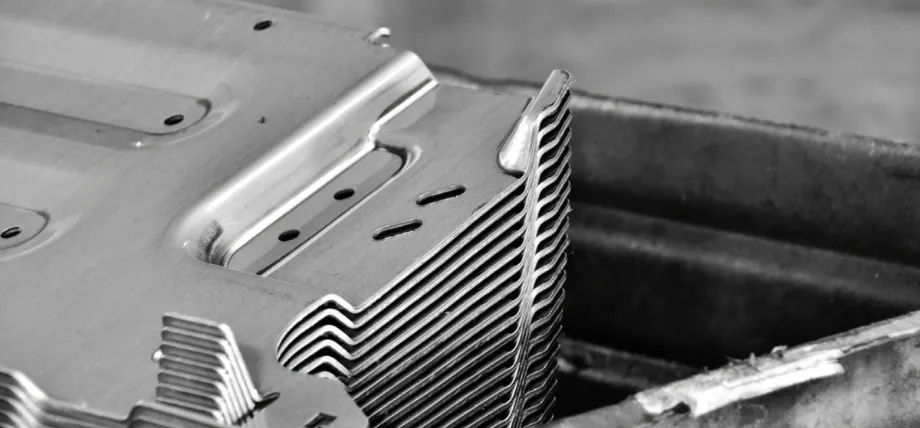
Sheet Metal Stamped Parts
This is a practical and scalable solution when it comes to producing repeatable sheet metal stamped parts with smooth surface finishes and tight tolerances. And, it is widely used for mass production since it is highly cost-efficient.
The Sheet Metal Stamping Process
The sheet metal stamping process has three main parts:
- Sheet Metal: Base material for the process.
- Metal Stamping Die: Decides the final shape of the product
- Press Machine: Provides the force needed for cutting or shaping the metal

Stamping Process Flowchart
Step 1: Material Preparation and Feeding
You should first choose the right material according to your needs. Metal is usually fed as flat sheets or coils. Before feeding into tools, you must clean the metals to remove any oils or contaminants since they could either damage tools or come out with poor surface quality.
Lubricants should be applied to reduce friction and facilitate smooth release. When feeding, you must position the metal precisely into the die area with proper alignment.
Step 2: Die and Tool Setup
Next, you have to install the metal stamping dies into the press. The die has two parts.
- Punch: This is also called the upper die and is attached to the moving press slide
- Cavity: This is the lower die, and it is fixed to the press bed
In addition, there are guides and strippers to support the control sheet movement during operation. You must properly align the tools since even a minor misalignment can cause defects and tool wear.
Step 3: Pressing and Forming
This is the step where flat metal sheets become functional metal stamping components. Force is applied to the sheet metal by the press. Depending on the design, the press stroke will perform one or more of the following actions.
- Blanking – cutting and removing the outer part of the metal
- Punching – creating holes or cut-outs in the metal
- Forming – bending or contouring the metal to form 3D geometries
- Flanging – bending edges to create rims or flanges for joining or improving strength
- Coining – pressing sharp and detailed features into the surface or thickness control
- Embossing – Creating raised or sunken features like logos, patterns, or textures
Sometimes, there are operations done across multiple stages using progressive dies.
Step 4: Ejection and Part Removal
After forming, you remove the completed parts carefully from the die. Then, the scrap metal should be separated, and the sheet should be advanced to the next cycle. Scrap is either disposed of or sometimes recycled.
Step 5: Finishing and Inspection
After carefully removing the part, you usually go to the surface finishing and inspection stage to improve product quality. During this stage,
- Sharp edges are smoothed
- Parts are cleaned to remove residues
- Shape, size, and surface quality are confirmed by inspection
In some cases, additional operations like deburring, plating, or heat treatments are carried out beforehand to improve performance.
Types of Stamping Techniques
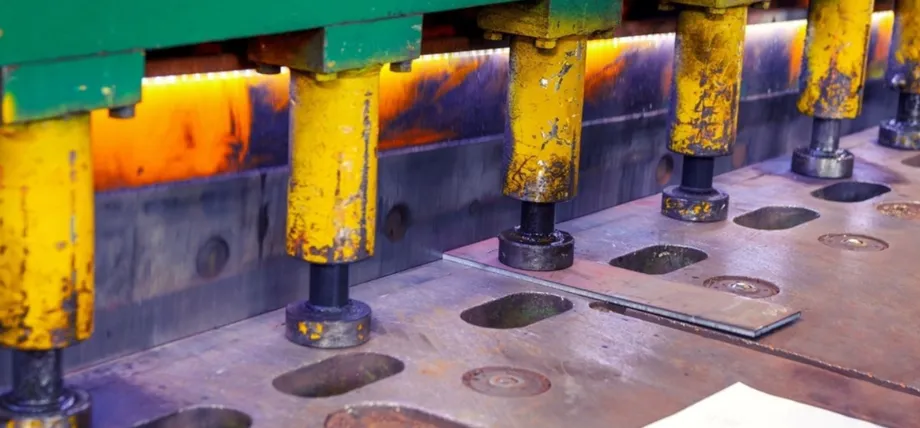
Hydraulic Stamping Press
Depending on the application, there are different stamping techniques designed to ease the production, improve accuracy, and reduce the cost.
Progressive Die Stamping
In progressive die stamping, you’ll find a single set of dies that can perform multiple operations when the metal moves through the press. That means there are multiple strokes that each complete a different stage.
Progressive die stamping is used when you need to improve the efficiency of high-volume production or ease the process of making complex shapes.
Deep Drawing
In deep drawing, the metal is pulled into a die cavity (which usually has a simple and uniform cross section). The parts formed have a significant depth compared to their diameter.
Deep drawing is an ideal choice if you need to produce cups, cylindrical and box-shaped parts, and seamless metal stamping components. This is a highly material-efficient process since it doesn’t involve cutting or any material removal within the part. However, there can be secondary trimming or deburring procedures when the design is too complicated.
Multi-Slide Stamping
In multi-slide stamping, you use multiple forming tools that operate simultaneously in different directions. If your parts have complex bends, need to be highly precise, or are very small in size, this method is highly useful.
Multi-slide systems highly reduce the need for secondary operations. Therefore, manufacturers highly use this method to save time, cost, and improve efficiency.
Materials Used in Sheet Metal Stamping
Not all the materials perform well during sheet metal stamping. The materials you are using for sheet metal stamping should meet specific property requirements. They must have good ductility to form without cracking, enough strength to hold shape, and clean shearability (for punching/blanking). They also have excellent surface properties to facilitate easy removal from the die and maintain the final quality.
Some of the most popular metals used for sheet metal stamping in the industry are given below.
- Carbon Steel – Has good strength, is economical, and handles blanking and forming well.
- Stainless Steel – Durable and ideal for corrosion-resistant custom metal stamping
- Aluminum – Lightweight, strong, and can be easily stamped into panels and covers.
- Copper – Highly conductive, and ideal for low-resistance electrical stamped parts
- Brass – Highly formable, corrosion-resistant, and stamps cleanly with a good finish
- Nickel Alloys – Highly heat and corrosion-resistant, good for high-performance parts
What Is a Stamping Die and Tool?
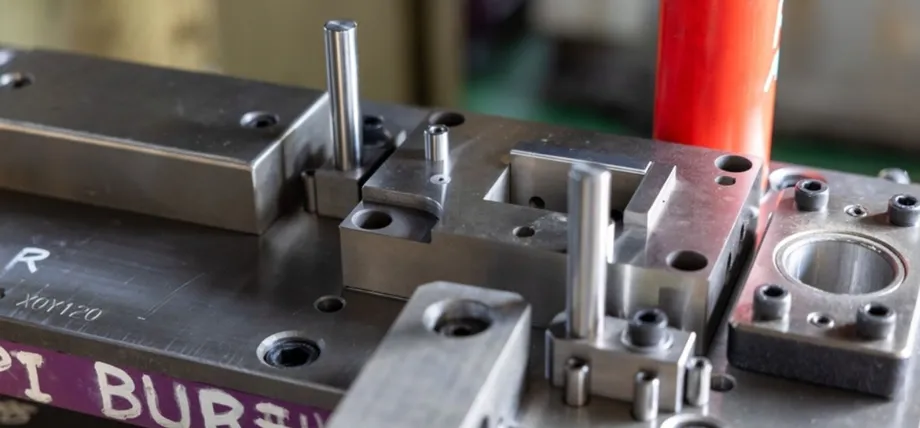
Precision Stamping Die
The stamping die is a hard metal mold used in the stamping manufacturing process. It is designed with the required final shape of the product. When the force is applied through the press, the metal stamping dies decide the final shape that the sheet metal is pushed into.
A stamping tool is the complete system needed for the stamping operation. It mainly includes the die (consisting of the punch and the cavity), guides, and supporting parts. The final product comes out as a result of the combined operation of all these components.
Applications of Sheet Metal Stamping
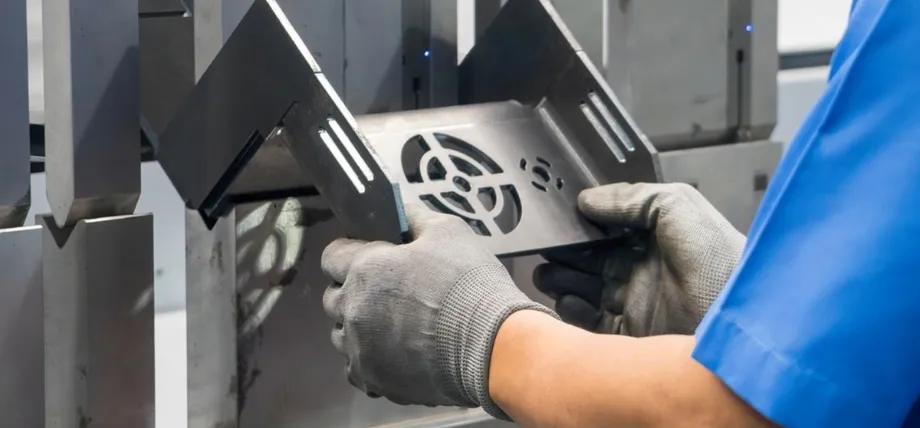
Finished Stamped Part Inspection
Electrical and Electronics Components
Electrical parts that need high precision, such as connectors, terminals, heat-dissipating parts, and shields, are mainly produced using sheet metal stamping.
Automotive Parts
Components like brackets, panels, terminals, and reinforcement parts that need high dimensional stability are formed using sheet metal stamping.
Consumer Products
Due to the high cost-efficiency, many housings, frames, and household appliances are made using sheet metal stamping.
Medical Devices
Sheet metal stamping is highly preferred for making non-critical components like shells and clips because of its high accuracy and repeatability.
Industrial Machinery
Many mechanical parts, like mounts, clips, covers, and enclosures, are made using sheet metal stamping due to its precision and consistency.
Benefits of Sheet Metal Stamping
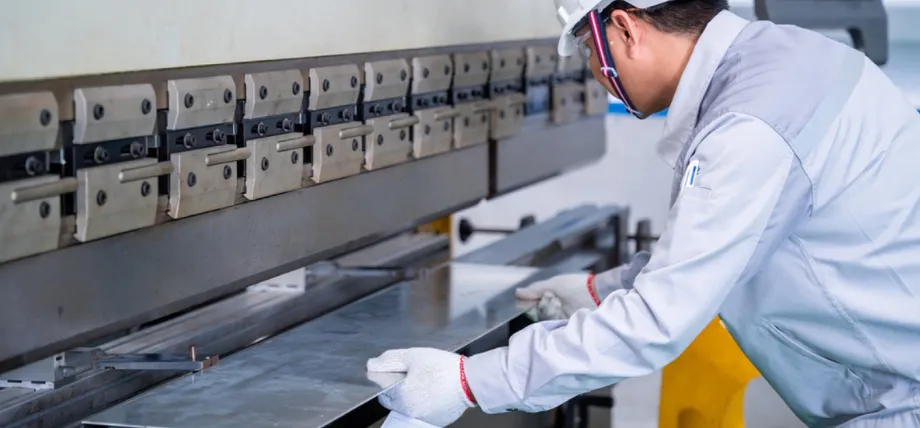
Sheet Metal Bending
- Production speed of sheet metal stamping is very high compared to most other manufacturing methods. Therefore, this method is ideal for large-scale production that includes multiple stages.
- Components produced are highly precise and repeatable since they are formed using a specially customized die.
- This is a highly cost-effective method for large-scale production. Although the initial tooling cost is somewhat high, the per-unit cost reduces when it comes to mass production.
- When the die is designed properly, material waste is very low compared to other manufacturing techniques.
- The process can be integrated easily into automated systems.
Sheet metal stamping vs Other Forming Methods
Sheet metal stamping mainly uses a die and a press to perform cutting or bending operations to form shapes or 3D geometries. Forming usually bends or reshapes material with minimal material removal. The main differences between these two processes are:
Key Differences Between Sheet Metal Stamping vs Forming
| Sheet Metal Stamping | Metal Forming |
| Mainly uses cutting and shaping using a press to create shapes or 3D parts | Mainly uses bending and reshaping to form new geometries |
| A die is required | A die is optional |
| Good for high-volume production | Good for low to medium production |
| Precision is extremely high | Precision is moderate to high |
| The final product is finished with metal-stamped parts | Mostly semi-formed components are obtained |
In many cases, sheet metal stamping is just one step in a complex sheet metal fabrication process. (e.g, logo embedding to a part, initial material removal, making patterns, etc.)
Custom Metal Stamping
Proleanmfg provides high-quality sheet metal stamping services for low-volume to high-volume production across electronics and automotive applications. Proleanmfg capabilities include progressive, deep draw, and precision stamping. We also offer secondary operations, including deburring, forming, and surface finishing, for all sheet metal parts.
Available material options include steel, stainless steel, aluminum, brass, and copper alloys. Stamping tolerances range from ±0.05 mm to ±0.10 mm, depending on material thickness and tool design.
Request a free quote today for your metal stamping project.
Conclusion
Sheet metal stamping is a reliable, scalable method to produce precise industrial and consumer parts with consistent quality. It always comes as a main solution for many industries when they need a fast, cost-efficient, and repeatable manufacturing process.