


Which type of milling machine, horizontal or vertical, is preferable for your company? When preparing for custom milling, this is a question that many manufacturers encounter.
Despite having different setups and capacities, both machines are made for precise tasks. The response is contingent upon the components you must manufacture, the intricacy of the designs, and the scope of your projects.
Horizontal machines efficiently cut deeper and can handle larger materials. For smaller runs, vertical machines benefit from versatility and setup simplicity. Cost, speed, and output are all impacted by the benefits and trade-offs of each option.
We will contrast the two machine types in this article to assist you in selecting the best one for your unique milling needs.
What is a Horizontal Milling Machine?
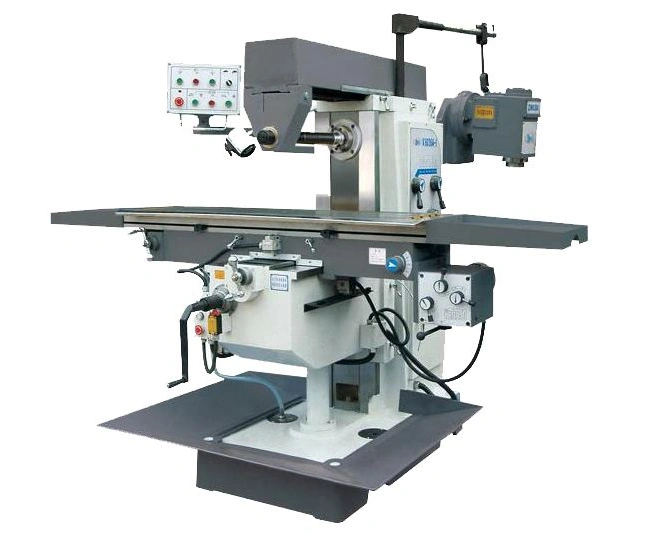
Horizontal Milling Machine
A horizontal milling machine is one where the spindle of the machine is horizontal. It is parallel to the worktable. This is as opposed to a vertical machine, where the spindles are erect. In a horizontal mill, the cutting tools are fixed in an arbor. This enables the cutting to be done at the side rather than the top.
These machines are constructed to do heavy work. They can cut a lot of material fast. Hence, they can be used in deep cuts as well as in shaping hard metals. The design of the tool also enables one machine to work on many surfaces simultaneously. This enhances productivity in mass production.
Previously, it was considered that horizontal mills were less accurate than vertical ones due to the high cutting forces. They are now powerful and accurate with modern CNC control and better tooling.
Applications of Horizontal Milling Machines
Since they provide the fastest milling process, horizontal milling machines are ideal for roughing tasks and shaping across multiple surfaces. The tolerance value of 3-axis milling, for example, is ± 0.005 inches (0.13 mm).
Tolerances for 5-axis milling and engraving of workpieces can differ, but the overall value stays the same. The tolerance of routers (cutting gaskets) and other milling operations is ±0.030 inches (0.762mm). Horizontal machines mandate several essential components for the aerospace sector in addition to their uses; some examples are shown below.
1. Avionics systems
2. Complex engine parts
3. Structures for performance aircraft
4. Intricate form, Internal metal components
5. Aerodynamic elements
Axels, electric motor stator housing, engine blocks, gearboxes, and other components are also used in the car industry.
What is a Vertical Milling Machine?
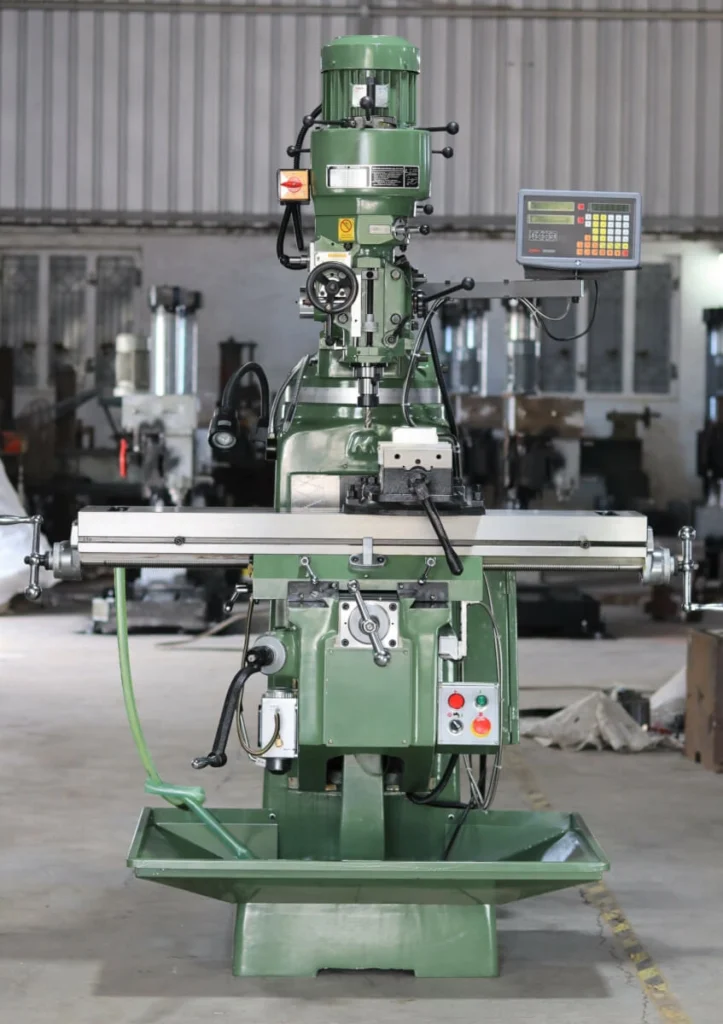
Vertical Milling Machine
The cutting spindle is oriented vertically in a vertical milling machine. The spindle rotates and contains multiple cutting tools while the workpiece stays still. As it rotates, the tool removes layers of material to shape or smooth the part’s surface.
Facing is a typical vertical milling operation where the tool moves across the top of the workpiece to produce a flat, even surface. This is quite useful when working with parts that don’t have a regular shape previously.
Vertical milling machines generally come in two main types:
- Turret Milling Machine: For the refinement of tiny geometries, a turret is advised. While the turret, a movable component, mills job material in both vertical and horizontal orientations, the spindle, a revolving tool, stays stationary in the setup.
- Bed Milling Machine: The spindle of bed milling machines, particularly the conventional ones, moves vertically while the bed aligns horizontally. This set of motions aids in cutting the workpiece, producing grooves and bores.
Many workshops also rely on a vertical milling center, which combines advanced CNC control with flexibility for both small and medium-sized projects.
Applications of Vertical Milling Machines
Workhorses are vertical milling machines that provide high torque and rapid machining. The vertical milling machines have mixed controls. Both manual and automatic CNC (Computer Numerical Controlled) systems are available for calibration.
In shorter lead periods, the stock material is usually removed from the workpiece using the spindle’s rotary cutter. In turret milling, a drill press offers even more machining control since it is a movable table that the vertical spindle rotates across. Here is a brief summary of its advantages:
1. Tools on vertical machines are thin and long.
2. It is simpler to accomplish slotting and groove operations using vertical mills.
Since vertical mills can be manual or CNC-operated, they fall under some of the most common types of CNC machines used across industries.
The Evolution of Milling: Why Horizontal Machines You should still Care about
Milling has developed to be not only manual but also completely automated CNC. Horizontal mills have never lost their significance, though the vertical machines gained popularity due to their ease of use and cost efficiency. They can cut material fast, handle heavy-duty tasks, and cut through more than one plane, which means they are applicable nowadays.
Industries in the modern world are a combination of tradition and technology. Most of the modern CNC horizontal mills integrate raw power and digital precision. This development continues to make horizontal machines in the industries where efficiency, longevity, and precision are the key to success.
Comparing Horizontal and Vertical Milling Machines
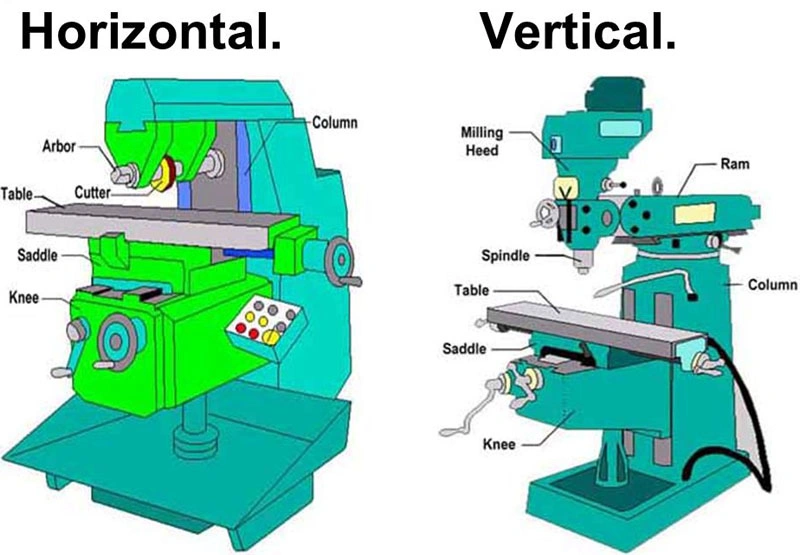
Horizontal vs. Vertical Milling Machine Parts
Cutting and shaping materials into the appropriate shape is the main purpose of both mills. They differ in how they are put together and how they are chopped or sheared. Let’s examine some of the primary distinctions between horizontal and vertical milling machines.
1. Orientation of the Spindle
The spindle’s orientation is the primary distinction. It is the machine’s main tool that controls how the cutter moves across the workpiece. In milling machines that are horizontal or vertical, the spindle is oriented differently. While the horizontal spindle orientation is employed for depth cutting over large workpieces. The vertical spindle orientation aids in precision cutting.
2. Geometry of the Tool
Both horizontal and vertical milling machines differ mainly in spindle orientation. The same cutting tools, such as spindle heads, collet chucks, slot drills, and end mills, are used, but they engage with the material differently. The cylindrical system of vertical milling machines is long and thin. Horizontal ones, on the other hand, feature tools with more complex design geometry. The accuracy of every machine is affected by these specifications.
3. Precision
The vertical tools provide more accuracy. These machines are constructed with various geometries. For example, vertical machines are ideal for carving out features in the workpiece. This is because the cutter and spindle are lightweight. This results in a more precise impact.
4. Cost of the Machine
The cost of horizontal versus vertical milling machines varies. Compared to vertical milling machines, horizontal milling machines are more costly. They are utilized for heavier cuts like chamfering, facing, etc. On the other hand, vertical milling machines are simpler to use and require less maintenance.
For this reason, vertical mills can be used in the operations of small firms. Furthermore, skilled operators are needed to ensure that the cutting processes are handled smoothly by horizontal milling machines. Both devices are equally significant. How they are used depends on the demands of the sector and the kind of product.
5. Working Rate
Another crucial element to take into account is the time restriction. In this sense, horizontal milling machines are superior because they provide excellent stability and generate deeper cuts quickly. Vertical milling machines have a restricted cutting capacity and are utilized for precision. As a result, the removal rate of vertical milling methods is somewhat lower than that of horizontal ones.
Key Differences Between CNC Milling and CNC Turning
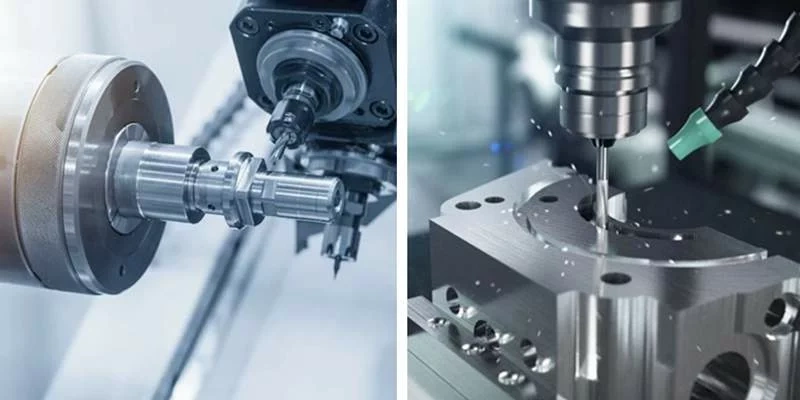
CNC Milling vs. CNC Turning
Although the terms “CNC milling” and “CNC turning” are frequently used interchangeably, they function very differently.
What is CNC Milling?
It cuts and shapes the target object (workpiece) by rotating the cutting tool while the workpiece stays motionless. The 3-axis (X, Y, Z) rotation of CNC milling makes it helpful for creating non-symmetrical components, functional prototypes, auxiliaries, and detailed feature pieces.
Different types of milling are used by machinists to produce exact shapes and functioning pieces, depending on the material and geometry. The exteriors and interiors of automobile and airplane parts, as well as jewelry, are common examples.
Among the most widely used milling machines are
1. The usual ranges of angles are 45°, 50°, 55°, and 60°.
2. Face
3. Plain
What is CNC Turning?
The process of CNC turning, on the other hand, involves the task material rotating along the machine’s axis as the tools cut. CNC turning is the best option for conical, cylindrical, and axially symmetrical objects. CNC turning, in contrast to traditional turning machines, uses computerized numerical control to shape material into the required shape. CNC turning makes possible choices such as:
1. Turning of the Taper
2. Turning Straight
3. Outside Grooving
4. Knurling
5. Using threading
6. Drilling and Boring
Now, here’s the side-by-side comparison of CNC milling and CNC turning:
| Factors | CNC Milling | CNC Turning |
| Part complexity | Intricate feature geometries | Rotational symmetric geometries |
| Tolerance range | ±0.005mm to ±0.02mm | ±0.01mm to ±0.05mm |
| Surface finish range | Ra 0.8 to Ra 3.2 µm | Ra 0.4 to Ra 1.6 µm |
| Material compatibility | Metals, plastics, composites | Metals, plastics |
| Lead time | Longer lead times for complex parts | Simple setups, shorter lead time |
Horizontal and Vertical Milling Machines: Which One You Should Choose?
It is up to the project needs and industry specifications to select the best milling machine. Another crucial factor in this choice is the budget. To make choosing for your next project easier, let’s dissect the factors for both systems.
Vertical Milling Machines:
1. Best for Small Workpieces: It is ideal for smaller workpieces. You can choose this option if the object needs fine detailing and lighter cuts. It works best when a cut is required on a single plane.
2. Precision and Surface Finish: It is great for surface polishing and precision cutting. The process removes thin layers of material with every pass, giving high accuracy. This makes it suitable for molds, dies, and projects where appearance matters.
3. Cost-Effective Choice: A sensible option for less money. Vertical milling systems are ideal for small workshops and businesses with limited space since they are simpler to install and maintain.
4. Easier to Learn and Operate: Additionally, they make operator training simpler. Because of its ease of setup, vertical milling can be swiftly adopted by novices and smaller businesses.
5. Versatile but Limited in Heavy Tasks: They might not be as effective at heavy-duty jobs as horizontal machines, though. Nevertheless, they are among the most prevalent kinds of CNC machines in workshops nowadays due to their adaptability.
Horizontal Milling Machines:
1. High-Volume Production: Horizontal machines are the go-to choice for large-volume production runs. They are built to handle heavier workloads and remove more material in less time.
2. Deep Cuts and Hard Metals: These machines are employed for carving one or more grooves in workpieces at multiple angles. The cutting tool design makes them efficient for shaping hard metals and deep cuts.
3. Multi-Surface Slotting: They are also useful for creating slots across multiple sides and several planes of the object. This multi-surface capability saves time in industries where precision and speed are equally important.
4. Higher Cost, Greater Output: Horizontal milling machines are often chosen when the budget allows more flexibility. Usually, maintenance, tooling, and operation costs are higher than those of vertical machines. But the payoff comes in faster production and greater durability of parts.
5. Power with Precision: Horizontal mills now deliver high accuracy along with power, with the help of advanced CNC Technology. They are commonly found in automotive, aerospace, and construction industries where complex, heavy-duty components are needed.
Conclusion
Both Horizontal and vertical milling machines serve different purposes. Horizontal mills are stronger, faster, and suited for heavy-duty tasks. They cut deeper and handle larger parts with ease. Vertical mills are more versatile, affordable, and accurate for smaller jobs. They are easier to learn and often preferred by small businesses.
Your decision should rest on the kind of materials you cut, the precision required, and your production volume. Both machines now offer reliable performance with CNC technology. The right choice comes from knowing your project size, detail needs, and budget. Matching these factors ensures the best return for your milling operation and long-term production goals.
From straightforward prototypes to intricate production runs, Prolean provides the appropriate service for any application, whether it’s vertical or horizontal milling services. Our experts are available to guide you through the procedure.
Get a quick quote by contacting us with your questions right now.