
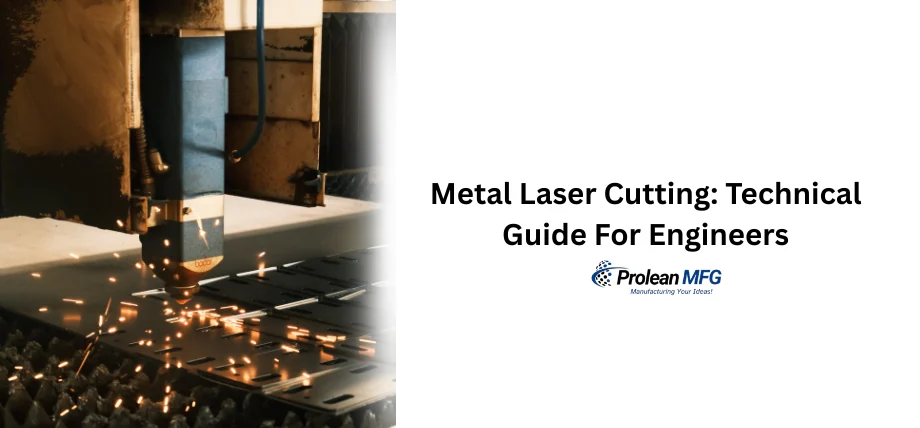

Metal laser cutting is a type of manufacturing process that uses high-energy laser beams to precisely cut metal materials.
This technology is called laser cutting. It uses the principles of light amplification. Basically, a stimulated emission of radiation is used to produce a highly concentrated beam. It is skilled in melting or vaporizing materials like metal at a focal point.
In this article, you will learn all about the technical aspects of laser cutting metal, suitable materials, advantages, industrial applications, design considerations, and types of lasers used for laser cutting.
What Kind of Sheet Metal Is Suitable For Laser Cutting?
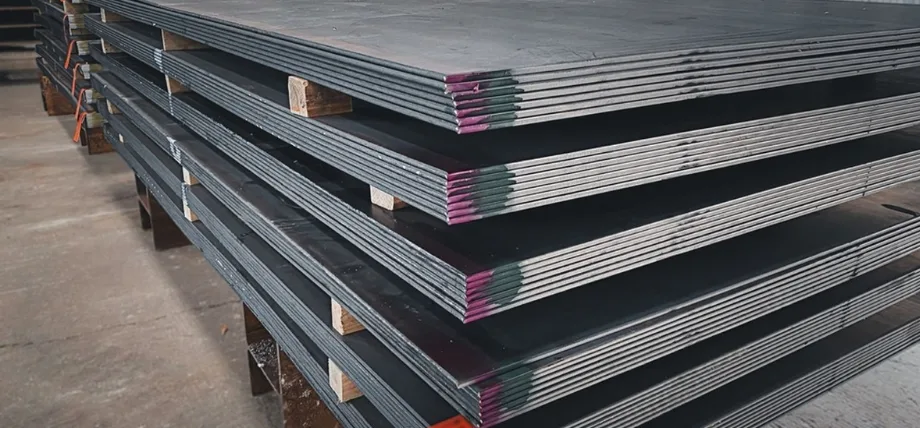
Steel sheets
Laser cutting works by utilizing a high-intensity laser beam to cut sheet metal with the most accurate precision available.
Whether a sheet of metal is fit for laser cutting depends on several considerations, including the material type, thickness, electrical conductivity, and reactivity, among others. The common materials for laser cutting are:
- Carbon Steel: This is most commonly used because of a balance of strength and price consideration. Carbon steel can be laser-cut with thicknesses ranging between 0.5 mm and 25 mm, depending on the power of the laser cutter (watts or kilowatts).
- Stainless Steel: Since it does not oxidize, it is used wherever durability is a priority, such as in aerospace and medical applications.
- Aluminum: Aluminum is light and corrosion resistant; however, it requires a laser working at a very high power to cut it because of its reflectivity properties.
- Brass: Brass is highly reflective and thermally conductive, making it challenging to cut with traditional CO₂ lasers. Fiber lasers, particularly those using shorter wavelengths (around 1 µm), are more suitable, though precautions like anti-reflective optics are often necessary.
- Titanium: Since it is highly valued in aerospace for its strength-to-weight ratio, it can be laser cut but requires a precisely controlled laser beam adjusting to its very high melting point.
The metal thickness greatly determines the cutting process to be used. For example, fiber lasers cut metal up to 30 mm, whereas CO2 lasers are better suited to thinner sheets, commonly up to 10 mm.
Laser cutting is very precise, with a narrow kerf (0.1 – 0.5 mm) depending on material, thickness, and laser type.
However, less reflective material or high thermal conductive materials can pose some problems and may necessitate special laser technologies or the use of assist gases like nitrogen.
What are The Advantages of Laser Cutting Metal?
Metal laser cutting has a lot of advantages, so it is chosen when an industry needs precision and efficiency. The main benefits of laser cutting of metals are as follows:
- Precision and Accuracy: Laser cutters can achieve dimensional tolerances typically ranging from ±0.05 mm to ±0.2 mm, so it may be used for complex 2D design work in prototyping and even in production.
- Versatility: Laser cutting services can cater to the cutting of metals, acrylics, and composites, among other materials, thus meeting all industrial requirements.
- Negligible Material Wastage: A narrow kerf and pinpoint focusing ability of the laser beam minimize the wastage of materials, allowing the best utilization of available resources.
- High Speed: Laser cutting machinery runs at high speeds, drastically lowering production times when compared to some of the other techniques, such as plasma cutting.
- Non-Contact Process: As a method, laser cutting sees the laser beam stay clear of any contact with the material, subsequently preserving machinery wear and often precluding the need for deburring.
- Automation-Friendly: Laser cutters can interface with CNC systems and CAD software for automated, repeatable cuts driven by G-code instructions.
Despite these advantages, a notable disadvantage is the high initial capital expenditure (capex) for laser cutting machines, particularly high-power lasers. Additionally, cutting thicker materials than laser capabilities allow may require plasma cutters, which are better suited for such tasks.
Common Sheet Metal Materials and Their Industrial Applications
Sheet metal laser cutting has found applications in almost every industry owing to its ability to handle almost any material. Here are some of the common materials and their uses:
- Carbon Steel: Carbon Steel is employed in the automotive and construction industries for structural members and machinery parts because of its strength and cost.
- Stainless Steel: Used in medical, food processing, and aerospace applications for corrosion resistance and a nice finish.
- Aluminum: Used in aerospace and automotive industries for almost everything that needs to be made light, such as small components like panels and frames.
- Brass: For decorative work and electrical components where electrical conductivity is needed, along with an aesthetic look.
- Titanium: Vital in aerospace for high-strength, lightweight turbine blades and structural work.
The selection of materials is carried out based on thickness, reactivity, and operational requirements.
For instance, aerospace applications require titanium or aluminum to meet strict weight and strength criteria, whereas brass would be selected because of its electrical conductivity for electronics.
Laser Cutting Considerations for Features in Metal Parts
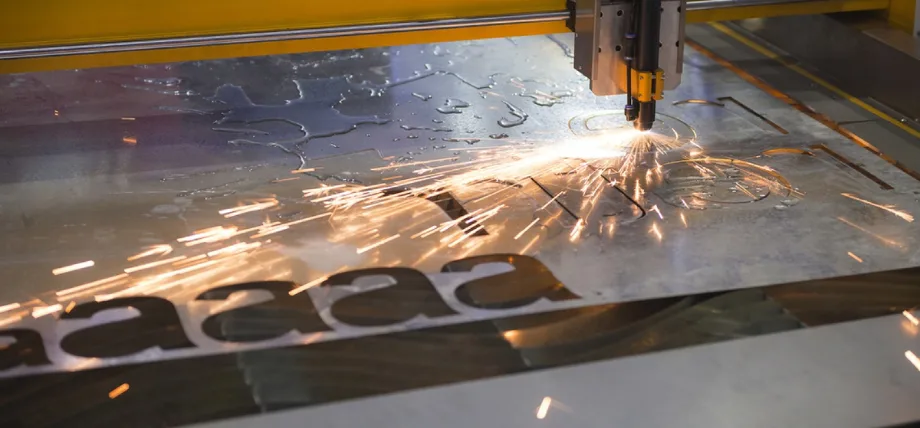
Laser cutting letters
When designing metal parts for laser cutting, engineers must consider multiple technical factors to optimize results and ensure manufacturability:
- Material Type and Thickness: The thickness of the metal sets the parameters for the laser type and power. Fiber lasers work well with thicker materials (up to 30 mm), and CO2 lasers do well with thinner sheets (up to 10 mm).
- Kerf Width: Since the kerf usually ranges from 0.08 to 0.3 mm, it must be accounted for in CAD designs to achieve the desired dimensional accuracy. Fiber lasers offer thinner kerfs, imparting higher precision, especially for intricate designs.
- Heat-Affected Zone (HAZ): The HAZ is formed by the high-energy laser beam, which modifies the microstructure and mechanical properties of the material. The use of inert gases like nitrogen limits oxidation, thereby minimizing the HAZ, especially for carbon steel or titanium.
- Edge Quality: The edges produced after laser cutting are smooth. However, with highly complex and thick materials, post-processing such as deburring may be required to achieve the required finish, particularly for aerospace applications where precision is paramount.
- Minimum hole size or edge distance: A good rule of thumb is that the minimum hole diameter should be 1 to 1.5 times the material thickness, depending on material type. The edge distance from the hole to the edge of the sheet should also be 1.5 times the thickness of the material to avoid structural weakness or warping of the sheet during the cutting process.
- Corner Radii and Feature Spacing: Sharp corners can cause overburning because of laser dwell time. Small radii (e.g., 0.1-0.5 mm) should be built into the CAD design to alleviate this problem. Slots or tabs should be spaced at least one material thickness apart to ensure structural integrity.
These considerations ensure that laser-cut parts meet stringent dimensional and functional requirements while minimizing defects and post-processing needs.
Types of Laser Cutting For Metals
Laser cutting machines employ various laser technologies, each with distinct technical characteristics suited to specific metal cutting applications.
Primary laser types used for laser cutting are classified depending on the gain medium involved, beam generation method, and suitability for materials and thicknesses.
CO2 Lasers
Gas lasers are a mixture of carbon dioxide, nitrogen, and other gases that produce the laser beam by means of electrical discharge.
CO2 lasers work at a wavelength of 10.6 micrometers, producing a beam of extremely high intensity suitable for cutting metals such as carbon steels and stainless steels, as well as non-metals like acrylics.
Normally, their output power lies between 1 and 6 kW, applicable enough to cut sheet metal up to 10 mm in thickness. However, since photon absorption is comparatively less at this wavelength due to the highly reflective materials, they cannot perform well when cutting brass or aluminum.
Often, nitrogen is employed as an assist gas to improve the edge quality and prevent oxidation.
Fiber Lasers
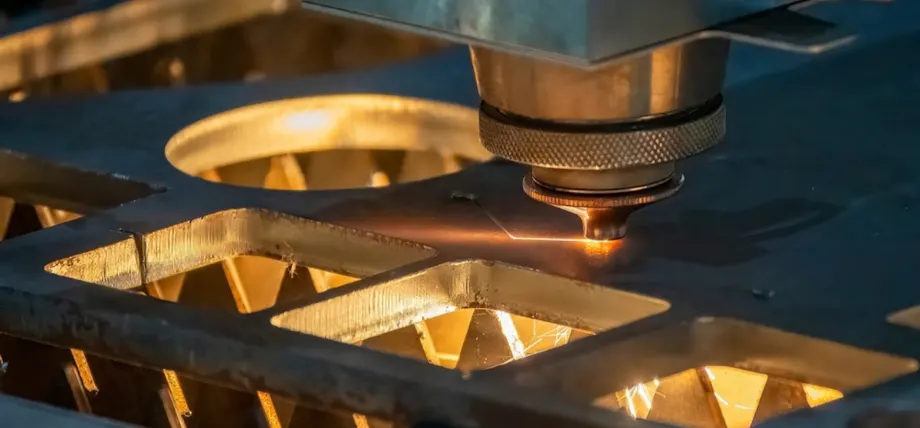
Fiber laser cutter
A fiber laser is a solid-state laser that amplifies a laser light in a rare-earth-doped optical fiber, like ytterbium-doped fiber. Operating at a wavelength close to 1.06 micrometers, fiber lasers provide better beam quality and higher absorption of photons by metals.
They are excellent for cutting electrically conductive materials such as carbon steel, stainless steel, aluminum, brass, and titanium. Fiber lasers have power outputs ranging from 1 kW to beyond 20 kW and a capacity to cut metals up to 30 mm thick with high speed and precision.
Their compact design and lower maintenance requirements compared to CO2 lasers make them a preferred choice for high-volume metal laser cutting.
Nd: YAG and Nd: YVO4 Lasers
These solid-state lasers use neodymium-doped crystals (yttrium aluminum garnet or yttrium orthovanadate) as the gain medium.
With a 1.064-micron wavelength, it possesses the properties required for metal works by the fiber lasers, but is less preferable because of its higher operation and maintenance costs, as well as its poor beam quality.
Nd: YAG lasers are, however, used to engrave or cut thin metals (up to 6 mm), and can deliver pulsed beams for high precision and energy application.
Disk Lasers
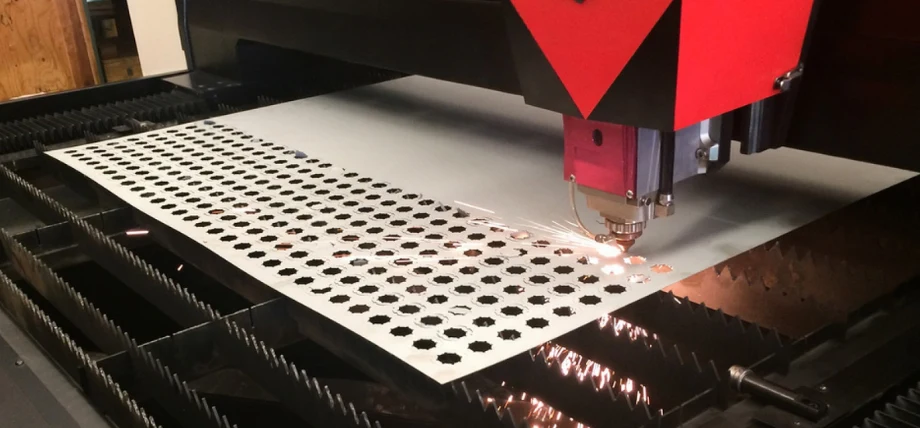
laser cutting machine in operation
Another major subset of the solid-state lasers, disk lasers, uses a thin disk of the ytterbium-doped gain medium that is efficiently cooled to extremely high power levels (even up to 16 kilowatts).
The beam quality is comparable to that of fiber lasers, and it is mostly used for cutting thick metals like titanium or stainless steel with a small HAZ.
Less popular than fiber lasers, disk lasers are reserved for certain applications that need very high precision and power, particularly for thick and hard-to-cut metals like titanium.
Choosing a laser depends on the various factors, including type and thickness of material, cut quality required, and production volume.
With advanced CNC systems and CAD integration, these lasers can follow complicated G-code functionality to make precise 2D cuts across a wide range of materials.
Sheet Metal Laser Cutting Service
Utilize our advanced sheet metal laser cutting services to achieve exceptional precision and efficiency. Get a quote today!
Conclusion
Metal laser cutting is a pivotal technology in precision manufacturing, enabling engineers to cut diverse metals with high accuracy and efficiency.
By selecting appropriate materials like carbon steel, stainless steel, or titanium and leveraging advanced laser technologies such as CO2 or fiber lasers, manufacturers can achieve superior results in industries like aerospace and automotive.