

Choosing the right 3-axis vs 5-axis CNC machine can make or break your project’s success, timeline, and costs. Knowing these machining technologies is really important for manufacturers who want the best results in today’s difficult market.
The main difference is simple: 3-Axis machines do great work for basic jobs, while the 5-axis system handles complex shapes like any other. Your choice changes everything how well you spend to how good your final parts look.
At ProleanMFG, we use both types of machines to provide you with amazing CNC machining services that fit exactly what you need. Our top-notch equipment and skilled workers ensure that your parts meet the highest quality and accuracy standards.
This complete guide looks at the main differences, benefits and uses. Let’s jump into important details that will help you make the right choice.
What is CNC Machining?
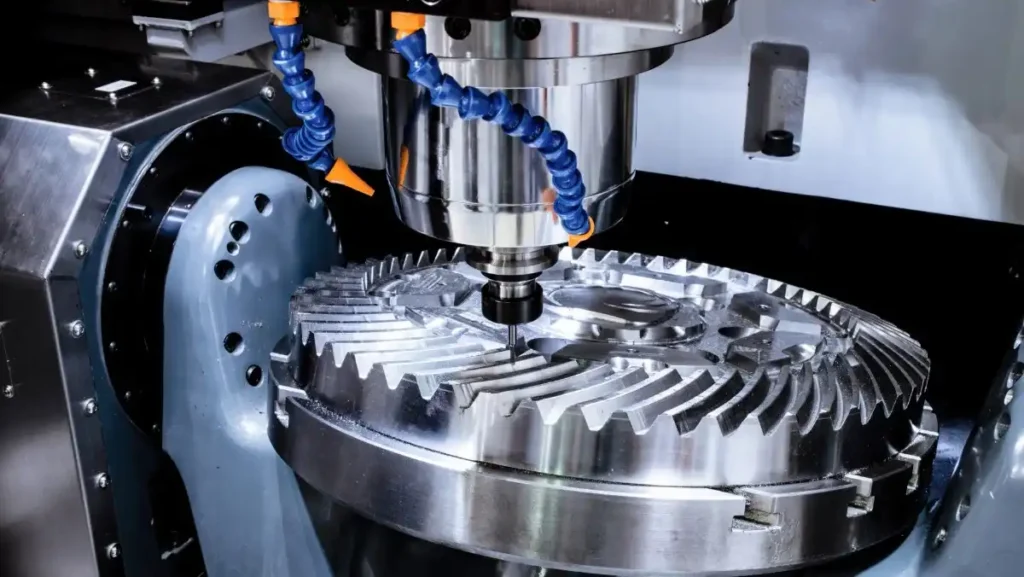
CNC Machining a Metal Gear
CNC machining is a smart way to cut parts by cutting away material from a solid block using computer-controlled machines. This technique mixes automated control systems with sharp cutting tools to achieve amazing accuracy and stability every time.
Many industries, such as cars, airplanes, electronics, and medical devices, require CNC machining for their most important parts. This process works with various materials, including aluminum, stainless steel, titanium, hard plastic, and special mixed materials.
Two main types, including 3-axis vs 5-axis CNC systems, have their special benefits for different manufacturing jobs. Learning CNC machining basics shows you why top manufacturers choose this technique to make prototypes and produce lots of parts.
What is a 3-Axis CNC Machine?
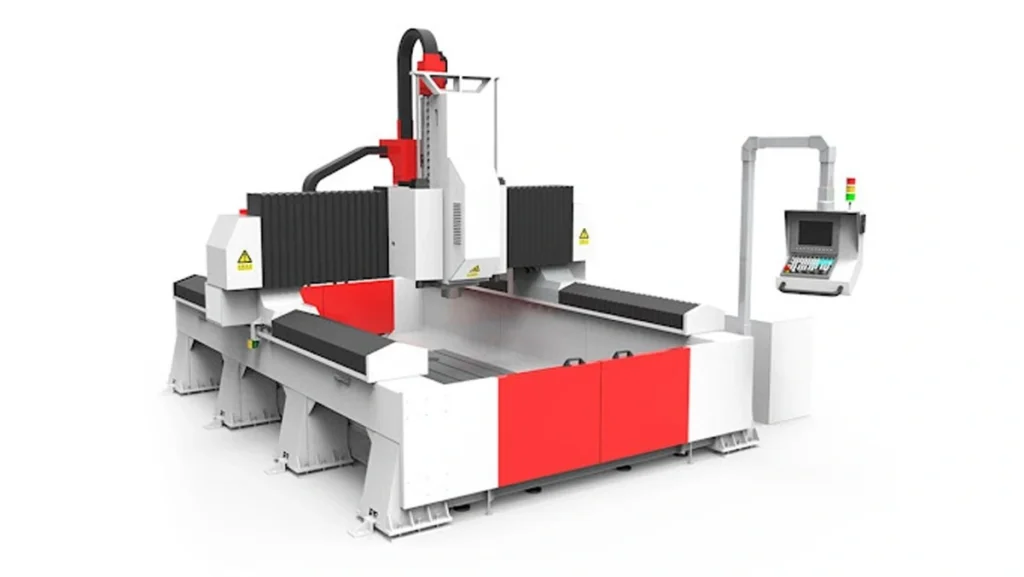
Large 3-Axis CNC Machine
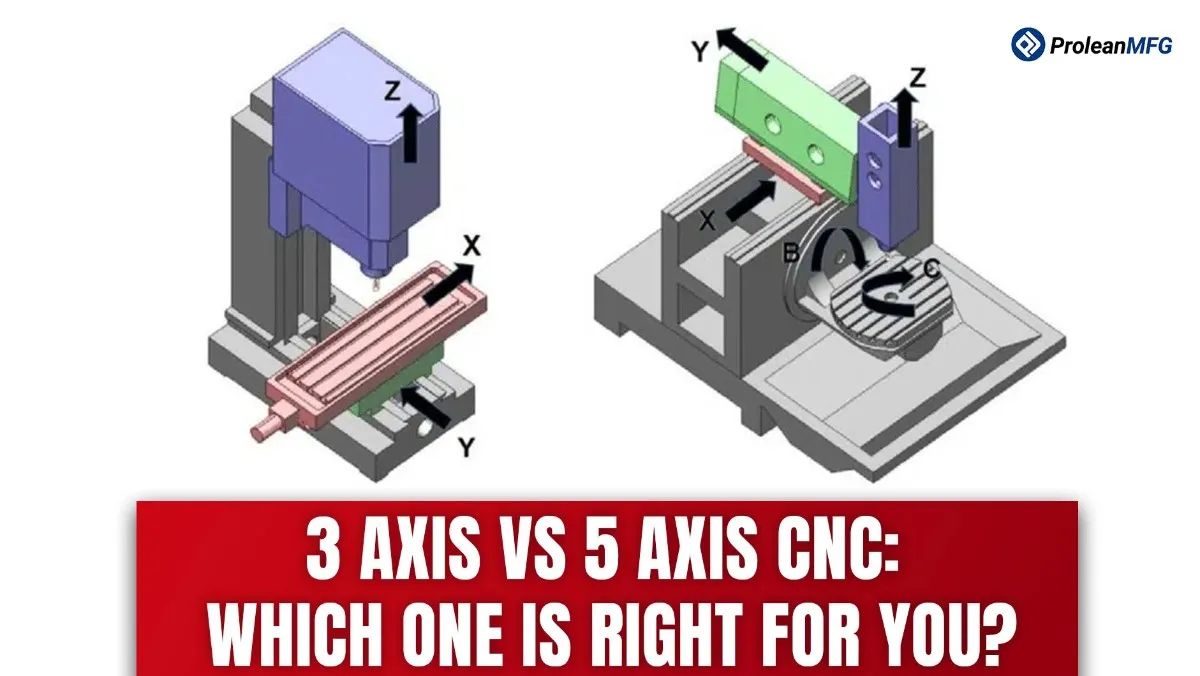
A 3 Axis machining center operates with three straight lines—X, Y, and Z—letting the cutting tools move in these directions. The cutting tool remains in the same position compared to the workpiece, making this setup perfect for most flat surfaces and parts with simple shapes.
This machining method works really well to create parts such as mounting plates, cases, frames, and basic molds, where you do not need fancy angled features. The workpiece stays still during machining, which means that you get the same good results every time.
What is a 5 Axis CNC Machine?
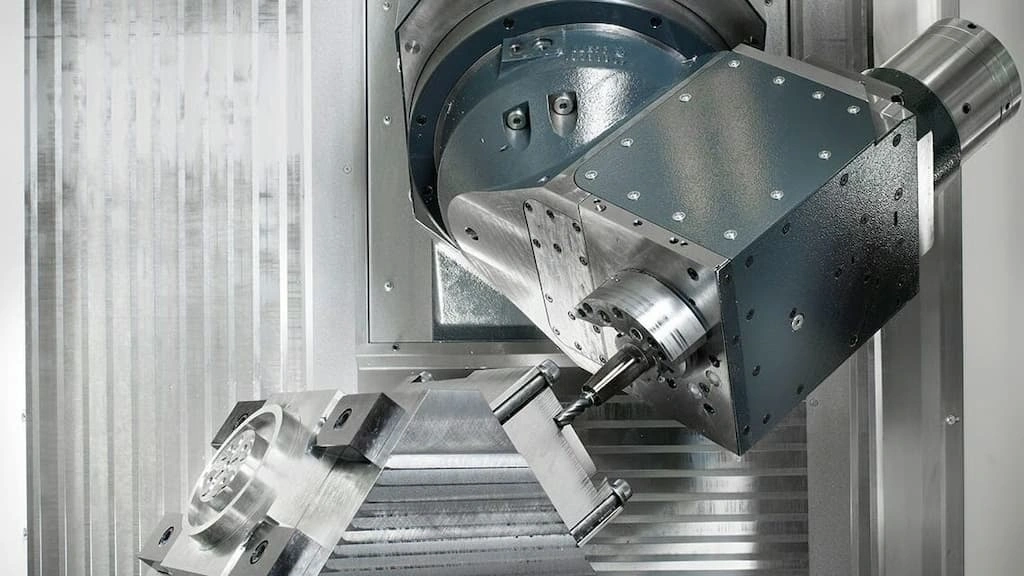
Intricate Part on 5-Axis CNC
5-Axis CNC machining connects two more spinning movements—usually A and B or B and C—on top of the standard X, Y, and Z straight movements. This setup allows the cutting tool to reach the workpiece from almost any angle that you can think of.
The amazing thing about 5-axis machining is that it can move in all five directions at the same time. Smart control systems coordinate all five axes in real time, keeping the tool in the right place while cutting complex shapes.
Smart computer programs process thousands of position calculations every second, making a smooth surface even on really challenging curves. This flexible movement gets rid of old problems with tool access and having to move the workpiece around.
The result is an amazing ability to make parts with undercuts, complex curves, angled features, and parts that require machining on many sides. Industries that demand correct accuracy —such as airplanes, medical equipment, and advanced car parts— depend heavily on this technique.
This better access means that you get better surface quality, require fewer additional operations, and can eliminate complex parts in a setup that will normally require multiple operations on regular machines.
When Should You Use 3-Axis CNC Machining?
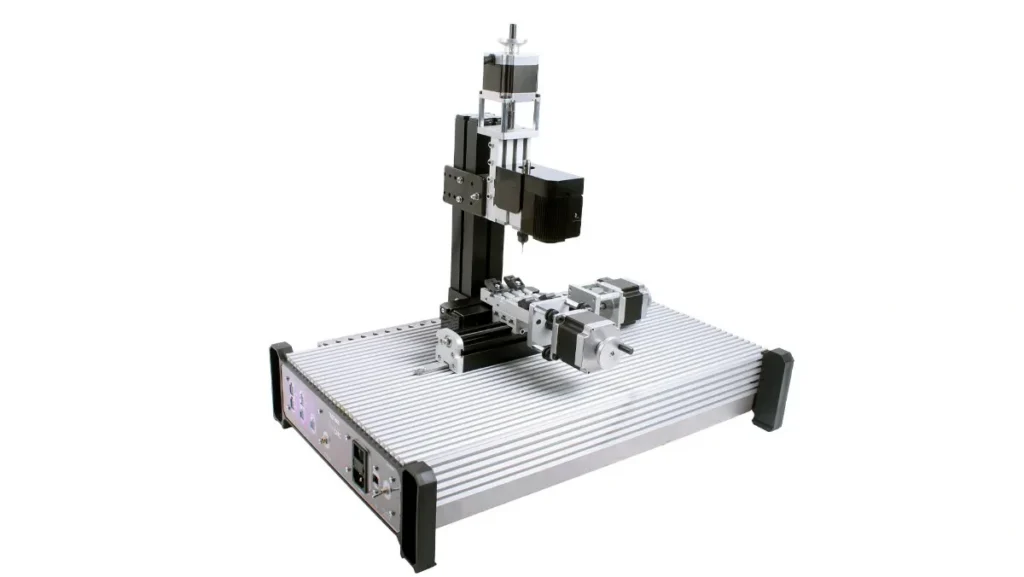
Desktop 3-Axis CNC Machine
3-Axis CNC systems are still very useful and efficient for many manufacturing jobs. These machines do very good work when part shapes match what they do best, providing rapid and inexpensive production solutions.
Best Uses Include:
- Structural brackets and mounting systems
- Standard threading work for basic fastening needs
- Cases and housing parts
- Sheet metal processing and fabrication
- Prototype development and design testing
For quick prototypes and initial design testing, a 3-axis machining center gives you unmatched speed and strength. When your project involves design changes and concept validation, this technology provides the correct balance of ability and cost-effectiveness.
What is a 5-axis CNC Machine Used For?
5-axis CNC technology becomes necessary when manufacturing is required that can do regular machining. The ability to reach complex surfaces and perform several jobs at the same time makes it invaluable for sophisticated applications.
Top Uses:
- Complex undercuts and internal features
- Curved surface finishing with better quality
- Tight tolerance parts requiring minimal error
- Multi-sided machining in single setups
With 5-Axis abilities, making parts with angled holes, complex internal passages, and complex surface features becomes regular rather than challenging. When precision and surface finish cannot be compromised, this technology provides extraordinary results.
Advantages of 3-Axis CNC Machining
What makes 3-Axis CNC so popular for many jobs? The answer is how it balances what it can do, how simple it is, and how much money it saves. Here are the main 3-axis machining advantages:
- Great for projects where you need to see your budget and small production runs.
- A simple setup means less prep time and easy programming.
- Basic parts do not require a lot of setup changes.
- Amazing stability for parts with the same orientation and simple shapes.
3-Axis machining provides you with excellent precision for parts that line up within a flat direction. Jobs like face milling, drilling, and basic shaping are done quickly and accurately.
This technique is the foundation for making essential parts such as brackets, covers, base plates, and structural pieces. Although it may not be as flexible as a multi-axis system, it gives you unbeatable reliability and cost savings for the right jobs.
But for those complex parts that require machining from many angles, you will see its limitations. This is the place where 5-Axis CNC machining shows its better abilities and greater possibilities.
What Are the Limitations of 3-Axis CNC Machining?
3-Axis CNC machines are used widely for their simplicity and effectiveness in many manufacturing processes. However, they come with some limitations that can restrict their application to more complex geometries.
Here are some limitations of 3-axis CNC machining:
- It struggles with parts that have undercuts or features on multiple sides, as the cutting tool can only move along X, Y, and Z axes.
- For some parts, you have to reposition the workpiece several times to access all the surfaces, which takes more time and can introduce errors.
- The tool might not be able to reach some areas, especially deep pockets or complex internal features.
- For those parts that require cuts from several angles, a 3-axis machine can be much slower than a machine with more axes due to additional setup.
What are the Benefits of 5-axis Machining?
5-Axis CNC machining is the top option for manufacturing flexibility, enabling you to make sophisticated parts that challenge regular machining methods. This technique is essential for industries that require extraordinary accuracy and complex figures.
Here are the top benefits of 5-Axis machining:
- Handles complex shapes easily
- Cuts down the setup and moving time
- Less finishing work is needed after
- Great with curved and contoured surfaces
- Higher accuracy and precision
But while watching this technique, you need to think about what are the limitations of a 5-axis CNC machine. – So here are some that you should consider:
- Costs more to buy equipment
- Needs experienced workers
- More complicated to maintain
3-Axis CNC Machining Applications
3-axis CNC machines are used for flat surface or 2.5D geometry machining. They are simple and cost-effective for many industries. Here are some common applications:
- Automotive: Engine mounts, transmission housings, dashboards
- Metal Fabrication: Flat plates, holes, and slots in metal parts
- Consumer Electronics: Aluminum enclosures, heat sinks, device frames
- Woodworking: Cabinet doors, moldings, signage
- Tool & Die Making: Simple dies, jigs, and fixtures
- Education & Prototyping: Great for training and basic prototyping
5-Axis CNC Machining Applications
5-axis CNC machining is used when precision, complex geometry, and multi-surface access are required. It’s used in high-tech industries and for making intricate parts. Here are some examples:
- Aerospace: Turbine blades, structural components, engine cases
- Medical Devices: Orthopedic implants, surgical instruments, dental frameworks
- Automotive: Cylinder heads, custom engine parts, performance parts
- Defense & Military: Missile components, gyroscopes
- Oil & Gas: Pump housings, impellers, complex valves
- Mold Making: Injection molds, casting dies, 3D-contoured molds
- Robotics: Complex brackets, multi-angled joints, robot arms
What is the Difference Between 3-axis and 5-axis Milling?
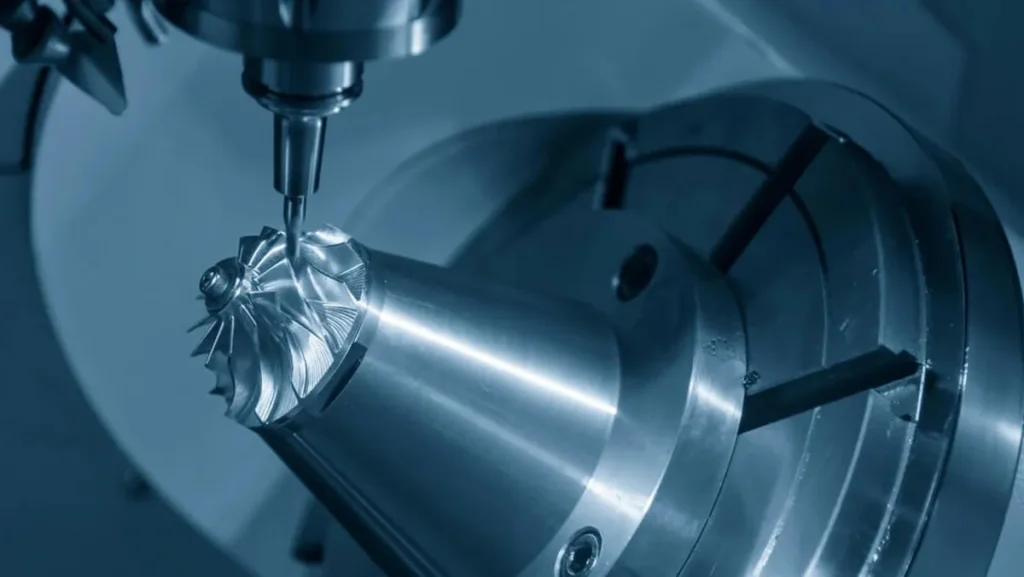
5-Axis Milling Intricate Turbine Part
Understanding the basic differences between 3-axis vs 5-axis CNC machining is really important for making smart technology choices. Here’s a complete side-by-side look.
| Aspect | 3-Axis CNC Machine | 5-Axis CNC Machine |
| Number of Axes | 3 (X, Y, Z) | 5 (X, Y, Z + A & B or A & C rotational axes) |
| Movement Capabilities | Moves the tool in three linear directions only | Moves in three linear directions plus two rotational axes |
| Complex Geometry Handling | Limited to simple and prismatic shapes | Handles complex 3D geometries with undercuts and deep cavities |
| Part Setup | Requires multiple setups for different angles | A single setup can access multiple sides and angles |
| Surface Finish Quality | May require secondary processes for a better finish | Superior surface finish due to consistent tool contact |
| Precision | High precision for basic geometry | Extremely high precision for complex contours and tolerances |
| Machining Time | Longer, due to multiple setups and repositioning | Shorter, thanks to reduced setups and continuous tool movement |
| Programming Complexity | Easier to program; compatible with basic CAM software | Requires advanced CAM software and skilled operators |
| Tool Accessibility | Limited to top or side surfaces | Full accessibility around the part |
| Cost of Machine | Lower initial investment | Higher investment due to added mechanics and controls |
| Maintenance & Calibration | Easier to maintain and calibrate | More complex maintenance due to additional moving parts |
| Operator Skill Level | Suitable for entry to intermediate-level machinists | Requires advanced knowledge and experience |
| Best For | Simple components, 2.5D parts, flat or stepped features | Aerospace, medical, automotive, and high-precision complex parts |
| Material Waste | Slightly more due to limitations in geometry handling | Optimized material use with fewer setups and re-cuts |
| Machine Footprint | Smaller and compact | Larger, due to rotary tables and complex kinematics |
Wrap Up
The choice between 3-Axis and 5-Axis CNC machining actually depends on your part shapes, surface finish needs, and production goals.
Simple designs with budget limits benefit from the speed and cost-effectiveness of 3-axis CNC solutions. However, when part size demands complex curves, accurate tolerances, or multi-sided features, 5-Axis CNC provides better precision and manufacturing flexibility.
From basic parts to highly sophisticated components, ProleanMFG provides 5-axis CNC machining services for reliable, high-quality results for each project. Contact Us Now!