
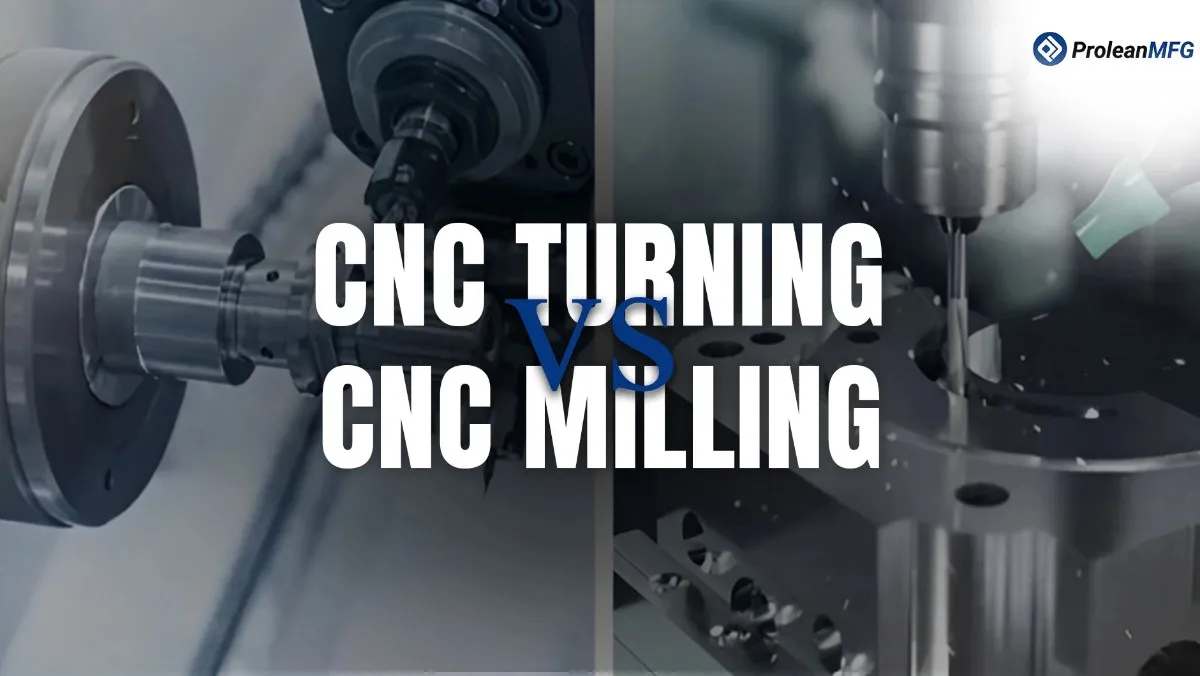

Turning vs Milling is a comparison every production manager, engineer, or business owner must know in modern manufacturing.
These are the two most common subtractive machining processes, each playing a key role in shaping raw material into precise finished parts.
While both are under the umbrella of CNC machining, the techniques, tools, movement, and results are very different.
Milling has a rotating cutting tool moving across a stationary workpiece, whereas turning rotates the workpiece against a static cutting tool.
ProleanMFG helps industry professionals like you decide which process is best for your product, budget, and time-to-market.
If you’re struggling to tell the difference between CNC turning services and CNC milling services, or are unsure how they impact your parts’ performance or cost, this guide is for you.
By the end, you’ll know which process fits your production strategy—and why choosing a trusted manufacturing partner makes all the difference.
What is CNC Milling?
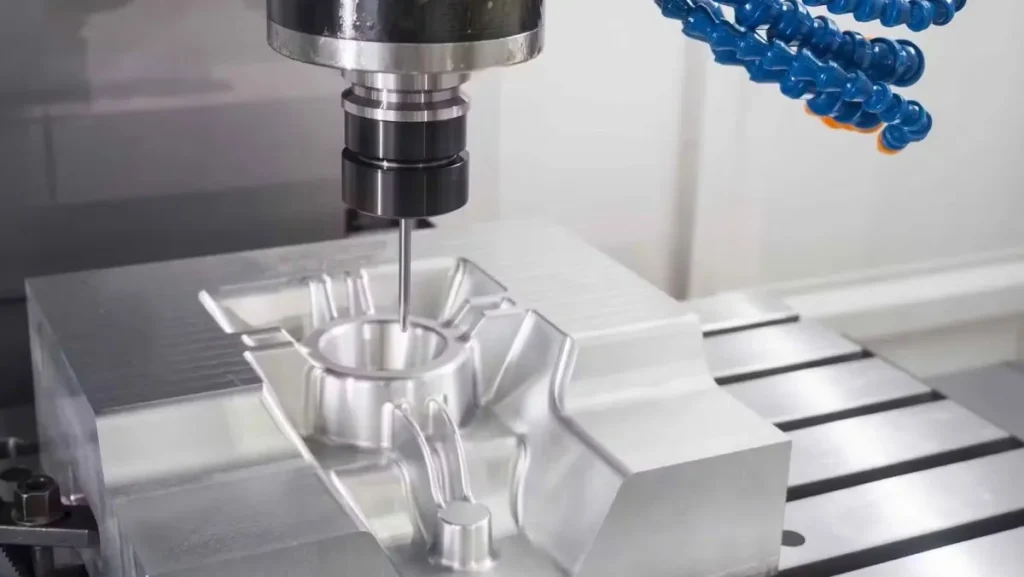
CNC Milling Metal Part
CNC milling is a machining process where a computer-controlled tool removes material from a solid block of material (commonly called the “workpiece”) to create the part.
Unlike manual milling machines, CNC mills use automated controls to ensure precision and consistency on even the most complex designs.
This machine milling process is great for parts with flat surfaces, pockets, intricate shapes, or multiple faces.
At its core, CNC milling allows manufacturers to create highly detailed parts with high repeatability.
The cutting tool rotates at high speed while moving along several axes—typically 3 (X, Y, Z), but more advanced machines may use 4 or 5 axes.
This freedom of motion makes CNC milling perfect for industries where design complexity and dimensional accuracy are critical, such as aerospace, medical devices, electronics, and automotive.
What is the Milling Process?
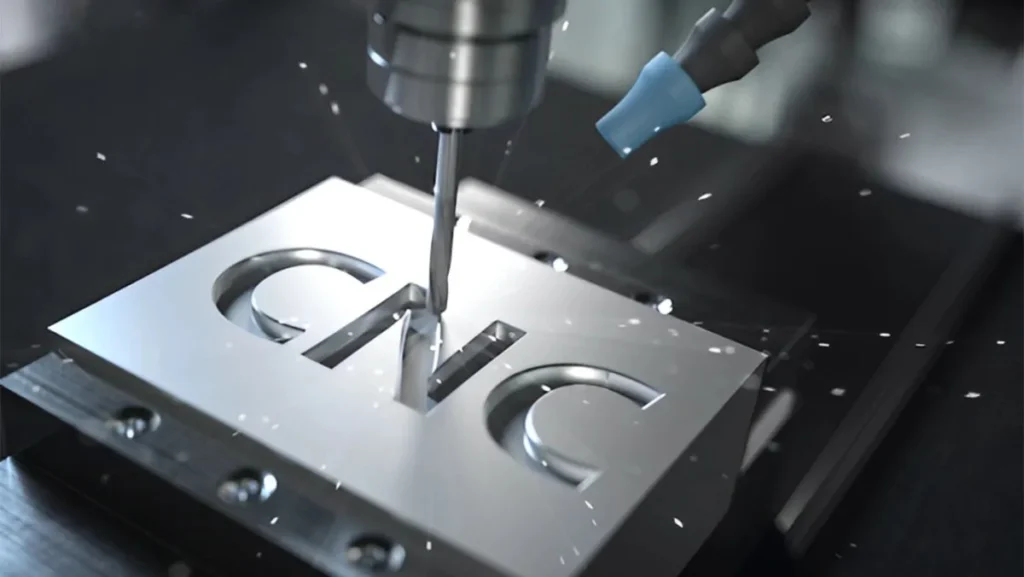
Precision Milling Process in Action
A CNC milling machine moves the tool and the workpiece to get to the desired shape.
The tool is mounted on a spindle that spins fast. The computer reads the digital instructions (G-code) for the cut’s direction, depth, and speed.
The workpiece is fixed to the table, and the tool approaches it from different angles.
Because CNC milling machines can move in multiple directions, they can create complex features like channels, slots, and angled surfaces in one setup.
No need to make frequent manual adjustments and minimize human error. The result is a consistently high-precision part that meets specifications.
Components of a CNC Milling Machine
A CNC milling machine comprises several vital components that work together to achieve high-precision results.
1. The spindle holds and rotates the cutting tool.
2. The worktable supports the raw material and can move in linear directions.
3. A servo motor system controls the motion of the machine’s axes, ensuring that movements are synchronized with the tool’s rotation.
4. A tool changer may be integrated to switch tools automatically during different operations.
5. The control unit serves as the machine’s brain, interpreting the G-code and managing every aspect of the machining cycle.
This high level of automation ensures repeatable results across multiple parts, even in high-volume CNC milling services.
Types of CNC Milling Operations
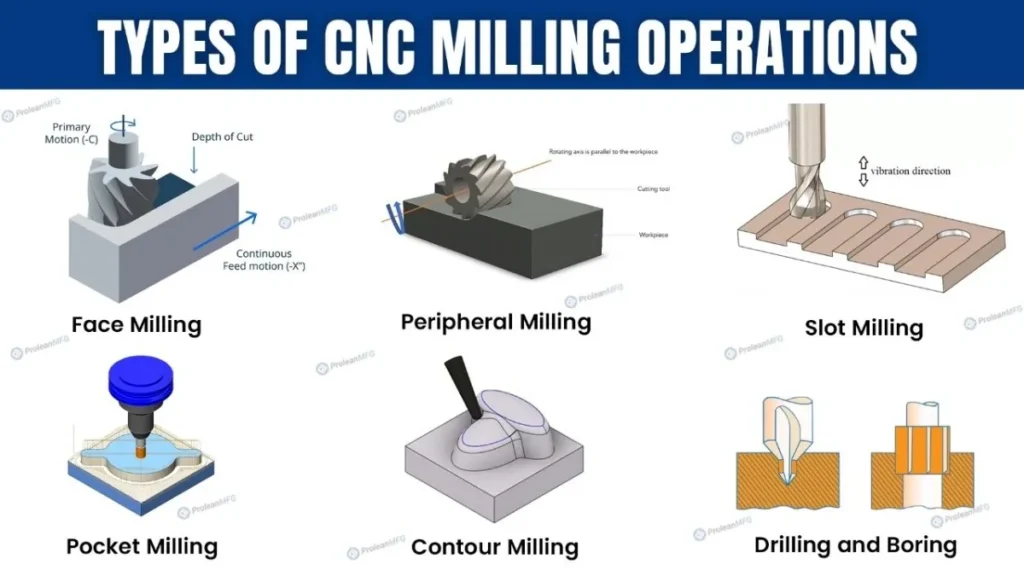
Types of CNC Milling Operations
CNC milling machines can perform many operations depending on the part geometry, material, and production goals. Here are the most common milling operations used across industries:
1. Face Milling
Face milling is used to create flat surfaces on top of a workpiece. The tool rotates perpendicular to the surface and removes material efficiently, producing smooth and even finishes. It’s suitable for preparing surfaces for further operations or precision finishing.
2. Peripheral Milling
Peripheral milling cuts along the outside of a workpiece. The tool moves parallel to the surface, allowing for contouring, slotting, and shaping complex external profiles. This is used to define the overall shape of parts.
3. Slot Milling
Slot milling is used to cut narrow slots or grooves into the material. The cutter moves straight into the surface and creates U-shaped or rectangular channels. It’s required for parts that need keyways, tabs, or alignment grooves in mechanical assemblies.
4. Pocket Milling
Pocket milling removes material from inside a workpiece, creating cavities or recesses. This operation produces parts with sunken features, such as boxes, molds, or enclosures in electronics and automotive parts.
5. Contour Milling (3D Contouring)
Contour milling, also known as 3D contouring, allows the creation of curved or sloped surfaces. It’s used when parts require complex geometries like aerodynamic shapes or ergonomic designs. This is used in aerospace and medical device manufacturing.
6. Drilling and Boring
While not exclusive to milling machines, many CNC mills can drill and bore. Drilling creates holes using a rotating bit, boring enlarges existing holes to precise diameters. This is used for bolt holes, bearings, and fastener pathways.
Advantages and Disadvantages of CNC Milling
CNC milling is a versatile and precise way to make complex parts; it’s a go-to solution across many industries. However, like any process, it has its own set of strengths and weaknesses.
Below is a breakdown to help you decide if it’s right for your project.
| Advantages | Disadvantages |
| Good for complex geometries | Longer setup time |
| High precision and repeatability | Higher cost per part in low-volume runs |
| Supports many materials | Not suitable for round or cylindrical shapes |
Materials Used in CNC Milling
CNC milling supports many materials, such as metals like aluminum, steel, brass, and titanium, as well as plastics like PEEK, ABS, and PTFE.
Material choice depends on application, strength, thermal stability, and surface finish.
ProleanMFG’s CNC milling services have over 100 material options so that you can match the right material to your performance requirements.
What is the Turning Process?
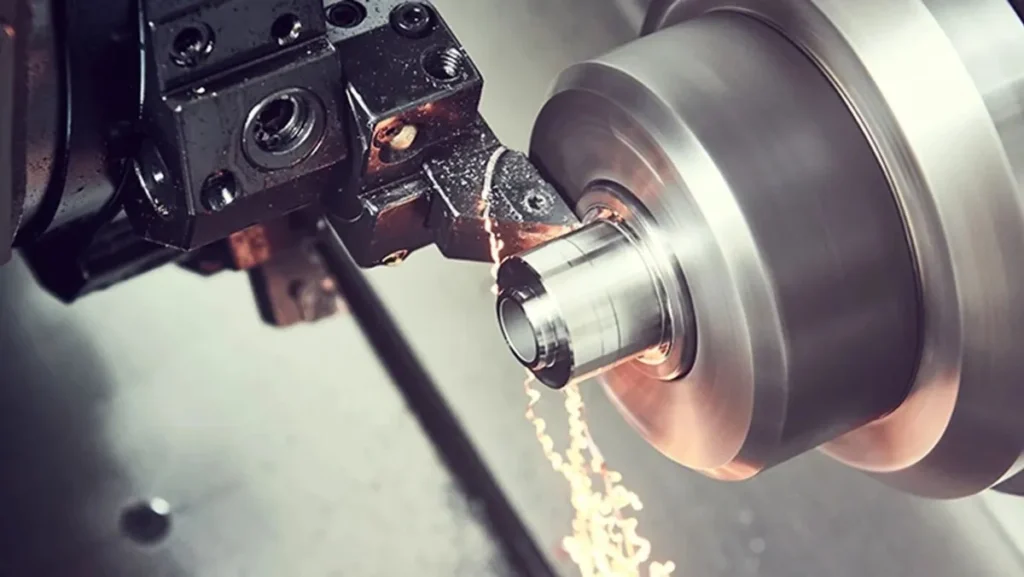
Turning Process: Metal Lathe
CNC machining turning is a subtractive manufacturing process used to make parts with symmetrical, round, or cylindrical shapes.
The raw material rotates at high speed in this process while a fixed cutting tool removes material by cutting layers.
The motion is generally limited to two axes (X and Z), which allows the machine to perform operations along the length and diameter of the part.
CNC turning makes parts like shafts, bushings, pins, and threaded components.
How CNC Turning Machines Operate?
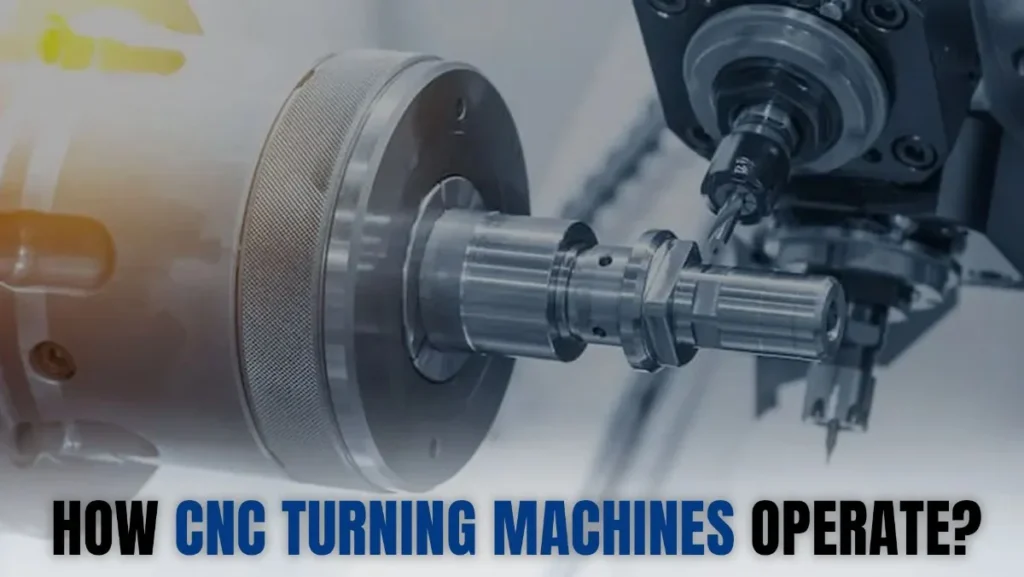
CNC Turning Machine Operation
The cylindrical workpiece is clamped in a chuck attached to a spindle in a CNC machining turning setup.
As the spindle rotates, the material, a cutting tool mounted on a turret, comes into contact with the spinning part. The tool moves along linear paths (X and Z) to perform facing, turning, grooving, and threading. operations
The process is automated by a control unit that interprets G-code to move the tool precisely.
Because of its simplicity and efficiency, turning is often used for parts that require high roundness or uniform outer diameter.
Components of a CNC Turning Machine
A CNC turning machine, or CNC lathe, cuts a spinning piece of material by shaving off excess with a fixed tool.
How precise and fast this process is depends on several key parts working together.
Key Parts of a CNC Turning Machine:
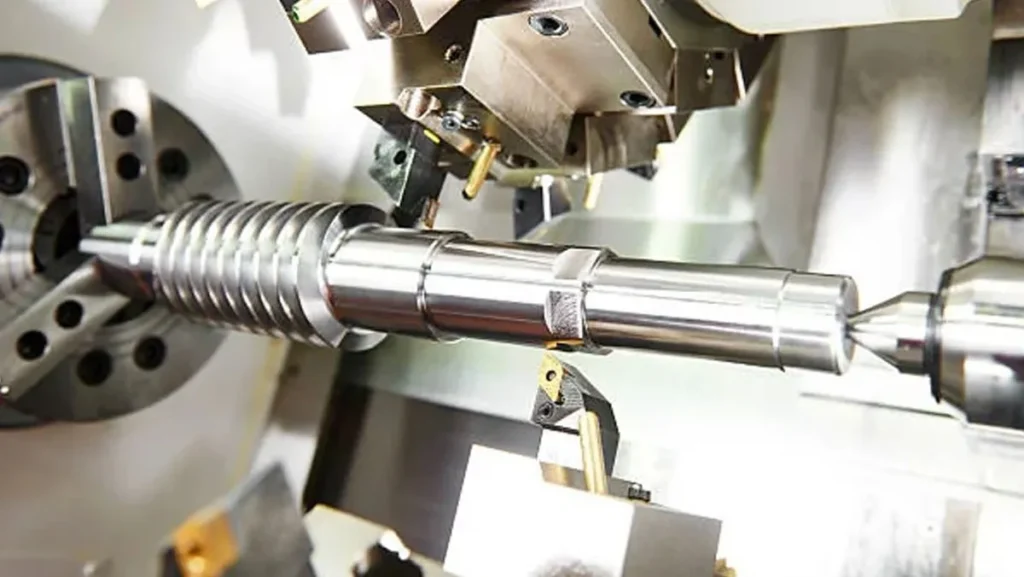
Key Parts of a CNC Turning Machine
- Spindle: Spins the material so the tool can work on it.
- Chuck: Holds the material tight so it doesn’t move.
- Turret: Holds different tools and can switch between them automatically for other tasks.
- Tailstock: Supports long or flexible material so it doesn’t bend during cutting.
- Control Panel: Like the machine’s brain, it uses computer software to tell the tool where to cut, how fast to move, and how fast the material should spin, based on a pre-set program.
- Bed/Base: The strong foundation that holds all the other parts and keeps the machine steady so it doesn’t shake or bend.
For CNC machining to be accurate, especially with tough metals or intricate designs, the machine must be strong, tuned, and designed to reduce shaking and bending. This ensures accuracy even when making many parts or cutting multiple times on one piece.
What Are the Types of Turning?
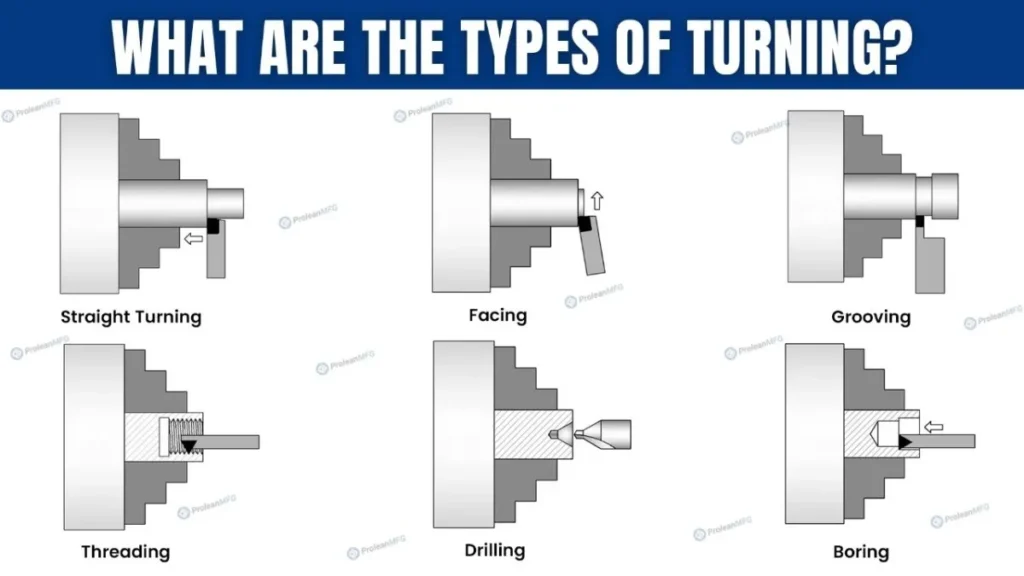
Types of CNC Turning Operations
CNC turning machines do many things to make parts exact and practical. Here are the most common:
1. Straight Turning
The machine makes a spinning part thinner by cutting along its length. The cutting tool moves straight, creating a perfect circle. Great for shafts, rods, and other round parts that need to be precise.
2. Facing
Facing means cutting a flat surface on the end of a part. It’s usually the first or last step to ensure a smooth and even end. This is important for parts that need to connect to other parts.
3. Grooving
Grooving is when the machine cuts narrow, recessed channels (like small ditches) into the inside or outside of a part. These grooves are for things like rings or seals. The machine can control how deep and wide these grooves are very accurately.
4. Threading
Threading creates spiral ridges or grooves on the inside or outside of a round part. CNC machines can make different types of threads, which are for screws, connectors and pipes. This is very important in industries like cars, airplanes, and plumbing, where strong connections are needed.
5. Drilling
Drilling on a CNC turning machine means pushing a spinning drill bit into the center of the part. This makes accurate holes along the middle. Often used to make starter holes or to prepare for other internal changes like boring or threading.
6. Boring
Boring makes an existing hole bigger with great accuracy and a smooth finish. It uses a single cutting tool to remove small amounts of material, making the hole the exact size and perfectly centered. Boring is key for getting precise inside diameters, especially for parts that need to be exact.
Advantages and Disadvantages of CNC Turning
Turning is fast with round parts. It’s excellent for material removal, especially for simple geometries. It’s also suitable for batch production and tight tolerance parts.
However, it has limitations with irregular or complex surfaces.
| Advantages | Disadvantages |
| Excellent for cylindrical shapes | Limited to rotationally symmetric parts |
| Fast cycle times | May require milling for complex features |
| High repeatability in mass production | Less versatile than milling |
Materials Used in CNC Turning
CNC turning machines can machine a wide range of materials. Standard materials are metals like stainless steel, brass, copper, titanium, and aluminum. Plastics like nylon, POM, and UHMW are also compatible.
Material choice depends on the end use requirements—corrosion resistance, weight, durability, or conductivity. Material stability and machinability are key to long-term performance for CNC high-volume precision turned parts.
What Are the Applications of CNC Turning vs Milling?
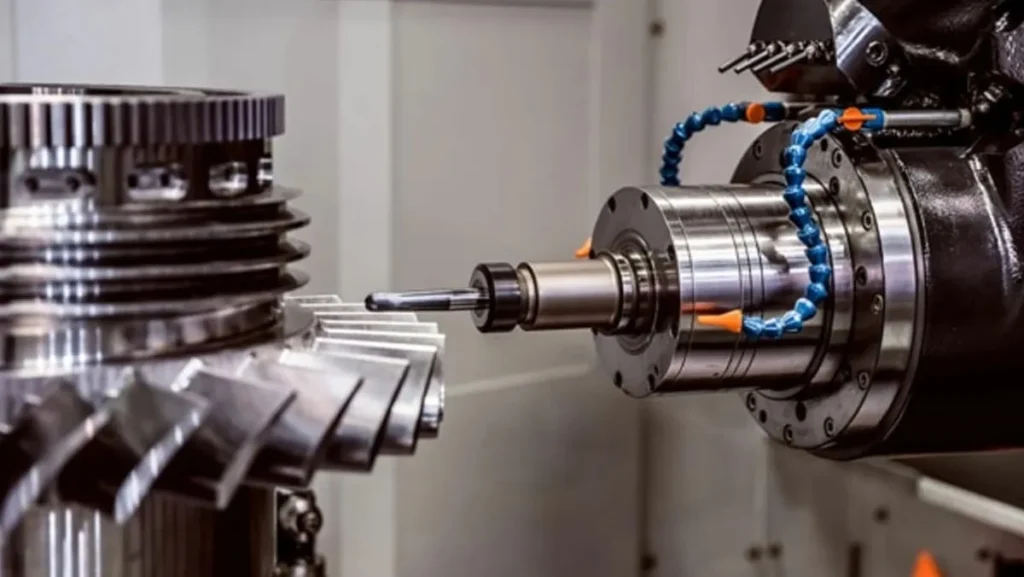
CNC Machining: Turning vs Milling
CNC milling is perfect for industries that require wide and accurate parts with complex shapes. It can handle various materials and is widely used in modern manufacturing.
CNC turning is the process of making complete round or cylindrical parts. It is sharp, accurate, and ideal for simple and wide component shapes.
Here are the applications of CNC turning vs CNC milling:
1. CNC Milling Applications
- Aerospace: Turbine Blade, Structural Brackets, and Housing Units with Tight Tolerance
- Automotive: Engine Parts, Gearbox Casting, Housing, and Brake System Components
- Electronics: Custom Caseing for Heat Sink, PCB Enclosure, and Electrical System
- Medical device: Surgical tools, prosthetic implants, and orthopedic parts from titanium or biocompatible plastic
- Robotics and automation: complex moving parts, housing, and stability components
- Defense and Firearms: Exact components for weapons and safety equipment.
2. Applications of CNC Turning
- Automotive: Shaft, Axle, Piston, and Wheel Hub
- Construction Equipment: PIN, Bushings, Spacers, and Couplings
- Aerospace: Jet Engine Shaft, Fastener, and High-Calcium Cylindrical Parts
- Electronics: Contact pin, connector, and threaded inserts
- Oil and Gas: Pipe Fittings, Valve Bodies, and Threaded Components
- General Manufacturing: Rollers, Pulleys, and Custom Cylindrical Parts for Machines
What is the Difference Between Milling and Turning? – Quick Comparison Table
| Feature | CNC Turning | CNC Milling |
| Workpiece Movement | Rotates | Stationary |
| Tool Movement | Stationary (moves linearly) | Rotates and moves on multiple axes |
| Best For | Cylindrical parts | Complex parts with flat/angled surfaces |
| Common Parts | Shafts, Bushings, Threads | Housings, Brackets, Heat sinks |
| Complexity | Limited to symmetry | Handles intricate 3D geometries |
| Volume | Excellent for high-volume production | Great for both prototyping and production |
| Setup Time | Shorter | Longer |
| Surface Finish | Excellent for round surfaces | Excellent for flat and curved features |
| Industry Examples | Automotive, Aerospace, Construction | Medical, Aerospace, Electronics |
Turning vs Milling: The Similarities
Yes, these two processes also have fundamental similarities, as we already know the difference between a lathe and a milling machine, but they also have similarities.
Both are subtractive processes, use computer numerical control (CNC), and can machine different types of materials. For more on these shared aspects, let’s look at these points in detail.
- Subtractive Machining Processes
Both turning and milling are subtractive processes, meaning they manufacture products by removing material from bar stock. As they machine the workpiece, the processes generate chips and heat. This is despite there being variations in the specific machining approach and shapes of materials used.
- The Use Of Computer Numerical Control (CNC)
The two processes use CNC technology, which is the application of computer capabilities to control the machining process. Manufacturers use this strategy to minimize human error and speed up manufacturing.
- Similar Types Of Materials
Turning and milling are also very versatile pertaining to the materials they can machine. The methods suit metals like aluminum, brass, steel, titanium, and many others. They also machine nonmetals such as plastics and ceramics.
Turning vs Milling: Which One To Choose?
Choosing between turning and milling requires a careful consideration of part geometry, production volume, surface finish, and shape of the stock. This is because, as we implied earlier, the results of either machining method differ. Consider the following points for the two for more on which one to choose.
When To Choose Turning
CNC turning involves a turning workpiece and a stationary cutting tool, so it is most suited for cylindrical precision turned parts. Therefore, manufacturers opt for this method when they require shafts or parts with cylindrical profiles.
While perfect for small to medium batches, CNC turning can also work for high-volume precision turned parts, particularly for repeatability.
Any manufacturing project related to small to medium volumes of tubular components can use this approach.
When To Choose Milling
CNC milling entails using a rotating multi-point tool to remove material from a material block fixed to a table. There are different types of milling, but the fundamentals are the same – the workpiece is stationary while the cutting tool can move according to the capabilities of the CNC machine.
Difference Between Lathe and Milling Machine
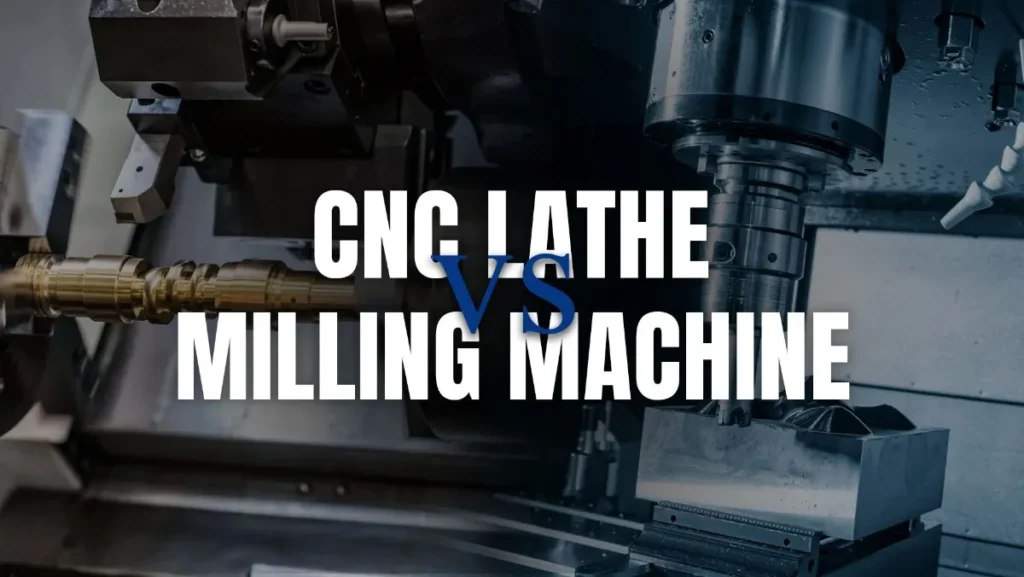
CNC Lathe vs Milling Machine
Both milling machines and lathes are essential in modern manufacturing, but they serve various objectives based on part design and machining needs.
A lathe rotates the workpiece while a stationary tool cuts it, perfect for cylindrical parts. On the other hand, a milling machine keeps the workpiece stable, while a rotating tool removes the material, making it ideal for complex surfaces and multi-way parts.
The main difference between a lathe and a milling machine is how the material is shaped.
Here’s a quick comparison of a milling machine vs a lathe:
| Feature | Lathe (Turning) | Milling Machine |
| Workpiece Motion | Rotates | Stationary |
| Tool Motion | Stationary (linear feed) | Rotates and moves along multiple axes |
| Ideal Part Shape | Cylindrical or symmetrical | Flat, complex, or multi-angled surfaces |
| Primary Operation | Turning | Cutting, slotting, contouring |
| Example Components | Shafts, bolts, bushings | Gears, housings, and engine blocks |
In a Nutshell
Both turning and milling are essential machining processes for different purposes in today’s manufacturing.
Turning is fast and precise for cylindrical parts; milling is better for complex shapes and multi-axis features.
Choose the right one based on your part’s geometry, material, and production needs.
At ProleanMFG, we do CNC turning and CNC milling, with tight tolerance parts across industries.
Ready to start your next project? Contact us or get a quote now to get moving.