
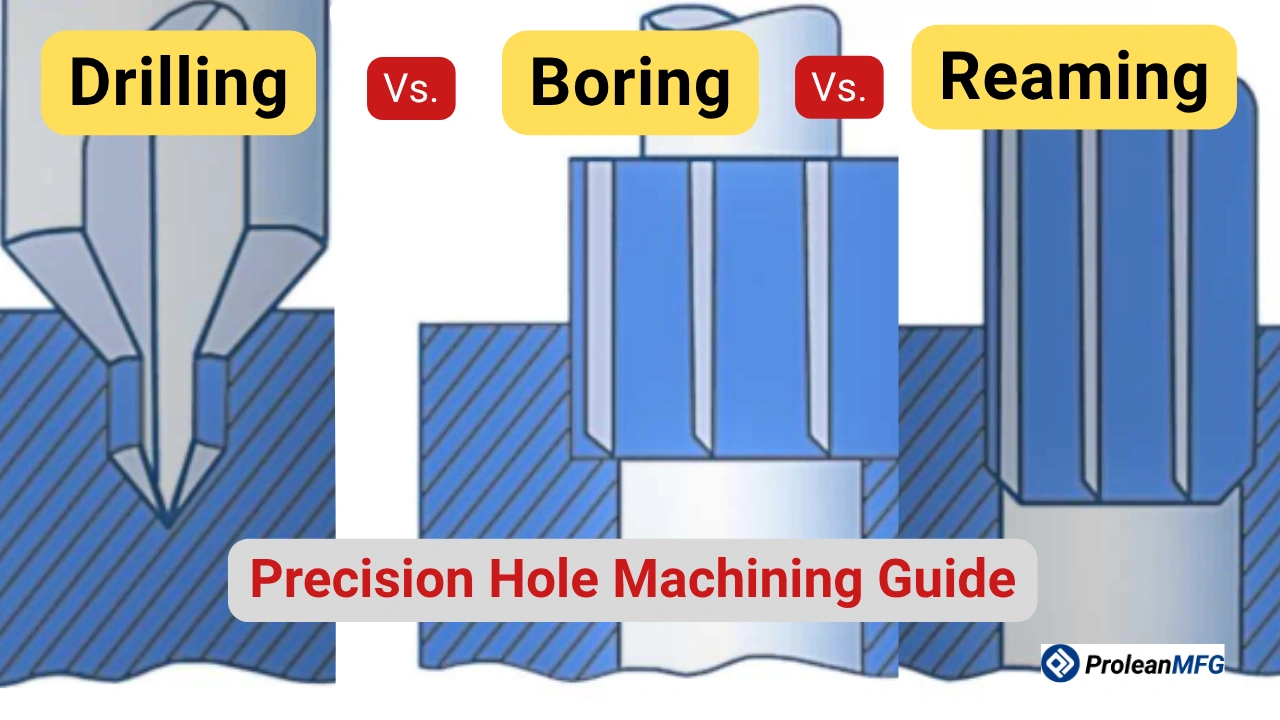

Drilling vs boring vs reaming is the definition of precision hole production sequence in CNC machining. Drilling machining produces the hole, boring machining enlarges and refines, while reaming machining produces the precision finish required for assembly.
While these processes are often intertwined and allies in machining, confusing and misplacing them can affect surface integrity, dimensional tolerance, and ultimately, the quality of assembly.
Businesses need to distinguish between these three types of precision holes to better specify for CNC machining. In the next sections, this article discusses the design, production, application, and comparison of these precision holes.
What is Drilling?
Drilling is a hole-making machining operation performed using a drill bit. The drill bit, a multi-point cutting tool with a pointed end, enters the workpiece axially. The resulting through-hole or blind-hole is equal in diameter to the tool.
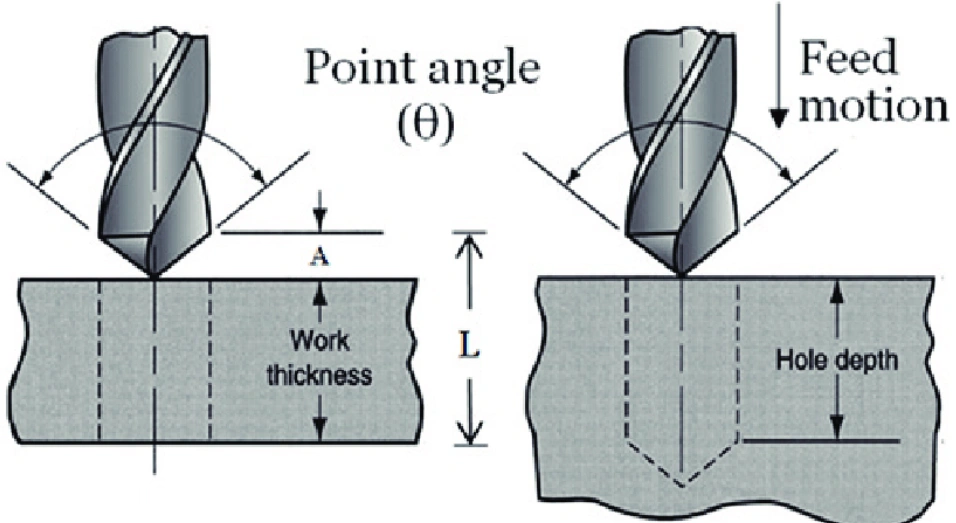
The most popular type of drill bit is the twist drill. However, there are other types, such as spot drill and center drill, which provide entry points. Indexable insert drills find use in high-volume manufacturing environments, delivering the required cost-effective, faster material removal.
How Drilling Works?
The drilling process is straightforward, starting with marking and progressing through a series of steps that culminate in the drilling operation.
First, the machinist draws the centerline of the hole location. The clarity and accuracy of this marking are critical.
Center drilling or spot drilling follows. This strategy produces a small recess on the workpiece for the twist drill to engage.
Next, the drill bit is selected based on the material requirements. Important criteria include coating, geometry, and diameter. The tool tip runout should not exceed 20 microns to prevent premature tool wear and oversized holes. [6]
The next step is to set the precision hole drilling parameters, which depend on the drill diameter, workpiece material, and required finish. Using the wrong machining parameters is a notable cause of premature tool wear and poor hole quality.
This is followed by engaging the rotating drill with the workpiece. This axial process is normally performed using peck drilling cycles to prevent chip clogging and heat buildup.
The cutting zone is treated with quality coolant throughout the cutting process. This could be externally or through the drilling tool.
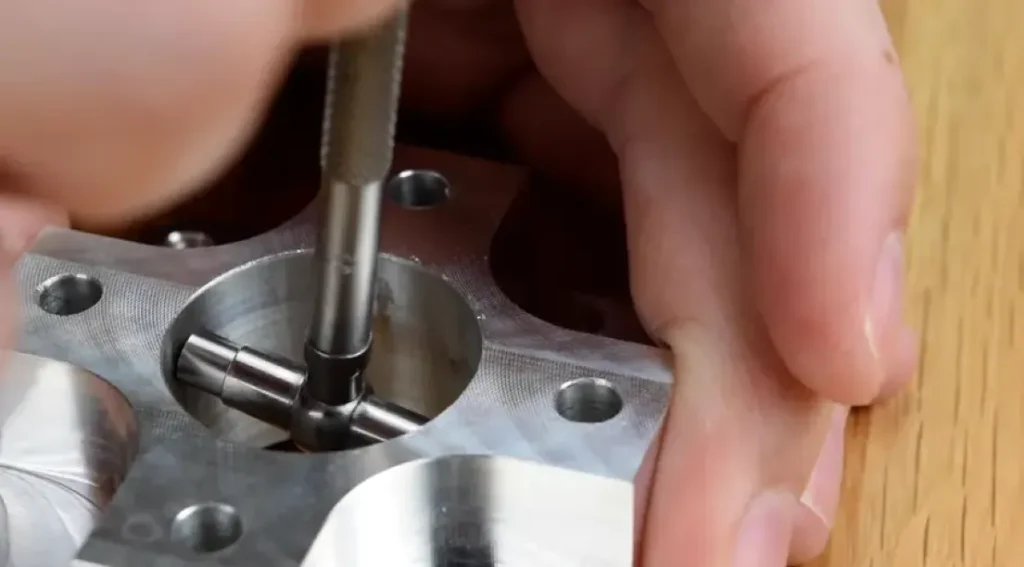
Finally, the drilled hole is inspected for depth, diameter, and position. Tools commonly used for this are bore gauges, plug gauges, and coordinate measurement machines (CMMs).
What are the Three Types of Drilling?
Drilling is available in spot, core, indexable insert, twist, and deep-hole forms. But the three main types of drilling are twist drilling, deep-hole drilling, and indexable insert drilling, differentiated by capabilities for hole geometry, application range, and production volume.
Indexable Insert Drilling – The drill body has replaceable carbide cutting inserts. An insert can be replaced with a new one when it gets damaged or worn out.
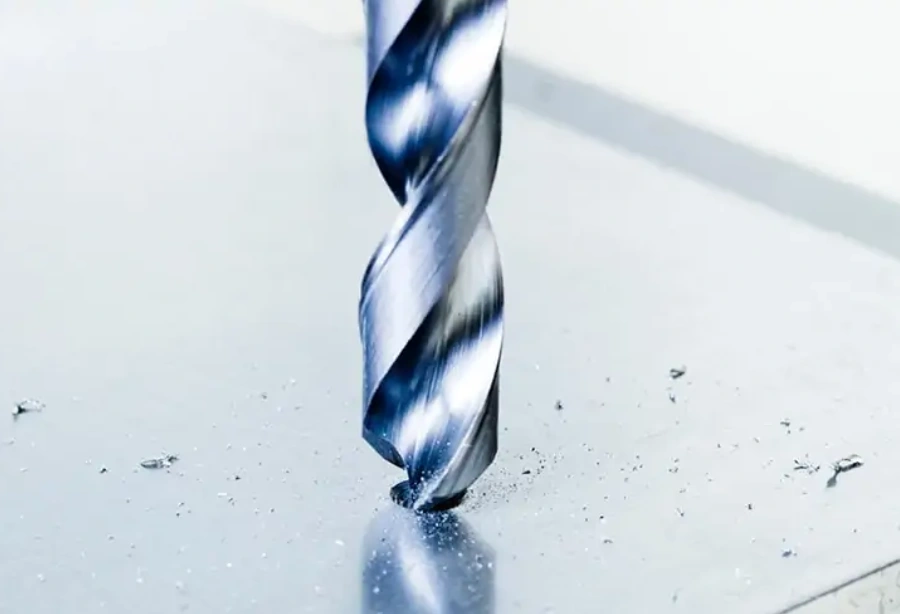
Twist Drilling – A twist drill, from which the process derives its name, has a pair of helical flutes and a tip. Its helical grooves facilitate chip removal.
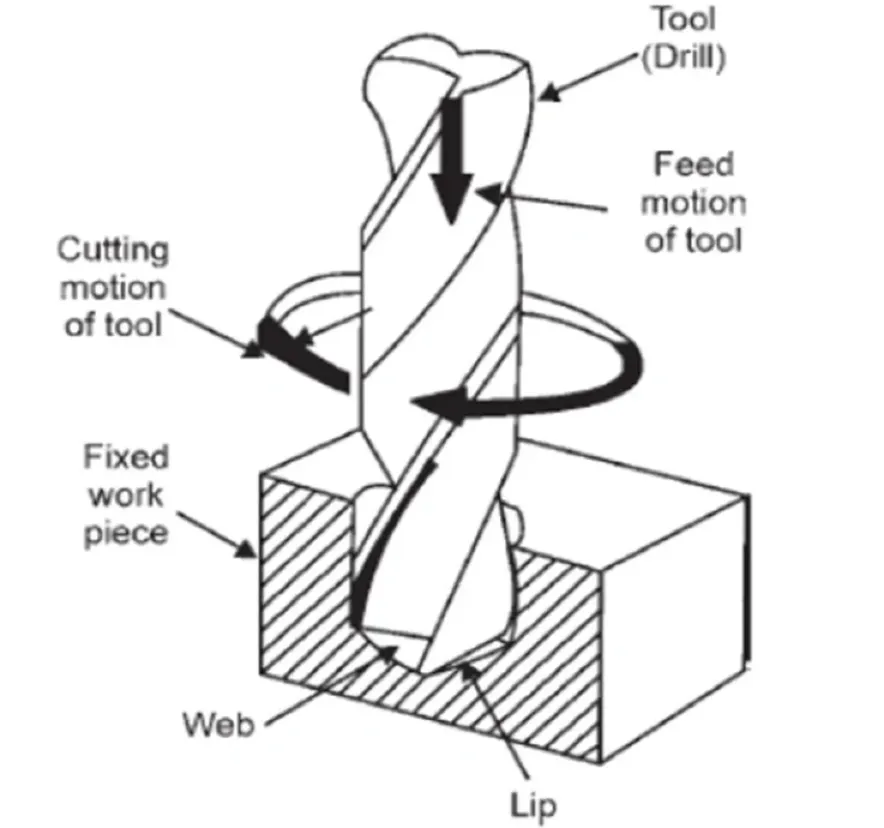
The main reasons you will find the twist drilling operation in almost every machine shop are its cost-effectiveness and versatility.
Deep Hole Drilling – Machinists use this drilling technique for holes exceeding 10 times the diameter. It is a standard procedure in BTA drilling and gun drilling.
Spot Drilling – Spot drilling is used to produce a narrow conical dent on the workpiece. The drill here is short and rigid. The main function of spot drilling is to provide a precise starting point for twist drilling.
Core Drilling – Core drilling is used to expand an existing hole. The tool doesn’t have a center point. However, it has multiple flutes. The process is mostly used to attain a more precise hole diameter before reaming or boring.
Advantages of Drilling
Drilling is versatile, scalable, cost-effective, and fast. It also doesn’t require the existence of a hole.
- Versatile: Drilling applies to a broad range of diameters and engineering materials. There is often no need to reconfigure the drilling machine for composites, metals, and plastics.
- Scalable: The drilling tooling seamlessly integrates into different machines. It can be easily automated. It can accommodate volume increase.
- Cost-Effective: The drilling tooling is relatively cost-effective. Drilling delivers acceptable results if the holes are not overly precise.
- Fast: Drilling offers the highest material removal rate compared to boring and reaming.
- No existing hole required – Unlike reaming and boring, drilling starts from a solid workpiece.
Limitations of Drilling
Precision hole drilling has its limitations, which include thermal damage, work hardening, positional drift, and poor finish in deep holes.
- Thermal Damage: The cutting rips and edges generate significant heat. For some materials, such as heat-treated steel, thermal dynamics can alter the material’s surface microstructure near the cutting zone.
- Work Hardening: Incorrect feed rates trigger plastic deformation at the surface of the drilled hole. The work-hardened surface promotes tool wear and can cause tool breakage.
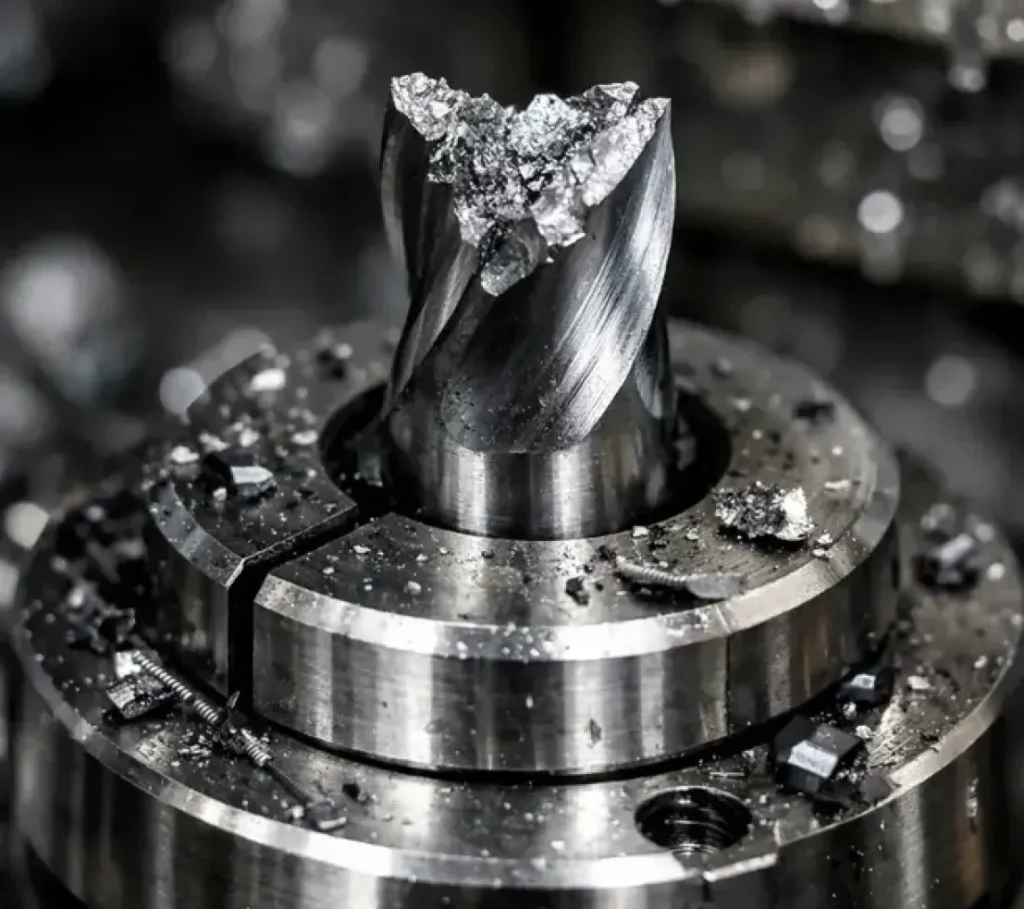
- Positional Drift: Drill bits tend to deflect on entry. This problem can be prevented by spot drilling at the start of the cut.
- Poor Finish in Deep Holes: Chip evacuation in deep holes is challenging. As chips re-enter the hole, they can damage the hole surface.
What is Boring?
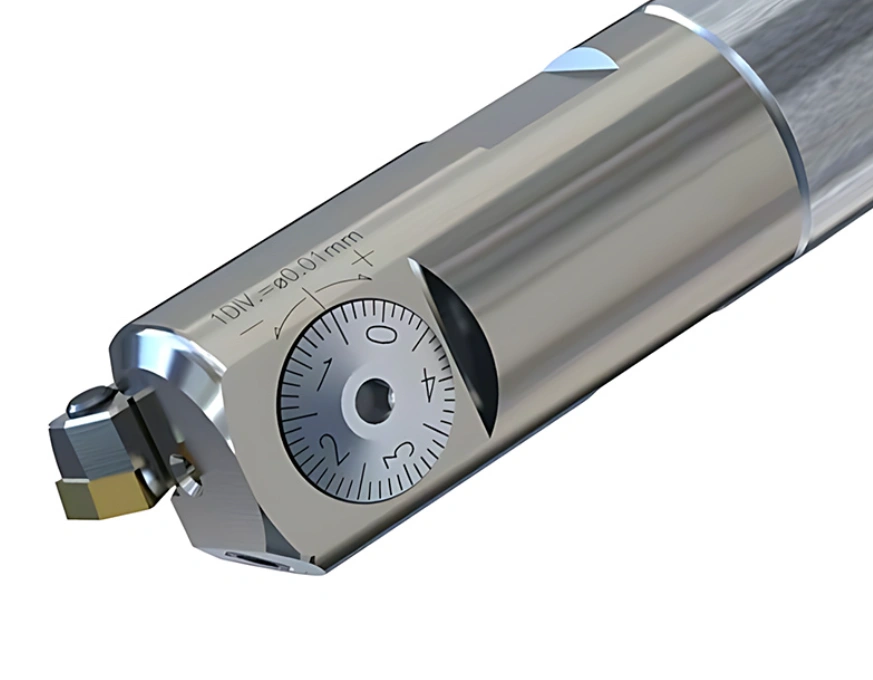
Boring is a hole-making operation that is performed on an existing hole to either attain more precise dimensions or enlarge the hole. The operation is done using a boring tool. An adjustable boring head can be used to adjust the tool’s diameter as it enters the hole axially.
The boring tool is aligned to the hole axis – it thrives in correcting and refining the hole. The machinist will use boring machining to remove the positional deviation that occurs during drilling.
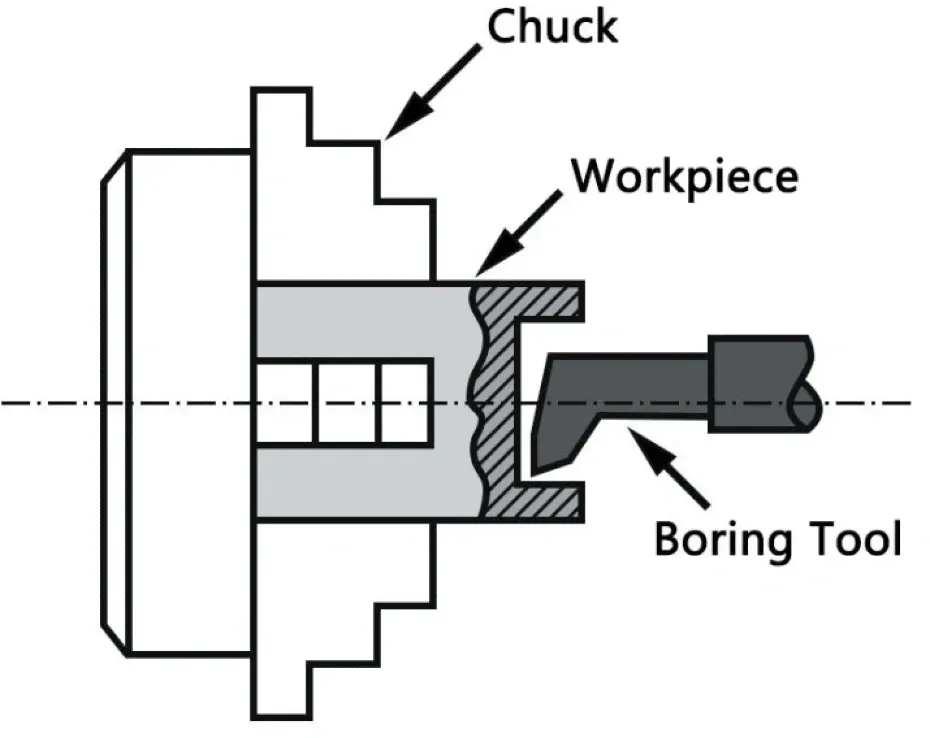
When performed on the CNC lathe, boring is considered a CNC Turning operation. When performed on the machining center, boring is considered a milling-type operation.
These are types of operations defined by a stationary tool (in this case, a boring bar) and a workpiece rotating against it.
How Boring Works?
Boring machining is characterized by a single-point tool advancing axially into a pre-drilled hole. The cutting insert in the tool removes a small amount of material from the hole walls.
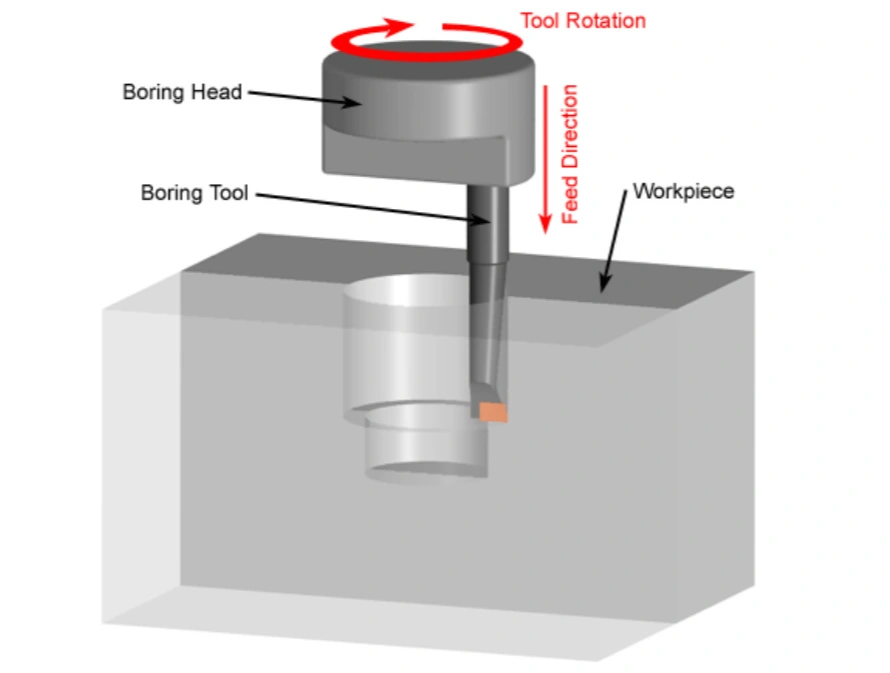
The specific material removed can be adjusted through CNC programming or manual adjustment of the boring head offset.
Rigidity is critical in boring machining. If there are long overhangs, the boring bar can experience chatter or vibrations. This affects dimensional accuracy and the surface finish. [4]
Types of Boring
The main types of boring are fine boring, line boring, back boring, jig boring, and rough boring. Let’s find out what each of these varieties offers in machining.
- Fine Boring: This type of boring produces the final finish and diameter of the bore using a single-point precision boring.
- Line Boring: Line boring uses a long boring bar to simultaneously produce multiple holes from the same centerline.
- Back Boring: It uses a backward-facing tool to machine bore surfaces that are unreachable using the standard forward machining.
- Jig Boring: This is an ultra-precise type of boring machining. It produces positional accuracy to within a few microns. Jig boring is commonly used in gauging machines and precision dies.
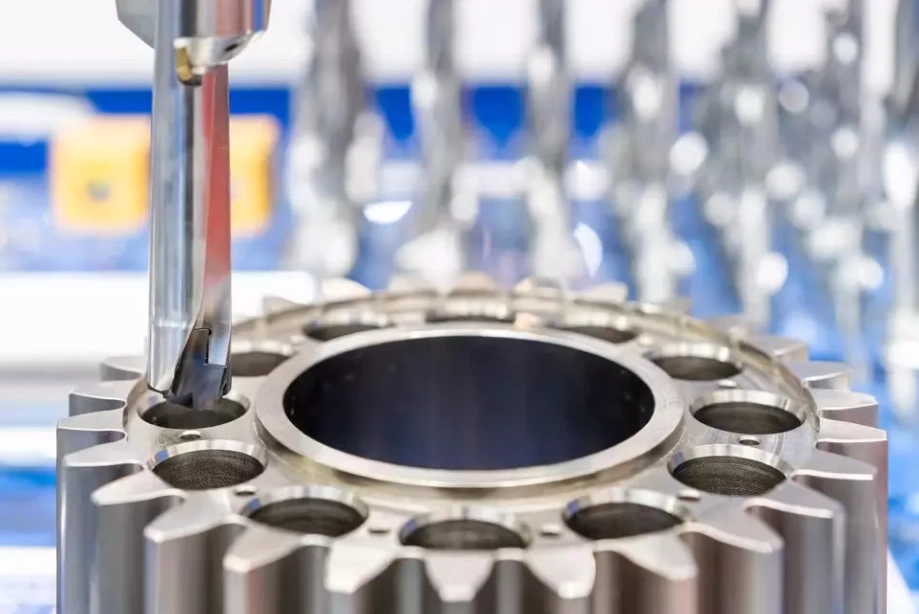
- Rough Boring: Rough boring precedes fine boring. Looking at the machining sequence for a hole, rough boring commonly comes after roughing. It is followed by fine boring and reaming in that order.
Advantages of Boring
Boring holes is normally a secondary hole-making operation, and its pros include error correction, surface quality, dimensional accuracy, scalability, and diameter flexibility.
Error Correction: Boring corrects geometric and positional errors of drilling.
Surface Quality: Fine boring can achieve Ra 0.8–1.6 µm, which is adequate for bearing and sealing surfaces.
Dimensional Accuracy: Boring can produce superior dimensional accuracy, which is required for precision mechanical assemblies and press fits, in line with IT6–IT8 requirements.
Scalability: Boring is easily automated in the CNC machines. Diameter offsets allow for non-stop production.
Diameter Flexibility: The use of a boring head helps cover a wide range of diameters.
Limitations of Boring
As a buyer, the constraints of boring to plan around are chatter sensitivity, low material removal rate, setup complexity, and relatively higher cost per hole.
Chatter Sensitivity: Cutting loads cause the boring bar to vibrate, particularly when machining deep bores. To mitigate this issue, machinists use minimal L/D ratios and carbide boring bars.
Low Material Removal Rate: Since it is a single-point cutting process, boring is relatively slow. It can increase costs in high-volume production.
Setup Complexity: Drilling and reaming don’t require head calibration, measurement verifications, and test cuts.
Relatively Higher Cost Per Hole: Due to the complexities mentioned above, boring is more expensive than reaming and drilling.
What is Reaming?
Reaming a hole is a precision machining operation for enhancing a hole’s accuracy and surface finish. It is performed with a reamer, a multipoint machining tool with flutes. The flutes can be helix or straight designs.
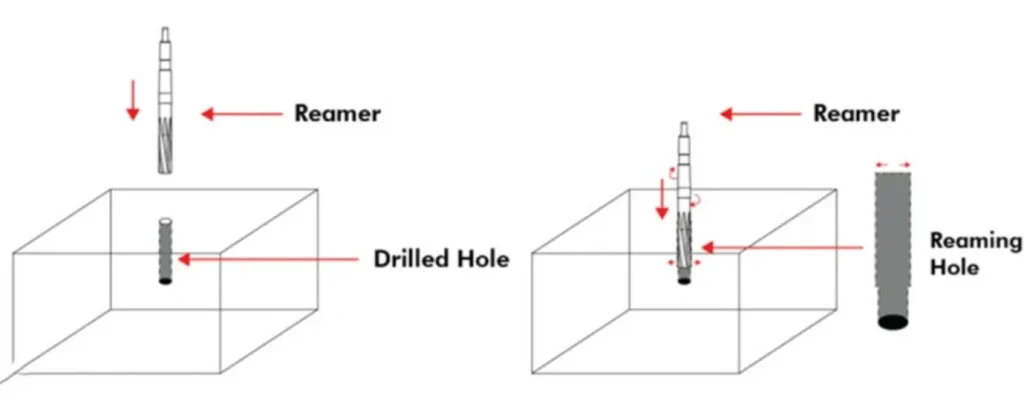
The purpose of reaming machining is to remove a small, measured amount of material (up to 0.3 mm). It works on a pre-drilled or pre-bored hole.
The improvement that reaming a hole brings to the dimensional and surface finish is superior, especially at production volumes.
How Reaming Works
Reaming a hole is also done axially into a pre-drilled hole in the workpiece. The tool, called a reamer, uses its chamfered edge to machine the hole-edge. The flute lands, burnishes and guides the tool.
Stock allowance is the most critical process parameter in reaming. For most applications, the diameter stock allowance should be between 0.1 mm and 0.3 mm.[3]
Types of Reaming
There are several types of reaming, including hand reaming, machine reaming, shell reaming, adjustable reaming, tapered reaming, and carbide-tipped reaming.
- Hand Reaming
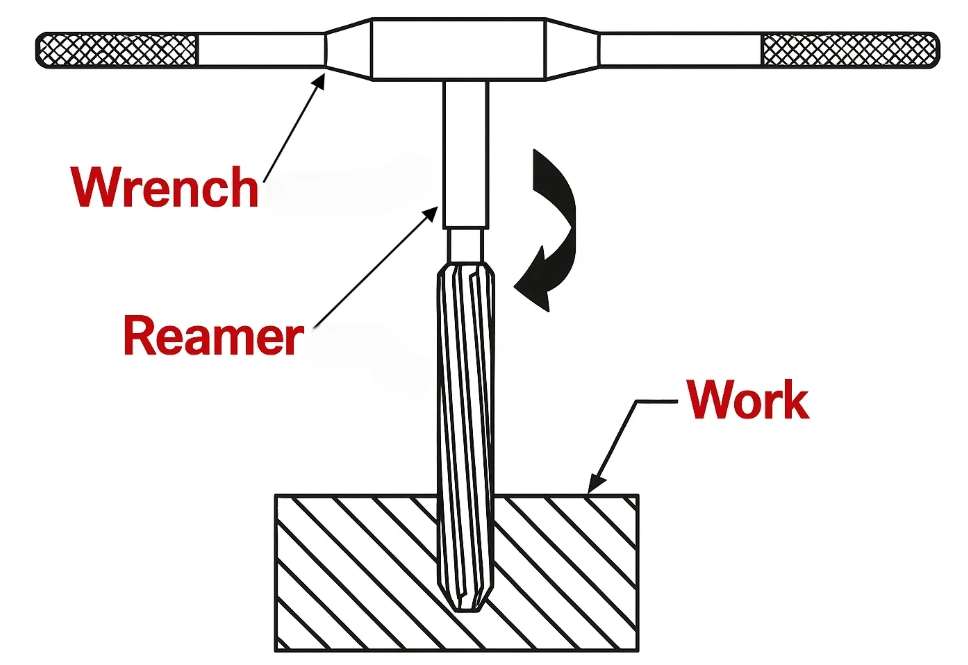
The reamer is turned manually using a tap wrench. It is ideal for single holes and repair work. Hand reaming is impractical for production work.
- Machine Reaming
The reamer is mounted in a CNC machine, where the feed and speed are controlled. This technology supports high-volume runs.
- Shell Reaming
A shell reamer comprises a large-sized reamer mounted on an arbor. This setup minimizes tooling cost. Shell reaming is ideal for holes larger than 20mm.
- Adjustable Reaming
An adjustable reamer is designed to change diameter as required, but within a set range. This type of reaming is mostly used for repair and maintenance work.
- Tapered Reaming
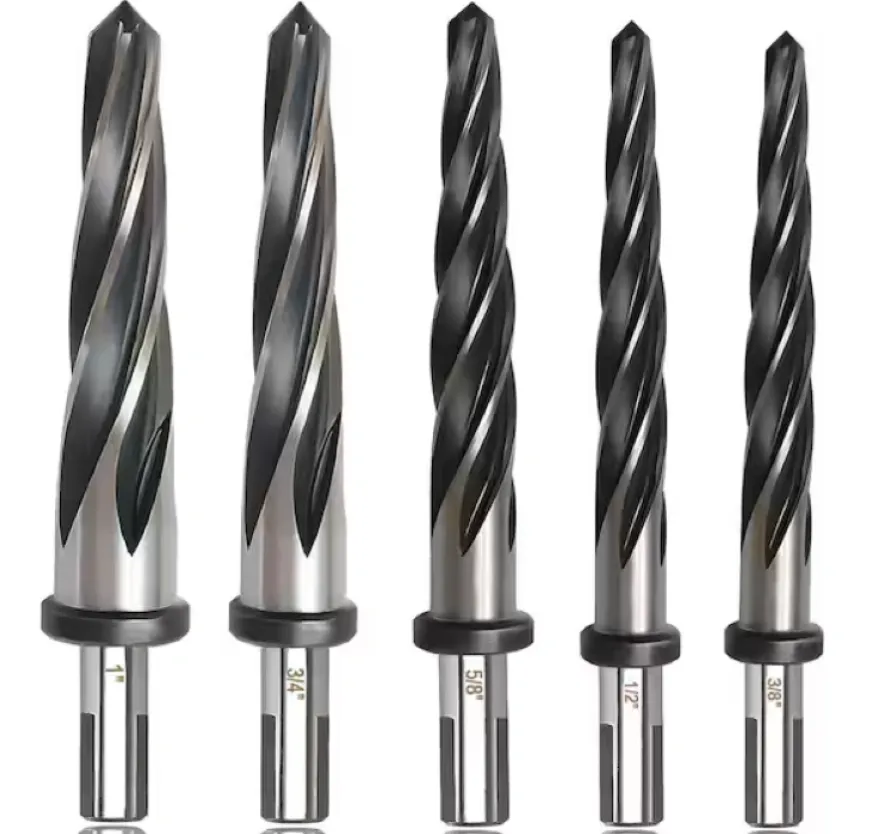
Tapered reaming finishes a hole that is progressively wider from one end to the other. It is commonly used to facilitate fit for tapered shafts or pins.
- Carbide-Tipped Reaming
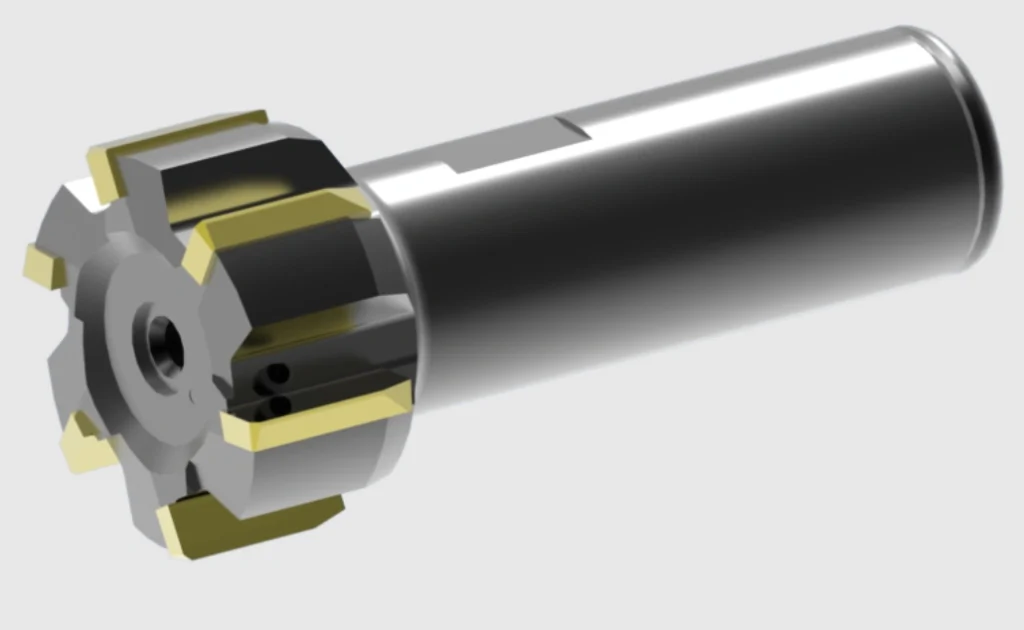
This reaming process uses a tool comprising a steel body and carbide cutting edges. The process is mostly recommended for cast iron and hardened steels.
Reaming vs Drilling: Why Use a Reamer Instead of a Drill Bit?
The advantages of reaming comprise process consistency, superior surface finish, tight tolerances, minimal thermal load, and cost-effective finishing. Here are a few angles for comparison of the reamer vs drill bit.
- Process Consistency: The finish and diameter in reaming are the same for every hole for a fixed geometry. The diameter and finish of drilling can vary due to tool wear.
- Superior Surface Finish: The process consistently produces Ra 0.4–1.6 µm [3], which a drill can struggle to achieve
- Tight Tolerances: Reaming is renowned for achieving tolerance grades of IT6–IT7 [1], which cannot be reliably achieved using drilling.
- Minimal Thermal Load: Reaming removes relatively little material from the workpiece – usually up to 0.3 mm in diameter.
- Cost-Effective Finishing: Reaming is a cheaper and faster method for simple blind and through holes. It delivers comparable results to internal grinding and honing.
So, in the reamer vs drill bit consideration, an important point to note is that reaming can only improve a hole that drilling has already produced. That is, reaming cannot correct any geometric or positional errors from drilling. That’s the function of boring.
Limitations of Reaming
Reaming is limited to refining a hole; it doesn’t correct significant geometric deviation. Other limitations are low stock allowance, material limitations, and tool limitations.
No Error Correction: Reaming relies on the existing hole axis. It cannot correct geometric or positional errors related to drilling.
Low Stock Allowance: Reaming machining results depend on the condition of the pre-existing wheel. The diameter allowance is limited to within 0.1–0.3 mm.
Material Limitations: Diameter inaccuracies and poor surface finishes are almost guaranteed when reaming gummy materials such as low-carbon steel and some plastics. Carbide-tipped reamers are usually employed to counter this challenge.
Tool Limitations: Reamers have diameter limitations. A reamer can easily get damaged in complex bore geometries or holes with interruptions.
Drilling vs Boring vs Reaming: Comparison Table
As shown in the comparison table below, the differences among drilling, boring, and reaming lie in function, surface finish, starting condition, accuracy, material removal rate, and applications.
| Aspect | Drilling | Boring | Reaming |
| Primary Function | Producing holes from solid material | enlarging/correcting existing holes | Finishing existing holes to tight tolerances |
| Surface finish (Ra) | 6.3–12.5 µm | 0.8–3.2 µm | 0.4–1.6 µm |
| Tolerance grade (ISO) | IT10–IT12 | IT6–IT8 | IT6–IT7 |
| Starting condition | Solid workpiece | Pre-drilled hole | pre-drilled/bored hole |
| Diameter flexibility | Fixed to the tool diameter | Adjustable | Fixed to the tool diameter |
| Material removal rate (MRR) | High | Average | Very low |
| Typical applications | Pilot holes, clearance holes | Large diameters, precision bores, bearing housings | Hydraulic bores, press fits |
*Tolerance grades according to ISO 286-1 [1]
*Surface finish values for standard production capability [2]
When to Use Drilling vs Boring vs Reaming?
Drilling, boring, and reaming have distinct ideal applications, which set them apart.
When to Use Drilling?
Drilling is commonly the first operation in the hole-making sequence. The operation is also reliable for producing holes with minimal concern for surface finish or fit. These include holes for fasteners, clearance, and cable routing.
However, note that drilling alone is not enough if the hole seals, mates, or loads.
Can Boring Improve Hole Accuracy After Drilling?
Boring machining is the preferred hole-making operation for geometric precision and positional accuracy. The purpose of boring is also to correct a drilled hole that needs tighter tolerances or has drifted out of position.
The boring tool is different from the drilling tool because it is aligned to the true axis of the hole. Boring sticks to the intended centerline. Any positional deviation from the drilling process can be corrected.
Consider if the drilled hole already matches the design positional and tolerance requirements. If it does, boring would be an unnecessary additional cost.
Is Reaming or Boring Better for Tight Tolerances?
Machinists opt to use reaming when the goal is IT6–IT7 tolerance with consistency and repeatability. Notable applications are precision assemblies, fits, and sealing surfaces.
A reamed hole is the standard solution for H7 holes required in press fits and bearings. [2][3]
There are instances when the hole only requires finishing and not correcting. For such, reaming is more cost-effective and faster than boring.
What Are the Similarities Between Drilling and Boring?
Drilling and boring are similar in that they both use rotary cutting tools, are controlled by the same fundamental cutting parameters, can be performed on the same machine, and can produce blind-holes and through-holes.
The core point is that while boring refines the hole created by drilling, the mechanism of rotary material removal applies to both processes.
What Goes Wrong When You Skip Boring?
Skipping boring can be counterproductive, but only when the functional requirements of the hole cannot be met by drilling alone.
Having said that, instances when skipping boring can be detrimental are;
Quality surface finish – Hydraulic bores and sealing surfaces must be smooth enough to prevent wear and leakage
High geometric accuracy – If roundness matters in an assembly, overlooking it can cause assembly errors
Tight tolerance fits – Drilling alone cannot hold the tolerance required for press fits and bearing seats
However, skipping boring can be harmless if you only require clearance holes or non-mating features.
So, the question to ask before skipping boring is whether the hole is for fitting, sealing, mating, or loading. If yes, skipping boring is risky. If not, skipping boring can actually be a time and money saver.
Design for Manufacturability (DFM) Considerations for Hole Machining
There are six DFM considerations for hole machining: Depth ratio, hole type, setup accessibility, tolerancing, diameter standardization, and entry surface geometry.
- Depth Ratio – The hole depth should be kept within 3x the diameter. Chip evacuation is more difficult and deflection is more pronounced at larger depths
- Hole Type – Through holes are preferable to blind holes. Chip evacuation is more complicated for blind holes
- Setup Accessibility – Designing for a single setup is recommended. Repositioning can introduce alignment errors and increase setup time.
- Tolerancing – The tightness of tolerance specification should only be as the functional demands to avoid unnecessary costs.
- Diameter Standardization – Hole diameters should be standardized to common tool diameters.
- Entry Surface Geometry – To prevent drill wander, the entry and exit surfaces should be flat. If this is not possible, spot facing would be necessary, but this adds cost.
The point is, the design requirements can differ for different holes. If a hole does not seal, mate, or load, simplifying its design is usually the better decision.
Conclusion
In machining, the choice among precision hole drilling, boring, and reaming depends on the intended hole’s functional requirements, surface quality, and assembly. Drilling is preferred when starting the hole, boring corrects and adds precision, and reaming finalizes the dimensional consistency and surface finish.
The key takeaway is that two or all three hole-making operations are usually required for precision holes. Optimizing the sequence, which involves cutting parameters, stock allowances, and cutting tools, is possible with an expert.
Need precision holes to IT6 tolerances or better? Prolean’s CNC machining services deliver drilling, boring, and reaming in a single workflow with DFM feedback, fast lead times, and tolerances down to ±0.005 mm.
Get a quote in 24 hours.
References
- https://www.engineersedge.com/international_tol.htm
- https://www.engineersedge.com/manufacturing/drill-mechanical-tolerances.htm
- https://www.walter-tools.com/en-gb/press/news/pages/2024-technical-compendium-holemaking.aspx
- https://cdn.walter-tools.com/files/sitecollectiondocuments/downloads/global/manuals/en-gb/technical-compendium-holemaking-2024-en.pdf
- https://uark.pressbooks.pub/mechanicaldesign/chapter/boring-tapping-and-broaching/
- https://www.sandvik.coromant.com/en-us/knowledge/drilling