
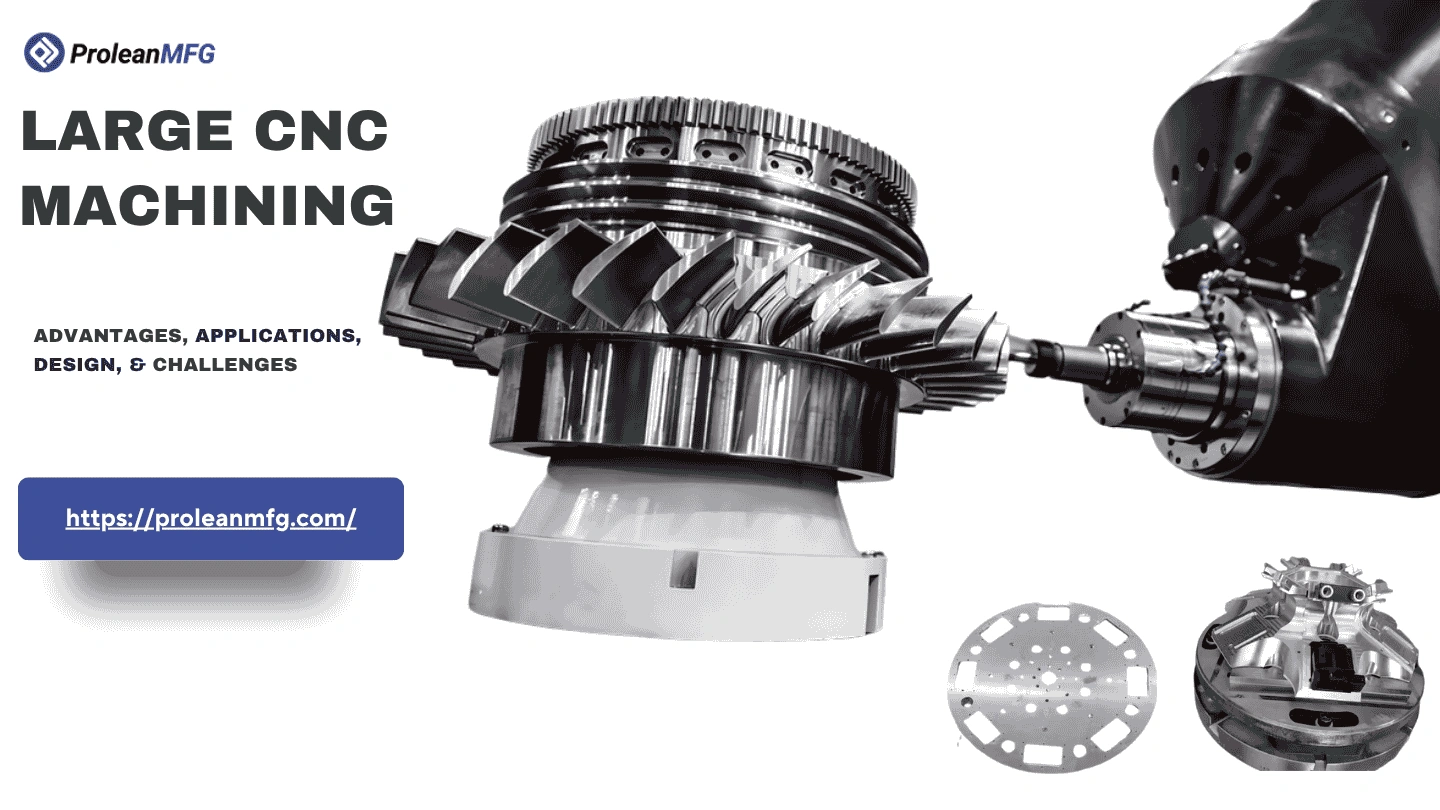

Large CNC machining delivers precision and speed in the manufacturing of extra-large components, such as energy structures, machine beds, shipbuilding components, industrial tooling, and aircraft engine mounts.
What makes it different from standard CNC machining is the machining scale, process control, thermal sensitivity, and end applications. Consequently, large-scale machining demands specialized equipment, effective tooling strategies, and effective thermal management.
This article will guide you through large CNC machining processes, equipment, critical considerations, advantages, disadvantages, and applications.
What is Large CNC Machining?
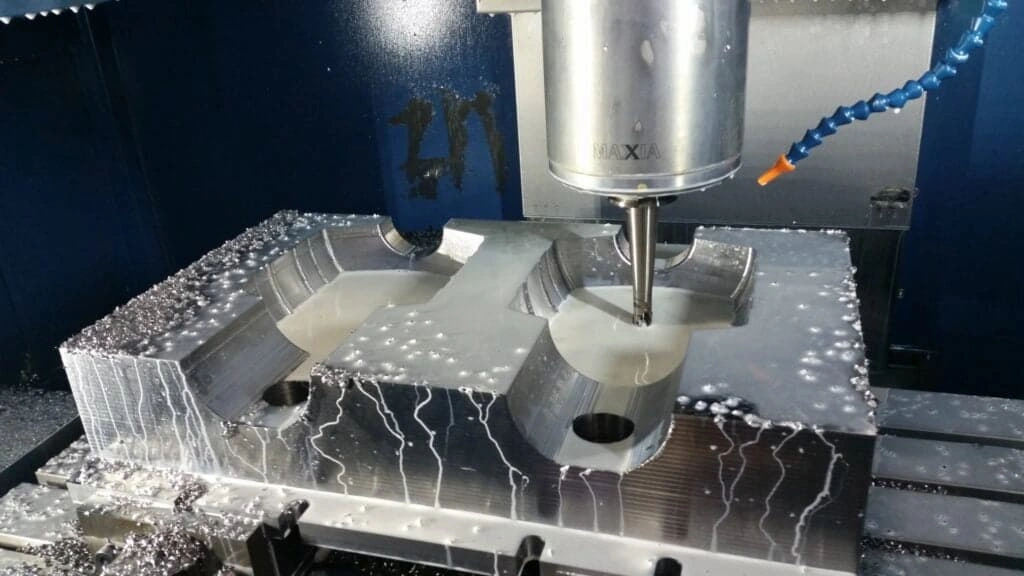
Large CNC Milling is characterized by the machining scale. It involves shaping any workpiece larger than 3 ft (about 36″ x 20″ x 20″) or with a diameter larger than 1 ft through material removal. This process is particularly useful for the production of large, heavy, and complex components.
For large CNC machining, rigid and powerful equipment is used, such as horizontal machining centers, gantry mills, and vertical bridge mills. The spindle can move 3+ meters along the axis.
Furthermore, it can work with diverse materials to produce a range of industrial components. Common materials are cast iron, stainless steel, alloy steel, and aluminum.
How Large CNC Machining is Different from Standard CNC?
The main difference between large CNC and standard CNC machining is the size of the workpiece they can handle. Standard CNC typically handles parts up to ~ 2 m in size, whereas it can exceed 10 m in large part machining.
A large CNC machine requires heavy equipment with a bed size of 2 x 8 m or higher. The equipment structure and setup must be rigid to withstand high cutting forces and vibration. Additionally, the swing diameter must be higher than 2 m for large part lathe machining.
Equipment Used in Large CNC Machining
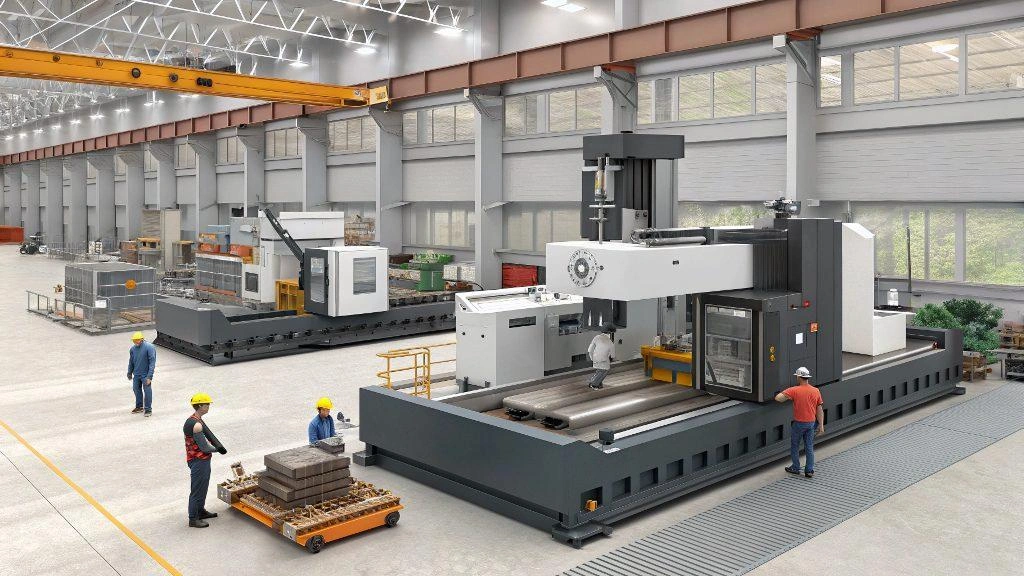
Gantry mills, vertical bridge mills, heavy-duty mills, and horizontal boring machines are common equipment used in large CNC machining.
- Gantry Mills: These are large & rigid milling machines with a large bridge spanning across material and come with 3 or 5 axes capabilities.
- Vertical Bridge Mills: These can be used for CNC milling for large parts, such as bases, plates, and foundations.
- Heavy-duty Lathes: These machines are suitable for large part CNC turning of cylindrical workpieces, typically with a diameter larger than 12 ″.
- Floor-type Mills: These are suitable for machining long and oversized components, such as beams.
- Horizontal Boring Mills: These boring machines involve horizontally oriented spindles, useful for creating deep pockets & slots on large workpieces.
What Are the Advantages of Large Component Machining?
Reduced need for assembly, structural integrity, heavy-duty precision, faster production, and repeatability are the advantages of large component machining.
Let’s further break down these advantages.
- Reduced Need for Assembly: As it allows the creation of oversized components, assembly steps can be reduced. Heavy component machining also reduces the number of unique items in your Bill of Materials (BOM) or other types of bills.
- Structural Integrity: large part lathe machining, milling, drilling, or any other processes eliminate the need for joints or welds. So, the structural integrity of machined items remains intact.
- Heavy-duty precision: In heavy-duty machining, it provides a general tolerance of ± 0.1 to 0.3 mm.
- Faster Production: With fewer assembly steps, shorter cycle times, and CNC automation, large CNC machining delivers a faster lead time.
- Repeatability: CNC programming enables the production of consistent, oversized parts for prototyping or small-volume projects.
Applications of Large CNC Machining
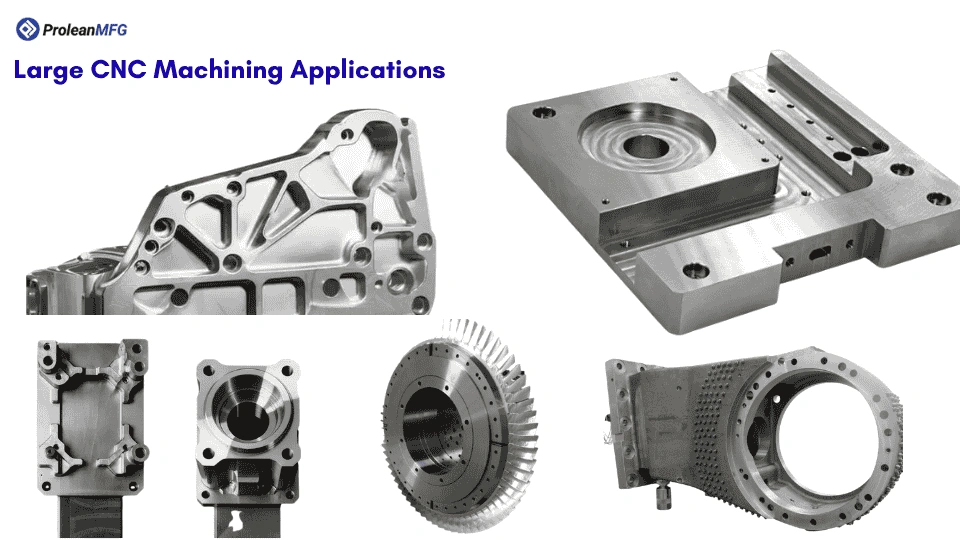
Large or CNC heavy precision machining is used to produce strong, rigid, and durable components for energy, industrial machinery, aerospace, automotive, mining, transportation, shipbuilding, and other industries.
Next, the table below outlines examples of large CNC machining applications.
| Industry | Application Examples |
| Energy | Generator rotors, wind turbine blades, housings, pressure vessels, etc. |
| Heavy Machinery | Equipment bases & frames, molds, conveyor system parts, automation components. |
| Aerospace | Aircraft wing spars, turbine parts, structural items, fuselage frames, and satellite housings. |
| Automotive | Gearbox casings, EV battery housings, engine cylinder heads, structural components. |
| Mining | Bases for drill rigs, gear housings, crusher frames, excavator arms, etc. |
| Shipbuilding | Hull parts, propeller shafts, hubs, offshore platform components |
What Are the Challenges of Large CNC Machining?
Tolerance limitations, need for specialized equipment, thermal management, vibration & chatter, and shipment of machined components are the main challenges of large CNC machining.
Let’s take a look at each of them.
Tolerance limitations
It is challenging to maintain tight tolerances in large part lathe machining and milling, like in standard or micro CNC machining processes. Heavy advance precision machining offers a general tolerance of ±0.1 mm.
Need for Specialized Equipment
Regular or small CNC equipment cannot handle large workpieces. You need industry-scale specialized lathes & machining centers.
Thermal Management
Excessive heat generation is another major challenge in large part CNC turning, milling, drilling, or any other processes. Due to high feed rates and a large engagement area between the tool & material, more heat is generated. If proper coolant is not applied, it can cause workpiece defects and rapid tool wear.
Vibration and Chatter
Due to high cutting forces and the workpiece’s size, vibration and chatter can occur, affecting machining accuracy. Therefore, the machine base, structure, and setup must be rigid & stable.
Shipment Challenges
Due to the large weight of components, it is challenging and costly to ship the produced items to the desired locations. However, we have a strong logistics support at ProleanMFG, which not only ensures low costs but also quick deliveries.
Design Guidelines for Large CNC Machining
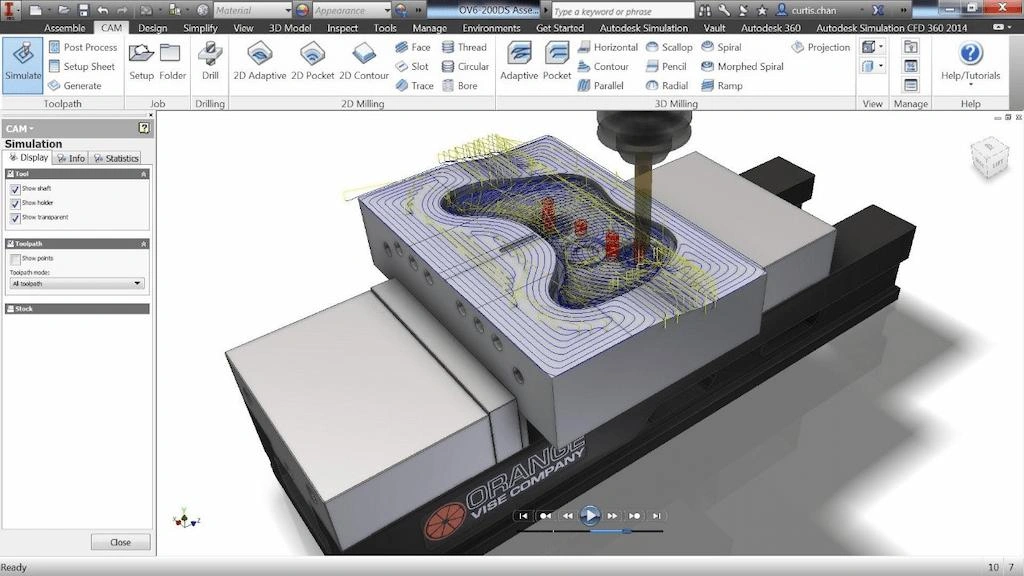
While designing a large part for CNC machining, consider Design for Manufacturability, CAM simulation & tool path, over-tolerancing, and thermal stress.
- Design for Manufacturability: Consider CNC capabilities for the large parts you have and the geometric features in your design, such as slots, grooves, and cavities.
- CAM Simulation: Choose appropriate, accessible tools for the desired machining areas, then perform a CAM simulation to optimize the tool path.
- Avoid Over-tolerancing: Design tolerances should be realistic and achievable.
- Thermal Stress: Consider heat buildup, coolant system, and material behavior.
Large CNC Machining Materials
Large CNC machining can work with cast iron, aluminum alloys, carbon steels, stainless steels, copper alloys, titanium alloys, and some engineering plastics & composites.
The table below outlines grades/types and properties of common materials used in large part machining
| Material | Grade / Types | Properties |
| Cast Iron | Gray Iron, Ductile Iron | High compressive strength and vibration damping, cost-effective |
| Aluminum Alloys | 6061, 7075, 2024 | Lightweight, high strength, thermal conductivity, machinability, corrosion resistant |
| Carbon Steel | AISI 1018, 1045 | High strength, low cost, and toughness |
| Alloy Steel | 4140, 4340 | High strength, fatigue resistance, and good wear resistance |
| Stainless Steel | 304, 316, 17-4 PH | Corrosion resistant, strong, good toughness |
| Titanium Alloys | Ti-6Al-4V | Lightweight & strength, high corrosion resistance, thermal stability |
| Copper Alloys | C101, Brass C360, and Bronze grades | electrical & thermal conductivity and ductility |
| Plastics | Nylon, POM, PEEK, and PTFE | Lightweight, corrosion-resistant, low-friction, chemical-resistant |
What Are the Large CNC Machining Capabilities?
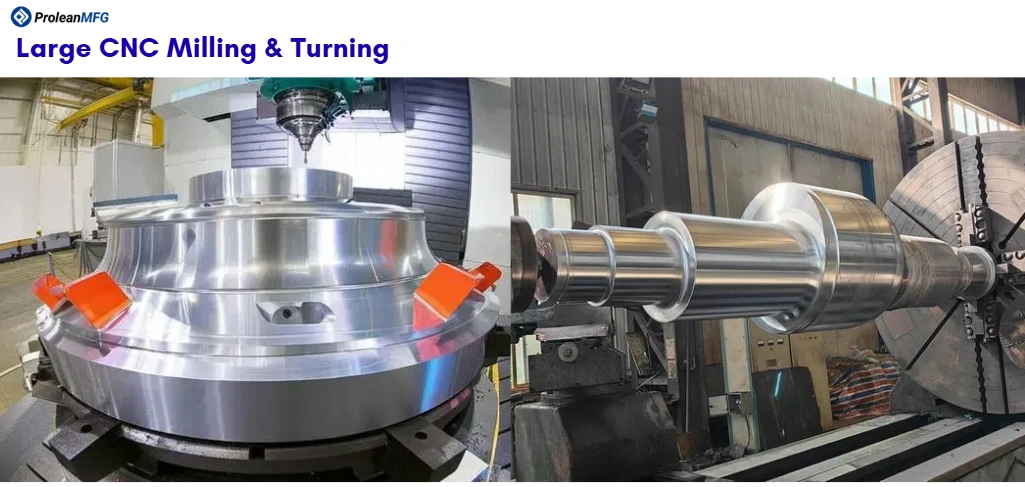
Large CNC machining can perform CNC turning, vertical milling, boring, and other processes for oversized parts manufacturing. At ProleanMFG, we have all these capabilities to deliver precision and diversity in applications. Our services offer design flexibility, complexity in large part machining, and customization.
Let’s further break down the CNC capabilities for large parts.
- Large Part CNC Turning: It handles cylindrical workpieces with a diameter larger than 12 inches. You can choose this for turbine shafts, crankshafts, hydraulic cylinders, etc.
- Vertical Milling: Large part vertical machining is suitable for flattening, contouring, profiling, slotting, and other operations.
- Boring: Large CNC machines with rigid spindles are used for machining of large diameter bore holes with dimensional & positional accuracy.
- Precision Finishing: This capability delivers smooth surfaces, with roughness of 0.8 µm or lower.
How to Choose a Large CNC Machining Partner?
To choose a reliable CNC machining partner for your large parts, consider available equipment, industry-relevant experience, design support, logistics, and cost competitiveness.
Available Equipment
First, consider what kind of large CNC machining equipment and quality control machines a manufacturer has. It is important to ensure that the available CNC capabilities for large parts meet your requirements.
Industry-relevant Experiences
The partner you choose for heavy component machining must have similar industry experience to the one you are making parts for. You can ask about previous projects and clients, and even request for related project catalogs.
Design and Other Supports
DFM impacts overall machining accuracy and cost, so consider whether the manufacturer provides design assistance, material selection, and other engineering support. It is especially critical for startups and small businesses.
Logistics
To avoid delays, ensure the manufacturer has logistics support to deliver large-sized parts to your location without damage.
Cost Competitiveness
After analyzing the factors mentioned above, send your design file and request an estimation. You can ask multiple manufacturers for quotations and evaluate cost competitiveness and their offerings.
Is it Expensive to Outsource Large CNC Machining Services?
Compared to standard CNC, the per-hour machining cost and logistics costs are higher for large parts machining, but it is cost-effective to outsource the services. The high initial investment for equipment and required installation space justifies the machining prices.
Outsourcing CNC machining services from ProleanMFG for large and heavy component machining can save both time and money.
Summing Up
To sum up, large CNC machining plays an important role in manufacturing oversized components for automotive, aerospace, energy, and other diverse industries. It provides a balance of machining scale, speed, precision, and cost. Saying this, you must use the right CNC equipment, tools, and procedures.
Furthermore, it is equally important to choose the right CNC machining pattern for your project. At ProleanMFG, we have extensive CNC capabilities for large parts, ensuring precision, cost-effectiveness, and quick leads.
Our multi-axis CNC equipment handles complex geometries and diverse materials. Additionally, the quality-control facility is equipped with CMM machines, digital inspection systems, gauges, and other instruments.
For further information about our CNC Machining Services, or an instant quotation, upload your design file.