
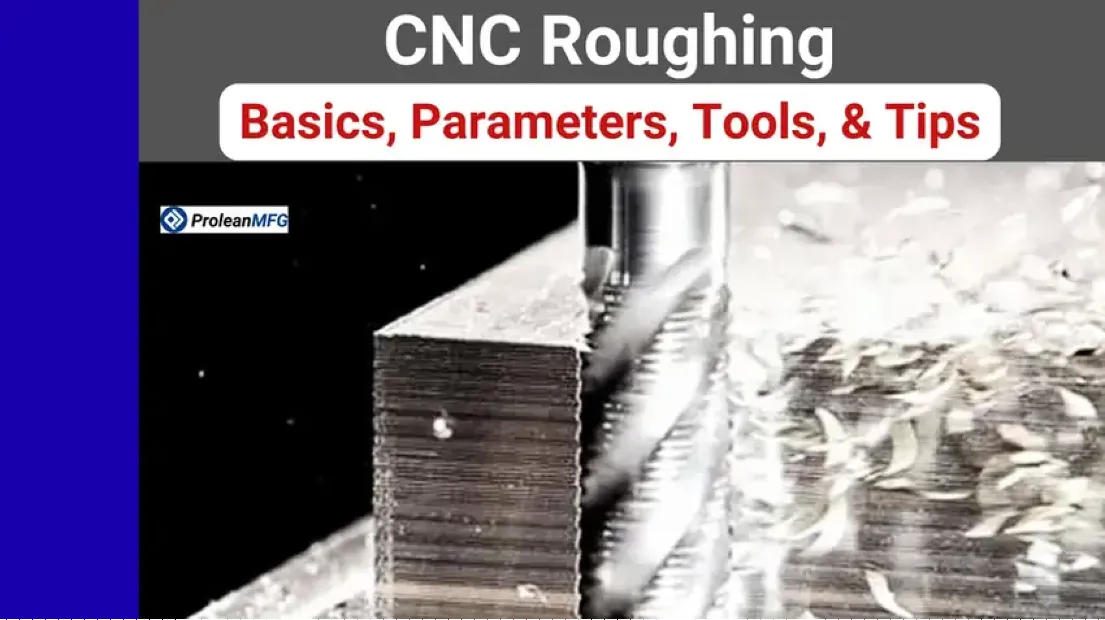

CNC roughing is the initial step in CNC machining. It involves fast and efficient bulk removal of material in preparation for subsequent finishing milling, turning, or other form of machining. This critical process does the heavy lifting in CNC machining. It shapes the raw stock into something close to the final piece.
Specific tools such as roughing end mills, twist drills, and indexable roughing inserts are prominent in rough milling and other roughing operations. Alongside the right tooling, the machinist requires proven and tried machining strategies.
Starting a CNC project on the right footing makes a lot of difference – and roughing cuts are the fundamentals of the process. But even with knowledge of CNC machining, a specific understanding of roughing and finishing can help achieve more accurate, smoother machining results.
The points outlined and more about roughing have been covered in more detail within this article.
What Kind of Process is Roughing?
Definition of CNC Roughing
Roughing is the initial stage in CNC machining. It involves the fast removal of excess material from the workpiece to bring its shape as close as possible to the design requirements. Every great, accurate cut starts with roughing.
Unlike CNC finishing milling, which emphasizes part appearance and detail, CNC roughing focuses on faster material removal. That’s why CNC roughing tools are built with sturdier cores, deeper flutes, and aggressive cutting edges.
What are the Benefits of CNC Roughing?
Applying the right CNC roughing strategy doesn’t just speed up the machining process – it protects the finishing milling tools, enhances chip control, lowers operating costs, and promotes part durability and strength.
- Speed up the machining process
Roughing machining has a high Material removal rate (mrr) of between 100 and 500 cm³/min to ensure as much of the material stock is removed in a minimal number of passes. [1] With adaptive clearing and other high-efficiency approaches, a consistent chip load can be maintained. Shorter lead times are therefore achievable for high-volume setups.
- Protects the finishing tools
Finishing tools are relatively delicate; pushing them against large chunks of stock is one way to break them. By leaving a 1%-2% of the finishing tooling diameter engagement, roughing ensures that finishing tools always operate at efficient levels. [2]
- Enhances chip control
Effective CNC roughing enhances chip management through;
- Peck drilling cycles
- Use of serrated end mills
- Application of trochoidal toolpaths [4]
- Use of powerful through-spindle coolant
- Lowers Operating Costs
Optimized roughing cuts reduce machining costs along key aspects, namely spindle time, tooling, and scrap rate.
Spindle time – For a CNC machine running at about $100/hr, every second saved by roughing can have a significant impact on volume orders.
Tooling – Multiple cutting edges in indexable insert tooling spread the cost
Scrap – A good roughing strategy reduces scrap at the finish machining stage, where the cost of tool damage is likely to be higher.
- Promotes Part Durability and Strength
Roughing affects the metallurgical integrity of the machined part, specifically concerning residual stress redistribution. This minimizes post-machining geometrical distortion.
Comparing CNC Roughing and Finishing
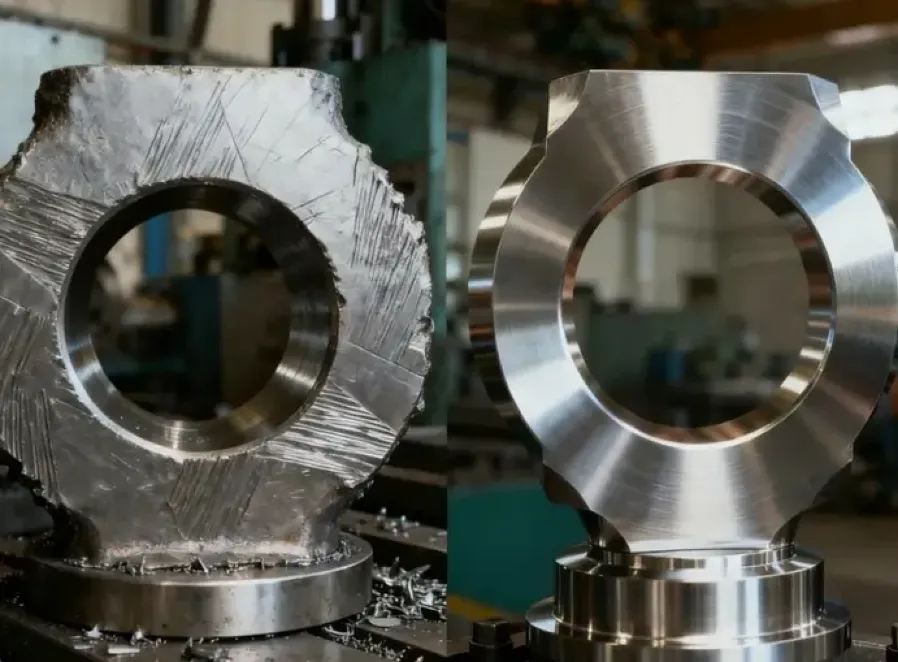
CNC roughing and finishing can be compared along elements such as primary function, tolerance, depth of cut, feed rate, surface finish, typical tooling, and stepover.
| Element | CNC Roughing | CNC Finishing |
| Primary Function | Maximum material removal rate (MRR) | Quality surface finish and dimensional accuracy |
| Tolerance | Loose tolerance of up to 0.3 mm | Tight tolerance at approximately ±0.01 mm |
| Depth of Cut | High – 1–3× tool diameter | Low – up to 0.5 mm |
| Feed Rate | High | Minimal |
| Surface Finish | Tool marks expected | Ra between 0.4 and 3.2 µm |
| Typical Tooling | High-feed mills, indexable insert mills | Reamers, solid carbide end mills |
| Main cost driver | Tooling and spindle time | Inspection and tooling precision |
The CNC Roughing Process
The first step in the CNC roughing process is CAM programming. This is followed by loading of the raw stock, machining, and process control.
Step 1: CAM Programming
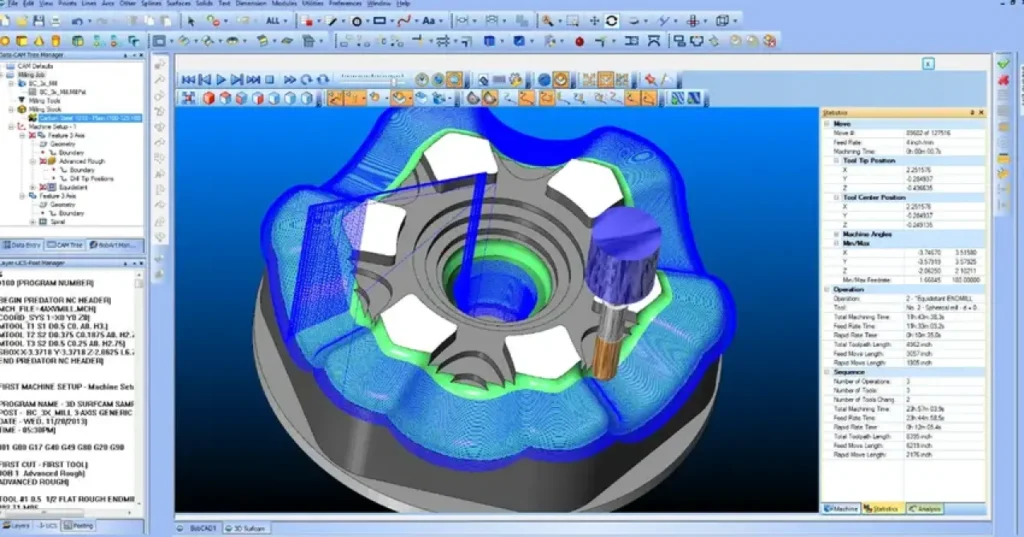
CAM programming is the formulation of a roughing or machining strategy from the material spec and part model. Key elements in this step include feed rates, tool selection, depth of cutting, and optimized toolpaths.
Step 2: Loading Raw Stock
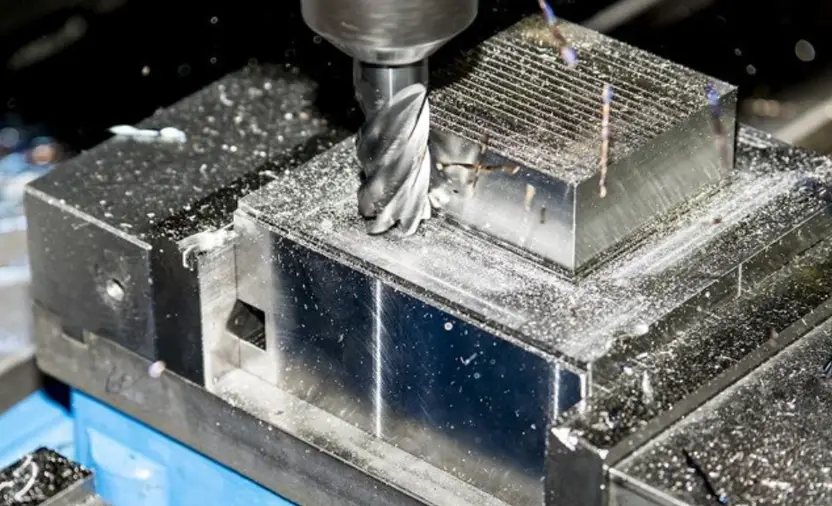
The material stock is fixed to the machine, and the program datum offset is set. Once the stock dimensions and fixture rigidity are confirmed, the machinist can proceed to perform the roughing operation.
Step 3: CNC Machining
The cutting tool engages and removes material from the stock progressively, as set in the CNC program. By the time this step is complete, the part geometry has already started to be recognizable.
Step 4: Process Control
The machinist uses methods such as CMM and probing to measure the remaining stock. After checks and approval, the machined part proceeds to other operations. The part has to be within the allowance; if not, it is reviewed.
CNC Roughing Strategies
The main CNC roughing strategies are conventional machining, adaptive clearing, high-feed milling (HFM), and high-efficiency milling (HEM).
- Conventional Machining
- Adaptive Clearing
- High-Feed Milling (HFM)
- High-Efficiency Milling (HEM)
What Are Common Challenges in CNC Roughing?
If CNC roughing is not executed correctly, challenges that may arise include vibration, tool wear, chip formation, and heat generation.
- Vibration – Aggressive roughing machining generates cutting forces that cause tool vibration. To avoid the dimensional inaccuracy, rigid toolholders, higher RPM, and reduced radial engagement are recommended.
- Tool Wear – Some materials, including stainless steel and titanium, retain heat. This accelerates tool wear and risks workpiece damage. Through-spindle coolant at least 70 bar and coated carbide tools are effective solutions.
- Chip Recutting – When chips remain at the cut zone, they are recut and can easily damage the tool and workpiece. Coolant combined with an optimized chip evacuation strategy is a common measure against the problem.
- Workpiece Distortion – Thin-walled parts can get distorted due to strong clamping forces. The solutions for this problem include re-fixturing mid-operation and sequence rough cutting.
What Are The Different Types of Roughing?
The main types are adaptive clearing, face milling, pocket roughing, and profile roughing.
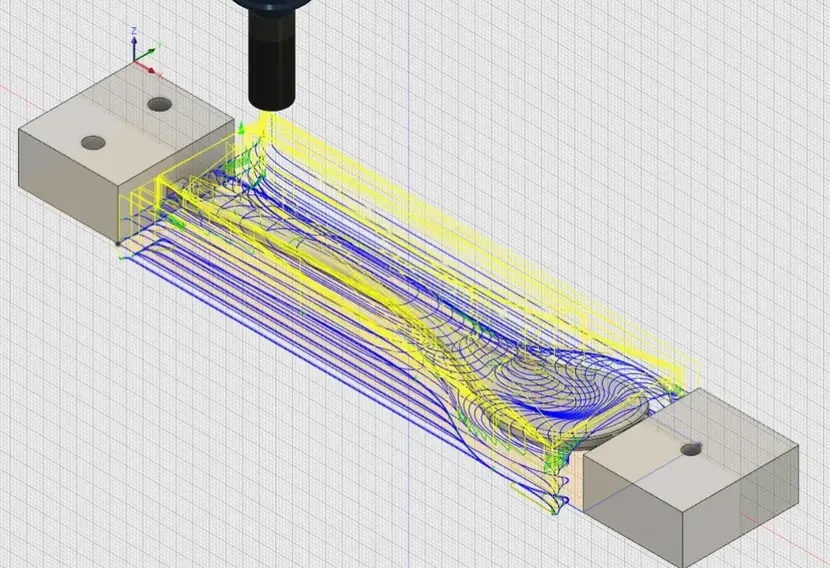
- Adaptive Clearing: This technique is characterized by toolpath adjustment to go with geometry changes. It involves high axial depth and low radial depth. Benefits include longer tool life and consistent cutting forces. Adaptive clearing is ideal for complex geometries and hard-to-machine materials such as Inconel.
- Face Milling: This is a top-down style of roughing machining of a flat surface. Since the style is for simple flat surfaces, it is straightforward and allows for high MRR. You will commonly witness this method in the manufacture of things like housings, flanges, and plates.
- Pocket Roughing: Pocket roughing entails a step-down style of machining. Layers are machined in succession, making it possible to handle cavities. The machinist must be capable of managing corner engagement and evacuating chips effectively.
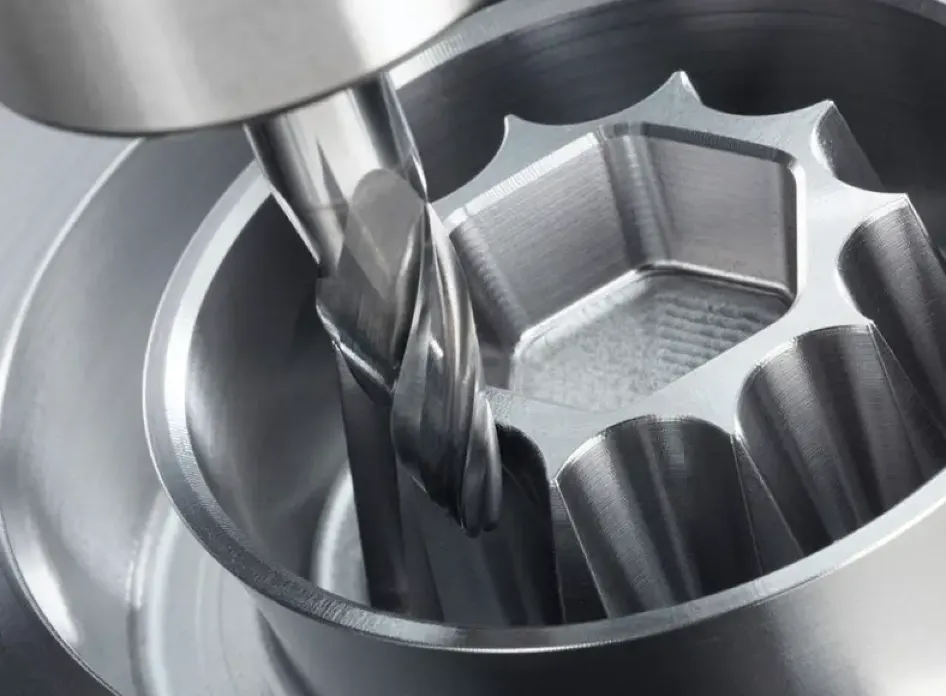
- Profile Roughing: The cutting tool follows the outline or profile of the workpiece. In other words, this operation focuses on the perimeter. It is ideal for external part geometry.
Cutting Parameters for CNC Roughing
Important variables to focus on when dealing with CNC roughing services are Radial Depth of Cut (Ae), Axial Depth of Cut (Ap), Cutting Speed (Vc), and Feed Rate.
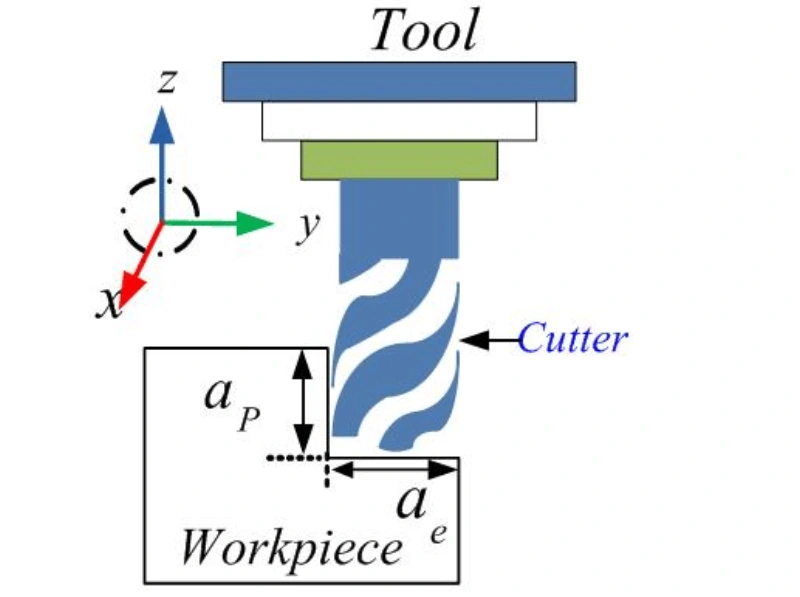
Radial Depth of Cut (Ae)
Traditional roughing uses up to 70% the tool diameter radially, but adaptive methods restrict it to 15%.
Axial Depth of Cut (Ap)
Ap measures how deep the tool engages the workpiece vertically. Traditional rough milling runs at around 1–3× tool diameter. The measurement is smaller up to 0.3× tool diameter) in high–feed scenarios.
Cutting Speed (Vc)
This parameter is measured in m/min or SFM. It depends on the material and cutting tool. Aluminum, which is relatively softer, can accommodate a cutting speed of 200–600 m/min, compared to approximately 80 m/min in hardened steel. [5]
Feed Rate
The feed rate refers to the speed of the cutting tool towards the workpiece. It can be denoted as a linear feed rate (mm/min) or mm/rev (millimeters per revolution).
What Tools Are Commonly Used in CNC Roughing?
Different machining materials and jobs demand specific roughing tools. Options include indexable roughers, shell mills, serrated end mills, twist drills, and roughing end mills. Others are center drills, deep-hole drills, turning tools, and face mills.
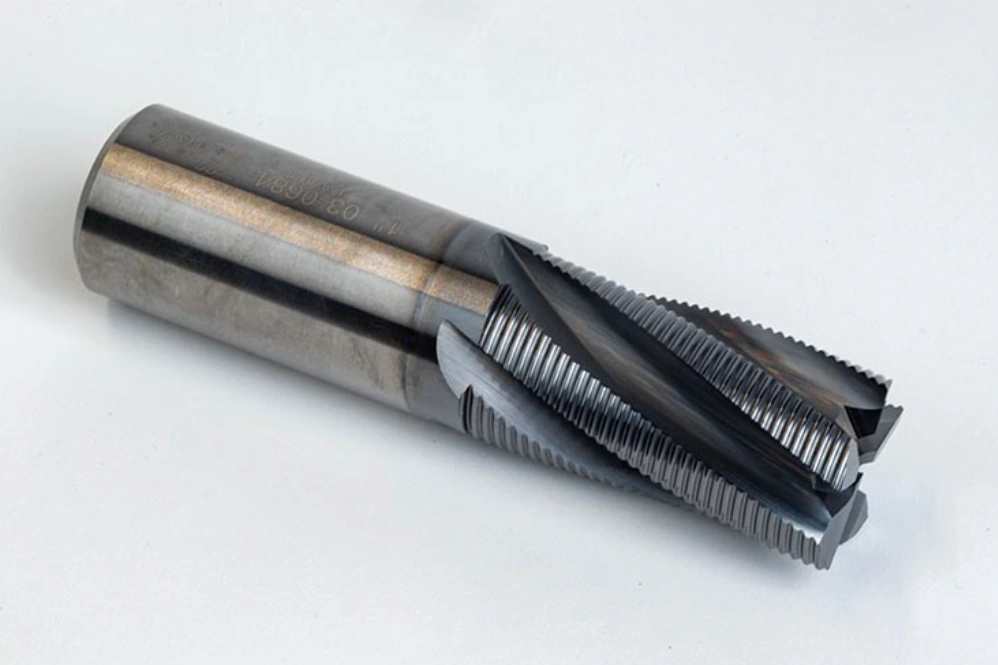
The table below outlines the categories and selection for these tools for roughing cuts.
| CNC Machining Type | Common Tools | Selection Guideline |
| Drilling | Centre drills, Twist drills, deep-hole drills | The first criterion is the hole depth-to-diameter ratioEntry points made using center drillsTwist drills make holesIf the hole is deeper than 10× diameter, deep-hole drills are recommended |
| Milling | Roughing end mills, face mills, serrated end mills | Sizeable flat stock machined using face millsRoughing end mills are ideal for deep pockets |
| Turning | External turning tools, internal boring tools, and indexable roughing inserts | The criteria are primarily based on edge strength and insert geometry. |
[1]
CNC Roughing for Different Materials
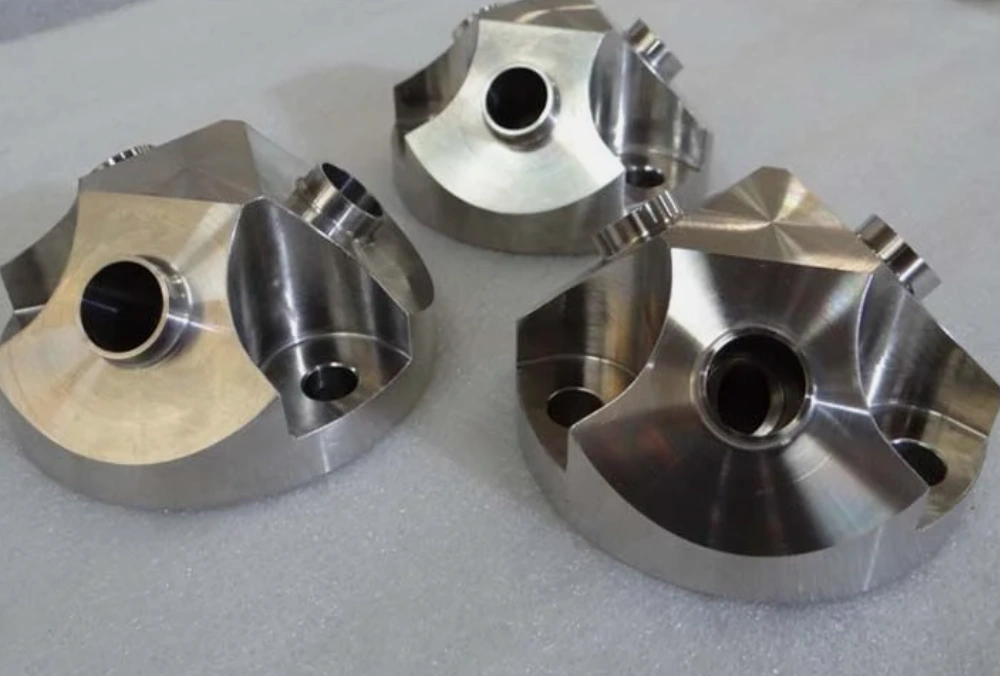
The requirements for different roughing in different materials differ. Whether it’s stainless steel, aluminum, titanium, or steel, it’s important to determine what’s required for the perfect CNC roughing cuts. Below, we expound on the requirements for these, plus cast iron and Inconel.
Stainless Steel: Stainless steel is prone to heat buildup and work hardening. Therefore, CNC roughing the material requires a rigid setup and lower cutting speeds. TiAlN-coated tools and carbide varieties are often advised when rough milling this material.
Aluminum: Aluminum has high thermal conductivity and machinability, so it can accommodate high-speed roughing (approximately 200–600 m/min with carbide tooling).
Titanium: For its notoriety to retain heat around the cutting area, titanium is roughing machined at slow speeds of 30–90 m/min. Along with this, high-pressure coolant and coated carbide tools are recommended.
Steel: Carbide inserts are usually used to rough-machine alloy and carbon steel. The ideal cutting speed is in the 120 to 300 m/min range.
Cast Iron: Cast iron can be rough-machined at 400 m/min due to its vibration-damping properties and brittle chip formation. ISO K standards are used for carbide inserts used on this material.
Inconel: The material’s extreme heat generation and work hardening prompt the use of coated carbide tools and rigid workholding. The cutting speeds should also be low, between 20 and 50 m/min. [5]
Tips for Optimized CNC Roughing
The CNC roughing process is commonly optimized through toolholding control, adaptive toolpaths, depth of cut utilization, and parameter optimization.
- Toolholding Control: This is a critical variable to control, considering that roughing presents high cutting forces. Runout should be maintained at below 5 µm to minimize chatter and tool wear.
- Adaptive Toolpaths: Trochoidal strategies and adaptive clearing ensure proper chip load management regardless of the workpiece geometry. Benefits include extended tool life and consistent cutting forces.
- Depth of Cut Utilization: Opting for a shallow depth of cut at a wide stepover not only increases cycle time but also promotes tool wear at the tip. To distribute wear along the full cutting edge, more radial engagement is recommended.
- Parameter Optimization: Manufacturer-recommended roughing values are a good starting point. Optimization is done through strategies like spindle load monitoring and tool life tracking.
Future Trends in CNC Roughing
CNC roughing, like the umbrella CNC machining space, is advancing, with a future of advanced toolpaths, non-coolant cutting, digital twin simulation, and in-process measurement imminent.
- Advanced Toolpaths: The contribution of artificial intelligence (AI) via CAM platforms will continue to enhance the use of live machining data to optimize engagement angles, feed rates, and other machining parameters. Programmer dependency for such optimizations is set to reduce.
- Non-Coolant Cutting: As CBN and ceramic tooling continue to increase, the reliance on coolant for roughing can be reduced. As a buyer, this is important because it touches on procurement requirements and environmental management.
- Digital Twin Simulation: Using a virtual environment for roughing operations before single-cut runs helps reduce raw material use and avoid the risk of physical prove-out.
- In-process Measurement: In-process measurement is changing the conventional stock verification process with automatic mid-operation measurements.
In Conclusion
CNC roughing lays a strong foundation for the machining process, ensuring efficiency is achieved. When well-executed, the roughing machining process speeds up machining, minimizes tool wear, and stabilizes the workpiece.
It doesn’t matter whether the machining job involves stainless steel, aluminum, titanium, or a premium alloy; a professional roughing strategy is necessary. The machinist considers crucial factors such as lead time, dimensional accuracy, and tooling cost.
With the right machining partner, you avoid issues such as excess cycle times, heat buildup, tool chatter, and inconsistent machining. We provide tolerances to ±0.01 mm, respond with a free quote within 24 hours, and handle machining requirements from prototypes to high-volume production runs. All this with strict process control and verifiable results.
If you are looking for a provider that has an engineering-level understanding of roughing and machining, try our CNC machining services.
Sources
[1]https://www.secotools.com/article/finish_stock_allowance_with_solid_end_mills?language=en
[2]https://www.mmsonline.com/articles/boost-metal-rates-with-constant-chip-load-machining
[3]https://www.mmsonline.com/articles/constant-material-removal-the-key-to-hard-milling
[4] https://cncphilosophy.com/trochoidal-milling/
[5] https://www.sandvik.coromant.com/en-us/knowledge/milling/profile-milling