


Rapid prototyping methods are fast manufacturing techniques used to turn CAD designs into physical parts for testing and validation. These manufacturing techniques include 3D printing, CNC machining, vacuum casting, and rapid casting, each serving different purposes. The selection of the right method depends on factors like material requirements, accuracy, cost, lead time, and production quantity. This article discusses different rapid prototyping techniques that help you choose the right process for your project.
This article discusses different rapid prototyping techniques that help you to choose the right process for your project.
Rapid prototyping methods are used to produce a physical part or assembly from a CAD design. These processes are used to iterate and test digital designs quickly to create a better final product. Therefore, there are several rapid prototyping methods, such as additive and subtractive manufacturing, as well as casting.
This article discusses different rapid prototyping techniques like 3D printing, CNC machining, vacuum casting, and rapid casting methods; in this way, it helps you to choose the right process for your project.
What is Rapid Prototyping?
Rapid prototyping is a set of techniques used to create physical parts from a 3D CAD model in the fastest, most direct way during product development. This commonly uses 3D printing, without the tooling investment or lead time of traditional production processes.
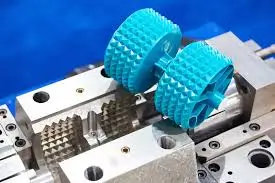
Precision textured rollers in metal mold setup
The prototype manufacturing process is a step-by-step procedure to convert a design into a workpiece. Rapid prototyping includes additive technologies such as FDM, SLA, SLS, and MJF. And subtractive techniques added as CNC machining, CNC Lathe, or Waterjet/Laser Cutting. A rapid prototype is produced to check the design, assembly, and material before any expensive manufacturing process.
Types of Rapid Prototyping Methods
There are many rapid prototyping methods available with their distinct strengths and challenges.
1. 3D Printing Rapid Prototyping
3D printing rapid prototyping is the most commonly used technique to get design options within a few hours or days. This is the most inexpensive process to test an idea using 3D printers. This is a fast and versatile fabrication process.
FDM Rapid Prototyping
FDM rapid prototyping extrudes a thermoplastic material and extrudes it layer by layer to build the model. This fused deposition modeling is an inexpensive 3D printing rapid prototyping method. This is ideally suitable for early-stage geometry validation, basic testing, and internal mock-ups. But the accuracy is relatively lower than resin-based photopolymerization processes.
SLA Rapid Prototyping
SLA rapid prototyping uses a laser to solidify liquid photosensitive resin layer by layer. The dimensional accuracy for appearance prototypes and display models is high with smooth surface finishes.
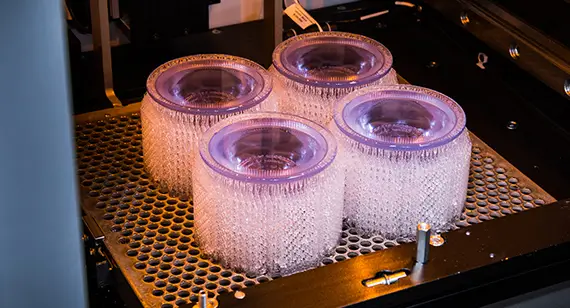
3D printed resin parts on the build platform
SLS Rapid Prototyping
SLS rapid prototyping uses a laser to sinter nylon powder and does not need any support structure. This process is well-suited to achieve dimensional accuracy for complex structures more than FDM and SLA.
DLP Rapid Prototyping
DLP rapid prototyping uses a digital light projector to cure the entire resin layer. Digital light processing is similar to SLA but faster for small batches. It provides intricate plastic parts with fine surfaces.
2. CNC Machining Rapid Prototyping
CNC machining rapid prototyping is a subtractive manufacturing process widely used in rapid prototyping. The material is removed from a base block through cutting and grinding to achieve the desired shape. Therefore, CNC machining is a preferred choice in hardware engineering for prototypes.
CNC Milling
CNC milling uses rotating multi-axis cutting tools. This process removes material from a fixed workpiece and machines slots, holes, contours, and intricate 3D geometries.
CNC Turning
CNC turning produces cylindrical or rotationally symmetric parts by rotating the workpiece against a stationary cutting tool. This process is suitable for round components with exceptional accuracy and repeatability.
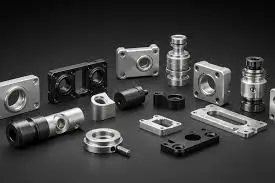
Precision CNC-machined metal components
CNC Machining vs 3D Printing: Quick Decision Table
| Factors | CNC Machining | 3D Printing | Best Choice (Decision) |
| Purpose | Functional / engineering-grade prototypes | Concept models / early validation | CNC → functional, 3D printing → concepts |
| Strength | High strength, real material performance | Moderate strength (depends on process) | CNC for load-bearing parts |
| Accuracy | Very high (±0.05–0.2 mm, ISO 2768 compliant) | Moderate (±0.1–0.5 mm depending on method) | CNC for tight tolerances |
| Design Complexity | Limited by tooling access | Very high freedom (internal & complex shapes) | 3D printing for complex geometry |
| Material Options | Metals + engineering plastics (production-grade) | Resins, polymers, and limited metals | CNC for real-world material testing |
| Lead Time | Medium (2–7 days) | Very fast (hours to 1–3 days) | 3D printing for urgent prototypes |
| Cost Efficiency | Higher cost for complex/low-volume parts | Lower cost for iterations | 3D printing for early-stage testing |
| Surface Finish | Excellent, machinable finish | Varies (SLA smooth, FDM visible layers) | CNC for high-quality finish |
Final Decision Rule
- Select CNC machining when you need strength, precision, and real material performance following ISO 2768 / ASME Y14.5 standards.
- Select 3D printing when you need speed, flexibility, and complex geometry following ISO/ASTM 52900 processes.
When CNC Machining Beats 3D Printing for Prototyping
CNC machining rapid prototyping is needed when:
- The part requires strength and can be tested under weight.
- The real material properties are needed more than just geometry.
- Tight tolerances ±0.2 mm are required to fit and work with actual hardware.
Whereas choose 3D printing when:
- The faster and more inexpensive prototype requires.
- Mainly focus on checking the design and shape.
3. Vacuum Casting
Vacuum casting mainly fills the gap between injection molding and 3D printing and rapid prototyping. This process particularly produces silicon molds. A liquid polyurethane is then poured into a silicon mold to produce parts that replicate injection-molded properties. However, a single silicon mold vacuum casting tool creates 10 to 30 parts.
Polyurethane Casting and Urethane Casting
There are two main methods of vacuum casting, named Polyurethane casting and urethane casting. The polyurethane resins can formulate a wide range of products, from plastics, ABS, rubber, and PP. However, the urethane components are strong but not as robust as injection-molded parts under heat.
Silicone Mold Vacuum Casting
Silicon mold vacuum casting involves four steps. A master model created by CNC machining. A flexible mold is formed by pouring liquid silicon. Then, PU resin is mixed and cured under vacuum to reduce bubbles of air. Lastly, the workpiece is then post-processed.
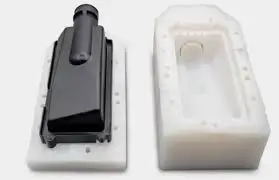
Injection mold and plastic housing part
4. Rapid Casting Methods
Rapid casting is a metal prototyping method, well-suited for complex geometries of metal. Rapid casting is a better choice for larger structures or complex metal parts compared to 3D printing or CNC machining.
Sand Casting
Sand casting is a commonly used method in which molten metal is poured into a sand mold cavity to form a part. This process handles a different metal with low tooling cost. This also needs post-machining for further precise surfaces. It is an ideal choice for both larger and smaller batch trial parts.
Investment Casting
Investment casting builds a mold shell around a wax model of the part. This method provides metal parts with better surface finishes than sand casting. The parts that undergo that under goes this method have fine features. It is exceptionally good for complex features.
Gravity Casting
Gravity casting uses gravity to fill permanent or semi-permanent molds with molten metal. This is best for non-ferrous and aluminum alloy metal prototypes with better dimensional consistency.
Rapid Prototyping Methods Compared
The table below is helpful to choose the right rapid prototype method for your project volume, material, and timeline.
| Method | Best Stage | Materials | Lead Time | Cost | Volume | Tolerance |
| FDM 3D Printing | Concept | Thermoplastics | 1–2 days | Very Low | 1–10 | ±0.3 mm |
| SLA 3D Printing | Appearance | Resin | 1–3 days | Low | 1–20 | ±0.1 mm |
| SLS 3D Printing | Functional | Nylon | 2–4 days | Medium | 1–30 | ±0.2 mm |
| DLP 3D Printing | Appearance | Resin | 1–2 days | Low | 1–20 | ±0.1 mm |
| CNC Milling | Functional | Metal / Plastic | 3–7 days | Med–High | 1–50 | ±0.05 mm |
| CNC Turning | Mechanical | Metal / Plastic | 2–5 days | Med–High | 1–50 | ±0.05 mm |
| Vacuum Casting | Bridge Prod. | PU / Urethane | 5–10 days | Low–Med | 10–50 | ±0.2 mm |
| Sand Casting | Metal Proto. | Metals | 1–3 weeks | Medium | 1–20 | ±0.5 mm |
| Investment Casting | Metal Proto. | Metals | 2–4 weeks | Med–High | 1–20 | ±0.2 mm |
| Gravity Casting | Metal Proto. | Aluminum | 1–2 weeks | Medium | 1–30 | ±0.3 mm |
The common rapid prototyping standards include ISO/ASTM 52900 for additive manufacturing processes, ISO 2768 for machining tolerances, and ASME Y14.5 for dimensional tolerancing.
Common Mistakes in Choosing Rapid Prototyping Methods
- The use of 3D printing for high-load functional testing is ideal for most materials, especially FDM and SLA. These materials cannot match the metal performance of CNC machining.
- 3D would be more efficient for simple design, early concept validation checks, than CNC machining.
- The prototype failed during the testing stage due to not considering the material behaviour before selecting the process.
- The overlooked tolerance requirements can lead to assembly issues.
- Another common mistake is to choose vacuum casting for mass production. It is suitable for low-volume production.
- CNC machining cannot handle complex internal features during manufacturing. You cannot ignore the geometric limitations of CNC machining.
- The selection of a slower method is not necessary when there is limited time and high project urgency.
ProLean MFG’s Rapid Prototyping Services
Rapid prototyping methods represent all stages of product development. The importance of each stage is non-negotiable. Rapid prototyping services of ProLean MFG move through the complete prototype manufacturing process. ProLean MFG provides a wide range of manufacturing capabilities for all of your prototyping and production needs.
For example, CNC machining is commonly used for functional metal prototypes in the automotive and aerospace industries because it offers high dimensional accuracy and strong material compatibility. Similarly, SLA 3D printing is ideal for medical and consumer product prototypes that require smooth surface finishes and fine details.
Contact us directly to learn more about rapid prototyping, to review your application, and recommend an approach that fits your timeline and validation goals.
Frequently Asked Questions
• The four types of prototyping based on their purpose are:
• Feasibility Prototypes,
• Low-Fidelity User Prototypes
• High-Fidelity User Prototypes
• Live-data Prototypes
8 6 4 rapid prototype method refers to a development timeline, such as 8 weeks for concept, 6 weeks for validation, and 4 weeks for testing.
The main 7 types of 3D printing rapid prototyping are:
• FDM (Fused Deposition Modeling)
• SLA (Stereolithography)
• SLS (Selective Laser Sintering)
• DLP (Digital Light Processing)
• MJF (Multi Jet Fusion)
• DMLS/SLM (Direct Metal Laser Sintering)
• Polyjet
It can’t be suggested which rapid prototyping method is the single best for your project. It completely depends on the development stages of your project.
Key Takeaways
- Rapid prototyping methods are used to quickly convert CAD designs into physical parts, involving different processes such as 3D printing, CNC machining, vacuum casting, and rapid casting.
- 3D printing is best for early design concept models, while CNC machining is ideal for accuracy and functional testing. Similarly, rapid casting is ideal for complex geometries, while vacuum casting is best for low-volume productions.
- Precision and engineering reliability are ensured by ISO/ASTM 52900, ISO 2768, and ASME Y14.5 industry standards in prototyping decisions.
- Rapid prototyping methods are combined to optimize speed, cost, and performance in modern product development.